
Reference: Essays on Substance
First postulate of Relativity
The mathematics of a physicist is self-consistent logic that he has applied to his starting postulates to arrive at certain approximate conclusions. Mathematics being a tool may be left to mathematicians to sharpen. Where physics is concerned, one should examine the starting postulates and conclusions that are arrived at by a physicist against the continuity, consistency and harmony of reality.
Let’s look at the first postulate underlying relativity.
(1) The laws of physics are the same in all inertial frames of reference.
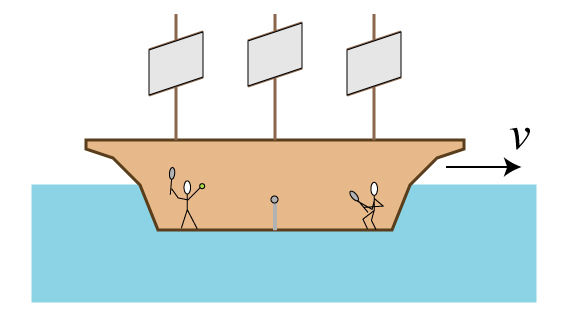
An inertial frame of reference is a fundamental concept in classical physics and special relativity. It is defined as a reference frame in which objects not subjected to external forces either remain at rest or move with constant velocity in a straight line. This definition is closely tied to Newton’s first law of motion, also known as the law of inertia.
Key characteristics of an inertial frame of reference include:
- No acceleration: The frame itself is not undergoing any acceleration.
- Uniform motion: Any frame moving at a constant velocity relative to an inertial frame is also an inertial frame.
- Consistency of physical laws: The laws of physics, particularly Newton’s laws of motion, hold true and have the same form in all inertial frames.
In practical terms, an inertial frame of reference can be understood through examples:
- A stationary train platform
- A car traveling at constant speed on a straight road
- A motionless ramp down which objects can roll
It’s important to note that the concept of an inertial frame is an idealization. In reality, truly inertial frames are rare due to the presence of gravitational fields and other forces. However, many situations can be approximated as inertial frames for practical purposes.
The concept of inertial frames is crucial in physics because it provides a foundation for describing motion and applying the laws of mechanics consistently. It also plays a significant role in the development of more advanced theories, such as special relativity, which generalizes the notion of inertial frames to include all physical laws, not just Newton’s first law.
In general relativity, the concept of inertial frames is only applicable locally. This means that inertial frames are well-defined in infinitesimal neighborhoods of spacetime points. In curved spacetime, there are no global inertial frames that extend throughout all of space and time.
General relativity incorporates Einstein’s equivalence principle, which states that no experiment can distinguish between a frame in gravitational free-fall and an inertial frame. This principle effectively extends the notion of inertial frames to include freely falling reference frames in gravitational fields.
In general relativity, the laws of physics are expressed in a way that is covariant under all coordinate transformations, not just the Lorentz transformations of special relativity. This means that the form of physical laws remains invariant under any smooth change of coordinates, reflecting the principle that the laws of physics should be the same for all observers, regardless of their state of motion or choice of coordinate system.
Free particles in general relativity follow geodesics, which are the curved spacetime equivalent of straight lines in flat spacetime. The principle that free particles follow geodesics replaces the notion of uniform motion in straight lines from special relativity.
In sufficiently small regions of spacetime, the effects of curvature become negligible, and the laws of physics reduce to those of special relativity. This is known as the principle of local flatness, which allows for the local application of special relativistic concepts in general relativity.
By generalizing the concept of inertial frames and incorporating the effects of gravity into the structure of spacetime itself, general relativity maintains the spirit of the original postulate while adapting it to a more comprehensive understanding of the universe.
CRITICISM
- Einstein applies the inertial frames of reference to matter only and not to all substance. His viewpoint is matter-centric. Please see: The Matter-Centric Fixation
- Einstein ignores inertia when considering relative speeds. In reality, light can be considered to travel at speed ‘c’ relative to matter; but matter cannot be considered to travel at speed ‘c’ relative to light.
.
