
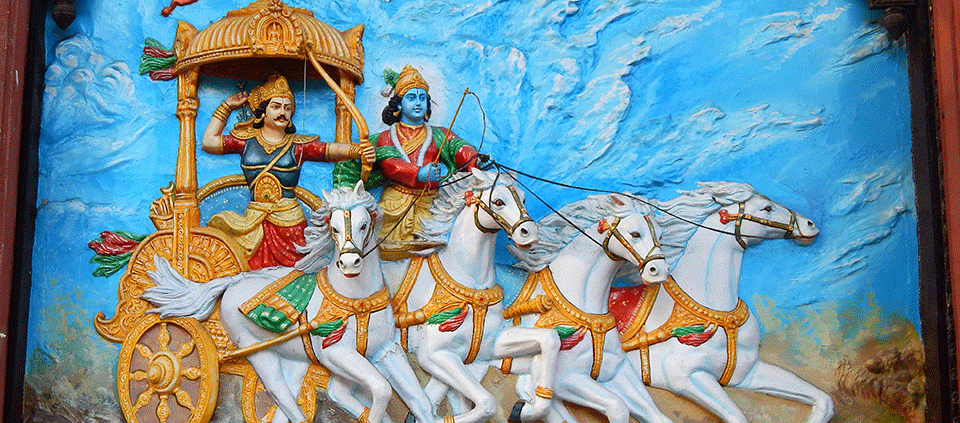
Reference: Course on The Bhagavad Gita
English Translation By Shri Purohit Swami
.
CHAPTER 4
श्रीभगवानुवाच
इमंविवस्वतेयोगंप्रोक्तवानहमव्ययम्।
विवस्वान्मनवेप्राहमनुरिक्ष्वाकवेऽब्रवीत्।।4.1।।
4.1 “Lord Shri Krishna said: This imperishable philosophy I taught to Vivasvan, the founder of the Sun dynasty, Vivasvan gave it to Manu the lawgiver, and Manu to King Ikshwaku!
एवंपरम्पराप्राप्तमिमंराजर्षयोविदुः।
सकालेनेहमहतायोगोनष्टःपरन्तप।।4.2।।
4.2 The Divine Kings knew it, for it was their tradition. Then, after a long time, at last it was forgotten.
एवायंमयातेऽद्ययोगःप्रोक्तःपुरातनः।
भक्तोऽसिमेसखाचेतिरहस्यंह्येतदुत्तमम्।।4.3।।
4.3 It is the same ancient Path that I have now revealed to thee, since thou are My devotee and My friend. It is the supreme Secret.
अर्जुनउवाच
अपरंभवतोजन्मपरंजन्मविवस्वतः।
कथमेतद्विजानीयांत्वमादौप्रोक्तवानिति।।4.4।।
4.4 Arjuna asked: My Lord! Viwaswana was born before Thee; how then canst Thou have revealed it to him?
श्रीभगवानुवाच
बहूनिमेव्यतीतानिजन्मानितवचार्जुन।
तान्यहंवेदसर्वाणिनत्वंवेत्थपरन्तप।।4.5।।
4.5 Lord Shri Krishna replied: I have been born again and again, from time to time; thou too, O Arjuna! My births are known to Me, but thou knowest not thine.
अजोऽपिसन्नव्ययात्माभूतानामीश्वरोऽपिसन्।
प्रकृतिंस्वामधिष्ठायसंभवाम्यात्ममायया।।4.6।।
4.6 I have no beginning. Though I am imperishable, as well as Lord of all that exists, yet by My own will and power do I manifest Myself.
यदायदाहिधर्मस्यग्लानिर्भवतिभारत।
अभ्युत्थानमधर्मस्यतदाऽऽत्मानंसृजाम्यहम्।।4.7।।
4.7 Whenever spirituality decays and materialism is rampant, then, O Arjuna, I reincarnate Myself!
परित्राणायसाधूनांविनाशायचदुष्कृताम्।
धर्मसंस्थापनार्थायसंभवामियुगेयुगे।।4.8।।
4.8 To protect the righteous, to destroy the wicked and to establish the kingdom of God, I am reborn from age to age.
BG Verses 4.1-4.8
This science of yoga was part of the ancient tradition; but over time it got lost. It is now being revealed again. The knowledge has continued all this time. Some are aware of it, others are not. This knowledge is ultimate awareness itself. It has no beginning and it is imperishable. It manifests at its own will to set things right whenever there is a decline. It protects what is right and destroys that which is wicked.
NOTE: The pure consciousness consists of the ancient knowledge of Yoga. Upon realizing it all wickedness falls away.
जन्मकर्मचमेदिव्यमेवंयोवेत्तितत्त्वतः।
त्यक्त्वादेहंपुनर्जन्मनैतिमामेतिसोऽर्जुन।।4.9।।
4.9 He who realises the divine truth concerning My birth and life is not born again; and when he leaves his body, he becomes one with Me.
वीतरागभयक्रोधामन्मयामामुपाश्रिताः।
बहवोज्ञानतपसापूतामद्भावमागताः।।4.10।।
4.10 Many have merged their existences in Mine, being freed from desire, fear and anger, filled always with Me and purified by the illuminating flame of self-abnegation.
येयथामांप्रपद्यन्तेतांस्तथैवभजाम्यहम्।
ममवर्त्मानुवर्तन्तेमनुष्याःपार्थसर्वशः।।4.11।।
4.11 Howsoever men try to worship Me, so do I welcome them. By whatever path they travel, it leads to Me at last.
काङ्क्षन्तःकर्मणांसिद्धिंयजन्तइहदेवताः।
क्षिप्रंहिमानुषेलोकेसिद्धिर्भवतिकर्मजा।।4.12।।
4.12 Those who look for success, worship the Powers; and in this world their actions bear immediate fruit.
चातुर्वर्ण्यंमयासृष्टंगुणकर्मविभागशः।
तस्यकर्तारमपिमांविद्ध्यकर्तारमव्ययम्।।4.13।।
4.13 The four divisions of society (the wise, the soldier, the merchant, the labourer) were created by Me, according to the natural distribution of Qualities and instincts. I am the author of them, though I Myself do no action, and am changeless.
नमांकर्माणिलिम्पन्तिनमेकर्मफलेस्पृहा।
इतिमांयोऽभिजानातिकर्मभिर्नसबध्यते।।4.14।।
4.14 My actions do not fetter Me, nor do I desire anything that they can bring. He who thus realises Me is not enslaved by action.
BG Verses 4.9-4.14
Krishna’s state of awareness is actually the free state of Brahman. Brahman is that state of awareness in which all unsettled karma has been resolved and no bondage remains. Many have attained this state by no longer being fixated on their personal self. There are many ways to resolve the bondage of karma and, thus, arrive at the state of Brahman. In this world, it is easy to attain success. Teacher, soldier, trader and laborer are the four natural functions in any society. A person who carries out the function naturally suited to him, without desiring the results, soon becomes free from any bondage of karma.
NOTE: Karma Yoga provides a simple solution to bondage that can be applied successfully in this world.
एवंज्ञात्वाकृतंकर्मपूर्वैरपिमुमुक्षुभिः।
कुरुकर्मैवतस्मात्त्वंपूर्वैःपूर्वतरंकृतम्।।4.15।।
4.15 In the light of wisdom, our ancestors, who sought deliverance, performed their acts. Act thou also, as did our fathers of old.
किंकर्मकिमकर्मेतिकवयोऽप्यत्रमोहिताः।
तत्तेकर्मप्रवक्ष्यामियज्ज्ञात्वामोक्ष्यसेऽशुभात्।।4.16।।
4.16 What is action and what is inaction? It is a question which has bewildered the wise. But I will declare unto thee the philosophy of action, and knowing it, thou shalt be free from evil.
कर्मणोह्यपिबोद्धव्यंबोद्धव्यंचविकर्मणः।
अकर्मणश्चबोद्धव्यंगहनाकर्मणोगतिः।।4.17।।
4.17 It is necessary to consider what is right action, what is wrong action, and what is inaction, for mysterious is the law of action.
कर्मण्यकर्मयःपश्येदकर्मणिचकर्मयः।
सबुद्धिमान्मनुष्येषुसयुक्तःकृत्स्नकर्मकृत्।।4.18।।
4.18 He who can see inaction in action, and action in inaction, is the wisest among men. He is a saint, even though he still acts.
यस्यसर्वेसमारम्भाःकामसङ्कल्पवर्जिताः।
ज्ञानाग्निदग्धकर्माणंतमाहुःपण्डितंबुधाः।।4.19।।
4.19 The wise call him a sage, for whatever he undertakes is free from the motive of desire, and his deeds are purified by the fire of Wisdom.
त्यक्त्वाकर्मफलासङ्गंनित्यतृप्तोनिराश्रयः।
कर्मण्यभिप्रवृत्तोऽपिनैवकिञ्चित्करोतिसः।।4.20।।
4.20 Having surrendered all claim to the results of his actions, always contented and independent, in reality he does nothing, even though he is apparently acting.
निराशीर्यतचित्तात्मात्यक्तसर्वपरिग्रहः।
शारीरंकेवलंकर्मकुर्वन्नाप्नोतिकिल्बिषम्।।4.21।।
4.21 Expecting nothing, his mind and personality controlled, without greed, doing bodily actions only; though he acts, yet he remains untainted.
BG Verses 4.15-4.21
Since ancient times, our ancestors have been following this Karma yoga. Philosophically, however, there is some confusion about what is action and what is inaction. Clarity is needed as to what is right action, what is wrong action, and what is inaction. When we look closely we see that there is inaction in action, and action in inaction, when the action is thought out wisely, and there is no desire for material gains. One then acts confidently without worrying about the outcome. He is always satisfied and not subject to external influences. He expects nothing, and acts physically with no attention on personal self. He is apparently acting; but in reality, he is not involved and remains free.
NOTE: When a person has been wise, and has thought deeply through the situation, and has accounted for the welfare of all involved, then he acts confidently. He has attention neither on his personal self, nor on results. Though he acts physically, he remains free of any bondage.
यदृच्छालाभसन्तुष्टोद्वन्द्वातीतोविमत्सरः।
समःसिद्धावसिद्धौचकृत्वापिननिबध्यते।।4.22।।
4.22 Content with what comes to him without effort of his own, mounting above the pairs of opposites, free from envy, his mind balanced both in success and failure; though he acts, yet the consequences do not bind him.
गतसङ्गस्यमुक्तस्यज्ञानावस्थितचेतसः।
यज्ञायाचरतःकर्मसमग्रंप्रविलीयते।।4.23।।
4.23 He who is without attachment, free, his mind centered in wisdom, his actions, being done as a sacrifice, leave no trace behind.
ब्रह्मार्पणंब्रह्महविर्ब्रह्माग्नौब्रह्मणाहुतम्।
ब्रह्मैवतेनगन्तव्यंब्रह्मकर्मसमाधिना।।4.24।।
4.24 For him, the sacrifice itself is the Spirit; the Spirit and the oblation are one; it is the Spirit Itself which is sacrificed in Its own fire, and the man even in action is united with God, since while performing his act, his mind never ceases to be fixed on Him.
दैवमेवापरेयज्ञंयोगिनःपर्युपासते।
ब्रह्माग्नावपरेयज्ञंयज्ञेनैवोपजुह्वति।।4.25।।
4.25 Some sages sacrifice to the Powers; others offer themselves on the alter of the Eternal.
श्रोत्रादीनीन्द्रियाण्यन्येसंयमाग्निषुजुह्वति।
शब्दादीन्विषयानन्यइन्द्रियाग्निषुजुह्वति।।4.26।।
4.26 Some sacrifice their physical senses in the fire of self-control; others offer up their contact with external objects in the sacrificial fire of their senses.
सर्वाणीन्द्रियकर्माणिप्राणकर्माणिचापरे।
आत्मसंयमयोगाग्नौजुह्वतिज्ञानदीपिते।।4.27।।
4.27 Other again sacrifice their activities and their vitality in the Spiritual fire of self-abnegation, kindled by wisdom.
द्रव्ययज्ञास्तपोयज्ञायोगयज्ञास्तथापरे।
स्वाध्यायज्ञानयज्ञाश्चयतयःसंशितव्रताः।।4.28।।
4.28 And yet others offer as their sacrifice wealth, austerities and meditation. Monks wedded to their vows renounce their scriptural learning and even their spiritual powers.
अपानेजुह्वतिप्राणप्राणेऽपानंतथाऽपरे।
प्राणापानगतीरुद्ध्वाप्राणायामपरायणाः।।4.29।।
4.29 There are some who practise control of the Vital Energy and govern the subtle forces of Prana and Apana, thereby sacrificing their Prana unto Apana, or their Apana unto Prana.
अपरेनियताहाराःप्राणान्प्राणेषुजुह्वति।
सर्वेऽप्येतेयज्ञविदोयज्ञक्षपितकल्मषाः।।4.30।।
4.30 Others, controlling their diet, sacrifice their worldly life to the spiritual fire. All understand the principal of sacrifice, and by its means their sins are washed away.
BG Verses 4.22-4.30
He is content with whatever comes to him as he acts without acting with no attention on personal self or on the duality of success and failure. He has no attachments, his mind is centered on wisdom, he acts with the welfare of everyone in mind. Thus he is free from any bondage of karma. He is completely absorbed in the pure consciousness of the sacrifice that is his action. Some have specific deities in mind, others focus on formless Brahman. Some focus on controlling their senses, others focus on controlling their contact with sense objects. Still others simply have no attention on personal self. Some give away their wealth, some perform austerities, some do yoga, some study scriptures, and some observe strict vows. Some work with balancing Prana and Apana through Pranayama. Others engage in fasting and in controlling their diet. With such sacrifices the sins are washed away.
NOTE: Karma Yoga helps one balance the present karma so no further unsettled karma accrues. The key component is sacrifice, which means to take into account the welfare of everyone involved in a situation, and not just the welfare of oneself. People focus on and engage in various rituals to accomplish this. The past karma resolves with better understanding of sacrifice.
यज्ञशिष्टामृतभुजोयान्तिब्रह्मसनातनम्।
नायंलोकोऽस्त्ययज्ञस्यकुतो़ऽन्यःकुरुसत्तम।।4.31।।
4.31 Tasting the nectar of immortality, as the reward of sacrifice, they reach the Eternal. This world is not for those who refuse to sacrifice; much less the other world.
एवंबहुविधायज्ञावितताब्रह्मणोमुखे।
कर्मजान्विद्धितान्सर्वानेवंज्ञात्वाविमोक्ष्यसे।।4.32।।
4.32 In this way other sacrifices too may be undergone for the Spirit’s sake. Know thou that they all depend on action. Knowing this, thou shalt be free.
श्रेयान्द्रव्यमयाद्यज्ञाज्ज्ञानयज्ञःपरन्तप।
सर्वंकर्माखिलंपार्थज्ञानेपरिसमाप्यते।।4.33।।
4.33 The sacrifice of wisdom is superior to any material sacrifice, for, O Arjuna, the climax of action is always Realisation.
तद्विद्धिप्रणिपातेनपरिप्रश्नेनसेवया।
उपदेक्ष्यन्तितेज्ञानंज्ञानिनस्तत्त्वदर्शिनः।।4.34।।
4.34 This shalt thou learn by prostrating thyself at the Master’s feet, by questioning Him and by serving Him. The wise who have realised the Truth will teach thee wisdom.
यज्ज्ञात्वानपुनर्मोहमेवंयास्यसिपाण्डव।
येनभूतान्यशेषेणद्रक्ष्यस्यात्मन्यथोमयि।।4.35।।
4.35 Having known That, thou shalt never again be confounded; and, O Arjuna, by the power of that wisdom, thou shalt see all these people as if they were thine own Self, and therefore as Me.
अपिचेदसिपापेभ्यःसर्वेभ्यःपापकृत्तमः।
सर्वंज्ञानप्लवेनैववृजिनंसन्तरिष्यसि।।4.36।।
4.36 Be thou the greatest of sinners, yet thou shalt cross over all sin by the ferryboat of wisdom.
यथैधांसिसमिद्धोऽग्निर्भस्मसात्कुरुतेऽर्जुन।
ज्ञानाग्निःसर्वकर्माणिभस्मसात्कुरुतेतथा।।4.37।।
4.37 As the kindled fire consumes the fuel, so, O Arjuna, in the flame of wisdom the embers of action are burnt to ashes.
नहिज्ञानेनसदृशंपवित्रमिहविद्यते।
तत्स्वयंयोगसंसिद्धःकालेनात्मनिविन्दति।।4.38।।
4.38 There is nothing in the world so purifying as wisdom; and he who is a perfect saint finds that at last in his own Self.
BG Verses 4.31-4.38
Sacrifice of the personal self for the welfare of all is the key to liberation in Karma Yoga. This sacrifice is manifested through different types of actions. The sacrifice of wisdom is the highest type because it culminates in realization. A spiritual master must be respected and served for the imparting of his wisdom. Through wisdom one shall see that the whole existence is one. Wisdom shall help a person overcome all transgressions and miseries. It helps settle all karma generated out of reaction. Once a person attains that wisdom it purifies everything.
NOTE: Karma Yoga is based on sacrifice through action. The sacrifice of wisdom is the highest of all sacrifices that purifies all actions past and present.
श्रद्धावाँल्लभतेज्ञानंतत्परःसंयतेन्द्रियः।
ज्ञानंलब्ध्वापरांशान्तिमचिरेणाधिगच्छति।।4.39।।
4.39 He who is full of faith attains wisdom, and he too who can control his senses, having attained that wisdom, he shall ere long attain Supreme Peace.
अज्ञश्चाश्रद्दधानश्चसंशयात्माविनश्यति।
नायंलोकोऽस्तिनपरोनसुखंसंशयात्मनः।।4.40।।
4.40 But the ignorant man, and he who has no faith, and the sceptic are lost. Neither in this world nor elsewhere is there any happiness in store for him who always doubts.
योगसंन्यस्तकर्माणंज्ञानसंछिन्नसंशयम्।
आत्मवन्तंनकर्माणिनिबध्नन्तिधनञ्जय।।4.41।।
4.41 But the man who has renounced his action for meditation, who has cleft his doubt in twain by the sword of wisdom, who remains always enthroned in his Self, is not bound by his acts.
तस्मादज्ञानसंभूतंहृत्स्थंज्ञानासिनाऽऽत्मनः।
छित्त्वैनंसंशयंयोगमातिष्ठोत्तिष्ठभारत।।4.42।।
4.42 Therefore, cleaving asunder with the sword of wisdom the doubts of the heart, which thine own ignorance has engendered, follow the Path of Wisdom and arise!”
BG Verses 4.39-4.42
When a person has put faith in something he has sensed, then that becomes his truth. From such truths he derives wisdom, and through that wisdom he soon attains peace. But a person, who always doubts and cannot have faith even in what he senses, is lost. He cannot be happy or at peace anywhere. But a person who sacrifices for the welfare of all, and gains truth and wisdom from that experience, is not bound by any karma. So, use the wisdom gained from sacrifices to resolve any doubts, and to face situations with firm resolve.
NOTE: We give meaning to what we sense and experience using the concepts we learn through our culture. At first such meanings are approximations as we do not have full understanding of those concepts; and there is a need to assimilate our experiences with the concepts we are learning. Over time we gain clearer perception of our experiences as we get better understanding of those concepts. From such assimilation emerges knowledge. As the knowledge from different areas assimilates further, wisdom comes about. The wider is the context of our actions and experience, such as, when we act according to the laws of nature and for the welfare of all, the greater that wisdom becomes; and greater then is our certainty and confidence to face situations in life.
.
Summary
According to BG, the default path to liberation is Karma yoga. This path is described in BG Chapter 3. To follow this path, a person must have some understanding (jnana) of Self. That understanding is provided in BG Chapter 2. BG Chapter 4 then expands upon Karma Yoga, and states that the practice of Karma yoga brings realizations (jnana) to a person that brings wisdom in living and liberation.
The ancient science of yoga is viewed as pure consciousness that has no beginning, and which is imperishable. When societies go into steep decline, this consciousness manifests itself to set things right. The Bhagavad Gita portrays Shri Krishna as this consciousness. In this state of consciousness, there is no accumulation of karma. The person operates in complete harmony with society and natural principles. He sacrifices his personal self for the welfare of all, without desiring results for sense gratification or material gain.
Since ancient times, our ancestors have been following this Karma yoga. When it is practiced the right way, one finds that there is inaction in action, and action in inaction. This comes about as the person has thought deeply through the situation, accounting for the welfare of all involved; and he then acts confidently without having any attention on the outcome. He is always satisfied and remains content in success and failure. He has no attachments. He is completely absorbed in the pure consciousness of the sacrifice. Though he acts physically, he remains free of any bondage.
In following this yoga, people focus on different deities and engage in various rituals. Some give away their wealth, some perform austerities, some study scriptures, and some observe strict vows. But the key is the sacrifice of personal self for the welfare of all. The sacrifice of wisdom is the highest sacrifice because it culminates in realization. The person then sees that the whole existence is one. The wisdom helps him overcome all reactions, transgressions and miseries, past and present.
A person, who always doubts and cannot have faith even in what he senses, is lost. He cannot be happy or at peace anywhere. But a person who sacrifices for the welfare of all, and gains truth and wisdom from that experience, is not bound by any karma.
.

Comments
THE DISCRIMINATIVE MIND
According to Buddha, the discriminative mind arises when there is sense data. It subsides when there is no sense data. The discriminative mind has a whole spectrum from analytical to reactive. At the analytical end of the spectrum the mind is broadly associative and logical. At the reactive end of the spectrum the mind is narrowly associative and therefore illogical from a broad perspective.
In Scientology, the effort is to eliminate the reactive end of the spectrum and retain the analytical end. But, according to the dual nature of the universe, some reactivity is always going to be there.
In Buddhism, the effort is to realize the impermanent nature of the discriminative mind and attain the perspective of the universal viewpoint from which things are perceived as they truly are.
Identitification is the tool for acquiring experience in order to evolve.
Ego is the natural consequence of the identitification.
Ahamkāra comes about as ego puts up resistance to the laws of nature.
Underlying this resistance is the ignorance of the laws of nature.