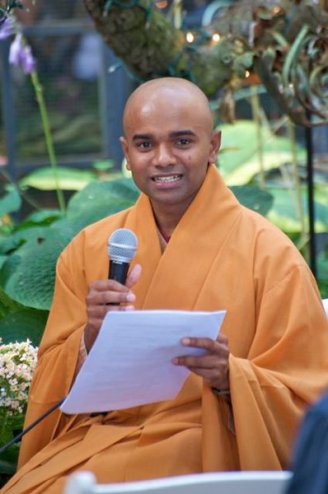
A person, when he starts out on mindfulness meditation, does not always have an easy time. Even when he maintains a comfortable meditation posture, he finds it difficult to continue with meditation for an hour. Other classes in meditation take a break from straight meditation every 30 minutes or so.
People who have learned to meditate can sit in meditation for hours quite comfortably. So this problem seems to arise when one is still learning. Maybe the person feels overwhelmed with what the mind unloads on him.
The instructions for meditation are there. These instructions can even be very precise as documented in Mindfulness Exercises. But the problem seems to lie in accessing the instructions when needed during meditation. The instructions can be simple but incomplete, or they can be complete but voluminous. A neophyte can easily get overwhelmed by a lack of instructions, or having too many instructions to digest.
In mindfulness meditation one is simply instructed to see things as they are. These simple instructions are then reinforced by giving precise instructions during meditation itself. This allows the person to adjust to one small aspect of meditation at a time, until he is fully established in mindfulness meditation.
Here are the steps:
-
The student starts with a posture that he can maintain comfortably for an hour or more.
-
The student then settles down in meditation with simple breathing exercises.
-
-
The instructor waits for 2 to 3 minutes and then gives out the next instruction. This gives the student enough time to get comfortably established with the first instruction.
-
The instructor thus gives out rest of the instructions of Mindfulness 0, spacing them apart by 2 to 3 minutes as above. This gives the student time to digest each instruction and execute it in real time.
-
The spacing may be reduced to a minute in subsequent sessions as the student gets more familiar with the instructions.
- Once the student is established in mindfulness meditation, the instructor may assist him further by calling out the instructions for mindfulness exercises 1 to 12.
Subsequent mindfulness exercises address specific filters of the mind, such as, desires, expectations, bias, prejudice, assumptions, etc. As the student progresses with these exercises he needs less and less external assistance. He may then simply do them by himself until he is fully established in mindfulness.
A person established in mindfulness is established in a mental state of ‘seeing things as they are’ whether his eyes are closed or open, whether he is sitting, standing or walking. He is established in mindfulness at all moments of activity and non-activity. One learns mindfulness in small steps. Sitting with eyes closed in mindfulness meditation is simply the beginning step.
The traditional posture for meditation is sitting down in a lotus position. This came naturally to our Indian ancestors. Unfortunately, this is not so natural for people in modern times. Generally, one is able to maintain this posture comfortably for not more than 20 to 30 minutes. After that one either fidgets to get more comfortable, or tries to restrain oneself from fidgeting.
A person is not really absorbed in meditation when he is consumed with the desire to become more comfortable. Minutes spent in discomfort are wasted meditation minutes. A person must start in a posture that he can maintain for a long period without feeling uncomfortable.
The proper posture simply requires an upright spine and a firm contact with the floor. This can be achieved either by sitting in a lotus position, or by sitting in a chair. Therefore one should select a posture right at the beginning of the meditation session that one can maintain comfortably for the duration of the session.
Then one should simply slide into meditation, without forcing oneself.
When a person is established in mediation, he would feel totally comfortable. That is the ideal situation. Any discomfort arising during meditation is then likely due to something other than the posture. In that case the person should fully experience that discomfort without interfering with it. Sooner or later he would realize the true reason for it, and at that point the discomfort would simply disappear.
A posture recommended for meditation in modern times is to sit on a straight-backed chair, with feet flat on the ground, and arms resting on one’s thighs. One should then be able to maintain this posture comfortably for the duration of the meditation session.
.
- There was neither non-existence nor existence then.
- There was uniform awareness that appeared as undisturbed space.
- There was no name, shape, form or even consciousness.
- There was mere continuity without any distinguishing features.
The fundamental principle is continuity and harmony. This principle underlies the universe.
.
- Disturbance arose in awareness and space.
- It was the seed of desire that appeared as time.
- Disturbed awareness appeared as consciousness.
- Disturbed space appeared as electromagnetism.
It seems that the earliest consciousness appeared as electromagnetism. Desire was buried in it as time.
.
- Consciousness then propagated throughout awareness.
- It appeared as electromagnetic wave propagating through space.
- The field of consciousness appeared as the electromagnetic field.
- Disturbance of all different frequencies played in that field.
The fundamental consciousness seems to arise when uniform awareness is disturbed. However, our view of consciousness is human-centric.
.
- The characteristic of discreteness came about with frequency.
- Frequency gradients then provided the distinguishing features.
- A universe was now taking form and could be so identified.
- That primary beingness was simple, continuous and harmonious.
The universe started out very simple and then grew to be increasingly complex. Human characteristics are very complex that grew out of much simpler characteristics.
.
- The universe was initially one continuous and harmonious form.
- But complexity soon brought about fundamental dichotomies.
- Outward concrete appearance came to be known as “physical”.
- The internal abstract essence came to be known as “spiritual”.
In Christianity, the outward appearance was broadly identified as the “world”; and the internal essence was idealized as “God”. In Scientology, the outward appearance became MEST, and the internal essence became THETA.
.
- Increasing complexity introduced complex forms.
- These forms were endowed with complex functions.
- These functions provided a gradient of life and aliveness.
- Complex nature of individual forms came to be known as “self”.
Physical forms with their spiritual essence range from simple to complex. The form and essence are deeply integrated. They are two sides of the same coin. It is an error to think that the essence creates the form, or that the form traps the essence as believed in Scientology.
.
- The physicality ultimately becomes fixed as discreteness of matter.
- But the physicality of electromagnetic field remains fluid.
- Similarly, the spirituality ultimately becomes fixed as discreteness of “self”.
- But the spirituality of consciousness remains fluid as well.
There are dynamic and fluid fields underlying matter and self. Ghosts may be a phenomenon of fluid fields that are immaterial and interact with human consciousness.
.
- Death makes body disintegrate into molecules, atoms and fields of forms.
- It makes “self” disintegrate into “molecules”,”atoms” and “fields” of essence.
- The idea of a fixed and eternal identity, like “soul” or “thetan”, is a myth.
- Only thing eternal is the uniform awareness of undisturbed space.
Humans are most concerned with the phenomenon of death. This phenomenon lies at the core of all religions. Lots of myths have built themselves around the subject of death.
.
- A new body starts with elements of previous bodies coming together.
- A new “self” starts with elements of previous “selves” coming together.
- It is not the same “self” or body that passes from one life to the next.
- The reincarnation modifies the “self”, just as it modifies the body.
On the other hand the phenomenon of birth attracts similar human concerns. Each birth is a reincarnation, but the “self” is a recombination of spiritual elements, just as the “body” is a recombination of physical elements.
.
- It is not agreement that restores continuity and harmony.
- It is the reduction of inconsistencies that restores them.
- All the rest may just be speculations.
- But this last conclusion is not.
Spiritual growth lies in the direction of gradual reduction of inconsistencies as one comes across them. This would ultimately lead to continuity and harmony on a universal scale.
.
- The Euclidean space is an idealization of dimensions of matter.
- Space is not necessarily discrete like dimensions of matter.
- Space is not necessarily rigid like dimensions of matter.
- In reality, space is neither discrete nor rigid.
Here the word “discrete” is used in the sense opposite to “continuous” meaning “apart or detached from others; separate; distinct”. We can talk about dimensions in discrete terms, but we cannot do so with space. Space is a continuous whole.
Here the word “rigid” is used in the sense opposite to “flexible” meaning “firmly fixed or set”. We can talk about units for the dimensions of matter to be fixed, but not so for space.
.
- A Euclidean point is an idealization of a location in space.
- A location in space is not necessarily dimensionless.
- A location is continuous with the space around it.
- A location is approximated by a discrete point only when there is matter.
It is matter that fixes locations in space by virtue of being rigid. When there is no matter, we cannot fix or pinpoint locations in space.
.
- Calculus approaches continuity from the direction of discreteness.
- Calculus talks about gradually shrinking infinitesimals in that process.
- We need mathematics that approaches discreteness from the direction of continuity.
- Such mathematics will approach discreteness as frequency.
Calculus uses a matter-centric viewpoint that approximates continuity in terms of shrinking infinitesimals. When there is no matter as in the case of electromagnetic fields we cannot use rigid infinitesimals for reference. We may need to use lessening frequency to approach continuity. Here discreteness seems to be provided by frequency.
.
- Mathematics considers a discrete point to be a primitive notion.
- In reality, it is the continuous space, which is a primitive notion.
- The rigidity of space is a function of disturbance in it.
- Infinite frequency of disturbance generates total rigidity in space.
We cannot use dimensionless Euclidean point as primitive notion because it is not seen as expanding into a continuous space. But we can use continuous space as primitive notion because we can see it as shrinking to generate a dense point that approaches discreteness. It is this “density” that can be associated with rigidity.
.
- Discreteness starts to form as space is disturbed.
- This discreteness increases with frequency.
- At a certain threshold frequency, rotational fields start to form within the electromagnetic fields.
- The first stable form of such rotational field is the electron.
It is postulated that electromagnetic field is the disturbed space. As this disturbance increases as frequency, pockets of rotational electronic fields appear in the wider electromagnetic field.
.
- As these rotational fields grow the high frequencies at their center starts to collapse to form a hard nucleus.
- The next stable form of this rotational field appears to be the hydrogen atom.
- Mass is naturally created in the nucleus as the frequency of disturbance increases the most at the center.
- The mysterious factor here is the role of “frequency”.
Mass is naturally created in the nucleus as the frequency of disturbance increases. The task now is to understand the nature of this disturbance.
The theory of special relativity talks about contraction of space and dilation of time at speeds approaching the speed of light. Such conclusions are subjective because the “observer” in that theory is limited in its observation by the speed of light.
Objectivity exists to the degree observer uses the whole universe as its reference. This means using all physical and mental senses. The moment one uses part of the universe as its reference one’s viewpoint descends into subjectivity. Thus mathematics employed by Einstein’s theory of Special Relativity is subjective.
Objectivity is the consistency among inputs from all physical and mental senses. To the degree this consistency is missing, observation is incomplete and subjective.
.


