Monthly Archives: January 2015

Interiorization & Exteriorization

Free8
Reference: What is Awareness, Scientifically?

In Scientology, INTERIORIZATION refers to a condition that has to do with “going into and becoming part of the body too fixedly.” EXTERIORIZATION is defined as “a state where the individual experiences being outside his body.”

But the experience of being outside the body is just a feeling. It is the sense of “I” that appears to be outside the body.  This sense is the “center of awareness” of the body-mind system. The mind extends from the body but way beyond it. Therefore, the body-mind system is way bigger than the body. The body is only a small part of it. The sense of “I,” or the “center of awareness,” can be anywhere in the body-mind system. When it locates itself outside the body, then, the person gets the idea that he is not merely a body.

Until then, maybe, the person thought that he is just that body because the body appeared to act as the center of awareness. It may be said that the person’s attention was actually fixed on the body but he was not aware of it. When that attention suddenly becomes unstuck, and the “center of awareness” moves outside the body, the person feels very liberated. This comes to him as a big surprise. He literally feels being outside the body. He thinks that something very special has happened. He feels a deep “spiritual awakening.”

INTERIORIZATION is the condition of attention being too fixed on the body. When that attention suddenly becomes unstuck the person feels very liberated. This feeling of liberation is called exteriorization.

Such “out-of-body” experiences are actually quite common, but they are random and uncontrolled. It just so happens that the person’s considerations shift in such a way that the “center of awareness” moves beyond the confines of the body. It, then, appears to the person that he is outside the body, while there is no physical separation. The feeling of exteriorization may go away just as suddenly as it had come. The person does not know what actually happened; but he remembers the brief experience and longs for it. After having such experience the person’s attention may get fixed on getting exterior to the body.

When a person’s attention is too fixed on separating “self” from the body, then it is just another form of INTERIORIZATION.

Scientology and other religions convince a person that he is an identity, or individuality, that is immortal, and which can operate outside the body permanently. This may sound crazy, but a person, who already believes in a God existing outside the universe, and a soul existing after death, can easily be convinced that he exists separate from the body. 

In truth, the sense of “I” is not something physical that is separate from the body. The real anomaly is that the person’s viewpoint is narrow and his idea of “self” is limited to his body. This is an area that needs to be carefully subject cleared. See SUBJECT CLEARING STEP 7—Subject: SELF.

The simple truth lies in broadening the viewpoint of the person on the subject of self.

But the broader problem is fixation of attention. The attention could be fixed on the body, or on getting out of the body, or on salvation, or on attaining nirvana. The actual problem is the state of the attention, which happens to be introverted. Wherever, the attention is fixed, it is an anomaly. That area of fixation must be subject cleared to broaden the viewpoint. In Hinduism, this is called getting rid of all attachments.

When the fixed attention truly becomes free by broadening the viewpoint, there is a feeling of liberation that continues. One attains the certainty that one is much more than some boxed in ideas and thinking patterns. This feeling is real and not just the illusion of being “outside the body.”

When there is no fixed attention either on body or on self, one can then be as large as the reality one is witnessing at any time.

The simple method for freeing fixed attention is subject clearing. One can then view the whole universe for what it is.

.

Relativistic Mass

motion_19

Rference: A New Explanation of Inertia

Does the mass of an object become infinite as it approaches the speed of light? That seems to be the conclusion derived from the Theory of Relativity. But can mass exist at the speed of light?

Looking at the wave-particle duality, it appears that a particle would turn more into a wave as it approaches the speed of light. For example, an electron is likely to turn into a gamma ray photon as it approaches the speed of light.

This is in the nature of inertia. Inertia as mass seems to be due to rotational spin. Inertia as frequency seems to be due to oscillations. Rotational spin seems to localize motion. Oscillations seem to let motion flow.

For motion to attain the speed of light it has to be more in the nature of oscillations than in the nature of spin. In other words, it has to be more of frequency than mass; or more of a wave than a particle.

As a particle with mass approaches the speed of light it becomes more of a wave with a frequency.

From Wikipedia:

“At high speeds, and especially near the speed of light, inertial mass can be determined by measuring the magnetic field strength and the curvature of the path of an electrically-charged mass such as an electron.”

We are measuring the inertial mass indirectly near the speed of light. It is more of a mathematical interpretation.

When we consider mass of an object to become infinite as it approaches the speed of light, we are making a mathematical projection. It is not something real.

A New Explanation of Inertia

image_1405_1e-Sagittarius-A

Reference:  A Proposed Measure of Motion

From the article on Inertia from Wikipedia:

“Inertia is the resistance of any physical object to any change in its state of motion, including changes to its speed and direction. It is the tendency of objects to keep moving in a straight line at constant velocity. The principle of inertia is one of the fundamental principles of classical physics that are used to describe the motion of objects and how they are affected by applied forces. Inertia comes from the Latin word, iners, meaning idle, sluggish. Inertia is one of the primary manifestations of mass, which is a quantitative property of physical systems. Isaac Newton defined inertia as his first law in his Philosophiæ Naturalis Principia Mathematica, which states:
The vis insita, or innate force of matter, is a power of resisting by which every body, as much as in it lies, endeavours to preserve its present state, whether it be of rest or of moving uniformly forward in a straight line.
“In common usage, the term “inertia” may refer to an object’s “amount of resistance to change in velocity” (which is quantified by its mass), or sometimes to its momentum, depending on the context. The term “inertia” is more properly understood as shorthand for “the principle of inertia” as described by Newton in his First Law of Motion: that an object not subject to any net external force moves at a constant velocity. Thus, an object will continue moving at its current velocity until some force causes its speed or direction to change.
“On the surface of the Earth, inertia is often masked by the effects of friction and air resistance, both of which tend to decrease the speed of moving objects (commonly to the point of rest), and gravity. This misled classical theorists such as Aristotle, who believed that objects would move only as long as force was applied to them.”

.

However, inertia seems to be more than just a resistance to change in motion.

Inertia is the inherent state of motion of a wave or a particle. This state maintains itself, the way a spinning top maintains its orientation.

We may say that when “concentrated” as in a particle, the inertia appears as mass. However, when “diluted” as in a wave, it appears as frequency.

The mass of a particle may be a spinning motion. This renders it discrete. But the frequency of a wave is more like an oscillatory motion that renders it partially discrete. Both spinning and oscillatory motions inherently maintain themselves – the spinning motion more rigidly than the oscillatory motion,

As frequency increases the inertia of the wave also increases. Then at the top of the elctromagnetic spectrum, the oscillatory motion of frequency seems to transform into the spinning motion of mass.

With mass comes the characteristic of being discrete and “located” compared to a wave. This may be called the characteristic of “centerdness.”

As mass of a particle increases, its “centerdness” also increases, and the particle becomes harder to move.

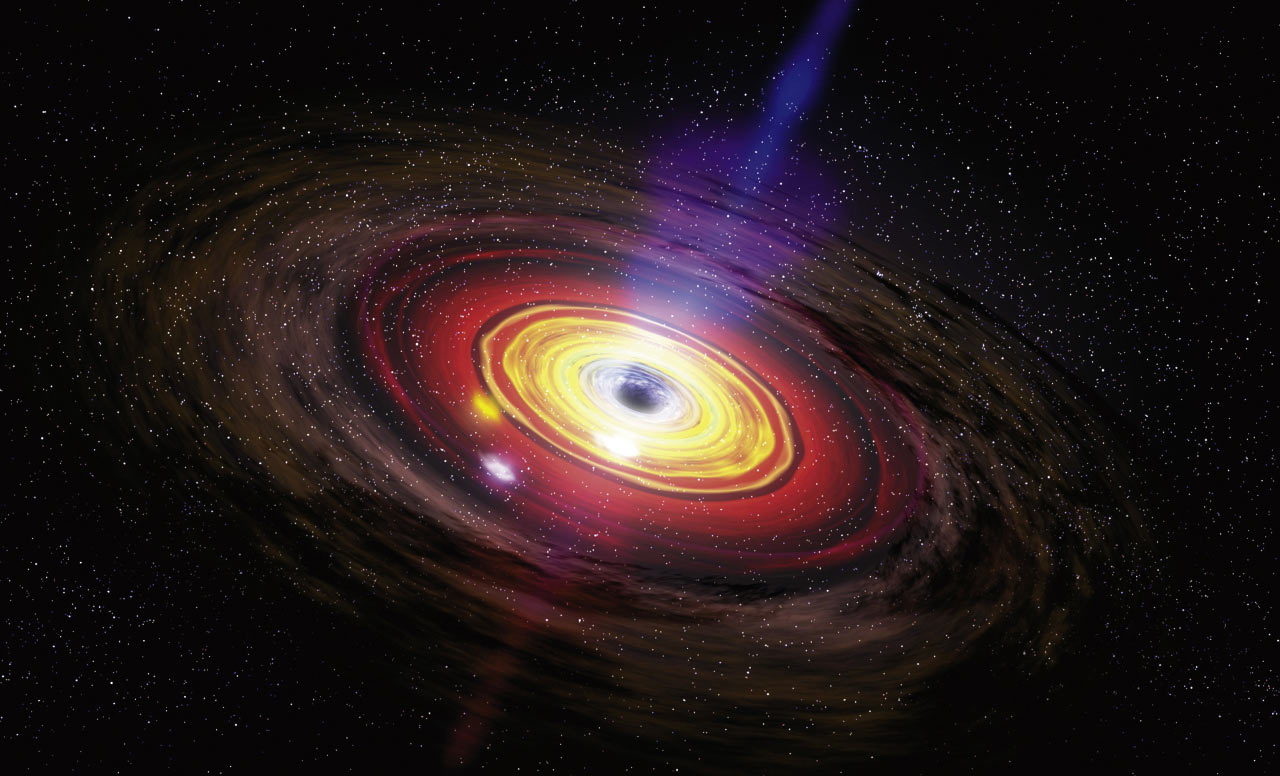
From this perspective, the stillest points in this universe shall be the black holes. All other particles and waves shall move around them.

The above is just a conjecture.

.

A Proposed Measure of Motion

brown1

Reference: The Quantum Phenomenon

The physical phenomena encountered in this universe are extremely varied. But there is a single aspect that characterizes all of them. That aspect is motion. Motion seems to underlie all physical phenomena. It is important to come up with a measure for motion that is consistent across the boards.

At cosmic levels, speed has served well as a measure of motion. It is a very basic notion of Classical mechanics. Even the theory of Relativity starts with the speed of light as a postulate. However, an interesting switch takes place at this point.

Speed is a notion derived from classical mechanics that assumes space and time to be absolute. The theory of relativity then demonstrates that neither space nor time is absolute. When one is traveling along a beam of light, the sense of space and time is very different. The units of space and time are no longer the “standard” units assumed when one is traveling along earth. We lose consistency in the measure of motion when we think about speed.

As long as one is viewing from a frame of reference that is “matter-centric” there is consistency in using speed as a measure of motion. But the moment one views from a frame of reference that is “light-centric” one loses that consistency. The inconsistency also shows up when viewing motion at atomic levels as studied in quantum mechanics.

The consistency of using speed as a measure of motion is limited to the classical “matter-centric” frame of reference.

Einstein leaned on Newton when he based his theory of relativity on a speed of light that was taken to be constant in all frames of reference. This postulate is exact enough when all the frames of reference being considered are matter-centric. There is a lot of validity to the theory of relativity as long as we make our observations in a matter-centric frame of reference.

The theory of relativity, however, leads to the conclusion that space and time are not absolute. Therefore, it cannot assume that the speed of light is absolute and independent of frames of references that are not matter-centric. Einstein’s postulate is also subject to the classical assumptions underlying the Maxwell’s equations. Quantum mechanics is now examining those assumptions as it tries to explain the wave-particle duality. One needs to reformulate Einstein’s postulate about speed of light for all frames of references.

However, this does not decrease, in any sense, the genius of Newton and Einstein. Their theories are extremely workable in their respective domains. And it is the understanding derived from those theories, which is now guiding us to properly address the inconsistencies noticed between the cosmic and atomic scale observations.

We can use Einstein’s equation to show that the frequency of a photon may act as a source of inertia (resistance to change in motion) just as the mass of an electron does.  This inertia may impart the property of discreteness as well.

From energy relationships,

E = hf = mc2
Or, f = [c2/h] m = [constant] m

In other words, frequency comes out proportional to mass equivalence, and it may play the same role as mass, within the electromagnetic spectrum. We may assume frequency to be a source of inertia where a wave is concerned, the same way that mass is a source of inertia for a particle.

Inertia is resistance to change in motion. Thus, as the frequency of electromagnetic radiation increases, it may act to slow its speed. However, from a matter-centric frame of reference, it may be difficult to detect the slowing down of the electromagnetic radiation.  But a difference might be detectable between the speeds of gamma rays and radio waves because there is a large difference between their frequencies. The following news item seems to suggest that this may be the case.

High Energy Gamma Rays Go Slower than the Speed of Light?

The article on Markarian 501 from Wikipedia states,

“The gamma rays from Mrk 501 are extremely variable, undergoing violent outbursts. The gamma ray spectrum of Mrk 501 shows two humps. One is below 1 keV and can be considered to be X rays and the other is above 1 Tev. During flares and outbursts the peaks increase in power and frequency. Flares lasting 20 minutes long with rise times of 1 minute have been measured by MAGIC. In these flares the higher energy gamma rays (of 1.2 Tev) were delayed 4 minutes over the 0.25 TeV gamma rays.”

When we carefully look at this situation, we see that frequency could be used as a more exact measure of motion than speed. Frequency is a repeating change that is observable with consistency despite the relativistic nature of space and time. Frequency may also suffer less than speed from a matter-centric bias.

The frequency of electromagnetic radiation could prove to be a better measure of motion than its speed.

Frequency as a measure of motion seems to open new avenues of investigation. For example, the de Broglie frequency of electron is in the same ballpark as the frequency of gamma rays. Therefore, a transition of inertia from frequency to mass seems to occur in gamma ray/electron region.

Of course, this is simply a hunch at this stage.
.

The Quantum Phenomenon (old)

Here are the notes for the above lecture:

Click to access notes_quantum_7.pdf

.

The phenomena being examined by quantum mechanics is that the motion of particles is not random at atomic levels.

Individual particles, when viewed together over a period of time, appear to be distributed in space as if they are parts of a wave pattern.

They somehow seem to “sense each other” not only when separated in space, much like a flock of birds, but also when separated in time.

Questions that spring up are:

  • Are these particles really discrete?
  • Do they really exist independent of each other in space and time?
  • What is the true nature of a particle?
  • What is the true nature of space and time?

We have created mathematical models that use the concept of probability to explain a pattern emerging from apparent randomness. But they do not really explain the underlying nature of matter, energy, space and time.

The above questions remain to be answered by science.