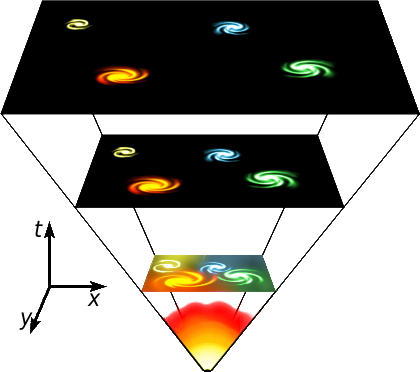
Both Classical and Quantum Mechanics seem to be based on a mathematical model that views physical space as a set of locations or points. This brings about the inconsistency that a continuous space is being defined by discrete points.
This is the first part of paper that looks at the above inconsistency. It starts by taking a conceptual approach to the subject of inertia.
Inertia
Here are some definitions from “Newton’s Principia for the Common Reader”:
Definition 1: The quantity of matter is the measure of the same, arising from its density and bulk conjointly.
Newton refers to the quantity of matter as body or mass. It is proportional to weight.
Definition 2: The quantity of motion is the measure of the same, arising from the velocity and quantity of matter conjointly.
Quantity of motion is momentum (mass x velocity) in our present terminology.
Definition 3: The vis insita, or innate state of matter, is a power of resisting, by which every body, as much as in it lies, continues in its present state, whether it be of rest, or of moving uniformly forwards in a right line.
Newton says, “This force is always proportional to the body whose force it is and differs nothing from the inactivity of the mass, but in our manner of conceiving it. A body, from the inert nature of matter, is not without difficulty put out of its state of rest or motion. Upon which account, this vis insita may, by a most significant name, be called inertia (vis inertiae) or force of inactivity. But a body only exerts this force when another force, impressed upon it, endeavors to change its condition; and the exercise of this force may be considered as both resistance and impulse, it is resistance so far as the body, for maintaining its present state, opposes the force impressed; it is impulse so far as the body, by not easily giving way to the impressed force of another, endeavors to change the state of that other. Resistance is usually ascribed to bodies at rest and impulse to those in motion; but motion and rest, as commonly conceived are only relatively distinguished; nor are those bodies always truly at rest, which commonly are taken to be so.”
Definition 4: An impressed force is an action exerted upon a body, in order to change its state, either of rest, or of uniform motion in a right line.
Newton says, “This force consists in the action only, and remains no longer in the body when the action is over. For a body maintains every new state it acquires, by its inertia only. But impressed forces are of different origins, as from percussion, from pressure, from centripetal force.”
Law 1: Every body continues in its state of rest, or of uniform motion in a right line, unless it is compelled to change that state by forces impressed upon it.
Conceptually, inertia is the inherent tendency of a state of motion to maintain its status quo.
Law 2: The change of motion is proportional to the motive force impressed; and is made in the direction of the right line in which that force is impressed.
This is stated as, “Force = mass x acceleration.” Force is proportional to acceleration, and the proportionality factor is the mass (quantity of matter). Mass is equivalent to the force that is required to produce unit acceleration.
Law 3: To every action there is always opposed an equal reaction: or, the mutual actions of two bodies upon each other are always equal, and directed to contrary parts.
The internal resistance encountered due to inertia equals the force applied. Thus, inertia may be accounted for in terms of mass.
The above discussion may be summarized in the following concepts.
- Inertia is the inherent tendency of a state of motion to maintain its status quo.
- Inertia comes into play when a force is impressed from outside, and acceleration is generated.
- Inertia is the property of quantity of matter, or mass.
- Mass depends on the density and volume of the body.
- Inertia increases or decreases as mass increases or decreases.
- Mass may be measured in terms of force required to produce unit acceleration.
Center of Mass
Here are some corollaries from “Newton’s Principia for the Common Reader”:
Corollary 4: The common center of gravity of two or more bodies does not alter its state of motion or rest by the actions of the bodies among themselves; and therefore the common center of gravity of all bodies acting upon each other (excluding external actions and impediments) is either at rest, or moves uniformly in a right line.
Newton says, “It is manifest that the common center of all never suffers any change in the state of its motion or rest from the actions of any two bodies between themselves… And therefore the same law takes place in a system consisting of many bodies as in one single body, with regard to their preserving in their state of motion or rest. For the progressive motion, whether of one single body, or of a whole system of bodies, is always to be estimated from the motion of the center of gravity.”
Proposition 24, Cor. 7: And hence appears a method both of comparing bodies one with another, as to the quantity of matter in each; and of comparing the weights of the same body in different places, to know the variation of its gravity. And by experiments made with the greatest accuracy, I have always found the quantity of matter in bodies to be proportional to their weight.
This conclusion is in support of Newton’s Law 2.
From Maxwell’s paper on Matter and motion cited in “Newton’s Principia for the Common Reader”:
-
Center of mass of two particles: C is a point such that if the masses of A and B were concentrated at C, their mass-vector from any origin O would be the same as when A and B are in their actual positions. The point C is called the Center of Mass of A and B.
-
Center of Mass of a system: The center of mass is therefore a definite point in the diagram of the configuration of the system. By assigning to the different points in the diagrams of displacement, velocity, total acceleration, and rate of acceleration, the masses of the bodies to which they correspond, we may find in each of these diagrams a point that corresponds to the center of mass, and indicates the displacement, velocity, total acceleration, or rate of acceleration of the center of mass.
The above discussion may be summarized in the following concepts.
- A body responds to motion as if its weight is concentrated at a point.
- Mass is proportional to weight.
- A body responds to motion as if its mass is concentrated at a point.
Physical Location
Classical mechanics treats physical objects as if all their mass is concentrated at a center. A dimensionless point is used to represent this location. The whole object is not dimensionless, but its center of mass comes closest to pinpointing its physical location, under the laws of classical mechanics.
This location appears in reference to the object itself. It depends on the mass of the object and how that mass is distributed within that object. Thus, the universe also has a location with respect to itself. This location is invariable if the total mass remains constant.
As the mass of an object increases it is harder to move. We may say that its physical location is becoming more centered. From this point of view, the most centered objects in this universe are Black Holes.
As the mass of an object decreases, its physical location becomes less centered even when it is looked upon as “in motion”. The location may still be approximated by a geometrical point, but it is increasingly unstable. It may be altered easily with respect to more stable locations. When there is no mass then there is no physical location that can be defined as a point in space. A massless photon shall have no physical point location even when it is looked upon as moving.
.
The above discussion may be summarized in the following concepts.
-
A physical point location in space depends on the distribution of mass around it.
-
If there is no mass in a section of space then there is no physical point location within that context.
-
Such physical point locations are discrete and they seem to be distributed in space according to the law of gravity of classical mechanics.
-
A mathematical point is different. It is discrete and it may be assumed anywhere in a continuous space even when there is no mass.
-
A physical location may be represented by a mathematical point. But a mathematical point in space does not necessarily represent a physical location.
-
The physical location of a massless photon may not be represented by a point or points as conceived in mathematics.
-
This paper essentially points out the difference between a physical location and a mathematical point.
.