Monthly Archives: April 2011

The Creation Hymn of Rig Veda

Reference: Religion

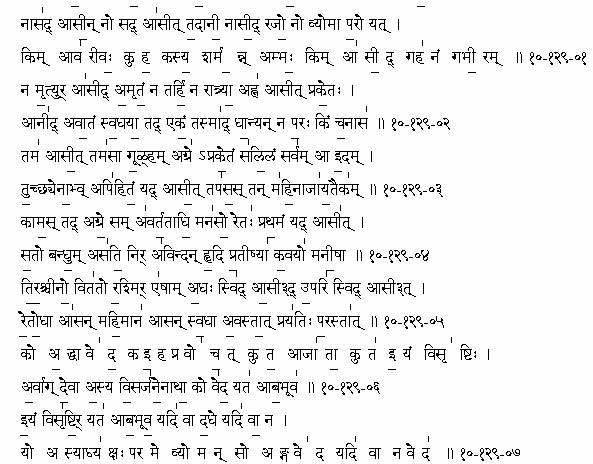
This is the Nasadiya Sukta (sometimes called Nasidya Sukta), which is the 129th hymn (sukta) of the 10th Mandala of the Rig Veda. This hymn is widely known as the “Hymn of Creation,” but more accurately, it is a profound meditation on the mystery and unknowability of cosmic origins.

Following is a translation by Wendy Doniger O’Flaherty. From the Book “The Rig Veda – Anthology”

There was neither non-existence nor existence then.
There was neither the realm of space nor the sky which is beyond.
What stirred?
Where?
In whose protection?
Was there water, bottomlessly deep?

There was neither death nor immortality then.
There was no distinguishing sign of night nor of day.
That One breathed, windless, by its own impulse.
Other than that there was nothing beyond.

Darkness was hidden by darkness in the beginning,
with no distinguishing sign, all this was water.
The life force that was covered with emptiness,
that One arose through the power of heat.

Desire came upon that One in the beginning,
that was the first seed of mind.
Poets seeking in their heart with wisdom
found the bond of existence and non-existence.

Their cord was extended across.
Was there below?
Was there above?
There were seed-placers, there were powers.
There was impulse beneath, there was giving forth above.

Who really knows?
Who will here proclaim it?
Whence was it produced?
Whence is this creation?
The gods came afterwards, with the creation of this universe.
Who then knows whence it has arisen?

Whence this creation has arisen
– perhaps it formed itself, or perhaps it did not –
the One who looks down on it,
in the highest heaven, only He knows
or perhaps He does not know.


Vinaire’s comments:

There was neither non-existence nor existence then.
There was neither the realm of space nor the sky which is beyond.
What stirred?
Where?
In whose protection?
Was there water, bottomlessly deep?

There were no considerations. There was no awareness of anything. None of the dichotomies were present then; but something stirred.

There was neither death nor immortality then.
There was no distinguishing sign of night nor of day.
That One breathed, windless, by its own impulse.
Other than that there was nothing beyond.

That primary sensation emerged on its own.

Darkness was hidden by darkness in the beginning,
with no distinguishing sign, all this was water.
The life force that was covered with emptiness,
that One arose through the power of heat.

Nothing had any meaning other than a primeval force emerging out of emptiness.

Desire came upon that One in the beginning,
that was the first seed of mind.
Poets seeking in their heart with wisdom
found the bond of existence and non-existence.

A desire to know arose. A meaning was assigned. Thus was found a bond from non-existence to existence.

Their cord was extended across.
Was there below?
Was there above?
There were seed-placers, there were powers.
There was impulse beneath, there was giving forth above.

Postulates extended across. Meanings manifested themselves. Thus there were maker of postulates and the power to postulate. Underlying the manifestation was the impulse.

Who really knows?
Who will here proclaim it?
Whence was it produced?
Whence is this creation?
The gods came afterwards, with the creation of this universe.
Who then knows whence it has arisen?

We may only speculate about the makers of postulates and their powers to postulate. For the whole creation and even the gods are the outcome of these postulates.

Whence this creation has arisen
– perhaps it formed itself, or perhaps it did not –
the One who looks down on it,
in the highest heaven, only He knows
or perhaps He does not know.

Who to say what occurred! There can only be postulates, speculations and assumptions.

.

The basic questions are: “Where?”, “When?”, Who?” or “What?”

Neither such questions, nor their answers are there in the beginning.

There is only manifestation, and awareness of that manifestation.

In case of absolute beginning, there is no “prior.”

In the “after,” there are these questions, and speculations for answers.

The questions manifest, and the speculations manifest

There is awareness of these manifestations.

This awareness then generates more questions and speculations.

Such speculations then going forward, as well as going backwards

Hide the unknowable.

.

Reference: The Quest for Certainty

.
Bible: Genesis (Part 1)

Reference: Religion

BIBLE:  THE BOOK OF GENESIS

Genesis 1:1 – In the beginning God created the heavens and the earth.

This first verse of the Bible introduces, acknowledges and celebrates the fact of CREATION. Creation is “bringing into existence,” or “manifesting that, which was not manifested.”

In creation there is always a manifestation that was not there before. In a light bulb, we have a form that didn’t exist before the light bulb was invented; therefore, the light bulb was a creation. But the light bulb was created out of existing materials.

That there are the manifestations we call heavens and earth is self-evident. So they must have been created out of something that existed earlier. This is confirmed by the law of conservation of matter and energy in Physics. Something that existed earlier is identified in Genesis 1:1 as God. It is, therefore, a natural conclusion that the concept of “God” implies the causative principle as well as the materials from which heavens and earth were created. Therefore, heavens and earth are simply an extension of God.

We may, therefore, say that God created the light bulb, even though that is an event much smaller in scale than the creation of heavens and earth. In this case, God is much more than the inventor, Thomas Edison. He wasn’t the only one who contributed to the development of this revolutionary technology. Many other notable figures are also remembered for their work with electric batteries, lamps and the creation of the first incandescent bulbs. Besides, we are looking at bodies and minds, which themselves are manifestations.

We may, therefore, conclude the following about God of Genesis 1:1.

  1. Heaven and earth are an extension of God because creator and creation cannot be separated from each other.
  2. God is not a human like beingness. It is rather a deep abstract principle describing order precipitating from chaos.

This nature of God is beautifully expressed in the Vedic Hymn of Creation. To think of God to be otherwise is to operate from a viewpoint of mystery. Bible need not be interpreted from this viewpoint of mystery.

.

Qur’an: The Opening

The Opening

Reference: Religion

[NOTE: I am not blogging about Islam. I am blogging about knowledge in the tradition of JNANA YOGA (the yoga of knowledge). My interest is to interpret Qur’an from the viewpoint of knowledge that is useful to mankind. I shall be interpreting this knowledge as consistent with my view of God as unknowable.If there is any historical, religious or cultural inconsistency in this material, I shall point it out as such. ~ Vinaire]

QUR’AN:  THE OPENING

IN THE NAME OF GOD, THE COMPASSIONATE, THE MERCIFUL

.

All praise belongs to God.

Lord of all worlds.

COMMENTARY:  God is the source of all that is spiritual and physical.  God is the Law that governs all that is spiritual and physical.

.

The Compassionate, the Merciful.

COMMENTARY:  God is the Law that provides for and supports survival in this universe.  The “personification” of God is simply poetic.  It has been used to communicate the beauty of the abstract reality, which is God, in all its majesty.  God is not physical or concrete.  God is abstract.  NOTE:  Here “abstract” does not mean imaginary.  The Law of Gravity is abstract but it is real.


Ruler of Judgment Day

COMMENTARY: Any action of Man is judged by these eternal laws.  A person faces the “Judgment Day” when, all of a sudden, he is faced with the truth that it is his own actions which are responsible for his condition.  He can either take responsibility for his actions and survive; or ignore his responsibilities and succumb.  Equivalent of this may apply to a society, a race, or even to whole mankind.


It is You that we worship,

and to You we appeal for help.

COMMENTARY:  It is this Law, and its Source, that we regard with utmost respect.  It is That to which we go back again and again for help and understanding.

.

Show us the straight way,

the way of those you have graced,

not of those on whom is Your wrath,

nor of those who wander astray. 

COMMENTARY:  May we perceive the right way according to these Laws, and recognize those who are following them; and not be deceived by those who have gone astray and are suffering as a result.

“God’s wrath” is the unyielding nature of these Laws, which apply to everyone in the same manner, whether one is aware of them or not.  One survives better when he follows the Law.  One suffers when he ignores it.  The image of a “Wise Old Man” who is angered at the impropriety of man has often been used for God.  But this is no more than a poetic expression to convey the urgency of the message.  Per Qur’an, God should not be substituted by any image.  This also applies to any image for God formed in one’s mind.

God is pure spirit – the pure essence of all creativity and intelligence, and the source of all life in its infinite variations.  God is not bound by any finite personality.  God is the source of all personalities.

.

CAUTION: Please keep in mind that the Qur’an is a poetic rendition. It seems to give the impression that God is some Being, separate from one and external to one. But God is not an entity. God is formless.

Any entity has to be defined in space. It is space that separates one thing from another. By separating things space gives form to those things. Form implies separation in space. Formlessness implies uniformity throughout the space.

Therefore, something that doesn’t have any form has to be uniform throughout the space imbibing uniformly anything in that space. It won’t be separate from anything. In short, it would not be a separable or an identifiable entity.

Islam considers God to be formless. Thus, God cannot be a separable or an identifiable entity. God has to be present uniformly in all things.

Thus, God is that POTENTIAL OF CREATIVITY that resides at the core of any beingness.

.

Note (April 2011): I wrote this essay many years ago. My expanded view on God is expressed in the essay The Nature of God.

.

Printing a human kidney

TED talk: Printing a human kidney

About this talk

Surgeon Anthony Atala demonstrates an early-stage experiment that could someday solve the organ-donor problem: a 3D printer that uses living cells to output a transplantable kidney. Using similar technology, Dr. Atala’s young patient Luke Massella received an engineered bladder 10 years ago; we meet him onstage.

.