
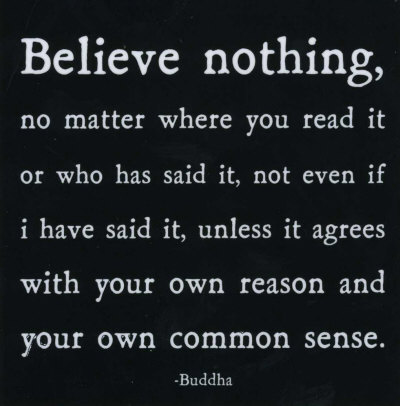
The Absolute Truth is that there is nothing absolute in the world, that everything is relative, conditioned and impermanent, and that there is no unchanging, everlasting, absolute substance like Self, Soul, or Ātman within or without. – Buddha.
.
Absolutism: any theory holding that values, principles, etc., are absolute and not relative, dependent, or changeable.
Philosophy: the rational investigation of the truths and principles of being, knowledge, or conduct.
.
My understanding is that
-
Absolutes are unattainable. This means that nothing can be defined with absolute certainty. Any certainty that one holds is subject to re-examination in the face of inconsistency.
-
Philosophy is an investigation of what is really there. It makes progress by thoroughly examining inconsistencies to the point of eliminating them.
.
Nothing that exists is so sacrosanct that it is beyond re-examination.
.
This stance may seem to be inconsistent with the principle of Confusion and Stable data promoted by L. Ron Hubbard, but it is not really so. According to Hubbard’s principle, mental confusions are held at bay by beliefs, and if those beliefs are destabilized then a person may be overwhelmed with confusion. This is apparently true.
However, it is always possible to replace a belief with a more consistent belief. But this may be regarded as addressing a conditioning with another conditioning. This seems to take place in the subject of Scientology.
An optimum course would be to remove the confusion altogether so a belief is no longer required. This seems to be the approach in Buddhism.
[NOTE: The above essay was inspired by an exchange with Geir Isene here: Comment-3712. The problem with Geir’s article ON WILL is its absolutist tendency to look at will and other things.]
.
References:
Is there an absolute Will?
Considerations and Free Will
.
