Tag Archives: 800000

Eddington 1927: Symbolic Knowledge and Intimate Knowledge

Unknowable

Reference: The Nature of the Physical World

This paper presents Chapter XV (section 2) from the book THE NATURE OF THE PHYSICAL WORLD by A. S. EDDINGTON. The contents of this book are based on the lectures that Eddington delivered at the University of Edinburgh in January to March 1927.

The paragraphs of original material are accompanied by brief comments in color, based on the present understanding.  Feedback on these comments is appreciated.

The heading below links to the original materials.

.

Symbolic Knowledge and Intimate Knowledge

May I elaborate this objection to introspection? We have two kinds of knowledge which I call symbolic knowledge and intimate knowledge. I do not know whether it would be correct to say that reasoning is only applicable to symbolic knowledge, but the more customary forms of reasoning have been developed for symbolic knowledge only. The intimate knowledge will not submit to codification and analysis; or, rather, when we attempt to analyse it the intimacy is lost and it is replaced by symbolism.

For an illustration let us consider Humour. I suppose that humour can be analysed to some extent and the essential ingredients of the different kinds of wit classified. Suppose that we are offered an alleged joke. We subject it to scientific analysis as we would a chemical salt of doubtful nature, and perhaps after careful consideration of all its aspects we are able to confirm that it really and truly is a joke. Logically, I suppose, our next procedure would be to laugh. But it may certainly be predicted that as the result of this scrutiny we shall have lost all inclination we may ever have had to laugh at it. It simply does not do to expose the inner workings of a joke. The classification concerns a symbolic knowledge of humour which preserves all the characteristics of a joke except its laughableness. The real appreciation must come spontaneously, not introspectively. I think this is a not unfair analogy for our mystical feeling for Nature, and I would venture even to apply it to our mystical experience of God. There are some to whom the sense of a divine presence irradiating the soul is one of the most obvious things of experience. In their view a man without this sense is to be regarded as we regard a man without a sense of humour. The absence is a kind of mental deficiency. We may try to analyse the experience as we analyse humour, and construct a theology, or it may be an atheistic philosophy, which shall put into scientific form what is to be inferred about it. But let us not forget that the theology is symbolic knowledge whereas the experience is intimate knowledge. And as laughter cannot be compelled by the scientific exposition of the structure of a joke, so a philosophic discussion of the attributes of God (or an impersonal substitute) is likely to miss the intimate response of the spirit which is the central point of the religious experience.

Intimate knowledge is spontaneous. It does not require any reasoning. But symbolic knowledge requires reasoning. Somewhere along the way, the reasoning through symbolic knowledge may trigger the ecstasy of intimate knowledge.  

.

Eddington 1927: Science and Mysticism

Mysticism

Reference: The Nature of the Physical World

This paper presents Chapter XV (section 1) from the book THE NATURE OF THE PHYSICAL WORLD by A. S. EDDINGTON. The contents of this book are based on the lectures that Eddington delivered at the University of Edinburgh in January to March 1927.

The paragraphs of original material are accompanied by brief comments in color, based on the present understanding.  Feedback on these comments is appreciated.

The heading below links to the original materials.

.

Science and Mysticism

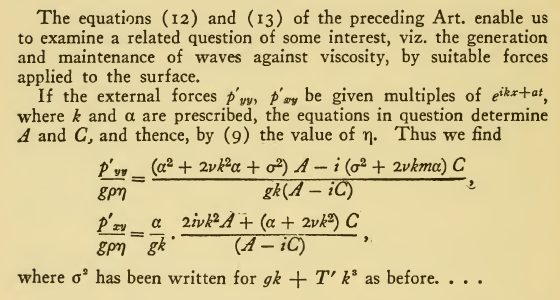
One day I happened to be occupied with the subject of “Generation of Waves by Wind”. I took down the standard treatise on hydrodynamics, and under that heading I read—

XV

And so on for two pages. At the end it is made clear that a wind of less than half a mile an hour will leave the surface unruffled. At a mile an hour the surface is covered with minute corrugations due to capillary waves which decay immediately the disturbing cause ceases. At two miles an hour the gravity waves appear. As the author modestly concludes, “Our theoretical investigations give considerable insight into the incipient stages of wave-formation”.

On another occasion the same subject of “Generation of Waves by Wind” was in my mind; but this time another book was more appropriate, and I read—

There are waters blown by changing winds to laughter
And lit by the rich skies, all day. And after,
Frost, with a gesture, stays the waves that dance
And wandering loveliness. He leaves a white
Unbroken glory, a gathered radiance,
A width, a shining peace, under the night.

The magic words bring back the scene. Again we feel Nature drawing close to us, uniting with us, till we are filled with the gladness of the waves dancing in the sunshine, with the awe of the moonlight on the frozen lake. These were not moments when we fell below ourselves. We do not look back on them and say, “It was disgraceful for a man with six sober senses and a scientific understanding to let himself be deluded in that way. I will take Lamb’s Hydrodynamics with me next time”. It is good that there should be such moments for us. Life would be stunted and narrow if we could feel no significance in the world around us beyond that which can be weighed and measured with the tools of the physicist or described by the metrical symbols of the mathematician.

Of course it was an illusion. We can easily expose the rather clumsy trick that was played on us. Aethereal vibrations of various wave-lengths, reflected at different angles from the disturbed interface between air and water, reached our eyes, and by photoelectric action caused appropriate stimuli to travel along the optic nerves to a brain-centre. Here the mind set to work to weave an impression out of the stimuli. The incoming material was somewhat meagre; but the mind is a great storehouse of associations that could be used to clothe the skeleton. Having woven an impression the mind surveyed all that it had made and decided that it was very good. The critical faculty was lulled. We ceased to analyse and were conscious only of the impression as a whole. The warmth of the air, the scent of the grass, the gentle stir of the breeze, combined with the visual scene in one transcendent impression, around us and within us. Associations emerging from their storehouse grew bolder. Perhaps we recalled the phrase “rippling laughter”. Waves—ripples—laughter—gladness —the ideas jostled one another. Quite illogically we were glad; though what there can possibly be to be glad about in a set of aethereal vibrations no sensible person can explain. A mood of quiet joy suffused the whole impression. The gladness in ourselves was in Nature, in the waves, everywhere. That’s how it was.

The mind is capable of great imagination. The person is not being deceived as long as he aware that it is imagination.

It was an illusion. Then why toy with it longer? These airy fancies which the mind, when we do not keep it severely in order, projects into the external world should be of no concern to the earnest seeker after truth. Get back to the solid substance of things, to the material of the water moving under the pressure of the wind and the force of gravitation in obedience to the laws of hydrodynamics. But the solid substance of things is another illusion. It too is a fancy projected by the mind into the external world. We have chased the solid substance from the continuous liquid to the atom, from the atom to the  electron, and there we have lost it. But at least, it will be said, we have reached something real at the end of the chase—the protons and electrons. Or if the new quantum theory condemns these images as too concrete and leaves us with no coherent images at all, at least we have symbolic co-ordinates and momenta and Hamiltonian functions devoting themselves with single-minded purpose to ensuring that qp—pq shall be equal to ih/2π.

After atom we have gotten only as far as the proton and electron; and mathematical functions and relationships.

In a previous chapter I have tried to show that by following this course we reach a cyclic scheme which from its very nature can only be a partial expression of our environment. It is not reality but the skeleton of reality. “Actuality” has been lost in the exigencies of the chase. Having first rejected the mind as a worker of illusion we have in the end to return to the mind and say, “Here are worlds well and truly built on a basis more secure than your fanciful illusions. But there is nothing to make any one of them an actual world. Please choose one and weave your fanciful images into it. That alone can make it actual”. We have torn away the mental fancies to get at the reality beneath, only to find that the reality of that which is beneath is bound up with its potentiality of awakening these fancies. It is because the mind, the weaver of illusion, is also the only guarantor of reality that reality is always to be sought at the base of illusion. Illusion is to reality as the smoke to the fire. I will not urge that hoary untruth “There is no smoke without fire”. But it is reasonable to inquire whether in the mystical illusions of man there is not a reflection of an underlying reality.

The knowledge obtained through science may be in the form of a cyclic scheme (tautology), but that cycle keeps on growing in detail. The difference between illusion and reality lies in the amount of anomalies present. The fewer anomalies there are the more real it is. Imagination is not opposite of reality. It has its place in reality as long as we recognize it for what it is, and resolve any anomalies present.

To put a plain question—Why should it be good for us to experience a state of self-deception such as I have described? I think everyone admits that it is good to have a spirit sensitive to the influences of Nature, good to exercise an appreciative imagination and not always to be remorselessly dissecting our environment after the manner of the mathematical physicists. And it is good not merely in a utilitarian sense, but in some purposive sense necessary to the fulfilment of the life that is given us. It is not a dope which it is expedient to take from time to time so that we may return with greater vigour to the more legitimate employment of the mind in scientific investigation. Just possibly it might be defended on the ground that it affords to the non-mathematical mind in some feeble measure that delight in the external world which would be more fully provided by an intimacy with its differential equations. (Lest it should be thought that I have intended to pillory hydrodynamics, I hasten to say in this connection that I would not rank the intellectual (scientific) appreciation on a lower plane than the mystical appreciation; and I know of passages written in mathematical symbols which in their sublimity might vie with Rupert Brooke’s sonnet.) But I think you will agree with me that it is impossible to allow that the one kind of appreciation can adequately fill the place of the other. Then how can it be deemed good if there is nothing in it but self-deception? That would be an upheaval of all our ideas of ethics. It seems to me that the only alternatives are either to count all such surrender to the mystical contact of Nature as mischievous and ethically wrong, or to admit that in these moods we catch something of the true relation of the world to ourselves—a relation not hinted at in a purely scientific analysis of its content. I think the most ardent materialist does not advocate, or at any rate does not practice, the first alternative; therefore I assume the second alternative, that there is some kind of truth at the base of the illusion.

In no way is the literary pursuit of imagination deceptive if it is understood for what it is. Using science is a reference point to judge is false.

But we must pause to consider the extent of the illusion. Is it a question of a small nugget of reality buried under a mountain of illusion? If that were so it would be our duty to rid our minds of some of the illusion at least, and try to know the truth in purer form. But I cannot think there is much amiss with our appreciation of the natural scene that so impresses us. I do not think a being more highly endowed than ourselves would prune away much of what we feel. It is not so much that the feeling itself is at fault as that our introspective examination of it wraps it in fanciful imagery. If I were to try to put into words the essential truth revealed in the mystic experience, it would be that our minds are not apart from the world; and the feelings that we have of gladness and melancholy and our yet deeper feelings are not of ourselves alone, but are glimpses of a reality transcending the narrow limits of our particular consciousness—that the harmony and beauty of the face of Nature is at root one with the gladness that transfigures the face of man. We try to express much the same truth when we say that the physical entities are only an extract of pointer readings and beneath them is a nature continuous with our own. But I do not willingly put it into words or subject it to introspection. We have seen how in the physical world the meaning is greatly changed when we contemplate it as surveyed from without instead of, as it essentially must be, from within. By introspection we drag out the truth for external survey; but in the mystical feeling the truth is apprehended from within and is, as it should be, a part of ourselves.

.

Eddington 1927: Interference with Statistical Laws

Human-body-elements

Reference: The Nature of the Physical World

This paper presents Chapter XIV (section 8) from the book THE NATURE OF THE PHYSICAL WORLD by A. S. EDDINGTON. The contents of this book are based on the lectures that Eddington delivered at the University of Edinburgh in January to March 1927.

The paragraphs of original material are accompanied by brief comments in color, based on the present understanding.  Feedback on these comments is appreciated.

The heading below links to the original materials.

.

Interference with Statistical Laws

Has the mind power to set aside statistical laws which hold in in organic matter? Unless this is granted its opportunity of interference seems to be too circumscribed to bring about the results which are observed to follow from mental decisions. But the admission involves a genuine physical difference between inorganic and organic (or, at any rate, conscious) matter. I would prefer to avoid this hypothesis, but it is necessary to face the issue squarely. The indeterminacy recognised in modern quantum theory is only a partial step towards freeing our actions from deterministic control. To use an analogy—we have admitted an uncertainty which may take or spare human lives; but we have yet to find an uncertainty which may upset the expectations of a life- insurance company. Theoretically the one uncertainty might lead to the other, as when the fate of millions turned on the murders at Sarajevo. But the hypothesis that the mind operates through two or three key-atoms in the brain is too desperate a way of escape for us, and I reject it for the reasons already stated.

The material, field, and thought substances work in conjunction with each other to maintain the continuum. This is the overall boundary condition. The rest comes out of that.

It is one thing to allow the mind to direct an atom between two courses neither of which would be improbable for an inorganic atom; it is another thing to allow it to direct a crowd of atoms into a configuration which the secondary laws of physics would set aside as “too improbable”. Here the improbability is that a large number of entities each acting independently should conspire to produce the result; it is like the improbability of the atoms finding themselves by chance all in one half of a vessel. We must suppose that in the physical part of the brain immediately affected by a mental decision there is some kind of interdependence of behaviour of the atoms which is not present in inorganic matter.

Interdependence of atoms comes from the boundary condition stated above. There are no totally independent (arbitrary) decisions.  Laws function as they are supposed to function.

I do not wish to minimise the seriousness of admitting this difference between living and dead matter. But I think that the difficulty has been eased a little, if it has not been removed. To leave the atom constituted as it was but to interfere with the probability of its undetermined behaviour, does not seem quite so drastic an interference with natural law as other modes of mental interference that have been suggested. (Perhaps that is only because we do not understand enough about these probabilities to realise the heinousness of our suggestion.) Unless it belies its name, probability can be modified in ways which ordinary physical entities would not admit of. There can be no unique probability attached to any event or behaviour; we can only speak of “probability in the light of certain given information”, and the probability alters according to the extent of the information. It is, I think, one of the most unsatisfactory features of the new quantum theory in its present stage that it scarcely seems to recognise this fact, and leaves us to guess at the basis of information to which its probability theorems are supposed to refer.

In dead matter the free-will (the ability of the mind to manipulate thought-substance) is missing.

Looking at it from another aspect—if the unity of a man’s consciousness is not an illusion, there must be some corresponding unity in the relations of the mind-stuff which is behind the pointer readings. Applying our measures of relation structure, as in chapter XI, we shall build matter and fields of force obeying identically the principal field-laws; the atoms will individually be in no way different from those which are without this unity in the background. But it seems plausible that when we consider their collective behaviour we shall have to take account of the broader unifying trends in the mind-stuff, and not expect the statistical results to agree with those appropriate to structures of haphazard origin.

I think that even a materialist must reach a conclusion not unlike ours if he fairly faces the problem. He will need in the physical world something to stand for a symbolic unity of the atoms associated with an individual consciousness, which does not exist for atoms not so associated—a unity which naturally upsets physical predictions abased on the hypothesis of random disconnection. For he has not only to translate into material configurations the multifarious thoughts and images of the mind, but must surely not neglect to find some kind of physical substitute for the Ego.

Neither material nor thought substance calls the shots. The conditions are determined by the drive to achieve an overall equilibrium.

.

Eddington 1927: Volition

Volition

Reference: The Nature of the Physical World

This paper presents Chapter XIV (section 7) from the book THE NATURE OF THE PHYSICAL WORLD by A. S. EDDINGTON. The contents of this book are based on the lectures that Eddington delivered at the University of Edinburgh in January to March 1927.

The paragraphs of original material are accompanied by brief comments in color, based on the present understanding.  Feedback on these comments is appreciated.

The heading below links to the original materials.

.

Volition

From the philosophic point of view it is of deep interest to consider how this affects the freedom of the human mind and spirit. A complete determinism of the material universe cannot be divorced from determinism of the mind. Take, for example, the prediction of the weather this time next year. The prediction is not likely ever to become practicable, but “orthodox” physicists are not yet convinced that it is theoretically impossible; they hold that next year’s weather is already predetermined. We should require extremely detailed knowledge of present conditions, since a small local deviation can exert an ever-expanding influence. We must examine the state of the sun so as to predict the fluctuations in the heat and corpuscular radiation which it sends us. We must dive into the bowels of the earth to be forewarned of volcanic eruptions which may spread a dust screen over the atmosphere as Mt. Katmai did some years ago. But further we must penetrate into the recesses of the human mind. A coal strike, a great war, may directly change the conditions of the atmosphere; a lighted match idly thrown away may cause deforestation which will change the rainfall and climate. There can be no fully deterministic control of inorganic phenomena unless the determinism governs mind itself. Conversely if we wish to emancipate mind we must to some extent emancipate the material world also. There appears to be no longer any obstacle to this emancipation.

The thought-substance is the pattern that establishes the continuum of material and field substance. Such pattern may not be clearly perceived by the human mind because of thought-filters due to ignorance and preconceived notions.

The human mind has the ability to dissolve such thought-filters by resolving anomalies (inconsistencies, disharmonies and discontinuities). This ability of the human mind to manipulate thought-substance as above is called FREE-WILL.

Let us look more closely into the problem of how the mind gets a grip on material atoms so that movements of the body and limbs can be controlled by its volition. I think we may now feel quite satisfied that the volition is genuine. The materialist view was that the motions which appear to be caused by our volition are really reflex actions controlled by the material processes in the brain, the act of will being an inessential side phenomenon occurring simultaneously with the physical phenomena. But this assumes that the result of applying physical laws to the brain is fully determinate. It is meaningless to say that the behaviour of a conscious brain is precisely the same as that of a mechanical brain if the behaviour of a mechanical brain is left undetermined. If the laws of physics are not strictly causal the most that can be said is that the behaviour of the conscious brain is one of the possible behaviours of a mechanical brain. Precisely so; and the decision between the possible behaviours is what we call volition.

There is no need to know all the laws if the human mind can simply the anomalies as it comes across them. In this process the laws may be discovered as needed.

Perhaps you will say, When the decision of an atom is made between its possible quantum jumps, is that also “volition”? Scarcely; the analogy is altogether too remote. The position is that both for the brain and the atom there is nothing in the physical world, i.e. the world of pointer readings, to predetermine the decision; the decision is a fact of the physical world with consequences in the future but not causally connected to the past. In the case of the brain we have an insight into a mental world behind the world of pointer readings and in that world we get a new picture of the fact of decision which must be taken as revealing its real nature—if the words real nature have any meaning. For the atom we have no such insight into what is behind the pointer readings. We believe that behind all pointer readings there is a background continuous with the background of the brain; but there is no more ground for calling the background of the spontaneous behaviour of the atom “volition” than for calling the background of its causal behaviour “reason”. It should be understood that we are not attempting to reintroduce in the background the strict causality banished from the pointer readings. In the one case in which we have any insight—the background of the brain—we have no intention of giving up the freedom of the mind and will. Similarly we do not suggest that the marks of predestination of the atom, not found in the pointer readings, exist undetectable in the unknown background. To the question whether I would admit that the cause of the decision of the atom has something in common with the cause of the decision of the brain, I would simply answer that there is no cause. In the case of the brain I have a deeper insight into the decision; this insight exhibits it as volition, i.e. something outside causality.

What is outside causality is unknown. But we may gradually come to know about the unknown by resolving anomalies. Will we ever come to know the unknown fully with no more anomalies to be resolved—we don’t know.

A mental decision to turn right or turn left starts one of two alternative sets of impulses along the nerves to the feet. At some brain centre the course of behaviour of certain atoms or elements of the physical world is directly determined for them by the mental decision— or, one may say, the scientific description of that behaviour is the metrical aspect of the decision. It would be a possible though difficult hypothesis to assume that very few atoms (or possibly only one atom) have this direct contact with the conscious decision, and that these few atoms serve as a switch to deflect the material world from one course to the other. But it is physically improbable that each atom has its duty in the brain so precisely allotted that the control of its behaviour would prevail over all possible irregularities of the other atoms. If I have at all rightly understood the processes of my own mind, there is no finicking with individual atoms.

The confusion in science seems to be coming from not differentiating the thought-substance from material substance. Similar confusion we see in quantum theory from not fully differentiating field-substance from material substance.

I do not think that our decisions are precisely balanced on the conduct of certain key-atoms. Could we pick out one atom in Einstein’s brain and say that if it had made the wrong quantum jump there would have been a corresponding flaw in the theory of relativity? Having regard to the physical influences of temperature and promiscuous collision it is impossible to maintain this. It seems that we must attribute to the mind power not only to decide the behaviour of atoms individually but to affect systematically large groups— in fact to tamper with the odds on atomic behaviour. This has always been one of the most dubious points in the theory of the interaction of mind and matter.

.

Eddington 1927: Natural and Supernatural

Reference: The Nature of the Physical World

This paper presents Chapter XIV (section 6) from the book THE NATURE OF THE PHYSICAL WORLD by A. S. EDDINGTON. The contents of this book are based on the lectures that Eddington delivered at the University of Edinburgh in January to March 1927.

The paragraphs of original material are accompanied by brief comments in color, based on the present understanding.  Feedback on these comments is appreciated.

The heading below links to the original materials.

.

Natural and Supernatural

A rather serious consequence of dropping causality in the external world is that it leaves us with no clear distinction between the Natural and the Supernatural. In an earlier chapter I compared the invisible agent invented to account for the tug of gravitation to a “demon”. Is a view of the world which admits such an agent any more scientific than that of a savage who attributes all that he finds mysterious in Nature to the work of invisible demons? The Newtonian physicist had a valid defence. He could point out that his demon Gravitation was supposed to act according to fixed causal laws and was therefore not to be compared with the irresponsible demons of the savage. Once a deviation from strict causality is admitted the distinction melts away. I suppose that the savage would admit that his demon was to some extent a creature of habit and that it would be possible to make a fair guess as to what he would do in the future; but that sometimes he would show a will of his own. It is that imperfect consistency which formerly disqualified him from admission as an entity of physics along with his brother Gravitation.

Any inconsistency means that some truth is missing. Discovery of that truth requires resolution of that inconsistency.

That is largely why there has been so much bother about “me”; because I have, or am persuaded that I have, “a will of my own”. Either the physicist must leave his causal scheme at the mercy of supernatural interference from me, or he must explain away my supernatural qualities. In self-defence the materialist favoured the latter course; he decided that I was not supernatural—only complicated. We on the other hand have concluded that there is no strict causal behaviour anywhere. We can scarcely deny the charge that in abolishing the criterion of causality we are opening the door to the savage’s demons. It is a serious step, but I do not think it means the end of all true science. After all if they try to enter we can pitch them out again, as Einstein pitched out the respectable causal demon who called himself Gravitation. It is a privation to be no longer able to stigmatise certain views as unscientific superstition; but we are still allowed, if the circumstances justify it, to reject them as bad science.

Bad science results from accepting inconsistencies, disharmonies and discontinuities.

.