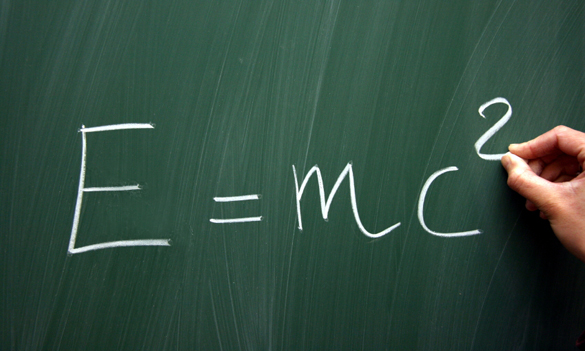
.
III. FIELD, RELATIVITY – Time, distance, relativity
Once more, the example of the moving room with outside and inside observers will be used. Again a light signal is emitted from the centre of the room and again we ask the two men what they expect to observe, assuming only our two principles and forgetting what was previously said concerning the medium through which the light travels. We quote their answers:
The inside observer: The light signal travelling from the centre of the room will reach the walls simultaneously, since all the walls are equally distant from the light source and the velocity of light is the same in all directions.
The outside observer: In my system, the velocity of light is exactly the same as in that of the observer moving with the room. It does not matter to me whether or not the light source moves in my c.s. since its motion does not influence the velocity of light. What I see is a light signal travelling with a standard speed, the same in all directions. One of the walls is trying to escape from and the opposite wall to approach the light signal. Therefore, the escaping wall will be met by the signal a little later than the approaching one. Although the difference will be very slight if the velocity of the room is small compared with that of light, the light signal will nevertheless not meet these two opposite walls, which are perpendicular to the direction of the motion, quite simultaneously.
Comparing the predictions of our two observers, we find a most astonishing result which flatly contradicts the apparently well-founded concepts of classical physics. Two events, i.e., the two light beams reaching the two walls, are simultaneous for the observer on the inside, but not for the observer on the outside. In classical physics, we had one clock, one time flow, for all observers in all c.s. Time, and therefore such words as “simultaneously”, “sooner”, “later”, had an absolute meaning independent of any c.s. Two events happening at the same time in one c.s. happened necessarily simultaneously in all other c.s.
.
In this thought experiment, the outside observer is at DL0, which is an inertia-less coordinate system. The inside observer is at, say DL150, which is a coordinate system very high on inertia scale. This is also the coordinate system of the source of light and the room. Light itself is at DL50, which is a coordinate system at the low end of the inertia scale.
The higher is the disturbance on the inertia scale the lower is its velocity. The velocity of the source (VS) is many orders of magnitudes (maybe 2100) slower than the speed of light (VL), relative to ether. Therefore, the contribution of the speed of source to the speed of light is virtually undetectable.
To the outside observer at DL0, VS would be extremely small compared to VL but not zero. To him both VS and VL shall be constant. To the inside observer at DL150, velocity of the source (VS) is zero, and the velocity of light (VL) shall appear to be the same in all directions.
Let’s look at Einstein’s thought experiment from the perspective of the Disturbance Hypothesis. Suppose the length of the room in the direction of travel is 2d and the source of light is at the center of the room. When the room is stationary, the light will travel the same distance to reach the front and back walls of the room.
Suppose the room travels to the right at a velocity VS along with the source of light and the inside observer. It travels a distance Δd in time Δd/VS. The light will still travel a distance d to the front and back walls from the perspective of the inside observer at DL150. However, it will travel a distance d+Δd to the front wall and a distance d-Δd to the back wall from the perspective of the outside observer at DL0.
From the perspective of DL0 (outside observer) the speed of light does not change. It takes slightly longer to reach the front wall than to the back wall because of the change in the distances. This shall be accounted for by the movement of the room. But from the perspective of DL150 (inside observer), who is not aware of the motion of the room, the speed of light would seem to slow down in the direction of the front wall and increase in the direction of the back wall. In reality, this difference would be undetectable because the velocity at DL150 is many orders of magnitude lower than the velocity of light at DL50.
Thus, Einstein’s conclusion that “the two light beams reaching the two walls, are simultaneous for the observer on the inside” is incorrect.
Einstein’s theory of relativity is formulated on a “matter-centric” conclusion of Michelson-Morley’s experiment that the velocity of light is constant in all coordinate systems with respect to matter. That experiment is not conclusive from the perspective of the Disturbance Hypothesis. According to this hypothesis the velocity of light is constant in the coordinate systems with respect to ether at DL0, and not to the coordinate systems with respect to matter at DL150 and above, but that difference is so small that it is practically undetectable.
.