Is Speed of Light the Real Limit?

abstract-speed-of-light

Reference: Speed of Light Essays

What is speed?

As long as a particle is moving at uniform speed, and not accelerating, any inertial frame of reference may be selected to determine its speed. The speed of the particle thus becomes arbitrary. It cannot be sensed with eyes closed because it is relative to an external reference. According to the principle of relativity, an absolute uniform speed cannot be determined because there is no absolute frame of reference.

We treat the speed of light as absolute. This appears to be an inconsistency.

The case with acceleration is different. It is a change in velocity regardless of what the velocity is. It will be the same in all inertial frames. We can sense acceleration with eyes closed. Acceleration is referenced by itself. It does not require an external reference frame.

Acceleration is absolute to the degree that it is self-referenced. 

A particle with inertia may be accelerated because it offers resistance to being pushed. But as it is accelerated, it offers less resistance to being pushed.  It then requires a greater force to accelerate it to a higher rate. In other words,

Inertia of a particle reduces as it is accelerated.

As a particle’s acceleration is increased, there comes a point when inertia has become so small that there is no resistance and nothing to push against. No available push can increase the rate of acceleration any farther. This limiting value of inertia is the same as the inertia of a photon. The inertia of a photon is so small that it cannot be accelerated.

The speed of light is uniform and constant because a photon cannot be accelerated.

The inertia of a photon is not zero because zero inertia shall correspond to infinite speed. The speed of light has a finite value because the inertia of a photon is non-zero though it is vanishingly small.

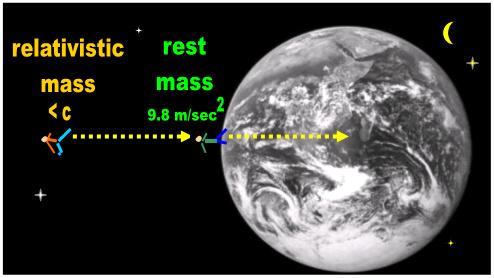
So, there is a limit to the acceleration that a particle may be subjected to. This limiting acceleration is equivalent to the “rest mass” of the particle, when it is moving at a uniform velocity and not accelerating.

The “rest mass” of a particle is the mass when it is not accelerating

The “rest mass” of a photon is zero because it cannot be accelerated from its uniform state.

So the real limit for light is the vanishing inertia.

.

SUMMARY

The limit on the speed of light is actually the limit on the acceleration to which a photon may be subjected to. In fact, photon is the limit because it has so little inertia that it cannot be accelerated. When you try to push something with no inertia, there is no resistance to push against, so there is no acceleration possible. A particle with mass may be accelerated, but as it is accelerated it requires greater and greater force to increase its acceleration. In fact there comes a point where no amount of push can accelerate it any further. That is the limiting characteristic of the photon.

So, this means that as you accelerate a particle, its inertia decreases. It keeps on decreasing with higher and higher acceleration, until it is like the inertia of a photon, and it cannot be accelerated any more. The speed of light, therefore, appears to be a limit, but that is just an appearance. The actual limit is the lack of inertia of the photon.

.

Common Core Standards

CC5
Reference: Frequently Asked Questions

The Common Core State Standards Initiative, known as Common Core, was developed by the states — with input from teachers, education experts and business leaders — and has been voluntarily adopted by 43 states and the District of Columbia.

Common Core is not a curriculum but a set of standards regarding what students should know and be able to do at each grade level in math and English language arts. How kids get there is left to the schools and teachers. The goal is more students graduate ready for college or a career.

In English language arts, the standards require certain critical content for all students, including:

  • Classic myths and stories from around the world
  • America’s founding documents
  • Foundational American literature
  • Shakespeare

The remaining crucial decisions about what content should be taught are made at the state and local levels. In addition to content coverage, the Common Core State Standards require that students systematically acquire knowledge in literature and other disciplines through reading, writing, speaking, and listening.

In mathematics, the standards lay a solid foundation in:

  • Whole numbers
  • Addition
  • Subtraction
  • Multiplication
  • Division
  • Fractions
  • Decimals

Taken together, these elements support a student’s ability to learn and apply more demanding math concepts and procedures. The middle school and high school standards call on students to practice applying mathematical ways of thinking to real-world issues and challenges.

Across the English language arts and mathematics standards, skills critical to each content area are emphasized. In particular, problem-solving, collaboration, communication, and critical-thinking skills are interwoven into the standards.

Education in a subject should be such that an educated person should be able to explain it simply to another.

.

The Scientific Frame of Reference

Reality1

Man looking out on the heavens. Woodcut from Universum by Camille Flammarion, published Paris, 1888. Monochrome version coloured by Hugo Heikenwaelder.

The “observer” of Einstein, whether it is a human or a physical instrument, is limited in its measurement by the velocity of light. Therefore, it cannot measure any velocity greater than the speed of light. The sense of space-time directly or through any instrument is similarly limited by the speed of light.

The Theory of Relativity basically acknowledges the physical perceptions to be limited by the speed of light.

However, mental perceptions are not limited by the speed of light. In order to define mental perception scientifically, let’s do the following thought experiment. Imagine being out there in the interstellar space without relying on physical perceptions. We ignore all light whether emitted from some source, or reflected by an object. This eliminates all external reference points. Now pay attention to your motion.

You could be standing still or you could be moving at the speed of light. But you will find that there is no mental perception of motion as long as it is uniform.  There is mental perception only when there is a change in motion accompanied by inertial resistance.

Mental perception seems to be related to inertial resistance.

Light that brings about physical perception of other objects is made up of changing electrical and magnetic fields. These changes are resisted by permittivity and permeability. This is a form of inertial resistance built into the very nature of light. We may refer to it as the inertia of light that is inherent. It determines the uniform motion of light.

In fact, this form of inertia is present wherever electromagnetic phenomenon is found, and that is pretty much in everything. Atoms and molecules consist of electromagnetic phenomenon and they make up all matter including the human body and brain. Thus inertia is built into the very fabric of the universe. Similar to mental perception, the physical perception also seems to based on inertia.

Physical perception seems to be related to inertia built into the fabric of the universe.

It seems that perception cannot be separated from inertia that is inherent to motion in all physical and mental phenomena. Every aspect of this universe is changing and giving rise to inertial forces at all times. This is a level of perception inherent to the universe.

This idea of perception goes far beyond what we think of as human perception and awareness. This perception is part of what is being observed. There is no separate viewpoint of the observer. The scientific method comes closest to this concept. Observation clarifies itself by looking more closely at inconsistencies.

Science is “observation” clarifying itself by looking at inconsistencies more closely.

The frame of reference of science is, therefore, the whole universe. In this frame of reference the perception is not limited by the speed of light. Science can perceive light creeping from star to star, while also perceiving the rotation of earth. Science can see the whole spectrum of motion in the universe at all times.

The Scientific frame of reference is the universe as a whole.

Once we fully understand this universal frame of reference, no other frame of reference is needed. In this frame of reference inertia determines the perception of motion and all other properties. The “uniform motion” of an object is determined by inherent inertial forces. These forces act to restore the uniform motion  whenever it is deviated from. The uniform motion of an object is not determined by the velocity of an external frame of reference.

The uniform motion of an object is determined by its inherent inertia.

All motion in this universe is continually changing. This makes the universe appear what it is. We may assume that the overall energy and momentum of the universe are conserved. This may mean that the universe, considered as a whole, is changeless. There is nothing beside the universe, so its overall properties are relative to itself only. We may assume the universe to have absolute motion of zero and infinite persistence.

The universe is inherently static and infinitely persistent.

Science may derive its sense of motion and time from the frame of reference of the universe as a whole.

.

Rest Mass in the Scientific Frame

RelMass4
Reference: The Scientific Frame of Reference

All motion and persistence in the universe is relative; nothing is at absolute rest except, maybe, the universe taken as a whole. There is no such thing as mass completely at rest. All objects naturally move at a uniform rate under their own inertia. Any departure from their uniform motion causes restorative force due to inertia.

Uniform motion simply means “absence of acceleration.” It has nothing to do with the velocity of the object, which is relative anyway. It is the mass of an object that is moving uniformly under its own inertia, which may be defined as “rest mass.”

The “rest mass” is the mass of an object that is moving at uniform speed under its own inertia.

When the uniform motion of an object is disturbed by external force, a restorative force appears due to its inertia. This inertial force acts to eliminate acceleration and restore uniform motion. This restorative inertial force, very likely, is converted inertial mass.

Thus the inertial mass of an accelerating object is less than the “rest mass,” maybe by an imperceptible amount. When the acceleration stops, the original “rest mass” is restored.

Inertial mass converts into restorative force to oppose any change in uniform motion. Thus, the inertial mass of an object reduces with acceleration.

Once we understand the universal frame of reference of the Scientific Observer, no other frame of reference is needed to explain things. Changes in inertia in this frame of reference can explain all phenomena.

The Scientific Observer is simultaneously aware of the whole universe. This awareness is not limited by the speed of light. The Scientific Observer can observe light creeping among stars. He can see earth rotating. He can see motion at all different scales.

The Scientific Observer is aware that the velocity of light in space is limited by its inertia (permittivity and permeability). . The higher is the inertia, the lower is the uniform motion of any object under its own inertia. Maybe a mathematical relationship can be worked out between inertia and uniform motion.

In this frame of reference all inertia shall interact with all other inertia. Gravity shall be a natural outcome of this interaction. It may be possible from this universal frame of reference to derive all conclusions of the Theory of Relativity.

.

Space-Time in the Scientific Frame

image_1405_1e-Sagittarius-A
Reference: The Scientific Frame of Reference

Space and time seems to vary in their characteristics with inertia of objects and particles. Therefore, we must consider space and time of objects and particles in terms of their inertia.

The primary forms of inertia are frequency (for a wave) and mass (for a particle).

In the wave-frequency form of inertia, inertial space is defined by the wavelength, and the inertial time is defined by the period of the wave.

As frequency decreases, the inertial space expands, and so does time. At the limiting frequency of zero, inertia also approaches zero. The space acts as the unlimited background of the Cosmos, against which finite extents of waves and particles could be viewed. The time also acts as the unlimited background against which the finite durations of waves and particles could be viewed.

The background of the Cosmos is characterized by unlimited extent of space and time. This background offers no inertia or resistance to change.

In the particle-mass form of inertia, the inertial space is defined by the shape, and the inertial time is defined by the duration, of the particle.

As mass increases, the inertial space contracts, and so does time. At the limiting value of infinite mass, inertia also becomes infinite. The space reduces to a point location against the background of the Cosmos. The time reduces to a completely durable state against a background that allows any change.

The content of the Cosmos is made up of waves and particles of varying extents, and durations. It offers inertia or resistance to change to various degrees.

.