Eddington 1927: Relative and Absolute Quantities

Reference: The Book of Physics

Note: The original text is provided below.
Previous / Next

Summary

.

Comments

.

Original Text

I will try to make clear the distinction between absolute and relative quantities. Number (of discrete individuals) is absolute. It is the result of counting, and counting is an absolute operation. If two men count the number of people in this room and reach different results, one of them must be wrong.

The measurement of distance is not an absolute operation. It is possible for two men to measure the same distance and reach different results, and yet neither of them be wrong.

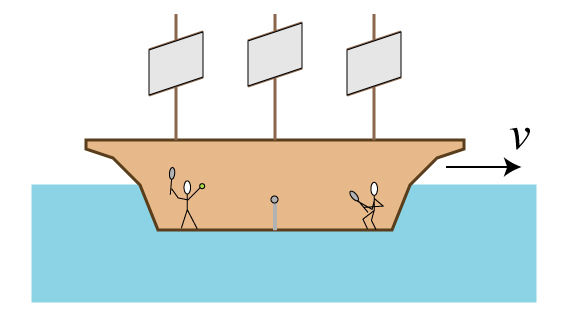
I mark two dots on the blackboard and ask two students to measure very accurately the distance between them. In order that there may be no possible doubt as to what I mean by distance I give them elaborate instructions as to the standard to be used and the precautions necessary to obtain an accurate measurement of distance. They bring me results which differ. I ask them to compare notes to find out which of them is wrong, and why? Presently they return and say: “It was your fault because in one respect your instructions were not explicit. You did not mention what motion the scale should have when it was being used.” One of them without thinking much about the matter had kept the scale at rest on the earth. The other had reflected that the earth was a very insignificant planet of which the Professor had a low opinion. He thought it would be only reasonable to choose some more important body to regulate the motion of the scale, and so he had given it a motion agreeing with that of the enormous star Betelgeuse. Naturally the FitzGerald contraction of the scale accounted for the difference of results.

I am disinclined to accept this excuse. I say severely, “It is all nonsense dragging in the earth or Betelgeuse or any other body. You do not require any standard external to the problem. I told you to measure the distance of two points on the blackboard; you should have made the motion of the scale agree with that of the blackboard. Surely it is common sense to make your measuring scale move with what you are measuring. Remember that next time.”

A few days later I ask them to measure the wavelength of sodium light—the distance from crest to crest of the light waves. They do so and return in triumphal agreement: ”The wave-length is infinite”. I point out to them that this does not agree with the result given in the book (.000059 cm.). “Yes”, they reply, “we noticed that; but the man in the book did not do it right. You told us always to make the measuring scale move with the thing to be measured. So at great trouble and expense we sent our scales hurtling through the laboratory at the same speed as the light.” At this speed the FitzGerald contraction is infinite, the metre rods contract to nothing, and so it takes an infinite number of them to fill up the interval from crest to crest of the waves.

My supplementary rule was in a way quite a good rule; it would always give something absolute—something on which they would necessarily agree. Only unfortunately it would not give the length or distance. When we ask whether distance is absolute or relative, we must not first make up our minds that it ought to be absolute and then change the current significance of the term to make it so.

Nor can we altogether blame our predecessors for having stupidly made the word “distance” mean something relative when they might have applied it to a result of spatial measurement which was absolute and unambiguous. The suggested supplementary rule has one drawback. We often have to consider a system containing a number of bodies with different motions; it would be inconvenient to have to measure each body with apparatus in a different state of motion, and we should get into a terrible muddle in trying to fit the different measures together. Our predecessors were wise in referring all distances to a single frame of space, even though their expectation that such distances would be absolute has not been fulfilled.

As for the absolute quantity given by the proposed supplementary rule, we may set it alongside distances relative to the earth and distances relative to Betelgeuse, etc., as a quantity of some interest to study. It is called “proper-distance”. Perhaps you feel a relief at getting hold of something absolute and would wish to follow it up. Excellent. But remember this will lead you away from the classical scheme of physics which has chosen the relative distances to build on. The quest of the absolute leads into the four-dimensional world.

A more familiar example of a relative quantity is “direction” of an object. There is a direction of Cambridge relative to Edinburgh and another direction relative to London, and so on. It never occurs to us to think of this as a discrepancy, or to suppose that there must be some direction of Cambridge (at present undiscoverable) which is absolute. The idea that there ought to be an absolute distance between two points contains the same kind of fallacy. There is, of course, a difference of detail; the relative direction above mentioned is relative to a particular position of the observer, whereas the relative distance is relative to a particular velocity of the observer. We can change position freely and so introduce large changes of relative direction; but we cannot change velocity appreciably—the 300 miles an hour attainable by our fastest devices being too insignificant to count. Consequently the relativity of distance is not a matter of common experience as the relativity of direction is. That is why we have unfortunately a rooted impression in our minds that distance ought to be absolute.

A very homely illustration of a relative quantity is afforded by the pound sterling. Whatever may have been the correct theoretical view, the man in the street until very recently regarded a pound as an absolute amount of wealth. But dire experience has now convinced us all of its relativity. At first we used to cling to the idea that there ought to be an absolute pound and struggle to express the situation in paradoxical statements —the pound had really become seven-and-sixpence. But we have grown accustomed to the situation and continue to reckon wealth in pounds as before, merely recognizing that the pound is relative and therefore must not be expected to have those properties that we had attributed to it in the belief that it was absolute.

You can form some idea of the essential difference in the outlook of physics before and after Einstein’s principle of relativity by comparing it with the difference in economic theory which comes from recognizing the relativity of value of money. I suppose that in stable times the practical consequences of this relativity are manifested chiefly in the minute fluctuations of foreign exchanges, which may be compared with the minute changes of length affecting delicate experiments like the Michelson-Morley experiment. Occasionally the consequences may be more sensational—a mark-exchange soaring to billions, a high-speed β particle contracting to a third of its radius. But it is not these casual manifestations which are the main outcome. Clearly an economist who believes in the absoluteness of the pound has not grasped the rudiments of his subject. Similarly if we have conceived the physical world as intrinsically constituted out of those distances, forces and masses which are now seen to have reference only to our own special reference frame, we are far from a proper understanding of the nature of things.

.

Eddington 1927: Chapter 1 Summary

Reference: The Book of Physics

Note: The original text is provided below.
Previous / Next

Summary

.

Comments

.

Original Text

This thought will be followed up in the next chapter. Meanwhile let us glance back over the arguments that have led to the present situation. It arises from the failure of our much-trusted measuring scale, a failure which we can infer from strong experimental evidence or more simply as an inevitable consequence of accepting the electrical theory of matter. This unforeseen behaviour is a constant property of all kinds of matter and is even shared by optical and electrical measuring devices. Thus it is not betrayed by any kind of discrepancy in applying the usual methods of measurement. The discrepancy is revealed when we change the standard motion of the measuring appliances, e.g. when we compare lengths and distances as measured by terrestrial observers with those which would be measured by observers on a planet with different velocity. Provisionally we shall call the measured lengths which contain this discrepancy “fictitious lengths”.

According to the Newtonian scheme length is definite and unique; and each observer should apply corrections (dependent on his motion) to reduce his fictitious lengths to the unique Newtonian length. But to this there are two objections. The corrections to reduce to Newtonian length are indeterminate; we know the corrections necessary to reduce our own fictitious lengths to those measured by an observer with any other prescribed motion, but there is no criterion for deciding which system is the one intended in the Newtonian scheme. Secondly, the whole of present-day physics has been based on lengths measured by terrestrial observers without this correction, so that whilst its assertions ostensibly refer to Newtonian lengths they have actually been proved for fictitious lengths.

The FitzGerald contraction may seem a little thing to bring the whole structure of classical physics tumbling down. But few indeed are the experiments contributing to our scientific knowledge which would not be invalidated if our methods of measuring lengths were fundamentally unsound. We now find that there is no guarantee that they are not subject to a systematic kind of error. Worse still we do not know if the error occurs or not, and there is every reason to presume that it is impossible to know.

.

L10 Considerations R/D

Reference: The L Processes

L10 Considerations R/D addresses purposes and intentions on following 43 items in the order they are listed. Make sure you have completed the Basic L10 approach before you attempt this rundown.

Purpose/Intention Lists

  1. Take a look at the following questions and select the one that appeals to you the most.
    • Who or what was (item from the list)?
    • Who or what would have been (item from the list)?
    • What past identity was (item from the list)?
    • What past identity would have been (item from the list)
  2. Use the selected question in a L&N action on an item. For example,
    • L&N: “Who or what was critical?”
  3. Handle each item on the above list in the given order as follows:
    1. L&N: “Who or what was __item__?”
    2. The correctly isolated “identity” from the L&N action will bring tremendous relief.
  4. Do the following only if there is still some attention on the “identity”.
    1. Run the O/Ws (Set 3) to unburden the identity.
    2. Run L&N to determine the purpose/intention of the identity.
      • “What is the basic purpose or intention of (identity)?”
    3. Run Date/Locate to blow the discovered purpose/intention, if evil.
  5. Continue down the list with rest of the items on the list.
  6. End the R/D when there is a major win.

.

The Laws of Thought

The fundamental law of thought is that all postulates affect each other because they are connected through understanding. More technically, one may say that all postulates are continuous, consistent and harmonious, and so is the reasoning proceeding from them. We may refer to this as the Principle of ONENESS.

An ANOMALY is any violation of the Principle of Oneness, such as, discontinuity (missing data), inconsistency (contradictory data), or disharmony (arbitrary data). The anomaly exists in how a person views the reality. Resolution of anomaly always expands one’s viewpoint and knowledge.

A person commits an OVERT (bad action) because of an anomaly in his thinking. If the person is aware on an overt, he can trace it back to an anomaly. This anomaly could be a concept that he did not understand fully; or it could be some experience that he didn’t perceive clearly. If he can resolve that anomaly then he can free himself from his regret, because he has now gained a new perception or understanding.

A person WITHHOLDS himself from acting freely because he feels he does not have certain ability. Underlying that lack of confidence are regrets long forgotten. Underlying those regrets are forgotten overts. If a person is aware of a withhold, he can trace it back to some overt and then to some anomaly in his thinking. If he can recognize and resolve that anomaly, he can regain some of his abilities.

.

L10 Overts by Dynamics Rundown

Reference: The L Processes

The L10 Overts by Dynamics R/D rundown addresses overts on each dynamic. Make sure you have completed the Basic L10 approach before you attempt this rundown.

  1. The prepared lists below outline intentions and behavior by dynamics.
  2. Assess these lists for the dynamics in descending order, starting from Dynamic 8.
    1. Go down the list of items for the dynamic.
    2. Stop at the item that you feel you have some charge on.
    3. Look at that item per The 12 Aspects of Mindfulness. Make sure you understand it.
    4. Get the earliest instance of when that overt was committed. It will produce relief.
    5. Continue going down the list this way till the end.
  3. Finish assessing the lists for each dynamic this way.

Please view these listed overts as opportunity to discover more overts of your own on each dynamic. As you resolve the considerations underlying these overts, it will strengthen and broaden your viewpoint.

.

EIGHTH DYNAMIC

  1. Have you ever doubted the truth of your religion?
  2. Have you ever desecrated a holy place? sacred object?
  3. Have you ever disobeyed God’s commandments?
  4. Have you ever failed to perform your religious duties?
  5. Have you ever neglected an opportunity to save a sinner?
  6. Have you ever been disrespectful to a holy person?
  7. Have you ever compromised your religious convictions?
  8. Have you ever attacked a religion?
  9. Have you ever tolerated a bad religion?
  10. Have you ever perverted a religion?
  11. Have you thought evil thoughts?
  12. Have you ever concealed (denied) your religion?
  13. Have you ever changed your religion?
  14. Have you ever committed a sin?
  15. Have you ever convinced others that some things are unknowable?
  16. Have you ever convinced another that there were effects he couldn’t create?
  17. Have you ever convinced another there were places he couldn’t be?
  18. Have you ever convinced another that there were Beings with whom he couldn’t communicate?
  19. Have you ever convinced another that some things cannot be communicated?
  20. Have you ever convinced another there were places he couldn’t leave?
  21. Have you ever persuaded another that he never created anything?

.

SEVENTH DYNAMIC

  1. Have you ever denied the existence of Beings?
  2. Have you ever made people believe they weren’t Beings?
  3. Have you ever persuaded others some thoughts are bad?
  4. Have you ever made a Being believe he was evil?
  5. Have you ever made another forget?
  6. Have you ever forced a beingness on another?
  7. Have you ever made another believe he was somewhere else?
  8. Have you ever made another believe he was in a different time?
  9. Have you ever made another believe he was someone else?
  10. Have you ever confused another’s memory?
  11. Have you ever persuaded another there were things he must resist?
  12. Have you ever prevented another from perceiving?
  13. Have you ever prevented another from being something?
  14. Have you ever convinced another his postulates didn’t work?
  15. Have you ever made another experience something he didn’t wish to?
  16. Have you ever convinced another that he was weak?
  17. Have you ever convinced another that he was incompetent?
  18. Have you ever convinced another that he was insane?
  19. Have you ever convinced another that he was stupid?
  20. Have you ever convinced another that he was dishonorable?
  21. Have you ever driven another insane?
  22. Have you ever enslaved another?

.

SIXTH DYNAMIC

  1. Have you ever failed to maintain a machine properly?
  2. Have you ever destroyed a useful object? beautiful object?
  3. Have you ever hid an object?
  4. Have you ever made harmful combinations of matter?
  5. Have you ever wasted metals? chemicals? inorganic materials?
  6. Have you ever misused a tool? machine?
  7. Have you ever forgotten how to build something?
  8. Have you ever perverted the use of a scientific discovery?
  9. Have you ever built something destructive?
  10. Have you ever built something that didn’t work?
  11. Have you ever made an ugly “work of art”?
  12. Have you ever put things too far apart?
  13. Have you ever put things too close together?
  14. Have you ever made a location a mystery?
  15. Have you ever misplaced something in time?
  16. Have you ever forgotten a place?
  17. Have you ever made an object mysterious?
  18. Have you ever made something vanish?
  19. Have you ever made something imperceptible?
  20. Have you ever misapplied energy?

.

FIFTH DYNAMIC

  1. Have you ever treated living creatures like objects? machines?
  2. Have you ever damaged crops?
  3. Have you ever used bad breeding stock?
  4. Have you ever eliminated good breeding stock?
  5. Have you ever crippled or killed living creatures for fun?
  6. Have you ever cut down trees without replanting?
  7. Have you ever let weeds take over cultivated areas?
  8. Have you ever failed to fertilize crops?
  9. Have you failed to provide water for livestock? crops?
  10. Have you ever put life forms to strange uses?
  11. Have you ever polluted water sources?
  12. Have you ever killed off a useful species faster than it could breed?
  13. Have you ever abused a living creature?
  14. Have you ever castrated or spayed domestic animals?
  15. Have you ever bred warped life forms?
  16. What life forms have you eaten?
  17. What life forms have you fed to other life forms?
  18. Have you ever kept a life form in an unsuitable environment?
  19. Have you ever destroyed other life forms?

.

FOURTH DYNAMIC

  1. Have you ever treated a member of your species like an animal? a machine?
  2. Have you ever made territory uninhabitable?
  3. Have you ever resigned from the human race?
  4. Have you ever pretended to be a human being?
  5. Have you ever done anything to keep mankind from uniting?
  6. Have you ever tried to exterminate a species?
  7. Have you ever pretended to be a member of a different species?
  8. Have you ever denied a species a place to live?
  9. Have you ever prevented a species form reproducing?
  10. Have you ever perverted the purpose of a species?
  11. Have you ever kept your own species ignorant?
  12. Have you ever eaten a member of your own species?
  13. Have you tried to start a war among your own species?
  14. Is there anything you’ve done to a species that would be unsafe for you to reveal?

.

THIRD DYNAMIC

  1. Have you ever joined a group without being qualified?
  2. Have you ever given a group less than you received from it?
  3. Have you ever split a group into factions?
  4. Have you ever perverted the purpose of a group?
  5. Have you ever made a group too dependent on you, and then left?
  6. Have you ever belonged to a secret society?
  7. Have you ever gone over to the other side?
  8. Have you ever been an informer?
  9. Have you ever brought your group into disrepute?
  10. Have you ever weakened your group?
  11. Have you ever been a spy?
  12. Have you ever been a double agent?
  13. Have you ever permitted your group to be wiped out?
  14. Have you ever joined a group you considered bad?
  15. Have you ever given a group bad leadership?
  16. Have you ever given a group bad service?
  17. Have you ever provided badly for your group?
  18. Have you ever made your side lose?
  19. Have you ever injured the survival of a fellow group member?
  20. Have you ever enturbulated a group?
  21. Have you ever done anything to a group?
  22. Have you ever destroyed or reduced the survival of your own group?

.

SECOND DYNAMIC

(Family)

  1. Have you ever been a disturbing element in a family?
  2. Have you ever joined a family out of revenge?
  3. Have you ever disowned a member of your family?
  4. Have you ever gotten a relative into trouble?
  5. Have you ever worked against your family?
  6. Have you ever badly raised a child?
  7. Have you failed to provide for a child of yours?
  8. Have you ever split up a family?
  9. Have you ever had a bastard?
  10. Have you ever passed off a bastard as legitimate?
  11. Have you ever claimed a blood-relationship you didn’t have ?
  12. Have you ever forced a child into an unsuitable profession?
  13. Have you ever forced a child into a loveless marriage?
  14. Have you ever interfered with an inheritance?
  15. Have you ever had a member of your family incarcerated?
  16. Have you ever had an abortion?
  17. Have you ever exposed an infant?
  18. Have you ever physically injured a relative?
  19. Have you neglected your child’s education?
  20. Have you caused hostile factions within a family?
  21. Have you ever lived parasitically on your family?

(Sex)

  1. Have you ever sexually aroused someone and then not satisfied him (her)?
  2. Have you ever been sexually aroused by an object?
  3. Have you ever aroused another sexually with an object?
  4. Have you ever made love to a person of the wrong age?
  5. Have you ever made love to a person of the wrong sex?
  6. Have you ever made love to a person of the wrong class?
  7. Have you ever made love to a person of the wrong race?
  8. Have you ever made love to a creature of the wrong species?
  9. Have you ever made love to someone who belonged to another?
  10. Have you ever taught another perverted sexual practices?
  11. Have you ever invented perverted sexual practices?
  12. Have you ever used sex unethically?
  13. Have you ever made love to a person you disliked?
  14. Have you ever used the wrong body part for intercourse?
  15. Have you ever caused someone to be castrated?
  16. Have you ever made someone’s body more exciting by warping or distorting it?
  17. Have you ever raped anyone?
  18. Have you ever failed to have intercourse with someone you should have?
  19. Have you ever had sex with a member of your own family?
  20. Have you ever made love to a person of your own sex?
  21. Is there anything about your sex life that would be unsafe to reveal?
  22. Have you ever misused sex?
  23. Have you ever withheld sex?
  24. Have you ever stood up a date?

.

FIRST DYNAMIC

  1. Have you ever denied yourself an opportunity?
  2. Is there something you haven’t let yourself have?
  3. Have you ever deliberately made someone think badly of you?
  4. Have you ever made someone punish you?
  5. Have you ever distrusted yourself?
  6. Have you ever made yourself sick?
  7. Have you ever deliberately hurt yourself?
  8. What haven’t you let yourself do?
  9. Have you ever considered anything to be “Much too good for you”?
  10. Have you ever hated yourself?
  11. Have you ever decided you were unworthy of your friends? family? job?
  12. Have you ever prevented yourself from accomplishing something?
  13. What haven’t you let yourself feel?
  14. What haven’t you let yourself think?
  15. Have you ever restrained yourself from a desired sexual experience?
  16. Is there anything you won’t let yourself eat? drink?
  17. What won’t you let yourself see? hear? touch?
  18. What won’t you let yourself understand?
  19. Have you ever attempted suicide?
  20. Have you ever misused a body part?
  21. Have you ever punished yourself?
  22. Have you ever lied to yourself?
  23. Have you ever failed to care for a body part?

.