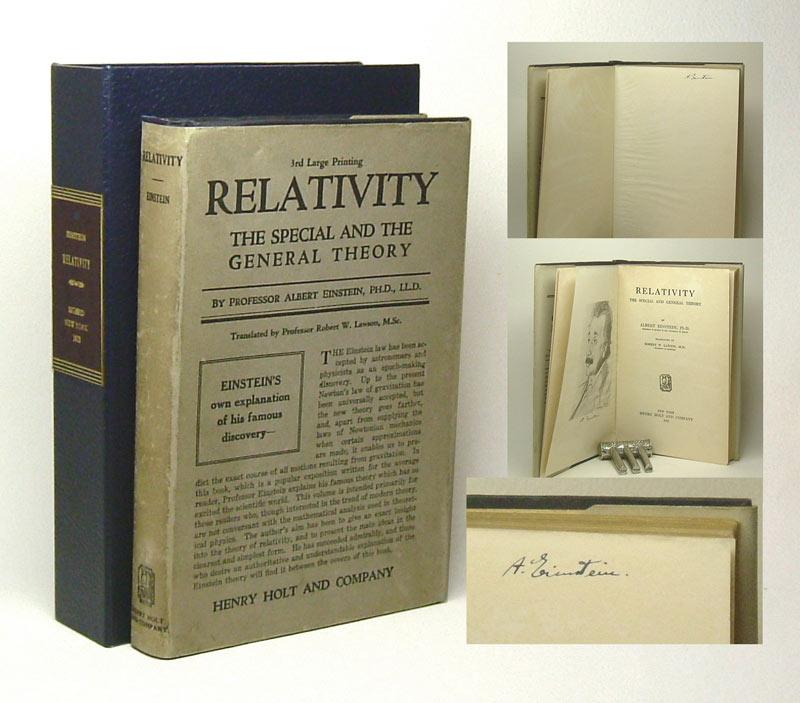
Reference: Einstein’s 1920 Book
Section IV (Part 1)
The Galileian System of Co-ordinates
Please see Section IV at the link above.
.
Summary
The Law of Inertia basically means that in the absence of external forces, a body moves without acceleration at an inherent constant velocity in a straight line.
If we use a system of co-ordinates which is rigidly attached to the earth, then, relative to this system, every fixed star describes a circle of immense radius in the course of an astronomical day. But this is opposed to the statement of the law of inertia, since the visible fixed stars have no motion or acceleration. We, therefore, conclude that the earth is actually rotating around an axis. Thus, the law of inertia also indicates the reference-bodies, or systems of co-ordinates, permissible in mechanics.
The “Galilean system of co-ordinates” is a system of co-ordinates of which the state of motion is such that the law of inertia holds relative to it. The laws of the mechanics of Galilei-Newton can be regarded as valid only for a Galilean system of co-ordinates.
.
Comments
The law of inertia is very specific about zero acceleration and the uniform velocity of the body in a straight line. However, it omits to mention anything about the magnitude of that uniform velocity.
The magnitude of the uniform velocity may depend on the mass of the body, because if the mass of the body is infinite, it cannot have inherent velocity.
.
Reference: Einstein’s 1920 Book
Section III (Part 1)
Space and Time in Classical Mechanics
Please see Section III at the link above.
.
Summary
“Space,” most likely, means a volume free of matter for a material object to exist in. The “position” of an object in that space can only be specified by referencing it from another object using the coordinate system. Thus, we always see the trajectory of a body relative to another body, and not independently.
Time is measured by the regular ticks of a clock that are standardly spaced apart. This clock is attached to the reference body. The motion of the object is determined by noting its position at every tick of the clock. The time coordinate should also take into account the time light takes in traveling from the object to the origin point on the reference body.
.
Comments
Einstein notes that the space coordinates shall be affected by the degree of rigidity of the coordinate system, and the time coordinates shall be affected by the finiteness of the velocity of light.
.
Reference: Einstein’s 1920 Book
Section II (Part 1)
The System of Co-ordinates
Please see Section II at the link above.
.
Summary
In reality, the body of reference is the rigid body with the point with which the position of an object or an event coincides. A length is correct only when it is measured directly with the use of a rigid rod of standard length.
Distance to locations that are far from the body of reference can be determined by means of optical observations according to the rules and methods laid down by Euclidean geometry, and taking into account the properties of the propagation of light.
We may apply the Cartesian system of co-ordinates to describe a position in space. Such a system shall consists of three rigid plane surfaces perpendicular to each other and rigidly attached to the body of reference. Perpendiculars can be dropped from that position to those three plane surfaces to describe it by means of three coordinates.
The measurements are generally made by indirect means as described above. However, the physical meaning of specifications of position must always be sought.
.
Comments
“Every description of events in space involves the use of a rigid body to which such events have to be referred. The resulting relationship takes for granted that the laws of Euclidean geometry hold for ‘distances’, the ‘distance’ being represented physically by means of the convention of two marks on a rigid body.” ~Einstein
.
Reference: Einstein’s 1920 Book
Section I (Part 1)
Physical Meaning of Geometrical Propositions
Please see Section I at the link above.
.
Summary
We all believe in the propositions of Euclid’s geometry with total certainty. But what is meant by the assertion that these propositions are true?
If we look closely, we note that geometry is not concerned with the relation of the ideas involved in it to objects of experience, but only with the logical connection of these ideas among themselves.
Geometrical ideas correspond to more or less exact objects in nature. This prevents geometry from attaining largest possible logical unity of structure.
When we consider the geometrical points to always correspond to points on a practically rigid body, then the rigidity of measuring instruments, such as, ruler and compass, also becomes significant. We can then treat geometry as a branch of physics.
In this sense, we find that the conviction of the “truth” of the Euclidean propositions is founded exclusively on rather incomplete experience.
.
Comments
The axioms and logic used in Euclidean geometry are idealistic rather than realistic. The distances measured in space do not maintain their exactness as geometry supposes them to. Therefore, when we use geometry to calculate distances in space, we are doing that based on incomplete experience.
.