Einstein 1938: Probability Waves

Reference: Evolution of Physics

This paper presents Chapter IV section 6 from the book THE EVOLUTION OF PHYSICS by A. EINSTEIN and L. INFELD. The contents are from the original publication of this book by Simon and Schuster, New York (1942).

The paragraphs of the original material (in black) are accompanied by brief comments (in color) based on the present understanding.  Feedback on these comments is appreciated.

The heading below is linked to the original materials.

.

Probability Waves

If, according to classical mechanics, we know the position and velocity of a given material point and also what external forces are acting, we can predict, from the mechanical laws, the whole of its future path. The sentence: “The material point has such-and-such position and velocity at such-and-such an instant,” has a definite meaning in classical mechanics. If this statement were to lose its sense, our argument (p. 32) about foretelling the future path would fail.

In the early nineteenth century, scientists wanted to reduce all physics to simple forces acting on material particles that have definite positions and velocities at any instant. Let us recall how we described motion when discussing mechanics at the beginning of our journey through the realm of physical problems. We drew points along a definite path showing the exact positions of the body at certain instants and then tangent vectors showing the direction and magnitude of the velocities. This was both simple and convincing. But it cannot be repeated for our elementary quanta of matter, that is electrons, or for quanta of energy, that is photons. We cannot picture the journey of a photon or electron in the way we imagined motion in classical mechanics. The example of the two pinholes shows this clearly. Electron and photon seem to pass through the two holes. It is thus impossible to explain the effect by picturing the path of an electron or a photon in the old classical way.

We must, of course, assume the presence of elementary actions, such as the passing of electrons or photons through the holes. The existence of elementary quanta of matter and energy cannot be doubted. But the elementary laws certainly cannot be formulated by specifying positions and velocities at any instant in the simple manner of classical mechanics.

We cannot picture the journey of a photon or electron in the way we imagined motion in classical mechanics by specifying positions and velocities at any instant.

Let us, therefore, try something different. Let us continually repeat the same elementary processes. One after the other, the electrons are sent in the direction of the pinholes. The word “electron” is used here for the sake of definiteness; our argument is also valid for photons.

The same experiment is repeated over and over again in exactly the same way; the electrons all have the same velocity and move in the direction of the two pinholes. It need hardly be mentioned that this is an idealized experiment which cannot be carried out in reality but may well be imagined. We cannot shoot out single photons or electrons at given instants, like bullets from a gun.

The outcome of repeated experiments must again be dark and light rings for one hole and dark and light stripes for two. But there is one essential difference. In the case of one individual electron, the experimental result was incomprehensible. It is more easily understood when the experiment is repeated many times. We can now say: light stripes appear where many electrons fall. The stripes become darker at the place where fewer electrons are falling. A completely dark spot means that there are no electrons. We are not, of course, allowed to assume that all the electrons pass through one of the holes. If this were so, it could not make the slightest difference whether or not the other is covered. But we already know that covering the second hole does make a difference. Since one particle is indivisible, we cannot imagine that it passes through both the holes. The fact that the experiment was repeated many times points to another way out. Some of the electrons may pass through the first hole and others through the second. We do not know why individual electrons choose particular holes, but the net result of repeated experiments must be that both pinholes participate in transmitting the electrons from the source to the screen. If we state only what happens to the crowd of electrons when the experiment is repeated, not bothering about the behaviour of individual particles, the difference between the ringed and the striped pictures becomes comprehensible. By the discussion of a sequence of experiments a new idea was born, that of a crowd with the individuals behaving in an unpredictable way. We cannot foretell the course of one single electron, but we can predict that, in the net result, the light and dark stripes will appear on the screen.

Let us leave quantum physics for the moment.

We have seen in classical physics that if we know the position and velocity of a material point at a certain instant and the forces acting upon it, we can predict its future path. We also saw how the mechanical point of view was applied to the kinetic theory of matter. But in this theory a new idea arose from our reasoning. It will be helpful in understanding later arguments to grasp this idea thoroughly.

There is a vessel containing gas. In attempting to trace the motion of every particle one would have to commence by finding the initial states, that is, the initial positions and velocities of all the particles. Even if this were possible, it would take more than a human lifetime to set down the result on paper, owing to the enormous number of particles which would have to be considered. If one then tried to employ the known methods of classical mechanics for calculating the final positions of the particles, the difficulties would be insurmountable. In principle, it is possible to use the method applied for the motion of planets, but in practice this is useless and must give way to the method of statistics. This method dispenses with any exact knowledge of initial states. We know less about the system at any given moment and are thus less able to say anything about its past or future. We become indifferent to the fate of the individual gas particles. Our problem is of a different nature. For example: we do not ask, “What is the speed of every particle at this moment?” But we may ask: “How many particles have a speed between 1000 and 1100 feet per second?” We care nothing for individuals. What we seek to determine are average values typifying the whole aggregation. It is clear that there can be some point in a statistical method of reasoning only when the system consists of a large number of individuals.

By applying the statistical method we cannot foretell the behaviour of an individual in a crowd. We can only foretell the chance, the probability, that it will behave in some particular manner. If our statistical laws tell us that one-third of the particles have a speed between 1000 and 1100 feet per second, it means that by repeating our observations for many particles, we shall really obtain this average, or in other words, that the probability of finding a particle within this limit is equal to one-third.

Similarly, to know the birth rate of a great community does not mean knowing whether any particular family is blessed with a child. It means a knowledge of statistical results in which the contributing personalities play no role.

By observing the registration plates of a great many cars we can soon discover that one-third of their numbers are divisible by three. But we cannot foretell whether the car which will pass in the next moment will have this property. Statistical laws can be applied only to big aggregations, but not to their individual members.

We can now return to our quantum problem.

The laws of quantum physics are of a statistical character. This means: they concern not one single system but an aggregation of identical systems; they cannot be verified by measurement of one individual, but only by a series of repeated measurements.

We cannot foretell the course of one single electron, but we can predict that, in the net result, the light and dark stripes will appear on the screen. For this we use the method of statistics. The laws of quantum physics are of a statistical character.

Radioactive disintegration is one of the many events for which quantum physics tries to formulate laws governing the spontaneous transmutation from one element to another. We know, for example, that in 1600 years half of one gram of radium will disintegrate, and half will remain. We can foretell approximately how many atoms will disintegrate during the next half-hour, but we cannot say, even in our theoretical descriptions, why just these particular atoms are doomed. According to our present knowledge, we have no power to designate the individual atoms condemned to disintegration. The fate of an atom does not depend on its age. There is not the slightest trace of a law governing their individual behaviour. Only statistical laws can be formulated, laws governing large aggregations of atoms.

Take another example. The luminous gas of some element placed before a spectroscope shows lines of definite wave-length. The appearance of a discontinuous set of definite wave-lengths is characteristic of the atomic phenomena in which the existence of elementary quanta is revealed. But there is still another aspect of this problem. Some of the spectrum lines are very distinct, others are fainter. A distinct line means that a comparatively large number of photons belonging to this particular wave-length are emitted; a faint line means that a comparatively small number of photons belonging to this wave-length are emitted. Theory again gives us statements of a statistical nature only. Every line corresponds to a transition from higher to lower energy level. Theory tells us only about the probability of each of these possible transitions, but nothing about the actual transition of an individual atom. The theory works splendidly because all these phenomena involve large aggregations and not single individuals.

The theory works splendidly because all these phenomena involve large aggregations and not single individuals.

It seems that the new quantum physics resembles somewhat the kinetic theory of matter, since both are of a statistical nature and both refer to great aggregations. But this is not so! In this analogy an understanding not only of the similarities but also of the differences is most important. The similarity between the kinetic theory of matter and quantum physics lies chiefly in their statistical character. But what are the differences?

If we wish to know how many men and women over the age of twenty live in a city, we must get every citizen to fill up a form under the headings “male”, “female”, and “age”. Provided every answer is correct, we can obtain, by counting and segregating them, a result of a statistical nature. The individual names and addresses on the forms are of no account. Our statistical view is gained by the knowledge of individual cases. Similarly, in the kinetic theory of matter, we have statistical laws governing the aggregation, gained on the basis of individual laws.

But in quantum physics the state of affairs is entirely different. Here the statistical laws are given immediately. The individual laws are discarded. In the example of a photon or an electron and two pinholes we have seen that we cannot describe the possible motion of elementary particles in space and time as we did in classical physics. Quantum physics abandons individual laws of elementary particles and states directly the statistical laws governing aggregations. It is impossible, on the basis of quantum physics, to describe positions and velocities of an elementary particle or to predict its future path as in classical physics. Quantum physics deals only with aggregations, and its laws are for crowds and not for individuals.

In the kinetic theory of matter, we have statistical laws governing the aggregation, gained on the basis of individual laws. Quantum physics abandons individual laws of elementary particles and states directly the statistical laws governing aggregations.

It is hard necessity and not speculation or a desire for novelty which forces us to change the old classical view. The difficulties of applying the old view have been outlined for one instance only, that of diffraction phenomena. But many others, equally convincing, could be quoted. Changes of view are continually forced upon us by our attempts to understand reality. But it always remains for the future to decide whether we chose the only possible way out and whether or not a better solution of our difficulties could have been found.

We have had to forsake the description of individual cases as objective happenings in space and time; we have had to introduce laws of a statistical nature. These are the chief characteristics of modern quantum physics.

Previously, when introducing new physical realities, such as the electromagnetic and gravitational field, we tried to indicate in general terms the characteristic features of the equations through which the ideas have been mathematically formulated. We shall now do the same with quantum physics, referring only very briefly to the work of Bohr, de Broglie, Schrodinger, Heisenberg, Dirac and Born.

Let us consider the case of one electron. The electron may be under the influence of an arbitrary foreign electromagnetic field, or free from all external influences. It may move, for instance, in the field of an atomic nucleus or it may diffract on a crystal. Quantum physics teaches us how to formulate the mathematical equations for any of these problems.

We have already recognized the similarity between an oscillating cord, the membrane of a drum, a wind instrument, or any other acoustical instrument on the one hand, and a radiating atom on the other. There is also some similarity between the mathematical equations governing the acoustical problem and those governing the problem of quantum physics. But again the physical interpretation of the quantities determined in these two cases is quite different. The physical quantities describing the oscillating cord and the radiating atom have quite a different meaning, despite some formal likeness in the equations. In the case of the cord, we ask about the deviation of an arbitrary point from its normal position at an arbitrary moment. Knowing the form of the oscillating cord at a given instant, we know everything we wish. The deviation from the normal can thus be calculated for any other moment from the mathematical equations for the oscillating cord. The fact that some definite deviation from the normal position corresponds to every point of the cord is expressed more rigorously as follows: for any instant, the deviation from the normal value is a function of the co-ordinates of the cord. All points of the cord form a one-dimensional continuum, and the deviation is a function defined in this one-dimensional continuum, to be calculated from the equations of the oscillating cord.

Analogously, in the case of an electron a certain function is determined for any point in space and for any moment. We shall call this function the probability wave. In our analogy the probability wave corresponds to the deviation from the normal position in the acoustical problem. The probability wave is, at a given instant, a function of a three-dimensional continuum, whereas, in the case of the cord the deviation was, at a given moment, a function of the one-dimensional continuum. The probability wave forms the catalogue of our knowledge of the quantum system under consideration and will enable us to answer all sensible statistical questions concerning this system. It does not tell us the position and velocity of the electron at any moment because such a question has no sense in quantum physics. But it will tell us the probability of meeting the electron on a particular spot, or where we have the greatest chance of meeting an electron. The result does not refer to one, but to many repeated measurements. Thus the equations of quantum physics determine the probability wave just as Maxwell’s equations determine the electromagnetic field and the gravitational equations determine the gravitational field. The laws of quantum physics are again structure laws. But the meaning of physical concepts determined by these equations of quantum physics is much more abstract than in the case of electromagnetic and gravitational fields; they provide only the mathematical means of answering questions of a statistical nature.

The equations of quantum physics determine the probability wave just as Maxwell’s equations determine the electromagnetic field and the gravitational equations determine the gravitational field; but the meaning of physical concepts determined by these equations of quantum physics is much more abstract.

So far we have considered the electron in some external field. If it were not the electron, the smallest possible charge, but some respectable charge containing billions of electrons, we could disregard the whole quantum theory and treat the problem according to our old pre-quantum physics. Speaking of currents in a wire, of charged conductors, of electromagnetic waves, we can apply our old simple physics contained in Maxwell’s equations. But we cannot do this when speaking of the photoelectric effect, intensity of spectral lines, radioactivity, diffraction of electric waves and many other phenomena in which the quantum character of matter and energy is revealed. We must then, so to speak, go one floor higher. Whereas in classical physics we spoke of positions and velocities of one particle, we must now consider probability waves, in a three-dimensional continuum corresponding to this one-particle problem.

Quantum physics gives its own prescription for treating a problem if we have previously been taught how to treat an analogous problem from the point of view of classical physics.

For one elementary particle, electron or photon, we have probability waves in a three-dimensional continuum, characterizing the statistical behaviour of the system if the experiments are often repeated. But what about the case of not one but two interacting particles, for instance, two electrons, electron and photon, or electron and nucleus? We cannot treat them separately and describe each of them through a probability wave in three dimensions, just because of their mutual interaction. Indeed, it is not very difficult to guess how to describe in quantum physics a system composed of two interacting particles. We have to descend one floor, to return for a moment to classical physics. The position of two material points in space, at any moment, is characterized by six numbers, three for each of the points. All possible positions of the two material points form a six-dimensional continuum and not a three-dimensional one as in the case of one point. If we now again ascend one floor, to quantum physics, we shall have probability waves in a six-dimensional continuum and not in a three-dimensional continuum as in the case of one particle. Similarly, for three, four, and more particles the probability waves will be functions in a continuum of nine, twelve, and more dimensions.

In dealing with quantum phenomenon, we cannot apply our old simple physics contained in Maxwell’s equations. We must now consider probability waves, in a three-dimensional continuum corresponding to positions and velocities of one particle. For two, three, four, and more particles the probability waves will be functions in a continuum of six, nine, twelve, and more dimensions.

This shows clearly that the probability waves are more abstract than the electromagnetic and gravitational field existing and spreading in our three-dimensional space. The continuum of many dimensions forms the background for the probability waves, and only for one particle does the number of dimensions equal that of physical space. The only physical significance of the probability wave is that it enables us to answer sensible statistical questions in the case of many particles as well as of one. Thus, for instance, for one electron we could ask about the probability of meeting an electron in some particular spot. For two particles our question could be: what is the probability of meeting the two particles at two definite spots at a given instant?

The probability waves are more abstract than the electromagnetic and gravitational field existing and spreading in our three-dimensional space. But they enable us to answer sensible statistical questions in the case of many particles as well as of one.

Our first step away from classical physics was abandoning the description of individual cases as objective events in space and time. We were forced to apply the statistical method provided by the probability waves. Once having chosen this way, we are obliged to go further toward abstraction. Probability waves in many dimensions corresponding to the many-particle problem must be introduced.

Let us, for the sake of briefness, call everything except quantum physics, classical physics. Classical and quantum physics differ radically. Classical physics aims at a description of objects existing in space, and the formulation of laws governing their changes in time. But the phenomena revealing the particle and wave nature of matter and radiation, the apparently statistical character of elementary events such as radioactive disintegration, diffraction, emission of spectral lines, and many others, forced us to give up this view. Quantum physics does not aim at the description of individual objects in space and their changes in time. There is no place in quantum physics for statements such as: “This object is so-and-so, has this-and-this property.” Instead we have statements of this kind: “There is such-and-such a probability that the individual object is so-and-so and has this-and-this property.” There is no place in quantum physics for laws governing the changes in time of the individual object. Instead, we have laws governing the changes in time of the probability. Only this fundamental change, brought into physics by the quantum theory, made possible an adequate explanation of the apparently discontinuous and statistical character of events in the realm of phenomena in which the elementary quanta of matter and radiation reveal their existence.

There is no place in quantum physics for laws governing the changes in time of the individual object. Instead, we have laws governing the changes in time of the probability. For example, “There is such-and-such a probability that the individual object is so-and-so and has this-and-this property.”

Yet new, still more difficult problems arise which have not been definitely settled as yet. We shall mention only some of these unsolved problems. Science is not and will never be a closed book. Every important advance brings new questions. Every development reveals, in the long run, new and deeper difficulties.

We already know that in the simple case of one or many particles we can rise from the classical to the quantum description, from the objective description of events in space and time to probability waves. But we remember the all-important field concept in classical physics. How can we describe interaction between elementary quanta of matter and field? If a probability wave in thirty dimensions is needed for the quantum description of ten particles, then a probability wave with an infinite number of dimensions would be needed for the quantum description of a field. The transition from the classical field concept to the corresponding problem of probability waves in quantum physics is a very difficult step. Ascending one floor is here no easy task and all attempts so far made to solve the problem must be regarded as unsatisfactory. There is also one other fundamental problem. In all our arguments about the transition from classical physics to quantum physics we used the old pre-relativistic description in which space and time are treated differently. If, however, we try to begin from the classical description as proposed by the relativity theory, then our ascent to the quantum problem seems much more complicated. This is another problem tackled by modern physics, but still far from a complete and satisfactory solution. There is still a further difficulty in forming a consistent physics for heavy particles, constituting the nuclei. In spite of the many experimental data and the many attempts to throw light on the nuclear problem, we are still in the dark about some of the most fundamental questions in this domain.

If a probability wave in thirty dimensions is needed for the quantum description of ten particles, then a probability wave with an infinite number of dimensions would be needed for the quantum description of a field. This presents a difficult problem. Further complications arise due to relativistic considerations of changing character of space and time. There is still a further difficulty in forming a consistent physics for heavy particles, constituting the nuclei.

There is no doubt that quantum physics explained a very rich variety of facts, achieving, for the most part, splendid agreement between theory and observation. The new quantum physics removes us still further from the old mechanical view, and a retreat to the former position seems, more than ever, unlikely. But there is also no doubt that quantum physics must still be based on the two concepts: matter and field. It is, in this sense, a dualistic theory and does not bring our old problem of reducing everything to the field concept even one step nearer realization.

Will the further development be along the line chosen in quantum physics, or is it more likely that new revolutionary ideas will be introduced into physics? Will the road of advance again make a sharp turn, as it has so often done in the past?

During the last few years all the difficulties of quantum physics have been concentrated around a few principal points. Physics awaits their solution impatiently. But there is no way of foreseeing when and where the clarification of these difficulties will be brought about.

The quantum physics must still be based on the two concepts of matter and field. It does not bring our old problem of reducing everything to the field concept.

.

Final Comment

The current physics assumes space and time being independent of the inertia of substance. Space as “extents” expands as inertia reduces. Time as “duration” also decreases as inertia reduces. This is the essence of relativistic phenomena.

The current physics assumes that the elementary quanta is an indivisible, dimensionless point, whose location requires a probabilistic determination. What if the elementary quanta is like a drop of water that has a finite size and which can split and combine back. The electrons and photons cannot be treated like point particles. Their actual size grows, and duration reduces, with decrease in inertia. We can no longer pinpoint their location and presence mathematically. The method of statistics hides this erroneous assumption of “point particle.” The probability approach is used because we are assuming point locations and permanent presence for particles of appreciable dimension and transient durations.

The awareness of these assumption gives physics a new direction.

.

Einstein 1938: The Waves of Matter

Reference: Evolution of Physics

This paper presents Chapter IV section 5 from the book THE EVOLUTION OF PHYSICS by A. EINSTEIN and L. INFELD. The contents are from the original publication of this book by Simon and Schuster, New York (1942).

The paragraphs of the original material (in black) are accompanied by brief comments (in color) based on the present understanding.  Feedback on these comments is appreciated.

The heading below is linked to the original materials.

.

The Waves of Matter

How can we understand the fact that only certain characteristic wave-lengths appear in the spectra of the elements?

It has often happened in physics that an essential advance was achieved by carrying out a consistent analogy between apparently unrelated phenomena. In these pages we have often seen how ideas created and developed in one branch of science were afterwards successfully applied to another. The development of the mechanical and field views gives many examples of this kind. The association of solved problems with those unsolved may throw new light on our difficulties by suggesting new ideas. It is easy to find a superficial analogy which really expresses nothing. But to discover some essential common features, hidden beneath a surface of external differences, to form, on this basis, a new successful theory, is important creative work. The development of the so-called wave mechanics, begun by de Broglie and Schrodinger, less than fifteen years ago, is a typical example of the achievement of a successful theory by means of a deep and fortunate analogy.

Our starting-point is a classical example having nothing to do with modern physics. We take in our hand the end of a very long flexible rubber tube, or a very long spring, and try to move it rhythmically up and down, so that the end oscillates. Then, as we have seen in many other examples, a wave is created by the oscillation which spreads through the tube with a certain velocity. If we imagine an infinitely long tube, then the portions of waves, once started, will pursue their endless journey without interference.

Now another case. The two ends of the same tube are fastened. If preferred, a violin string may be used. What happens now if a wave is created at one end of the rubber tube or cord? The wave begins its journey as in the previous example, but it is soon reflected by the other end of the tube. We now have two waves: one creation by oscillation, the other by reflection; they travel in opposite directions and interfere with each other. It would not be difficult to trace the interference of the two waves and discover the one wave resulting from their superposition; it is called the standing wave. The two words “standing” and “wave” seem to contradict each other; their combination is, nevertheless, justified by the result of the superposition of the two waves.

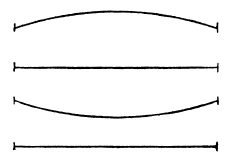
The simplest example of a standing wave is the motion of a cord with the two ends fixed, an up-and down motion, as shown in our drawing. This motion is the result of one wave lying on the other when the two are travelling in opposite directions. The characteristic feature of this motion is: only the two end-points are at rest. They are called nodes. The wave stands, so to speak, between the two nodes, all points of the cord reaching simultaneously the maxima and minima of their deviation.

But this is only the simplest kind of a standing wave. There are others. For example, a standing wave can have three nodes, one at each end and one in the centre. In this case three points are always at rest. A glance at the drawings shows that here the wave-length is half as great as the one with two nodes. Similarly, standing waves can have four, five, and more nodes. The wavelength in each case will depend on the number of nodes. This number can only be an integer and can change only by jumps. The sentence “the number of nodes in a standing wave is 3.576″—is pure nonsense. Thus the wave-length can only change discontinuously. Here, in this most classical problem, we recognize the familiar features of the quantum theory. The standing wave produced by a violin player is, in fact, still more complicated, being a mixture of very many waves with two, three, four, five, and more nodes and, therefore, a mixture of several wave-lengths. Physics can analyse such a mixture into the simple standing waves from which it is composed. Or, using our previous terminology, we could say that the oscillating string has its spectrum, just as an element emitting radiation. And, in the same way as for the spectrum of an element, only certain wave-lengths are allowed, all others being prohibited.

We have thus discovered some similarity between the oscillating cord and the atom emitting radiation. Strange as this analogy may seem, let us draw further conclusions from it and try to proceed with the comparison, once having chosen it. The atoms of every element are composed of elementary particles, the heavier constituting the nucleus, and the lighter the electrons. Such a system of particles behaves like a small acoustical instrument in which standing waves are produced.

Yet the standing wave is the result of interference between two or, generally, even more moving waves. If there is some truth in our analogy, a still simpler arrangement than that of the atom should correspond to a spreading wave. What is the simplest arrangement? In our material world, nothing can be simpler than an electron, an elementary particle, on which no forces are acting, that is, an electron at rest or in uniform motion. We could guess a further link in the chain of our analogy: electron moving uniformly → waves of a definite length. This was de Broglie’s new and courageous idea.

It was previously shown that there are phenomena in which light reveals its wave-like character and others in which light reveals its corpuscular character. After becoming used to the idea that light is a wave, we found, to our astonishment, that in some cases, for instance in the photoelectric effect, it behaves like a shower of photons. Now we have just the opposite state of affairs for electrons. We accustomed ourselves to the idea that electrons are particles, elementary quanta of electricity and matter. Their charge and mass were investigated. If there is any truth in de Broglie’s idea, then there must be some phenomena in which matter reveals its wave-like character. At first, this conclusion, reached by following the acoustical analogy, seems strange and incomprehensible. How can a moving corpuscle have anything to do with a wave? But this is not the first time we have faced a difficulty of this kind in physics. We met the same problem in the domain of light phenomena.

Fundamental ideas play the most essential role in forming a physical theory. Books on physics are full of complicated mathematical formulae. But thought and ideas, not formulae, are the beginning of every physical theory. The ideas must later take the mathematical form of a quantitative theory, to make possible the comparison with experiment. This can be explained by the example of the problem with which we are now dealing. The principal guess is that the uniformly moving electron will behave, in some phenomena, like a wave. Assume that an electron or a shower of electrons, provided they all have the same velocity, is moving uniformly. The mass, charge, and velocity of each individual electron are known. If we wish to associate in some way a wave concept with a uniformly moving electron or electrons, our next question must be: what is the wave-length? This is a quantitative question and a more or less quantitative theory must be built up to answer it. This is indeed a simple matter. The mathematical simplicity of de Broglie’s work, providing an answer to this question, is most astonishing. At the time his work was done, the mathematical technique of other physical theories was very subtle and complicated, comparatively speaking. The mathematics dealing with the problem of waves of matter is extremely simple and elementary but the fundamental ideas are deep and far-reaching.

Previously, in the case of light waves and photons, it was shown that every statement formulated in the wave language can be translated into the language of photons or light corpuscles. The same is true for electronic waves. For uniformly moving electrons, the corpuscular language is already known. But every statement expressed in the corpuscular language can be translated into the wave language, just as in the case of photons. Two clues laid down the rules of translation. The analogy between light waves and electronic waves or photons and electrons is one clue. We try to use the same method of translation for matter as for light. The special relativity theory furnished the other clue. The laws of nature must be invariant with respect to the Lorentz and not to the classical transformation. These two clues together determine the wave-length corresponding to a moving electron. It follows from the theory that an electron moving with a velocity of, say, 10,000 miles per second, has a wave-length which can be easily calculated, and which turns out to lie in the same region as the X-ray wave-lengths. Thus we conclude further that if the wave character of matter can be detected, it should be done experimentally in an analogous way to that of X-rays.

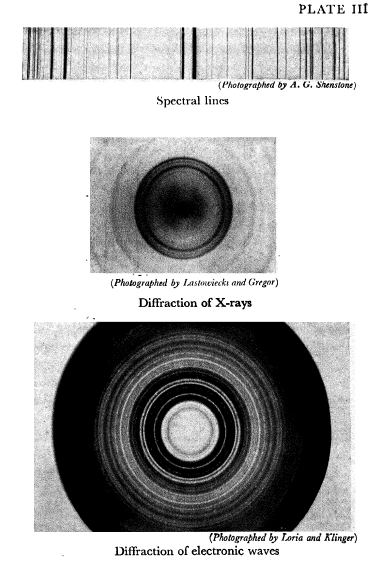
Imagine an electron beam moving uniformly with a given velocity, or, to use the wave terminology, a homogeneous electronic wave, and assume that it falls on a very thin crystal, playing the part of a diffraction grating. The distances between the diffracting obstacles in the crystal are so small that diffraction for X-rays can be produced. One might expect a similar effect for electronic waves with the same order of wave-length. A photographic plate would register this diffraction of electronic waves passing through the thin layer of crystal. Indeed, the experiment produces what is undoubtedly one of the great achievements of the theory: the phenomenon of diffraction for electronic waves. The similarity between the diffraction of an electronic wave and that of an X-ray is particularly marked as seen from a comparison of the patterns in Plate III. We know that such pictures enable us to determine the wave-lengths of X-rays. The same holds good for electronic waves. The diffraction pattern gives the length of a wave of matter and the perfect quantitative agreement between theory and experiment confirms the chain of our argument splendidly.

Our previous difficulties are broadened and deepened by this result. This can be made clear by an example similar to the one given for a light wave. An electron shot at a very small hole will bend like a light wave. Light and dark rings appear on the photographic plate. There may be some hope of explaining this phenomenon by the interaction between the electron and the rim, though such an explanation does not seem to be very promising. But what about the two pinholes? Stripes appear instead of rings. How is it possible that the presence of the other hole completely changes the effect? The electron is indivisible and can, it would seem, pass through only one of the two holes. How could an electron passing through a hole possibly know that another hole has been made some distance away?

We asked before: what is light? Is it a shower of corpuscles or a wave? We now ask: what is matter, what is an electron? Is it a particle or a wave? The electron behaves like a particle when moving in an external electric or magnetic field. It behaves like a wave when diffracted by a crystal. With the elementary quanta of matter we came across the same difficulty that we met with in the light quanta. One of the most fundamental questions raised by recent advance in science is how to reconcile the two contradictory views of matter and wave. It is one of those fundamental difficulties which, once formulated, must lead, in the long run, to scientific progress. Physics has tried to solve this problem. The future must decide whether the solution suggested by modern physics is enduring or temporary.orary.

.

Final Comment

.

OT 1948: The “Laws” of Returning

Reference: DIANETICS: The Original Thesis

This paper presents Chapter 16 from the book DIANETICS: THE ORIGINAL THESIS by L. RON HUBBARD. The contents are from the original publication of this book by The Hubbard Dianetic Foundation, Inc. (1948).

The paragraphs of the original material (in black) are accompanied by brief comments (in color) based on the present understanding.  Feedback on these comments is appreciated.

The heading below is linked to the original materials.

.

The “Laws” of Returning

By aberration is meant the aberree’s reactions to and difficulties with his current environment.

By somatic is meant any physical or physically sensory abnormality which the preclear manifests generally or sporadically in his environment, or any such manifestation encountered and re-experienced during auditing.

The aberration is the mental error caused by engrams and the somatic is the physical error occasioned by the same source.

According to Dianetics, the source of all aberrations and somatics are engrams.

The auditor follows the general rule that no aberrations or somatics exist in a subject which cannot be accounted for by engrams. He may ordinarily be expected to discover that anything which reduces the physical or mental perfection of the subject is engramic. He applies this rule first and in practice admits no organic trouble of any character. Only when he has obviously obtained a Clear and when he has observed and has had that Clear medically examined after a period of sixty days to six months from the end of auditing should he be content to assign anything to organic origin. He cannot be expected to know until the final examination exactly what somatic was not engramic. In other words he must persistently adhere to one line of thought (that the preclear can be brought to mental and physical perfection) before he resigns any mental or physical error in the preclear to a purely organic category. Too little is known at this writing of the recoverability of the mind and body for a dianeticist to deny that ability to recover. Since primary research, considerable practice has demonstrated that this ability to reconstruct and recover is enormous, far beyond anything previously conceived possible.

Dianetics assumes that all psychiatric and medical problems arise from engrams only. Therefore, it does not recommend any medical or psychiatric treatment. Exceptions are medical treatments for obvious injuries like cuts, broken bones, etc.

Essentially, the Dianetic thesis is saying that the aberrated electric signals from the mind bring about aberrated chemical changes in the body; and the focus should be on fixing the aberrated electric signals.

Dianetics accounts for all faith healing phenomena on an entirely scientific basis and the dianeticist can expect himself to consort daily in his practice with what appear to be miracles.

In addition to knowledge of his subject, considerable intelligence and imagination, and a personality which inspires confidence, the dianetic auditor must possess persistency to a remarkable degree. In other words, his drives must be phenomenally high. There is no substitute for the auditor’s having been cleared. It is possible for an individual to operate with Dianetics without having been released and he may do so for some time without repercussion, but as he audits he will most certainly encounter the perceptics contained in some of his own engrams time after time until these engrams are so restimulated that he will become mentally or physically ill.

When an auditor is handling the auditee, it is basically a mind handling another mind. It is difficult for an aberrated mind to handle the aberrations of the mind. So, the auditor must somehow prevent his own aberrated circuits from getting activated while trying to fix another mind’s aberrated circuits.

In psychoanalysis it was possible for the analyst to escape this fate because he dealt primarily with locks occurring in the post-speech life. The analyst might even experience relief from operating on patients since it might clarify his own locks which always had been more or less completely available to his analytical mind. This is very far from the case with the dianeticist who handles continually the vital and highly charged data which cause physical and mental aberrations. An auditor in Dianetics may work with impunity for a very short time only before his own condition demands that he himself be audited. While this is aside from the main subject of auditing, it has been too often observed to be neglected.

Very often the auditor’s aberrated circuits get activated when addressing the aberrated circuits of the auditee. This is a problem often observed in Dianetics. It is a problem observed in most professions dealing with the mind. It mainly manifests itself as sexual abuse. Look at the Catholic Church.

Every engram possesses some quality which denies it to the analytical mind. There are several types. First there is the “denyer” engram which contains the species of phrase, “Frank will never know about this,” “Forget it!” “Cannot remember it!” and so forth. Second is the self-invalidating engram which contains the phrases, “Never happened,” “Can’t believe it,” “Wouldn’t possibly imagine it,” and so on.

Third is the “bouncer” engram which contains the species of phrase, “Can’t stay here,” “Get out!” and other phrases which will not permit the preclear to remain in its vicinity but return him to present time. A fourth is the “holder” engram which contains “Stay here,” “Hold still,” “Can’t get out,” and so on.

These are four of the general types which the dianeticist will find occasion him the greatest difficulty. The type of phrase being encountered, however, is easily diagnosed from preclear reaction.

There are many other types of engrams and phrases which will be encountered. There is the self-perpetuating engram which implies that, “It will always be this way,” and “It happens all the time.” The auditor will soon learn to recognize them, forming lists of his own.

An aberrated mind cannot fully identity similar aberrations in another mind. For the same reason, a mind cannot identify its own aberrations. Therefore, Dianetics uses repetition of certain “engramic phrases” used by the auditee to, hopefully, bring up the engramic incident.

An engram would not be an engram unless it had strong compulsive or repressive data contained in it. All engrams are self-locking to some degree, being well off the time track and touching it slightly, if at all, with some minor and apparently innocuous bit of information which the analytical mind disregards as unimportant. Classed with the denyer variety are those phrases which deny perception of any kind. The dianetic auditor will continually encounter perception denial and will find it one of the primary reasons the preclear cannot recall and articulate the engram. “Can’t see,” “Can’t hear,” “Can’t feel,” and “Isn’t alive” tend to deny the whole engram containing any such phrases.

Dianetics thesis views “engramic phrases” as hypnotic commands that need to be defused by uncovering the moment when they were received.

As the engram is a powerful surcharge of physical pain, it will without any phrases whatsoever deny itself to the analytical mind which, in seeking to scan the engram, is repelled by the operating principle that it must avoid pain for the organism. As has already been covered, there are five ways the organism can handle a source of pain. It can neglect it, attack it, succumb to it, flee from it, or avoid it. As the entire organism handles exterior pain sources, so does the analytical mind tend to react to engrams. There is an exterior world reaction of the organism to pain sources then. This is approximated when the analytical mind is addressed in regard to engrams. There is an excellent reason for this. Everything contained in the reactive mind is exterior source material. The analytical mind went out of circuit and was recording imperfectly if at all in the time period when the exterior source was entered into the reactive mind.

Dianetics points out that there are five ways the organism can handle a source of pain—neglect it, attack it, succumb to it, flee from it, or avoid it. The dianetic procedure attacks the engram. This requires facing the pain of the engram.

An analytical mind when asked to approach an engram reacts as it would have had it been present, which is to say, in circuit, at the moment when the engram was being received. Therefore, an artificial approach to the engram must be made which will permit the auditor to direct the subject’s analytical mind into but one source of action: Attack.

The actual incident must be located and re-experienced. In that the analytical mind has five possible ways of reacting to the engram and in that the auditor desires that only one of these—attack—be used, the preclear must be persuaded from using the remaining four.

Then mental matrix was overwhelmed when the engram was received. It has been overwhelmed by the irrational actions of the engram since. The dianetic solution is to push through the pain to locate and re-experience the engram. This has led to many difficulties.

On this general principle can be created many types of approach to the problem of obtaining a Clear. The one which is offered in this manual is that one which has met with quicker and more predictable results than others researched at this time. It has given, in use, one hundred per cent results. In the beginning, at this time, an auditor should not attempt to stray far from this offered technique. He should attempt to vary it only when he himself has had extensive and sufficient practice which will enable him to be very conversant with the nature of engrams. Better techniques will undoubtedly be established which will provide swifter exhaustion of the reactive mind. The offered technique has produced results in all types of cases so far encountered.

The technique offered in THE ORIGINAL THESIS requires cleverly using Dianetic phrases to access and re-experience the engrams. This technique requires lot of skill and is limited in its scope. It only gets the low hanging fruits. The researcher, however, is overly optimistic.

There are three equations which demonstrate how and why the auditor and preclear can reach engrams and exhaust them:

I.          The auditor’s dynamics are equal to or less than the engramic surcharge in the preclear.

II.         The preclear’s dynamics are less than the engramic surcharge.

III.        The auditor’s dynamics plus the preclear’s dynamics are greater than the engramic surcharge.

When the preclear’s dynamics are entirely or almost entirely reduced, as in the case of amnesia trance, drug trances and so forth, the auditor’s dynamics are not always sufficient to force the preclear’s analytical mind into an attack upon the engram.

Only the auditee can handle his aberrations. The auditor can do no more than support him.

The auditor’s dynamics directed against an engram in a preclear who has not been subjected to a process which will inhibit the free play of his reactive mind and concentrate it, ordinarily provokes the preclear into one of the four unusable methods of succumbing, fleeing, avoiding or neglecting the engram. Demanding that the preclear “face reality,” or “see reason,” or that he “stop his foolish actions” falls precisely into this category. The auditor’s dynamics operating against an awake preclear can produce an “insanity break,” temporary or of considerable duration in the preclear.

You cannot force the auditee to resolve his irrationality.

When the preclear is in reverie some of his own dynamics are present and the auditor’s dynamics added to these make a combination sufficient to overcome the engramic surcharge.

If the auditor releases his dynamics against the analytical mind of the preclear, which is to say, the person of the preclear, while an attempt is being made to reach an engram (in violation of the auditor’s code, or with some erroneous idea that the whole person of the preclear is confronting him) he will receive in return all the fury of the engramic surcharge.

The auditee is, at least, restraining his engram from dramatizing itself. That restrain may go away if the auditor gets upset with the auditee.

An engram can be dramatized innumerable times, for such is the character of the reactive mind that the surcharge of the engram cannot exhaust itself and will not exhaust itself regardless of its age or the number of times dramatized until it has been approached by the analytical mind of the subject.

The additive dynamic drive law must be made to apply before engrams are reached. It is occasionally very necessary to change dianetic auditors, for some preclears will work well only with either a male or a female auditor, or with one or another individual auditor. This will not be found necessary in many cases. Three cases are on record where the preclear was definitely antipathetic toward the auditor throughout the entire course of auditing. The dianeticist was found to be a restimulator for one or more of the persons contained in the engrams. Even so, these persons responded. Greater patience was required on the part of the auditor. Closer observance of the auditor’s code was necessary and a longer time was required for auditing. It will be discovered that once the preclear understands what is desired of him and why, his basic personality is aroused to the extent that it will cooperate with any auditor in order to be free. It will suffer through many violations of the auditor’s code. Once a preclear has started his auditing he will ordinarily continue to cooperate in the major requirements to the fullest extent, no matter what apparent antagonisms he may display in minor matters.

In Dianetics, if the auditor is not the right one for the auditee the auditing may not work or progress may become very slow.

Reverie is a method that has been used with success. The analytical mind of the preclear, while reduced in its potential and under direction, is still capable of thinking its own thoughts and forming its own opinions. Implicit obedience to whatever the auditor suggests is not desirable as the preclear will inject extraneous material at the faintest suggestion of the auditor. Drugs inhibit the somatic and have no use in entering a case.

Regression reduces the minds ability to think its own thoughts. Drugs inhibit the somatic.

The fact that the dianeticist is interested solely in what has been done to the preclear and is not at all interested in what the preclear himself has done to others greatly facilitates auditing since there is no social disgrace in having been an unwitting victim.

Dianetics only looks at what has been done to the person.

In reverie the preclear is placed in a light state of “concentration” which is not to be confused with hypnosis. In the state of alliance, therefore, the mind of the preclear will be found to be, to some degree, detachable from his surroundings and directed interiorly. The first thing that the dianeticist will discover in most preclears is aberration of the sense of time. There are various ways that he can circumvent this and construct a time track along which he can cause the preclear’s mind to travel. Various early experiences which are easily reached are examined and an early diagnosis can be formed. Then begins an immediate effort to reach basic, with attempted abortion or prenatal accident predominating. Failures on the first attempts to reach prenatal experiences should not discourage the dianetic auditor since many hours may be consumed and many false basics reached and exhausted before the true prenatal basic is attained.

In Dianetics, the auditor puts the person in reverie and sends him back on the time track and examines various early experiences. After that he makes immediate effort to reach the basic.

In this type of reverie the dianeticist can use and will observe certain apparently natural laws in force. They are as follows: The difficulties the analytical mind encounters when returned to or searching for an engram are identical to the command content of that engram.

An aberree in adult life is more or less obeying, as restimulated, the composite experiences contained in his engrams.

The preclear’s behavior in reverie is regulated by the commands contained in the engram to which he is returned and is modified by the composite of chronologically preceding engrams on his time track.

The somatics of a preclear are at their highest in an engram where they were received and at the moment of reception in that experience.

When returned to a point prior to an engram, the commands and somatics of that engram are not effective on the preclear. As he is returned to the moment of an engram, the preclear experiences, as the common denominator of all engrams, a considerable lessening of his analytical potential. He speaks and acts in a modified version of the engram. All complaints he makes to the auditor should be regarded as possibly being verbatim from, first, the engram that he is re-experiencing or, second, from prior engrams.

At the precise moment of an engramic command the preclear experiences obedience to that command. The emotion a preclear experiences when regressed to an engram is identical to the emotional tone of that engram. Excesses of emotion will be found to be contained in the word content of the engram as commands.

Dianetics thesis is that a person is generally behaving hypnotically as dictated by his engrams. Such hypnotic behavior increases when he is returned in auditing and approaches his engrams. He speaks and acts in a modified version of the engram. The somatics are highest when he accesses the engram.

When a preclear is returned to before the moment of reception of an engram he is not subject to any part of that engram, emotionally, aberrationally, or somatically.

When the time track is found to contain loops or is blurred in any portion, its crossings or confusions are directly attributable to engramic commands which precisely state the confusion.

Any difficulty a preclear may experience with returning, reaching engrams, perceiving, or recounting, is directly and precisely commanded by engrams.

An engram would not be an engram were it easy to reach or if it gave the preclear no difficulty and contained no physical pain.

Dianetics believes that engram can be located by moving the auditee up and down on his time track, but even this may become confused by engramic commands. The auditor may guess the engramic commands by observing this confusion.

The characteristic of engrams is confusion. First, the confusion of the time track; second, the confusion of an engramic chain wherein similar words or somatics mix incidents; third, confusion of incidents with engrams.

This confusion is occasioned by the disconnected state of the analytical mind during the receipt of the engram. Auditing by location and identification of hidden incidents, first rebuilds at least the early part of the time track, locates and fixes engrams in relation to one another in time, and then locates the basic of the basic chain and exhausts it. The remainder of the chain must also be exhausted. Other engrams and incidents exhaust with ease after the erasure of the basic or the basic of any chain (within that chain). Locks vanish without being located. A tone four gained on basic permits the subsequent erasure on the time track to go forward with ease. A whole chain may rise to four without the basic chain having been located.

Dianetics believes that once the basic engram is contacted and relieved, the rest of the chain of aberration can be relieved much easily. However, in practice this is relative and not absolute.

Any perception of pre-speech life during reverie denotes the existence of engramic experience as far back as the time track is open.

Photographic memory of early moments of one’s life means that there could be engrams hidden in those moments.

If the individual’s general tone is clearly not tone four, if he is still interested in his engrams, another more basic chain than the one found still exists.

When a person has no engrams his attention will be totally extroverted. He will be rationally considering broader problems beyond himself.

Engramic patterns tend to form an avoidance pattern for the preclear. From basic outward there is an observable and progressive divergence between the person himself and his returned self. In the basic engram of the basic chain and for a few subsequent incidents on that chain, he will be found within and receiving the experiences as himself. In subsequent incidents cleavage is observable, and in late engrams the preclear is found to be observing the action from outside of himself, almost as a disinterested party. This forms the principal primary test for the basic of the basic chain. Another test for basic is “sag.”

In Dianetics, a person recounts the incident after being returned to it. But if he is recounting the incident without experiencing it, it won’t produce any positive and permanent results.

Any engram may be exhausted to a point where it will recede without reaching tone four. Although it is temporarily and momentarily lost to the individual and apparently does not trouble him, that engram which has been exhausted in a chain without the basic having been reached will “sag” or reappear within twenty-four to sixty hours. Basic on any chain will not “sag” but will lift on a number of recountings, rise to tone four and will remain erased. Another test for basic is whether or not it begins to lift with ease. If an engram does not intensify or remain static after many recountings, it can be conceived to be at least a basic on some chain. Locks will lift and disappear without returning as they are not fixed by physical pain. Large numbers of locks can be exhausted bringing an alleviation of the preclear’s difficulties and such a course may occasionally be pursued in the entrance of a case. The discovery and lifting of the basic to which the locks are appended removes the locks automatically.

The Dianetic procedure is all about accessing engramic incidents and recounting them. Upon recounting the engram disappears only when it is experienced and its contents assimilate into the mental matrix. Many a time this does not happen.

These rules and laws even if modified in their statement will be found invariable. Incompetent auditing cannot be excused by the supposed discovery of a special case or exception. A physical derangement must be in the category of actually missing parts of the organism which cause permanent disability, and instances of this are not common.

This Dianetic thesis seems to blame the lack of success in applying the dianetic procedure to incompetent auditing, which does not fully understand these laws.

.

Final Comments

KEY WORDS: Laws of Returning

This Dianetic procedure needs to be examined closely if its application does not produce results in the hands of others. Apparently, the author of this thesis is able to produce results where others run into difficulty. In my observation, many difficulties arise because of the violation of the gradient in approaching the engram.

According to the laws of returning, the analytical awareness starts to shut down as one approaches the engram, and the thinking increasingly dramatizes the content of the engram. The person is not aware of this change but the auditor is. The auditor is then required to navigate the auditee through it skillfully.

According to the thesis, the auditor’s dynamic assists the auditee’s dynamic in overcoming the effects of the laws of returning. But in practice, the auditor takes over the awareness of the auditee instead of assisting it. Even the use of E-meter brings awareness to the auditor only. The auditee is simply being told what to do, and he is never in command of himself while approaching the engram. He mechanically obeys either the engram or the auditor.

Only the auditee can handle his aberrations. The auditor can only support, encourage and guide him but he can’t approach and assimilate the engram for the auditee. The only solution is for the auditee to remain in control of his awareness while approaching the engram and assimilating its content. This requires the auditee to overcome the effects of the law of returning. Can he approach and assimilate the contents of the engram without returning?

It is important to remember that Hubbard was an expert hypnotist and he thought in terms of returning. So, he may not have even considered the possibility of neutralizing the short-circuiting of the mental matrix by the engram without returning.

In hypnotism, the hypnotist installs a hypnotic command. That command can be neutralized by recalling the moment that command was installed. Hypnotist can easily do it because he knows when he installed that command. But the situation is very different in life. One suspects that there is a painful incident, which installed an engram in the mind but nothing is known about it. Engram is not like a simple hypnotic command. It has many tentacles reaching into many logic circuits of the mental matrix. Its relationship with the mind is much more complex compared to that of a simple hypnotic command.

The dianetic approach is to attack the source of pain (the engram). It tries to push through the pain to locate and re-experience the engram. It neglects the very many and much finer relationships that need to be straightened out in the process of neutralizing the engram. Thus it violates the principle of gradient. The more the gradient is violated, the more forceful is the reaction of the engram. The laws of returning are simply the result of violating the gradient. There are no such laws in play when the engram is approached on a gradient.

The mindfulness approach allows the engram to unwind itself through free association on its own natural gradient. The auditee simply focuses on the aberration that is bothering him. He examines that aberration in detail. He lets all data that comes up associate non-judgmentally in the context of that aberration. He watches objectively the reactions and even strong emotions that come up. He lets all such reactions run out as they may. He doesn’t interfere even when the awareness seems to attenuate as in falling asleep. These are contents of the engramic node getting released to the mental matrix.

It does not matter what the auditee has done or what has been done to him. He does not guess or search for the contents of the engram. If a phrase is running around in his head he simply focuses on it. He experiences whatever comes up without resisting. He may be supported, encouraged and guided by a mindfulness auditor. But it is the auditee’s dynamic that lies behind this free association. Using the gradient of free association any engram can be reached safely and easily.

The Dianetic thesis seems to blame any lack of success on incompetent auditing. It is noted that a proper procedure would be effective and easy to apply at the same time. Hopefully, the mindfulness auditing approach shall be able to overcome the difficulties that have plagued the dianetic procedure.

The out-gradient in dianetic procedure ends up in the auditor taking over the awareness of the auditee instead of assisting it. This seems to have become ingrained so much so that the auditee is expected to submit to the dictates of the organization delivering auditing. This organization is presently the “Church of Scientology”, which closely monitors all its parishioners and expects them to comply with its “code of ethics”. It keeps them in line through a system of reward and punishment. Anyone who rebels against the control of the Church is declared a “potential trouble source” or a “suppressive person”.

Fortunately, with mindfulness approach one can audit oneself to great improvement. He can then help others get started with their auditing. Only this way can a grass roots movement be started which is up to meeting the demands of the society.

.

Einstein 1938: Light Spectra

Reference: Evolution of Physics

This paper presents Chapter IV section 4 from the book THE EVOLUTION OF PHYSICS by A. EINSTEIN and L. INFELD. The contents are from the original publication of this book by Simon and Schuster, New York (1942).

The paragraphs of the original material (in black) are accompanied by brief comments (in color) based on the present understanding.  Feedback on these comments is appreciated.

The heading below is linked to the original materials.

.

Light Spectra

We already know that all matter is built of only a few kinds of particles. Electrons were the first elementary particles of matter to be discovered. But electrons are also the elementary quanta of negative electricity. We learned furthermore that some phenomena force us to assume that light is composed of elementary light quanta, differing for different wave-lengths. Before proceeding we must discuss some physical phenomena in which matter as well as radiation plays an essential role.

The sun emits radiation which can be split into its components by a prism. The continuous spectrum of the sun can thus be obtained. Every wave-length between the two ends of the visible spectrum is represented. Let us take another example. It was previously mentioned that sodium when incandescent emits homogeneous light, light of one colour or one wave-length. If incandescent sodium is placed before the prism, we see only one yellow line. In general, if a radiating body is placed before the prism, then the light it emits is split up into its components, revealing the spectrum characteristic of the emitting body.

The discharge of electricity in a tube containing gas produces a source of light such as seen in the neon tubes used for luminous advertisements. Suppose such a tube is placed before a spectroscope. The spectroscope is an instrument which acts like a prism, but with much greater accuracy and sensitiveness; it splits light into its components, that is, it analyses it. Light from the sun, seen through a spectroscope, gives a continuous spectrum; all wave-lengths are represented in it. If, however, the source of light is a gas through which a current of electricity passes, the spectrum is of a different character. Instead of the continuous, multi-coloured design of the sun’s spectrum, bright, separated stripes appear on a continuous dark background. Every stripe, if it is very narrow, corresponds to a definite colour or, in the language of the wave theory, to a definite wavelength. For example, if twenty lines are visible in the spectrum, each of them will be designated by one of twenty numbers expressing the corresponding wavelength. The vapours of the various elements possess different systems of lines, and thus different combinations of numbers designating the wave-lengths composing the emitted light spectrum. No two elements have identical systems of stripes in their characteristic spectra, just as no two persons have exactly identical finger-prints. As a catalogue of these lines was worked out by physicists, the existence of laws gradually became evident, and it was possible to replace some of the columns of seemingly disconnected numbers expressing the length of the various waves by one simple mathematical formula.

All that has just been said can now be translated into the photon language. The stripes correspond to certain definite wave-lengths or, in other words, to photons with a definite energy. Luminous gases do not, therefore, emit photons with all possible energies, but only those characteristic of the substance. Reality again limits the wealth of possibilities.

Atoms of a particular element, say, hydrogen, can emit only photons with definite energies. Only the emission of definite energy quanta is permissible, all others being prohibited. Imagine, for the sake of simplicity, that some element emits only one line, that is, photons of a quite definite energy. The atom is richer in energy before the emission and poorer afterwards. From the energy principle it must follow that the energy level of an atom is higher before emission and lower afterwards, and that the difference between the two levels must be equal to the energy of the emitted photon. Thus the fact that an atom of a certain element emits radiation of one wave-length only, that is photons of a definite energy only, could be expressed differently: only two energy levels are permissible in an atom of this element and the emission of a photon corresponds to the transition of the atom from the higher to the lower energy level.

But more than one line appears in the spectra of the elements, as a rule. The photons emitted correspond to many energies and not to one only. Or, in other words, we must assume that many energy levels are allowed in an atom and that the emission of a photon corresponds to the transition of the atom from a higher energy level to a lower one. But it is essential that not every energy level should be permitted, since not every wave-length, not every photon-energy, appears in the spectra of an element. Instead of saying that some definite lines, some definite wave-lengths, belong to the spectrum of every atom, we can say that every atom has some definite energy levels, and that the emission of light quanta is associated with the transition of the atom from one energy level to another. The energy levels are, as a rule, not continuous but discontinuous. Again we see that the possibilities are restricted by reality.

It was Bohr who showed for the first time why just these and no other lines appear in the spectra. His theory, formulated twenty-five years ago, draws a picture of the atom from which, at any rate in simple cases, the spectra of the elements can be calculated and the apparently dull and unrelated numbers are suddenly made coherent in the light of the theory.

Bohr’s theory forms an intermediate step toward a deeper and more general theory, called the wave or quantum mechanics. It is our aim in these last pages to characterize the principal ideas of this theory. Before doing so, we must mention one more theoretical and experimental result of a more special character.

Our visible spectrum begins with a certain wavelength for the violet colour and ends with a certain wave-length for the red colour. Or, in other words, the energies of the photons in the visible spectrum are always enclosed within the limits formed by the photon energies of the violet and red lights. This limitation is, of course, only a property of the human eye. If the difference in energy of some of the energy levels is sufficiently great, then an ultraviolet photon will be sent out, giving a line beyond the visible spectrum. Its presence cannot be detected by the naked eye; a photographic plate must be used.

X-rays are also composed of photons of a much greater energy than those of visible light, or in other words, their wave-lengths are much smaller, thousands of times smaller in fact, than those of visible light.

But is it possible to determine such small wavelengths experimentally? It was difficult enough to do so for ordinary light. We had to have small obstacles or small apertures. Two pinholes very near to each other, showing diffraction for ordinary light, would have to be many thousands of times smaller and closer together to show diffraction for X-rays.

How then can we measure the wave-lengths of these rays? Nature herself comes to our aid.

A crystal is a conglomeration of atoms arranged at very short distances from each other on a perfectly regular plan. Our drawing shows a simple model of the structure of a crystal. Instead of minute apertures, there are extremely small obstacles formed by the atoms of the element, arranged very close to each other in absolutely regular order. The distances between the atoms, as found from the theory of the crystal structure, are so small that they might be expected to show the effect of diffraction for X-rays. Experiment proved that it is, in fact, possible to diffract the X-ray wave by means of these closely packed obstacles disposed in the regular three-dimensional arrangement occurring in a crystal.

Suppose that a beam of X-rays falls upon a crystal and, after passing through it, is recorded on a photographic plate. The plate then shows the diffraction pattern. Various methods have been used to study the X-ray spectra, to deduce data concerning the wavelength from the diffraction pattern. What has been said here in a few words would fill volumes if all theoretical and experimental details were set forth. In Plate III we give only one diffraction pattern obtained by one of the various methods. We again see the dark and light rings so characteristic of the wave theory. In the centre the non-diffracted ray is visible. If the crystal were not brought between the X-rays and the photographic plate, only the light spot in the centre would be seen. From photographs of this kind the wave-lengths of the X-ray spectra can be calculated and, on the other hand, if the wave-length is known, conclusions can be drawn about the structure of the crystal.

.

Final Comment

From the center of the atom to the periphery, the energy levels decrease, or the wavelengths increase with the increasing radius. This gives an idea of the structure of an atom. The mass or inertia is decreasing along the radius of an atom from the center to the periphery.

.

OT 1948: Prenatal, Birth and Infant Engrams

Reference: DIANETICS: The Original Thesis

This paper presents Chapter 15 from the book DIANETICS: THE ORIGINAL THESIS by L. RON HUBBARD. The contents are from the original publication of this book by The Hubbard Dianetic Foundation, Inc. (1948).

The paragraphs of the original material (in black) are accompanied by brief comments (in color) based on the present understanding.  Feedback on these comments is appreciated.

The heading below is linked to the original materials.

.

Prenatal, Birth and Infant Engrams

The human mind and the human anatomy are enormously more powerful and resilient than has commonly been supposed. Only incidents of the greatest magnitude in physical pain and hostile content are sufficient to aberrate a mind.

It takes quite a shock to aberrate the mind.

The ability of the mind to store data can scarcely be overrated. In early life before sound is analyzed as speech a human being receives and stores exact impressions of everything which occurs. At some future date, when similar perceptics are encountered, the reactive mind re-analyzes—on the basis of identities only—the content of the early mind. This becomes the foundation of the post-conception personality. The actual personality in the individual is powerful and very difficult to aberrate. Unlike animals which can be driven mad by minor mechanisms of experimental psychology, a man must be most severely handled before he begins to show any signs of derangement. That derangement proceeds from the ability of the reactive mind to store perceptions from the earliest moments of existence and retain them on either the analytical or the reactive plane for future reference.

The mental matrix originates from DNA like all other aspects of a human baby. Exact impressions do not exist in the mental matrix as that takes more storage. Exact impressions exist only in perceptions before they get assimilated in the mental matrix as perceptual elements. This assimilation minimizes storage by storing only the original of each perceptual element. New associations of these perceptual elements are made with later experiences and, thus, new meanings are acquired by older perceptions. The personality of the person develops as the mental matrix develops.

The basic personality does not proceed from engrams, and the dynamics of the individual are impeded not enhanced by engrams. The dynamics are entirely separate and are as native to the individual as his basic personality, of which they are a part.

The basic personality of the individual, and his dynamics, are the expressions of the assimilated mental matrix.

Information falls into two categories: the educational or experience level, banked and available to the analytical mind on at least its deeper levels; and aberrational, or data stored in the reactive mind and often used but never reached by the analytical mind, save through auditing. There would seem to be two types of recording. The first is cellular recording in which the cells would seem to store data. In that cells in procreating become themselves again—which is to say that when cell A divides, both halves are still cell A—cellular intelligence is not lost. Personal identity is duplicated. In the case of individual men, procreation is far more complex and individual identity is lost—the son is not the father but a genetic composite of vast numbers of ancestors.

The assimilated matrix contains nodes of unassimilated shocks. Circuits passing through such nodes are influenced more by the singular content of the shock than by the logic of the assimilated matrix. This mental matrix extends into the cellular matrix of the person. Combinations of it are passed to successive generations through DNA.

The cells of the human being shortly after conception are capable of enormous perceptic and retentive power. After a very short time in the womb, the brain and nervous system are already operating. From then until birth the human being is apparently capable of computations of a rather complex nature on the analytical mind level. Far more certainly he retains information on the reactive level.

The mental matrix starts forming soon after conception, and continues to develop during the prenatal period in the womb.

Fear, pain, and unconsciousness extend the range of perception of the individual. When the human being in the womb is injured his senses extend so as to record sounds outside the mother’s body. He records them so well that their precise nature is stored for future reference. The human being in the womb responds exactly as it does after birth to the receipt of engrams, storing the data with precision and reacting to it.

Many perceptions (sound, pressure, etc.) from outside the womb reach the rapidly developing mental-cellular matrix and become part of it, especially when there is shock and injury.

The repair facilities available to a human being before birth are greatly enhanced by the presence of ample connective tissue, oxygen and sustenance. These repair facilities are unimaginably great so that a prenatal human being can be severely torn and ripped without becoming structurally deficient. It does, however, receive engrams and these are subject to restimulation. In many cases of attempted abortions it was found that large sections of the prenatal human being’s brain could apparently be injured without the brain being deficient or even scarred after birth. These repair facilities do not however lessen the extreme severity of the engrams which can be received by the prenatal human being. The word foetus is dropped at this point and it is advised that it should be dropped from the language as a description of a pre-birth human being. Insufficient evidence is at hand to make an outright declaration that attempted abortions are responsible for the bulk of our criminal and insane aberrees. But according to the cases at hand the attempted abortion must be accounted responsible for the majority.

Hubbard, in his research, found many instances of engrams from the prenatal period generated by attempted abortions.

The attempted abortion is the most serious aberration producer. So exact is the recording of the pre-birth human being that the reactive mind makes no errors in recognizing its enemies after birth. The mind becomes aberrated in having to depend upon these same enemies for the ordinary sustenance of life while the child is a helpless infant. The diagnosis of a prenatal case is relatively simple. Nearly all preclears will be found to have at least one prenatal engram and the case will not solve unless that prenatal is reached and exhausted.

The dianeticist can usually establish the attempted abortion preclear by an investigation of the conduct of the infant and child. Uneasiness or unhappiness in the home, a feeling of not being wanted, unreasonable fear, and a strong attachment to grandparents or another non-parental member of the household are often signs of an attempted abortion. Fear of the dark is usually but not always a part of the attempted abortion case. The auditor should suspect an abortion attempt in every preclear he audits, at least for this next generation. Whether or not the preclear disbelieves the diagnosis is of no importance to the auditor as the prenatal engrams may very well contain the words, “Can’t believe it.” The parents themselves, as well as society, mislead the individual as to the enormous prevalence of this practice at this time. The attempted abortion preclear may not be discovered to be such until considerable auditing has already been done. Any auditing done on an attempted abortion preclear, unless it is solely addressed to making the case workable, is wasted until the attempted abortions are reached.

The post-birth aberree presents a somewhat different case than the prenatal since his case can be entered at any point and the earliest moments of it can be attained easily. This is not true of the attempted abortion preclear. Attempted abortions may run to any number. Since they are easily the most prevalent dramatization of engrams in the society, they are repeated time and again. The auditor will find it necessary to “unstack” the prenatal period. He will ordinarily reach the latest prenatal injury first. As he finds and examines it, it places itself on the time track. By going to earlier and earlier attempts, more and more of these engrams are revealed until at last the earliest is discovered. The auditor must be prepared to spend many hours of hard work in unstacking injuries. He will many times believe that he has reached the basic of that engram chain only to discover that another type of abortion was attempted prior to that moment. He need not address these engrams for any length of time before he goes on to the earlier one. He should only get some idea of them so that they will be easily locatable on the return. The basic engram on the attempted abortion case may be found shortly after the first missed period of the mother.

Its emotion will be exactly that of the person or persons attempting to perform the abortion. The prenatal human being identifies himself with himself but an adult returned to the prenatal period is reinterpreting the data and will find that he has and is confusing himself with other people associated in the attempts. This engramic data may have slumbered for years before it became violently restimulated and may indeed never have been awakened. It must be removed, however, before a release can be obtained. The auditor should be prepared to unstack fifty or more incidents before birth if necessary.

The mindfulness approach may work better than the dianetic approach in case of pre-natal engrams too.

When he is at last in the vicinity of the basic, even the most skeptical preclear (one who has skepticism as part of the prenatal engram chains) will have no further question as to what is happening to him. The auditor should be prepared to encounter difficulty in the ability of the preclear to hear voices or feel pain, as it is quite common for the engramic content to contain such phrases as “Unconscious” and “Can’t see, can’t feel, can’t hear,” this having been the misconception of the society regarding prenatal life.

The auditor should never be appalled at the damage the prenatal human being has received and so question the validity of his preclear’s data. Unless the umbilical cord is severed or the heart is stopped it is apparently the case that no damage, particularly in the earlier months, is too great for the organism to reconstruct. In that parents performing abortions are usually dramatizing attempted abortions which have been performed on them, rationality of content in the engrams should not be expected. Even the data given for it by the abortionist father, mother or professional is often entirely inaccurate.

The test of an engram is whether or not it will lift and whether or not the somatics which accompanied it disappear and a tone four is obtained. Rearranging data into other sequences will not obtain this. The exact content must be brought out. The attempted abortion human being is often struck unconscious by the earliest part of each attempt since the head is so available to the knitting needles, hat pins, orange-wood sticks, buttonhooks, and so forth which are employed. These periods of unconsciousness must be penetrated and will quite ordinarily release slowly.

The number of prenatal engrams should not particularly appall the auditor for when the basic has been discovered and a tone four achieved, the succeeding experiences will lift with greater and greater ease. The periods of consciousness interspersed between the prenatal engrams, being locks, will vanish.

In the mindfulness approach, the auditor and the auditee let the mind freely associate without much significance given to the nature of data.

Birth is in itself a severe experience and is recorded by the human being from the first moments of pain throughout the entire experience. Everything in a birth is engramic since the human being conceives the ministrations to be more or less antagonistic when they are accompanied by so much pain. A birth must be lifted as a matter of course but not until the presence or absence of prenatals has been established. Even after birth has been lifted, prenatals should be looked for, since prenatals may often be found only after birth has been exhausted. The habits of obstetricians, the presence of sound and speech in the delivery room, the swabbing of an infant’s nostrils, the examination of its mouth, the severe treatment administered to start its breathing and the drops on the eyes may account in themselves for many psychosomatic ills. A cough, however, although it is present in birth and seems to be alleviated by the exhaustion of the birth engram, is quite ordinarily blood running down the throat of the prenatal during an attempted abortion. Any perception during birth, when difficulty is encountered with breathing, may become a restimulator for asthma. Clean fresh air and electric lights may cause allergies and may be the principal restimulators. Everything said during birth, as well as everything said during prenatal experiences, is recorded in the reactive mind and acts as aberrational matter which can and does cause psychological and physiological changes in the individual. Because the parents are not greatly in evidence at birth, this experience may not be restimulated for many years. Prenatals, on the other hand, restimulate more easily.

Birth is a painful experience that may result in an engramic node.

Infant life is very sentient. Delay in learning to talk is delay in learning the complexity of handling vocal muscles rather than an inability to record. Everything in infant life is recorded and the engrams received in it are extremely valid.

The auditor will find himself dealing mainly with prenatal, birth, and infant life. The cases are very rare which have many important basics in childhood or adult life. These last periods contain mainly other engrams which, though they must be addressed to create the release, should not engage much initial attention on the part of the dianeticist. Most of the experiences of mental anguish in childhood and adult life are founded on very early engrams and are locks which are almost self-removing.

Most aberrated nodes come about from the very early part of life.

Moments of unconsciousness which contain physical pain and conceived antagonism lying in childhood and adult life are serious and can produce aberration. Engram chains complete with basic may be found which will, all by themselves, exhaust.

.

Final Comments

KEY WORDS: DNA, Prenatals, Birth

This information is important from the viewpoint of Dianetic procedure, because that procedure always looks for an earlier painful experience on the time track, when it runs into difficulty with auditing. But in mindfulness approach any such data, when it exists, is automatically included in the free association. It is, however, good to know that such data exists and its assimilation is important for case resolution.

.