Reference: The Book of Scientology
Cycle of Action
Please see the original section at the link above.
.
Summary
A cycle is a series of events that are regularly repeated in the same order. For a person, this is a cycle of havingness, when it has to do with a series of conclusions, understandings or accomplishments. But havingness does not necessarily imply fixation as it happens with identification. As long as a person does not identify himself with his conclusion, understanding or accomplishment then he is not controlled by the cycle associated with the MEST universe.
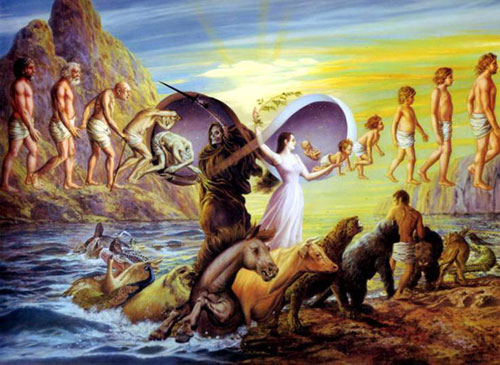
Therefore, having possessions does not necessarily subject a person to time; though the possessions themselves, being MEST objects, are subject to time. The cycle of MEST object may be stated as: creation, growth, conservation, decay and death or destruction. A cycle may be defined in terms of the motion of an object as: start, change, stop; or in terms of experience as: creation, alteration and destruction.
Past, present and future are connected to a person through his identification with body, self, family, society, postulates, goals, etc. The body goes through the stages of creation, growth, conservation, decay and death. This determines a life cycle. He may be connected with a past life cycle through his identification with the facsimiles that are carried forward from one life cycle to the next.
Hubbard talks about a person having lived through “spirals.” These spirals also go through the stages of creation, growth, conservation, decay and death. Hubbard claims that the present spirals are about 40,000 years long. Such “spirals” may be due to the person identifying himself with a postulate or a goal.
.
Comments
The conclusions, understanding, accomplishments, possessions, objects etc., go through cycles. Therefore, they are subject to time. When a person becomes attached to these MEST objects, he conceives himself also to be subject to time. From this identification springs a person’s fixation on self.
.