SCHOPENHAUER: The Man

Reference: The Story of Philosophy

This paper presents Chapter VII Section 2 from the book THE STORY OF PHILOSOPHY by WILL DURANT. The  contents are from the 1933 reprint of this book by TIME INCORPORATED by arrangement with Simon and Schuster, Inc.

The paragraphs of the original material (in black) are accompanied by brief comments (in color) based on the present understanding.

.

II. The Man

Schopenhauer was born at Dantzig on February 22, 1788. His father was a merchant noted for ability, hot temper, independence of character, and love of liberty. He moved from Dantzig to Hamburg when Arthur was five years old, because Dantzig lost its freedom in the annexation of Poland in 1798. Young Schopenhauer, therefore, grew up in the midst of business and finance; and though he soon abandoned the mercantile career into which his father had pushed him, it left its mark upon him in a certain bluntness of manner, a realistic turn of mind, a knowledge of the world and of men; it made him the antipodes of that closet or academic type of philosopher whom he so despised. The father died, apparently by his own hand, in 1805. The paternal grandmother had died insane. 

Young Schopenhauer grew up in the midst of business and finance; and it left its mark upon him in a certain bluntness of manner, a realistic turn of mind, a knowledge of the world and of men.

“The character or will,” says Schopenhauer, “is inherited from the father; the intellect from the mother.” The mother had intellect—she became one of the most popular novelists of her day—but she had temperament and temper too. She had been unhappy with her prosaic husband; and when he died she took to free love, and moved to Weimar as the fittest climate for that sort of life. Arthur Schopenhauer reacted to this as Hamlet to his mother’s re-marriage; and his quarrels with his mother taught him a large part of those half-truths about women with which he was to season his philosophy. One of her letters to him reveals the state of their affairs: “You are unbearable and burdensome, and very hard to live with; all your good qualities are over-shadowed by your conceit, and made useless to the world simply because you cannot restrain your propensity to pick holes in other people.” So they arranged to live apart; he was to come only to her “at homes,” and be one guest among others; they could then be as polite to each other as strangers, instead of hating each other like relatives. Goethe, who liked Mme. Schopenhauer because she let him bring his Christiane with him, made matters worse by telling the mother that her son would become a very famous man; the mother had never heard of two geniuses in the same family. Finally, in some culminating quarrel, the mother pushed her son and rival down the stairs; whereupon our philosopher bitterly informed her that she would be known to posterity only through him. Schopenhauer quitted Weimar soon afterward; and though the mother lived twenty-four years more, he never saw her again. Byron, also a child of 1788, seems to have had similar luck with his mother. These men were almost by this circumstance doomed to pessimism; a man who has not known a mother’s love—and worse, has known a mother’s hatred—has no cause to be infatuated with the world.

Schopenhauer had a difficult time with his mother who took to free love after his father died. He never knew a mother’s love and ended up breaking his relationship with her. This doomed him to pessimism.

Meanwhile Schopenhauer had gone through “gymnasium” and university, and had learned more than was on their schedules. He had his fling at love and the world, with results that affected his character and his philosophy. He became gloomy, cynical, and suspicious; he was obsessed with fears and evil fancies; he kept his pipes under lock and key, and never trusted his neck to a barber’s razor; and he slept with loaded pistols at his bedside—presumably for the convenience of the burglar. He could not bear noise: “I have long held the opinion,” he writes, ”that the amount of noise which anyone can bear undisturbed stands in inverse proportion to his mental capacity, and may therefore be regarded as a pretty fair measure of it. … Noise is a torture to all intellectual people. … The superabundant display of vitality which takes the form of knocking, hammering, and tumbling things about, has proved a daily torment to me all my life long.” He had an almost paranoiac sense of unrecognized greatness; missing success and fame, he turned within and gnawed at his own soul. 

His education, relations and experiences turned Schopenhauer into a  gloomy, cynical, and suspicious man. He became obsessed with fears and evil fancies. He could not bear noise. He had an almost paranoiac sense of unrecognized greatness.

He had no mother, no wife, no child, no family, no country. “He was absolutely alone, with not a single friend; and between one and none there lies an infinity.” Even more than Goethe he was immune to the nationalistic fevers of his age. In 1813 he so far fell under the sway of Fichte’s enthusiasm for a war of liberation against Napoleon, that he thought of volunteering, and actually bought a set of arms. But prudence seized him in time; he argued that “Napoleon gave after all only concentrated and untrammeled utterance to that self-assertion and lust for more life which weaker mortals feel but must perforce disguise.” Instead of going to war he went to the country and wrote a doctor’s thesis in philosophy. 

Schopenhauer was absolutely alone without family, friends and country. He wanted to volunteer in a war of liberation against Napoleon; instead he went to the country and wrote a doctor’s thesis in philosophy.

After this dissertation On the Fourfold Root of Sufficient Reason (1813),* Schopenhauer gave all his time, and devoted all his power, to the work which was to be his masterpiece—The World as Will and Idea. He sent the MS. to the publisher magna cum laude; here, he said, was no mere rehash of old ideas, but a highly coherent structure of original thought, “clearly intelligible, vigorous, and not without beauty”; a book ”which would hereafter be the source and occasion of a hundred other books.” All of which was outrageously egotistic, and absolutely true. Many years later Schopenhauer was so sure of having solved the chief problems of philosophy that he thought of having his signet ring carved with an image of the Sphinx throwing herself down the abyss, as she had promised to do on having her riddles answered.

*Schopenhauer insists, hardly with sufficient reason, and almost to the point of salesmanship, that this book must be read before the World all Will and idea can be understood. The reader may nevertheless rest content with knowing that the “principle of sufficient reason” is the “law of cause and effect,” in four forms: 1-Logical, as the determination of conclusion by premises; 2-Physical, as the determination of effect by cause; 3-Mathematical, as the determination of structure by the laws of mathematics and mechanics; and 4-Moral, as the determination of conduct by character. 

Schopenhauer was outrageously egotistic in promoting his work to the point of salesmanship. He was sure of having solved the chief problems of philosophy.

Nevertheless, the book attracted hardly any attention; the world was too poor and exhausted to read about its poverty and exhaustion. Sixteen years after publication Schopenhauer was informed that the greater part of the edition had been sold as waste paper. In his essay on Fame, in “The Wisdom of Life,” he quotes, with evident allusion to his masterpiece, two remarks of Lichtenberger’s: ”Works like this are as a mirror: if an ass looks in you cannot expect an angel to look out”; and “when a head and a book come into collision, and one sounds hollow, is it always the book?” Schopenhauer goes on, with the voice of wounded vanity: “The more a man belongs to posterity—in other words, to humanity in general—so much the more is he an alien to his contemporaries; for since his work is not meant for them as such, but only in so far as they form part of mankind at large, there is none of that familiar local color about his productions which would appeal to them.” And then he becomes as eloquent as the fox in the fable: ”Would a musician feel flattered by the loud applause of an audience if he knew that they were nearly all deaf, and that to conceal their infirmity he saw one or two persons applauding? And what would he say if he discovered that those one or two persons had often taken bribes to secure the loudest applause for the poorest player?”—In some men egotism is a compensation for the absence of fame; in others, egotism lends a generous cooperation to its presence. 

Schopenhauer’s book attracted hardly any attention. This wounded his vanity.

So completely did Schopenhauer put himself into this book that his later works are but commentaries on it; he became Talmudist to his own Torah, exegete to his own Jeremiads. In 1836 he published an essay On the Will in Nature, which was to some degree incorporated into the enlarged edition of The World as Will and Idea which appeared in 1844. In 1841 came The Two Ground-Problems of Ethics, and in 1851 two substantial volumes of Parerga et Paralipomena—literally, “By-products and Leavings”—which have been translated into English as the Essays. For this, the most readable of his works, and replete with wisdom and wit, Schopenhauer received, as his total remuneration, ten free copies. Optimism is difficult under such circumstances. 

Schopenhauer’s later works are but commentaries on his main book, “The World as Will and Idea.” Even though all his works were brilliant, he hardly got compensated for them.

Only one adventure disturbed the monotony of his studious seclusion after leaving Weimar. He had hoped for a chance to present his philosophy at one of the great universities of Germany; the chance came in 1822, when he was invited to Berlin as privat-docent. He deliberately chose for his lectures the very hours at which the then mighty Hegel was scheduled to teach; Schopenhauer trusted that the students would view him and Hegel with the eyes of posterity. But the students could not so far anticipate, and Schopenhauer found himself talking to empty seats. He resigned, and revenged himself by those bitter diatribes against Hegel which mar the later editions of his chef-d’oeuvre. In 1831 a cholera epidemic broke out in Berlin; both Hegel and Schopenhauer fled; but Hegel returned prematurely, caught the infection, and died in a few days. Schopenhauer never stopped until he reached Frankfort, where he spent the remainder of his seventy-two years. 

Schopenhauer invited to Berlin as privat-docent. He deliberately chose for his lectures the very hours at which the then mighty Hegel was scheduled to teach; and he found himself talking to empty seats.

Like a sensible pessimist, he had avoided that pitfall of optimists—the attempt to make a living with the pen. He had inherited an interest in his father’s firm, and lived in modest comfort on the revenue which this brought him. He invested his money with a wisdom unbecoming a philosopher. When a company in which he had taken shares failed, and the other creditors agreed to a 70% settlement, Schopenhauer fought for full payment, and won. He had enough to engage two rooms in a boarding-house; there he lived the last thirty years of his life, with no comrade but a dog. He called the little poodle Atma (the Brahmins’ term for the World-Soul), but the wags of the town called it “Young Schopenhauer.” He ate his dinners, usually, at the Englischer Hof. At the beginning of each meal he would put a gold coin upon the table before him; and at the end of each meal he would put the coin back into his pocket. It was, no doubt, an indignant waiter who at last asked him the meaning of this invariable ceremony. Schopenhauer answered that it was his silent wager to drop the coin into the poor-box on the first day that the English officers dining there should talk of anything else than horses, women, or dogs.

Schopenhauer did not attempt to make a living with the pen. He had inherited an interest in his father’s firm, and lived in modest comfort on the revenue which this brought him. 

The universities ignored him and his books, as if to substantiate his claim that all advances in philosophy are made outside of academic walls. “Nothing,” says Nietzsche, “so offended the German savants as Schopenhauer’s unlikeness to them.” But he had learned some patience; he was confident that, however belated, recognition would come. And at last, slowly, it came. Men of the middle classes—lawyers, physicians, merchants—found in him a philosopher who offered them no mere pretentious jargon of metaphysical unrealities, but an intelligible survey of the phenomena of actual life. A Europe disillusioned with the ideals and efforts of 1848 turned almost with acclamation to this philosophy that had voiced the despair of 1815. The attack of science upon theology, the socialist indictment of poverty and war, the biological stress on the struggle for existence,—all these factors helped to lift Schopenhauer finally to fame. 

The universities ignored Schopenhauer and his books, but belated recognition did come from men of the middle classes. They found in him a philosopher who offered them no mere pretentious jargon of metaphysical unrealities, but an intelligible survey of the phenomena of actual life.

He was not too old to enjoy his popularity: he read with avidity all the articles that appeared about him; he asked his friends to send him every bit of printed comment they could find—he would pay the postage. In 1854 Wagner sent him a copy of Der Ring der Nibelugen, with a word in appreciation of Schopenhauer’s philosophy of music. So the great pessimist became almost an optimist in his old age; he played the flute assiduously after dinner, and thanked Time for ridding him of the fires of youth. People came from all over the world to see him; and on his seventieth birthday, in 1858, congratulations poured in upon him from all quarters and every continent.

Schopenhauer was not too old to enjoy his popularity. So the great pessimist became almost an optimist in his old age.

It was not too soon; he had but two more years to live. On September 21, 1860, he sat down alone to breakfast, apparently well. An hour later his landlady found him still seated at the table, dead. 

Schopenhauer passed away peacefully, seated at his breakfast table, at age 72.

.

SCHOPENHAUER: The Age

Reference: The Story of Philosophy

This paper presents Chapter VII Section 1 from the book THE STORY OF PHILOSOPHY by WILL DURANT. The  contents are from the 1933 reprint of this book by TIME INCORPORATED by arrangement with Simon and Schuster, Inc.

The paragraphs of the original material (in black) are accompanied by brief comments (in color) based on the present understanding.

.

I. The Age

Why did the first half of the nineteenth century lift up, as voices of the age, a group of pessimistic poets—Byron in England, De Musset in France, Heine in Germany, Leopardi in Italy, Pushkin and Lermontof in Russia; a group of pessimistic composers—Schubert, Schumann, Chopin, and even the later Beethoven (a pessimist trying to convince himself that he is an optimist); and above all, a profoundly pessimistic philosopher—Arthur Schopenhauer?

Schopenhauer represents an age of pessimism—the first half of the nineteenth century.

That great anthology of woe, The World as Will and Idea, appeared in 1818. It was the age of the “Holy” Alliance. Waterloo had been fought, the Revolution was dead, and the “Son of the Revolution” was rotting on a rock in a distant sea. Something of Schopenhauer’s apotheosis of Will was due to that magnificent and bloody apparition of the Will made flesh in the little Corsican; and something of his despair of life came from the pathetic distance of St. Helena—Will defeated at last, and dark Death the only victor of all the wars. The Bourbons were restored, the feudal barons were returning to claim their lands, and the pacific idealism of Alexander had unwittingly mothered a league for the suppression of progress everywhere. The great age was over. “I thank God,” said Goethe, “that I am not young in so thoroughly finished a world.” . 

The great Age of Reason was over with the French Revolution, and monarchy was being restored.

All Europe lay prostrate. Millions of strong men had perished; millions of acres of land had been neglected or laid waste; everywhere on the Continent life had to begin again at the bottom, to recover painfully and slowly the civilizing 

economic surplus that had been swallowed up in war. Schopenhauer, traveling through France and Austria in 1804, was struck by the chaos and uncleanliness of the villages, the wretched poverty of the farmers, the unrest and misery of the towns. The passage of the Napoleonic and counter-Napoleonic armies had left scars of ravage on the face of every country. Moscow was in ashes. In England, proud victor in the strife, the farmers were ruined by the fall in the price of wheat; and the industrial workers were tasting all the horrors of the nascent and uncontrolled factory-system. Demobilization added to unemployment. “I have heard my father say,” wrote Carlyle, “that in the years when oatmeal was as high as ten shillings a stone, he had noticed the laborers retire each separately to a brook, and there drink instead of dining, anxious only to hide their misery from one another.” Never had life seemed so meaningless, or so mean. 

The wars had left devastation and misery all around Europe and England.

Yes, the Revolution was dead; and with it the life seemed to have gone out of the soul of Europe. That new heaven; called Utopia, whose glamour had relieved the twilight of the gods, had receded into a dim future where only young eyes could see it; the older ones had followed that lure long enough, and turned away from it now as a mockery of men’s hopes. Only the young can live in the future, and only the old can live in the past; men were most of them forced to live in the present, and the present was a ruin. How many thousands of heroes and believers had fought for the Revolution! How the hearts of youth everywhere in Europe had turned towards the young republic, and had lived on the light and hope of it,—until Beethoven tore into shreds the dedication of his Heroic Symphony to the man who had ceased to be the Son of the Revolution and had become the son-in-law of reaction. How many had fought even then for the great hope, and had believed, with passionate uncertainty, to the very end? And now here was the very end: Waterloo, and St. Helena, and Vienna; and on the throne of prostrate France a Bourbon who had learned nothing and forgotten nothing. This was the glorious denouement of a generation of such hope and effort as human history had never known before. What a comedy this tragedy was—for those whose laughter was yet bitter with tears! 

The Revolution was dead; and with it the life seemed to have gone out of the soul of Europe. 

Many of the poor had, in these days of disillusionment and suffering, the consolation of religious hope; but a large proportion of the upper classes had lost their faith, and looked out upon a ruined world with no alleviating vision of a vaster life in whose final justice and beauty these ugly ills would be dissolved. And in truth it was hard enough to believe that such a sorry planet as men saw in 1818 was held up in the hand of an intelligent and benevolent God. Mephistopheles had triumphed, and every Faust was in despair. Voltaire had sown the whirlwind, and Schopenhauer was to reap the harvest. 

These were the days of disillusionment and suffering.

Seldom had the problem of evil been flung so vividly and insistently into the face of philosophy and religion. Every martial grave from Boulogne to Moscow and the PyramIds lifted a mute interrogation to the indifferent stars. How long, O Lord,. and Why? Was this almost universal calamity the vengeance of a just God on the Age of Reason and unbelief? Was it a call to the penitent intellect to bend before the ancient virtues of faith, hope and charity? So Schlegel thought, and Novalis, and Chateaubriand, and De Musset, and Southey, and Wordsworth, and Gogol; and they turned back to the old faith like wasted prodigals happy to be home again. But some others made harsher answer: that the chaos of Europe but reflected the chaos of the universe; that there was no divine order after all, nor any heavenly hope; that God, if God there was, was blind, and Evil brooded over the face of the earth. So Byron, and Heine, and Lermontof, and Leopardi, and our philosopher. 

Seldom had the problem of evil been flung so vividly and insistently into the face of philosophy and religion. Some thought that there was no divine order after all, nor any heavenly hope; that God, if God there was, was blind, and Evil brooded over the face of the earth.

.

VOLTAIRE: Dénouement

Reference: The Story of Philosophy

This paper presents Chapter V Section 10 from the book THE STORY OF PHILOSOPHY by WILL DURANT. The  contents are from the 1933 reprint of this book by TIME INCORPORATED by arrangement with Simon and Schuster, Inc.

The paragraphs of the original material (in black) are accompanied by brief comments (in color) based on the present understanding.

.

X. Dénouement

Meanwhile the old “laughing philosopher” was cultivating his garden at Ferney; this “is the best thing we can do on earth.” He had asked for a long life: “my fear is that I shall die before I have rendered service”; but surely now he had done his share. The records of his generosity are endless. “Everyone, far or near, claimed his good offices; people consulted him, related the wrongs of which they were the victims, and solicited the help of his pen and his credit.” Poor people guilty of some misdemeanor were his especial care; he would secure a pardon for them and then set them up in some honest occupation, meanwhile watching and counseling them. When a young couple who had robbed him went down on their knees to beg his forgiveness, he knelt to raise them, telling them that his pardon was freely theirs, and that they should kneel only for God’s. One of his characteristic undertakings was to bring up, educate, and provide a dowry for the destitute niece of Corneille. “The little good I have done,” he said,·”is my best work. … When I am attacked I fight like a devil; I yield to no one; but at bottom I am a good devil, and I end by laughing.”

The records of Voltaire’s generosity are endless. Poor people guilty of some misdemeanor were his especial care; he would secure a pardon for them and then set them up in some honest occupation, meanwhile watching and counseling them.

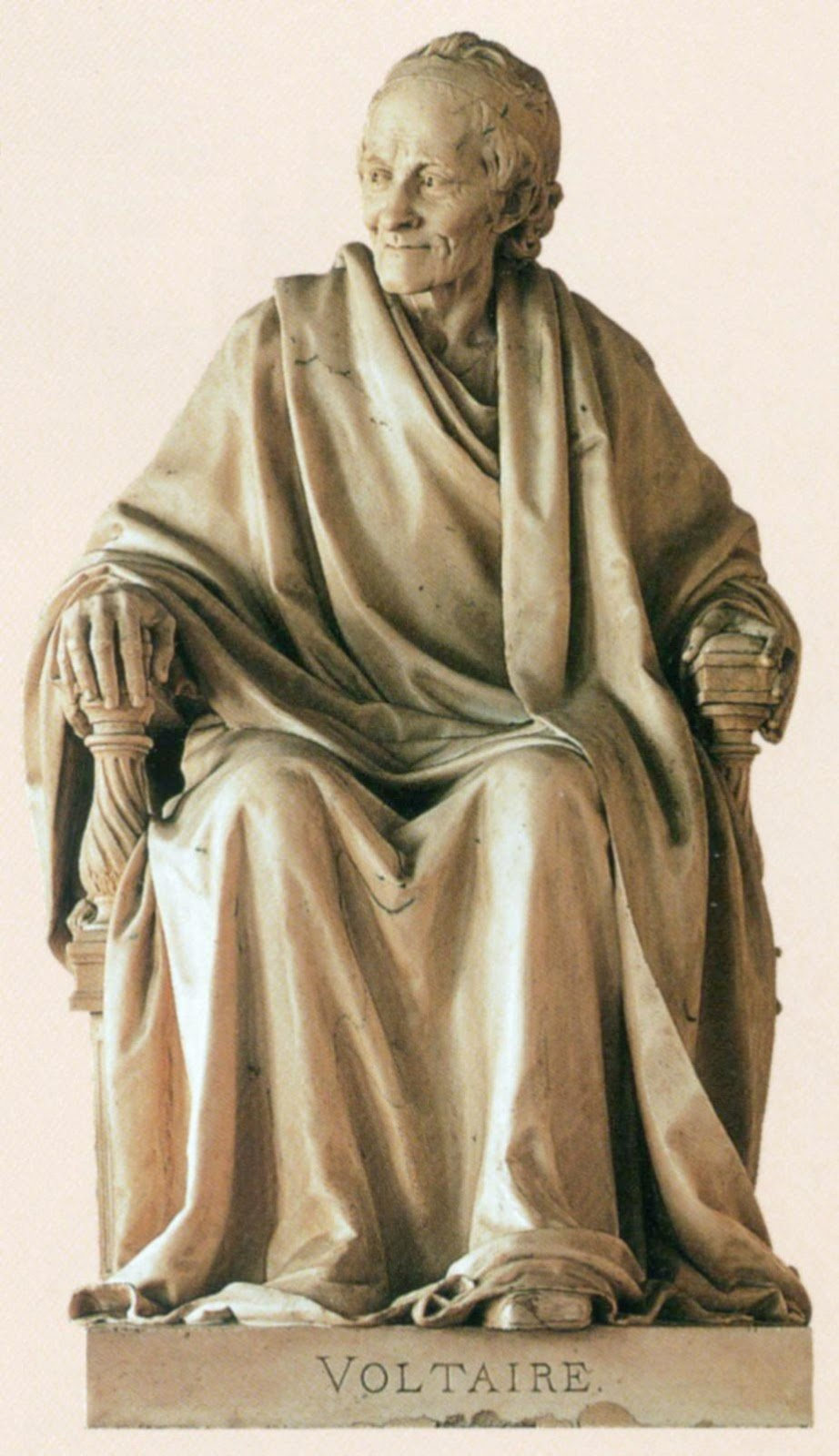
In 1770 his friends arranged a subscription to have a bust made of him. The rich had to be forbidden to give more than a mite, for thousands asked the honor of contributing. Frederick inquired how much he should give; he was told, “A crown piece, sire, and your name.” Voltaire congratulated him on adding to his cultivation of the other sciences this encouragement of anatomy by subscribing for the statue of a skeleton. He demurred to the whole undertaking on the ground that he had no face left to be modeled. “You would hardly guess where it ought to be. My eyes have sunk in three inches; my cheeks are like old parchment; … the few teeth I had are gone.” To which d’Alembert replied: “Genius … has always a countenance which genius, its brother, will easily find.” When his pet, Bellet-Bonne, kissed him, he said it was “Life kissing Death.” 

In 1770 his friends arranged a subscription to have a bust made of him. The rich had to be forbidden to give more than a mite, for thousands asked the honor of contributing. 

He was now eighty-three; and a longing came over him to see Paris before he died. The doctors advised him not to undertake so arduous a trip; but “if I want to commit a folly,” he answered, “nothing will prevent me”; he had lived so long, and worked so hard, that perhaps he felt he had a right to die in his own way, and in that electric Paris from which he had been so long exiled. And so he went, weary mile after weary mile, across France; and when his coach entered the capital his bones hardly held together. He went at once to the friend of his youth, d’Argental: “I have left off dying to come and see you,” he said. The next day his room was stormed by three hundred visitors, who welcomed him as a king; Louis XVI fretted with jealousy. Benjamin Franklin was among the callers, arid brought his grandson for Voltaire’s blessing; the old man put his thin hands upon the youth’s head and bade him dedicate himself to “God and Liberty.” 

He was now eighty-three; and a longing came over him to see Paris before he died. And so he went, weary mile after weary mile, across France. After he arrived his room was stormed by three hundred visitors, who welcomed him as a king.

He was so ill now that a priest came to shrive him. “From whom do you come, M. l’Abbé?’, asked Voltaire. “From God Himself,” was the answer. “Well, well, sir,” said Voltaire; “your credentials?” The priest went away without his prey. Later Voltaire sent for another abbé, Gautier, to come and hear his confession; Gautier came, but refused Voltaire absolution until he should sign a profession of full faith in Catholic doctrine. Voltaire rebelled; instead, he drew up a statement which he gave to his secretary, Wagner: “I die adoring God, loving my friends, not hating my enemies, and detesting superstition. (Signed) Voltaire. February 28, 1778.”

Voltaire was so ill now that a priest came to shrive him. But when asked to sign a profession of full faith in Catholic doctrine, Voltaire refused. Instead, he drew up a statement, “I die adoring God, loving my friends, not hating my enemies, and detesting superstition.”

Though sick and tottering, he was driven to the Academy, through tumultuous crowds that clambered on his carriage and tore into souvenirs the precious pelisse which Catherine of Russia had given him. “It was one of the historic events of the century. No great captain returning from a prolonged campaign of difficulty and hazard crowned by the most glorious victory, ever received a more splendid and far-resounding greeting.” At the Academy he proposed a revision of the French dictionary; he spoke with youthful fire, and offered to undertake all such part of the work as would come under the letter A. At the close of the sitting he said, “Gentlemen, I thank you in the name of the alphabet.” To which the chairman, Chastellux, replied: “And we thank you in the name of letters.” 

Voltaire went to the Academy in Paris, where he proposed a revision of the French dictionary, and spoke with youthful fire.

Meanwhile his play, Irene, was being performed at the theatre; against the advice of the physicians again, he insisted on attending. The play was poor; but people marveled not so much that a man of eighty-three should write a poor play, but that he should write any play at all; and they drowned the speech of the players with repeated demonstrations in honor 

of the author. A stranger, entering, supposed himself to be in a madhouse, and rushed back frightened into the street.

Voltaire attended his play, Irene, which was being performed at the theatre; against the advice of the physicians again.

When the old patriarch of letters went home that evening he was almost reconciled to death. He knew that he was exhausted now; that he had used to the full that wild and marvelous energy which nature had given to him perhaps more than to any man before him. He struggled as he felt life being torn from him; but death could defeat even Voltaire. The end came on May 30, 1778. 

Voltaire’s end finally came on May 30, 1778. 

He was refused Christian burial in Paris; but his friends set him up grimly in a carriage, and got him out of the city by pretending that he was alive. At Scellières they found a priest who understood that rules were not made for geniuses; and the body was buried in holy ground. In 1791 the National Assembly of the triumphant Revolution forced Louis XVI to recall Voltaire’s remains to the Pantheon. The dead ashes of the great flame that had been were escorted through Paris by a procession of 100,000 men and women, while 600,000 flanked the streets. On the funeral car were the words: “He gave the human mind a great impetus; he prepared us for freedom.” On his tombstone only three words were necessary:

HERE LIES VOLTAIRE 

What a wonderful life and end Voltaire had!

.

VOLTAIRE: Voltaire and Rousseau

Reference: The Story of Philosophy

This paper presents Chapter V Section 9 from the book THE STORY OF PHILOSOPHY by WILL DURANT. The  contents are from the 1933 reprint of this book by TIME INCORPORATED by arrangement with Simon and Schuster, Inc.

The paragraphs of the original material (in black) are accompanied by brief comments (in color) based on the present understanding.

.

IX. Voltaire and Rousseau

Voltaire was so engrossed in the struggle against ecclesiastical tyranny that during the later decades of his life he was compelled almost to withdraw from the war on political corruption and oppression. “Politics is not in my line: I have always confined myself to doing my little best to make men less foolish and more honorable.” He knew how complex a matter political philosophy can become, and he shed his certainties as he grew. “I am tired of all these people who govern states from the recesses of their garrets”; “these legislators who rule the world at two cents a sheet; … unable to govern their wives or their households they take great pleasure in regulating the universe.” It is impossible to settle these matters with simple and general formulae, or by dividing all people into fools and knaves on the one hand, and on the other, ourselves. “Truth has not the name of a party”; and he writes to Vauvenargues: “It is the duty of a man like you to have preferences, but not exclusions.”

Voltaire was so engrossed in the struggle against ecclesiastical tyranny that during the later decades of his life he was compelled almost to withdraw from the war on political corruption and oppression. 

Being rich, he inclines towards conservatism, for no worse reason than that which impels the hungry man to call for a change. His panacea is the spread of property: ownership gives personality and an uplifting pride. “The spirit of property doubles a man’s strength. It is certain that the possessor of an estate will cultivate his own inheritance better than that of another.”

Being rich, Voltaire inclines towards conservatism.

He refuses to excite himself about forms of government. Theoretically he prefers a republic, but he knows its flaws: it permits factions which, if they do not bring on civil war, at least destroy national unity; it is suited only to small states protected by geographical situation, and as yet unspoiled and untorn with wealth; in general “men are rarely worthy to govern themselves.” Republics are transient at best; they are the first form of society, arising from the union of families; the American Indians lived in tribal republics, and Africa is full of such democracies. But differentiation of economic status puts an end to these egalitarian governments; and differentiation is the inevitable accompaniment of development. ”Which.is better,” he asks, “a monarchy or a republic?”—and he replies: “For four thousand years this question has been tossed about. Ask the rich for an answer—they all want aristocracy. Ask the people—they want democracy. Only the monarchs want monarchy. How then has it come about that almost the entire earth is governed by monarchs? Ask the rats who proposed to hang a bell about the neck of the cat.” But when a correspondent argues that monarchy is the best form of government he answers: “Provided Marcus Aurelius is monarch; for otherwise, what difference does it make to a poor man whether he is devoured by a lion or by a hundred rats?”

Voltaire refuses to excite himself about forms of government. Theoretically he prefers a republic, but he knows its flaws. In general “men are rarely worthy to govern themselves.” 

Likewise, he is almost indifferent to nationalities, like a traveled man; he has hardly any patriotism in the usual sense of that word. Patriotism commonly means, he says, that one hates every country but one’s own. If a man wishes his country to prosper, but never at the expense of other countries, he is at the same time an intelligent patriot and a citizen of the universe. Like a “good European” he praises England’s literature and Prussia’s king while France is at war with both England and Prussia. So long as nations make a practice of war, he says, there is not much to choose among them.

Patriotism commonly means, Voltaire says, that one hates every country but one’s own. 

For he hates war above all else. “War is the greatest of all crimes; and yet there is no aggressor who does not color his crime with the pretext of justice.” “It is forbidden to kill; therefore all murderers are punished unless they kill in large numbers and to the sound of trumpets.” He has a terrible “General Reflection on Man,” at the end of the article on “Man” in the Dictionary:

Twenty years are required to bring man from the state of a plant, in which he exists in the womb of his mother, and from the state of an animal, which is his condition in infancy, to a state in which the maturity of reason begins to make itself felt. Thirty centuries are necessary in which to discover even a little of his structure. An eternity would be required to know anything of his soul. But one moment suffices in which to kill him. 

Voltaire hates war above all else. 

Does he therefore think of revolution as a remedy? No. For first of all, he distrusts the people: ”When the people undertake to reason, all is lost.” The great majority are always too busy to perceive the truth until change has made the truth an error; and their intellectual history is merely the replacement of one myth by another. ”When an old error is established, politics uses it as a morsel which the people have put into their own mouths, until another superstition comes along to destroy this one, and politics profits from the second error as it did from the first.” And then again, inequality is written into the very structure of society, and can hardly be eradicated while men are men and life is a struggle. “Those who say that all men are equal speak the greatest truth if they mean that all men have an equal right to liberty, to the possession of their goods, and to the protection of the laws”; but “equality is at once the most natural and the most chimerical thing in the world: natural when it is limited to rights, unnatural when it attempts to level goods and powers.” “Not all citizens can be equally strong; but they can all be equally free; it is this which the English have won. … To be free is to be subject to nothing but the laws.” This was the note of the liberals, of Turgot and Condorcet and Mirabeau and the other followers of Voltaire who hoped to make a peaceful revolution; it could not quite satisfy the oppressed, who called not so much for liberty as for equality, equality even at the cost of liberty. Rousseau, voice of the common man, sensitive to the class distinctions which met him at every turn, demanded a leveling; and when the Revolution fell into the hands of his followers, Marat and Robespierre, equality had its turn, and liberty was guillotined.

Voltaire and his followers hoped for a peaceful revolution. Their note was, “Not all citizens can be equally strong; but they can all be equally free; it is this which the English have won. … To be free is to be subject to nothing but the laws.” 

Voltaire was skeptical of Utopias to be fashioned by human legislators who would create a brand new world out of their imaginations. Society is a growth in time, not a syllogism in logic; and when the past is put out through the door it comes in at the window. The problem is to show precisely by what changes we can diminish misery and injustice in the world in which we actually live. In the “Historical Eulogy of Reason,” Truth, the daughter of Reason, voices her joy at the accession of Louis XVI, and her expectation of great reforms; to which Reason replies: “My daughter, you know well that I too desire these things, and more. But all this requires time and thought. I am always happy when, amid many disappointments, I obtain some of the amelioration I longed for.” Yet Voltaire too rejoiced when Turgot came to power, and wrote: “We are in the golden age up to our necks!” —now would come the reforms he had advocated: juries, abolition of the tithe, an exemption of the poor from all taxes, etc. And had he not written that famous letter?—

Everything that I see appears to be throwing broadcast the seed of a revolution which must some day inevitably come, but which I shall not have the pleasure of witnessing. The French always come late to things, but they do come at last. Light extends so from neighbor to neighbor, that there will be a splendid outburst on the first occasion; and then there will be a rare commotion! The young are fortunate; they will see fine things.

Voltaire happily expected a peaceful revolution when Turgot, in 1774, was put in control of finances by Louis XVI. He knew that changes will take place, but slowly.

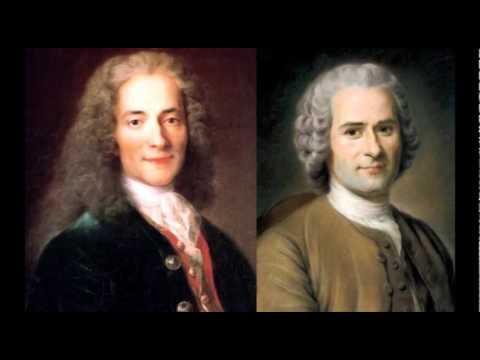
Yet he did not quite realize what was happening about him; and he never for a moment supposed that in this “splendid outburst” all France would accept enthusiastically the philosophy of this queer Jean Jacques Rousseau who, from Geneva and Paris, was thrilling the world with sentimental romances and revolutionary pamphlets. The complex soul of France seemed to have divided itself into these two men, so different and yet so French. Nietzsche speaks of “la gaya scienza, the light feet, wit, fire, grace, strong logic, arrogant intellectuality, the dance of the stars”—surely he was thinking of Voltaire. Now beside Voltaire put Rousseau: all heat and fantasy, a man with noble and jejune visions, the idol of la bourgeoise gentile-femme, announcing like Pascal that the heart has its reasons which the head can never understand. 

Voltaire did not quite realize that the people of France will opt for a philosophy that was all heat and fantasy and asserted that the heart has its reasons which the head can never understand. This was the philosophy of Rousseau.

In these two men we see again the old clash between intellect and instinct. Voltaire believed in reason always: “we can, by speech and pen, make men more enlightened and better.” Rousseau had little faith in reason; he desired action; the risks of revolution did not frighten him; he relied on the sentiment of brotherhood to re-unite the social elements scattered by turmoil and the uprooting of ancient habits. Let laws be removed, and men would pass into a reign of equality and justice. When he sent to Voltaire his Discourse on the Origin of Inequality, with its arguments against civilization, letters, and science, and for a return to the natural condition as seen in savages and animals, Voltaire replied: “I have received, sir, your new book against the human species, and I thank you for it. … No one has ever been so witty as you are in trying to turn us into brutes; to read your book makes one long to go on all fours. As, however, it is now some sixty years since I gave up the practice, I feel that it is unfortunately impossible for me to resume it.” He was chagrined to see Rousseau’s passion for savagery continue into the Social Contract: “Ah, Monsieur,” he writes to M. Bordes, “you see now that Jean Jacques resembles a philosopher as a monkey resembles a man.” He is the “dog of Diogenes gone mad.” Yet he attacked the Swiss authorities for burning the book, holding to his famous principle: “I do not agree with a word that you say, but I will defend to the death your right to say it.” And when Rousseau was fleeing from a hundred enemies Voltaire sent him a cordial invitation to come and stay with him at Les Délices. What a spectacle that would have been! 

In Voltaire and Rousseau we see again the old clash between intellect and instinct. Voltaire believed in reason always; but Rousseau had little faith in reason; he desired action. In spite of his disagreement, Voltaire respected Rousseau’s right to speak what he believed in.

Voltaire was convinced that all this denunciation of civilization was boyish nonsense; that man was incomparably better off under civilization than under savagery; he informs Rousseau that man is by nature a beast of prey, and that civilized society means a chaining of this beast, a mitigation of his brutality, and the possibility of the development, through social order, of the intellect and its joys. He agrees that things are bad: “A government in which it is permitted a certain class of men to say, ‘Let those pay taxes who work; we should not pay, because we do not work,’ is no better than a government of Hottentots.” Paris has its redeeming features, even amidst its corruption. In “The World as It Goes,” Voltaire tells how an angel sent Babouc to report on whether the city of Persepolis should be destroyed; Babouc goes, and is horrified with the vices he discovers; but after a time “he began to grow fond of a city the inhabitants of which were polite, affable and beneficent, though they were fickle, slanderous and vain. He was much afraid that Persepolis would be condemned. He was even afraid to give in his account. This he did, however, in the following manner. He caused a little statue, composed of different metals, of earth and of stones (the most precious and the most vile) to be cast by one of the best founders of the city, and carried it to the angel. ‘Wilt thou break,’ said he, ‘this pretty statue ‘because it is not wholly composed of gold and diamonds?'” The angel resolved to think no more of destroying Persepolis, but to leave “the world as it goes.” After all, when one tries to change institutions without having changed the nature of men, that unchanged nature will soon resurrect those institutions. 

Voltaire didn’t agree with Rousseau’s denunciation of civilization. He informs Rousseau that man is by nature a beast of prey, and that civilized society means a chaining of this beast. After all, when one tries to change institutions without having changed the nature of men, that unchanged nature will soon resurrect those institutions. 

Here was the old vicious circle; men form institutions, and institutions form men; where could change break into this ring? Voltaire and the liberals thought that intellect could break the ring by educating and changing men, slowly and peacefully; Rousseau and the radicals felt that the ring could be broken only by instinctive and passionate action that would break down the old institutions and build, at the dictates of the heart, new ones under which liberty, equality and fraternity would reign. Perhaps the truth lay above the divided camps: that instinct must destroy the old, but that only intellect can build the new. Certainly the seeds of reaction lay fertile in the radicalism of Rousseau: for instinct and sentiment are ultimately loyal to the ancient past which has begotten them, and to which they are stereotyped adaptations: after the catharsis of revolution the needs of the heart would recall supernatural religion and the “good old days” of routine and peace; after Rousseau would come Chateaubriand, and De Staël, and De Maistre, and Kant. 

Perhaps the truth lay above the divided camps: that instinct must destroy the old, but that only intellect can build the new. 

.

VOLTAIRE: Écrasez l’Infame

Reference: The Story of Philosophy

This paper presents Chapter V Section 8 from the book THE STORY OF PHILOSOPHY by WILL DURANT. The  contents are from the 1933 reprint of this book by TIME INCORPORATED by arrangement with Simon and Schuster, Inc.

The paragraphs of the original material (in black) are accompanied by brief comments (in color) based on the present understanding.

.

VIII. Écrasez l’Infame

Under ordinary circumstances it is probable that Voltaire would never have passed out of the philosophic calm of this courteous skepticism to the arduous controversies of his later years. The aristocratic circles in which he moved agreed so readily with his point of view that there was no incentive to polemics; even the priests smiled with him over the difficulties of the faith, and cardinals considered whether, after all, they might not yet make him into a good Capuchin. What were the events that turned him from the polite persiflage of agnosticism to a bitter anti-clericalism which admitted no compromise, but waged relentless war to “crush the infamy” of ecclesiasticism?

In his later years, Voltaire turned from the polite persiflage of agnosticism to a bitter anti-clericalism, which admitted no compromise.

Not far from Ferney lay Toulouse, the seventh city of France. In Voltaire’s day the Catholic clergy enjoyed absolute sovereignty there; the city commemorated with frescoes the Revocation of the Edict of Nantes (an edict which had given freedom of worship to Protestants), and celebrated as a great feast the day of the Massacre of St. Bartholomew. No Protestant in Toulouse could be a lawyer, or a physician, or an apothecary, or a grocer, or a book-seller, or a printer; nor could a Catholic keep a Protestant servant or clerk—in 1748 a woman had been fined 3000 francs for using a Protestant midwife. 

There was extreme discrimination of Protestants by Catholics in the city of Toulouse.

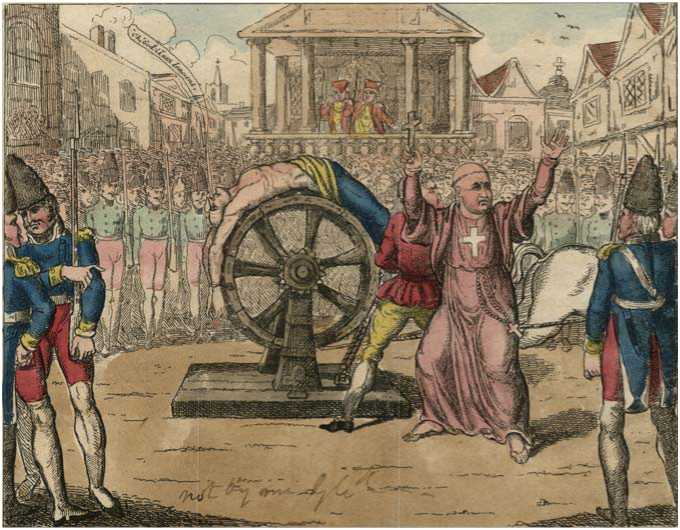
Now it happened that Jean Calas, a Protestant of Toulouse, had a daughter who became a Catholic, and a son who hanged himself, presumably because of disappointment in business. There was a law in Toulouse that every suicide should be placed naked on a hurdle, with face down, drawn thus through the streets, and then hanged on a gibbet. The father, to avert this, asked his relatives and his friends to testify to a natural death. In consequence, rumor began to talk of murder, and to hint that the father had killed the son to prevent his imminent conversion to Catholicism. Calas was arrested, put to the torture, and died soon after (1761). His family, ruined and hunted, fled to Ferney, and sought the aid of Voltaire. He took them into his home, comforted them, and marveled at the story of medieval persecution which they told. 

The Calas family was subjected to medieval persecution in Toulouse for being Protestants. They sought the aid of Voltaire.

About the same time (1762) came the death of Elizabeth Sirvens; again rumor charged that she had been pushed into a well just as she was about to announce her conversion to Catholicism. That a timid minority of Protestants would hardly dare to behave in this way was a rational consideration, and therefore out of the purview of rumor.—In 1765 a young man by the name of La Barre, aged sixteen, was arrested on the charge of having mutilated crucifixes. Subjected to torture, he confessed his guilt; his head was cut off, and his body was flung into the flames, while the crowd applauded. A copy of Voltaire’s Philosophic Dictionary, which had been found on the lad, was burned with him. 

More atrocities were committed by Catholics on Protestants.

For almost the first time in his life, Voltaire became a thoroughly serious man. When d’Alembert, disgusted equally with state, church and people, wrote that hereafter he would merely mock at everything, Voltaire answered, “This is not a time for jesting; wit does not harmonize with massacres. … Is this the country of philosophy and pleasure? It is rather the country of the Massacre of St. Bartholomew.” It was with Voltaire now as with Zola and Anatole France in the case of Dreyfus; this tyrannous injustice lifted him up; he ceased to be merely a man of letters, and became a man of action too; he laid aside philosophy for war, or rather turned his philosophy into relentless dynamite. ”During this time not a smile escaped me without my reproaching myself for it as for a crime.” It was now that he adopted his famous motto, Écrasez l’Infame [crush the infamous], and stirred the soul of France against the abuses of the church. He began to pour forth such intellectual fire and brimstone as melted mitres and sceptres, broke the power of the priesthood in France, and helped to overthrow a throne. He sent out a call to his friends and followers, summoning them to battle: “Come, brave Diderot, intrepid d’Alembert, ally yourselves; … overwhelm the fanatics and the knaves, destroy the insipid declamations, the miserable sophistries, the lying history, … the absurdities without number; do not let those who have sense be subjected to those who have none; and the generation which is being born will owe to us its reason and its liberty.”

Voltaire took this situation seriously and began to pour forth such intellectual fire and brimstone as melted mitres and sceptres, broke the power of the priesthood in France, and helped to overthrow a throne.

Just at this crisis an effort was made to buy him off; through Mme. de Pompadour he received an offer of a cardinal’s hat as the reward of reconciliation with the Church. As if the rule of a few tongue-tied bishops could interest a man who was the undisputed sovereign of the world of intellect! Voltaire refused; and like another Cato, began to end all his letters with “Crush the infamy.” He sent out his Treatise on Toleration: he said he would have borne with the absurdities of dogma had the clergy lived up to their sermons and had they tolerated differences; but “subtleties of which not a trace can be found in the Gospels are the source of the bloody quarrels of Christian history.” “The man who says to me, ‘Believe as I do, or God will damn you,’ will presently say, ‘Believe as I do, or I shall assassinate you.'” “By what right could a being created free force another to think like himself?” “A fanaticism composed of superstition and ignorance has been the sickness of all the centuries.” No such perpetual peace as the Abbé de St.-Pierre had pleaded for could ever be realized unless men learned to tolerate one another’s philosophic, political and religious differences. The very first step towards social health was the destruction of the ecclesiastical power in which intolerance had its root. 

Voltaire sent out his Treatise on Toleration: he said he would have borne with the absurdities of dogma had the clergy lived up to their sermons and had they tolerated differences.

The Treatise on Toleration was followed up with a Niagara of pamphlets, histories, dialogues, letters, catechisms, diatribes, squibs, sermons, verses, tales, fables, commentaries and essays, under Voltaire’s own name and under a hundred pseudonyms—“the most astonishing pell-mell of propaganda ever put out by one man.” Never was philosophy phrased so clearly, and with such life; Voltaire writes so well that one does not realize that he is writing philosophy. He said of himself, over-modestly, “I express myself clearly enough: I am like the little brooks, which are transparent because they are not deep.” And so he was read; soon everybody, even the clergy, had his, pamphlets; of some of them 300,000 copies were sold, though readers were far fewer then than now; nothing like it had ever been seen in the history of literature. “Big books,” he said, “are out of fashion.” And so he sent forth his little soldiers, week after week, month after month, resolute and tireless, surprising the world with the fertility of his thought and the magnificent energy of his seventy years. As Helvetius put it, Voltaire had crossed the Rubicon, and stood before Rome.

It was followed up with a Niagara of pamphlets, histories, dialogues, letters, etc. and he was read. Voltaire writes so well that one does not realize that he is writing philosophy. 

He began with a “higher criticism” of the authenticity and reliability of the Bible; he takes much of his material from Spinoza, more of it from the English Deists, most of it from the Critical Dictionary of Bayle (1647-1706); but how brilliant and fiery their material becomes in his hands! One pamphlet is called “The Questions of Zapata,” a candidate for the priesthood; Zapata asks, innocently, “How shall we proceed to show that the Jews, whom we burn by the hundred, were for four thousand years the chosen people of God?” [Voltaire himself was something of an anti-Semite, chiefly because of his not quite admirable dealings with the financiers.]—and he goes on with questions which lay bare the inconsistencies of narrative and chronology in the Old Testament. “When two Councils anathematize each other, as has often happened,. which of them is infallible?” At last, “Zapata, receiving no answer, took to preaching God in all simplicity. He announced to men the common Father, the rewarder, punisher, and pardoner. He extricated the truth from the lies, and separated religion from fanaticism; he taught and practiced virtue. He was gentle, kindly, and modest; and he was burned at Valladolid in the year of grace 1631.”

Voltaire begins with a “higher criticism” of the authenticity and reliability of the Bible, and he goes on with questions which lay bare the inconsistencies of narrative and chronology in the Old Testament.

Under the article on “Prophecy” in the Philosophic Dictionary, he quotes Rabbin Isaac’s Bulwark of Faith against the application of Hebrew prophecies to Jesus, and then goes on, ironically: “Thus these blind interpreters of their own religion and their own language, combated with the Church, and obstinately maintained that this prophecy cannot in any manner regard Jesus Christ.” Those were dangerous days, in which one was compelled to say what one meant without saying it, and the shortest line to one’s purpose was anything but straight. Voltaire likes to trace Christian dogmas and rites to Greece, Egypt and India, and thinks that these adaptations were not the least cause of the success of Christianity in the ancient world. Under the article on “Religion” he asks, slyly, “After our own holy religion, which doubtless is the only good one, what religion would be the least objectionable?”—and he proceeds to describe a faith and worship directly opposed to the Catholicism of his day. “Christianity must be divine,” he says, in one of his most unmeasured sallies, “since it has lasted 1,700 years despite the fact that it is so full of Villainy and nonsense.” He shows how almost all ancient peoples had similar myths, and hastily concludes that the myths are thereby proved to have been the inventions of priests: “the first divine was the first rogue who met the first fool.” However, it is not religion itself which he attributes to the priests, but theology. It is slight differences in theology that have caused so many bitter disputes and religious wars. “It is not the ordinary people … who have raised these ridiculous and fatal quarrels, the sources of so many horrors. … Men fed by your labors in a comfortable idleness, enriched by your sweat and your misery, struggled for partisans and slaves; they inspired you with a destructive fanaticism, that they might be your masters; they made you superstitious not that you might fear God but that you might fear them.”

According to Voltaire, Catholicism of his day was the opposite of Jesus’s Christianity of the ancient world. The Christian priests had invented their own theology. It is slight differences in theology that have caused so many bitter disputes and religious wars.

Let it not be supposed from all this that Voltaire was quite without religion. He decisively rejects atheism; so much so that some of the Encyclopedists turned against him, saying, “Voltaire is a bigot, he believes in God.” In “The Ignorant Philosopher” he reasons towards Spinozist pantheism, but then recoils from it as almost atheism. He writes to Diderot: 

I confess that I am not at all of the opinion of Saunderson, who denies a God, because he was born sightless. I am, perhaps, mistaken; but in his place I should recognize a great Intelligence who had given me so many substitutes for sight; and perceiving, on reflection, the wonderful relations between all things, I should have suspected a Workman infinitely able. If it is very presumptuous to divine ‘What He is, and why He has made everything that exists, so it seems to me very presumptuous to deny that He exists. I am exceedingly anxious to meet and talk with you, whether you think yourself one of His works, or a particle drawn, of necessity, from eternal and necessary matter. Whatever you are, you are a worthy part of that great whole which I do not understand.

Voltaire did not deny God. He hoped that he could understand God better.

To Holbach he points out that the very title of his book, the System of Nature, indicates a divine organizing intelligence. On the other hand he stoutly denies miracles and the supernatural efficacy of prayer: 

I was at the gate of the convent when Sister Fessue said to Sister Confite: “Providence takes a visible care of me; you know how I love my sparrow; he would have been dead if I had not said nine Ave-Marias to obtain his cure.” … A metaphysician said to her: “Sister, there, is nothing so good as Ave-Marias, especially when a girl pronounces them in Latin in the suburbs of Paris; but I cannot believe that God has occupied himself so much with your sparrow, pretty as it is; I pray you to believe that he has other things to attend to. …” Sister Fessue: “Sir, this discourse savors of heresy. My confessor … will infer that you do not believe in Providence.” Metaphysician: ” I believe in a general Providence, dear Sister, which has laid down from all eternity the law which governs all things, like light from the sun; but I believe not that a particular Providence changes the economy of the world for your sparrow.”

To Voltaire, the system of nature indicated a divine organizing intelligence. But he stoutly denied miracles and the supernatural efficacy of prayer.

“His Sacred Majesty, Chance, decides everything.” True prayer lies not in asking for a violation of natural law but in the acceptance of natural law as the unchangeable will of God.

Similarly, he denies free will. As to the soul he is an agnostic: “Four thousand volumes of metaphysics will not teach us what the soul is.” Being an old man, he would like to believe in immortality, but he finds it difficult. 

Nobody thinks of giving an immortal soul to the flea; why then to an elephant, or a monkey, or my valet? … A child dies in its mother’s womb, just at the moment when it has received a soul. Will it rise again foetus, or boy, or man? To rise again—to be the same person that you were—you must have your memory perfectly fresh and present; for it is memory that makes your identity. It your memory be lost, how will you be the same man? … Why do mankind flatter themselves that they alone are gifted with a spiritual and immortal principle? … Perhaps from their inordinate vanity. I am persuaded that if a peacock could speak he would boast of his soul, and would affirm that it inhabited his magnificent tail.

Voltaire has good logic because he doubts when there is lack of clarity. He recognizes anomalies. Therefore, he denies free will. As to the soul he is an agnostic.

And in this earlier mood he rejects also the view that belief in immortality is necessary for morality: the ancient Hebrews were without it, just when they were the “chosen people”; and Spinoza was a paragon of morality. 

In later days he changed his mind. He came to feel that belief in God has little moral value unless accompanied by belief in an immortality of punishment and reward. Perhaps, “for the common people (la canaille) a rewarding and avenging God” is necessary. Bayle had asked, If a society of atheists could subsist?—Voltaire answers, “Yes, if they are also philosophers.” But men are seldom philosophers; “if there is a hamlet, to be good it must have a religion.” “I want my lawyer, my tailor, and my wife to believe in God,” says “A” in “A, B, C”; “so, I imagine, I shall be less robbed and less deceived.” “If God did not exist it would be necessary to invent him.” “I begin to put more store on happiness and life than on truth”;—a remarkable anticipation, in the midst of the Enlightenment, of the very doctrine with which Immanuel Kant was later to combat the Enlightenment. He defends himself gently against his friends the atheists; he addresses Holbach in the article on “God;’ in the Dictionary: 

You yourself say that belief in God … has kept some men from crime; this alone suffices me. When this belief prevents even ten assassinations, ten calumnies, I hold that all the world should embrace it. Religion, you say, has produced countless misfortunes; say rather the superstition which reigns on our unhappy globe. This is the cruelest enemy of the pure worship due to the Supreme Being. Let us detest this monster which has always torn the bosom of its mother; those who, combat it are the benefactors of the human race; it is a serpent which chokes religion in its embrace; we must crush its head without wounding the mother whom it devours.” 

Voltaire favors a religion without superstition, a religion that brings understanding and happiness.

This distinction between superstition and religion is fundamental with him. He accepts gladly the theology of the Sermon on the Mount, and acclaims Jesus in tributes which could hardly be matched even with the pages of saintly ecstasy. He pictures Christ among the sages, weeping over the crimes that have been committed in his name. At last he built his own church, with the dedication, “Deo erexit Voltaire” [“God raised Voltaire”]; the only church in Europe, he said, that was erected to God. He addresses to God a magnificent prayer; and in the article “Theist” he expounds his faith finally and clearly:

The theist is a man firmly persuaded of the existence of a supreme being as good as he is powerful, who has formed all things … ; who punishes, without cruelty, all crimes, and recompenses with goodness all virtuous actions. … Re-united in this principle with the rest of the universe, he does not join any of the sects which all contradict one another. His religion is the most ancient and the most widespread; for the simple worship of a God preceded all the systems of the world. He speaks a language which all peoples understand, while they do not understand one another. He has brothers from Pekin to Cayenne, and he counts all the sages for his fellows. He believes that religion consists neither in the opinions of an unintelligible metaphysic, nor in vain shows, but in worship and in justice. To do good is his worship, to submit to God is his creed. The Mohammedan cries out to him, “Beware if you fail to make the pilgrimage to Mecca!”—the priest says to him, “Curses on you if you do not make the trip to Notre Dame de Lorette!” He laughs at Lorette and at Mecca: but he succors the indigent and defends the oppressed. 

Voltaire believes in a just and compassionate God. He call God a Supreme Being but it is not defined by any priest. It is how a person sees it. A person may see God as the laws of nature.

.