Education Fundamentals

Reference: Subject: Education
Reference: Course on Subject Clearing

There are two parts to teaching: 

  1. Imparting information
  2. Handling confusions

In a school, information is imparted through lectures and supported by textbooks. In the world of technology today, lectures may be replaced by pre-recorded videos; and the textbooks may be simplified through precise definitions and animated examples. Both video lectures and animated textbooks can be made available online through Internet. One may access them anywhere. A good example of this is Khan Academy | Free Online Courses, Lessons & Practice.

There are going to be confusions in student’s mind. These may be handled through interactions with a tutor on line. Simple confusion may be handled on the spot; otherwise, the student may be directed to study the materials that he missed. The better is the quality, and sequencing, of the study materials, the less confusions will be there to be addressed by a tutor.

Schools then become places where one may go to study and engage in laboratory experiments under supervision.

.

The Ideal Scene

I see the ideal scene for education as follows:

  1. Easy access to well-organized learning materials. 
  2. Active and self-paced learning.
  3. Realization of rational and systematic thinking.
  4. Attainment of a clear mind that can efficiently solve problems.
  5. Full realization of one’s potentials.  

.

Motivation to Learn

From birth, a child is exploring and learning. He is naturally motivated to learn. That natural motivation is killed when the child is,

  1. Not provided with enough examples to understand something properly
  2. Not given enough time to understand something fully
  3. Pushed past too many things not understood

When the child has been pushed past too many things not understood, he gives up on independent thinking. He then lets the forced schooling condition his mind. This is not a good situation because, as he grows up, he is unable to creatively think his way out of situations. He then becomes subject to a lot of stress in life.

A way out of this situation is Subject Clearing Your Schooling. This application restores the motivation to learn and to think creatively. It can be self-applied to oneself; or two people may pair up and apply it to each other; or a tutor may apply it his or her students individually as needed.

In general, one must never allow one’s motivation to be killed by the reasons listed above.

.

Self-Learning

Once one is motivated to learn, one can self-learn to a great extent in today’s technological environment. Self-learning can be supported greatly by a tutor who is familiar with Subject Clearing.

Self-learning materials have the following characteristics:

  1. They lay out the materials in a logical sequence starting from the fundamentals.
  2. They provide a suitable gradient of learning.
  3. They explain each concept using precise definition and enough illustrative examples.
  4. They allow the student enough time to understand the concepts.
  5. They are written in simple language.
  6. They provide a glossary for the key words used to describe the concepts.

In self-learning it is very important not to go by something one does not understand. One’s mind should always be full of curiosity and eagerness to learn. Whenever, there is a doubt, perplexity or confusion, it should be treated as an ANOMALY.

An anomaly is any violation of the integrity of reality, such as, discontinuity (missing data), inconsistency (contradictory data), or disharmony (arbitrary data).

The moment one becomes aware of an anomaly one must make some effort to resolve it.  He should actually resolve the anomaly; or, at least, add it to a TO DO LIST, that he checks on a regular basis.

.

Creative Thinking

Self-learning helps a student explore his potentials to the fullest degree. He naturally picks up the subjects that he is most interested in. He would then excel in those subjects because he wants to. Self learning maintains and even enhances a person’s ability to think independently and creatively at all times.

Here are some elementary question to check creative thinking ability: What is Mathematics?

Here is an example of addressing the fundamentals of a subject: Numbers

The subject of education is explored here: Subject: Education

.

JUDAISM: Meaning in History

Reference: Judaism

Note: The original text is provided below.
Previous / Next

Judaism focused on evolution in this world from a historical perspective; while, Hinduism focused on spiritual evolution from the perspective of infinity.

.

Summary

.

Comments

.

Original Text

Let us begin with a contrast. “According to most classical philosophies and religions,” a historian writes, “ultimate reality is disclosed when man, either by rational contemplation or mystic ascent, goes beyond the flow of events which we call ‘history.’ The goal is the apprehension of an order of reality unaffected by the unpredictable fortunes of mankind. In Hinduism, for instance, the world of sense experience is regarded as maya, illusion; the religious man, therefore, seeks release from the wheel of life in order that his individuality may fade out into the World-Soul, Brahma. Or, Greek philosophers looked upon the world as a natural process which, like the rotation of the seasons, always follows the same rational scheme. The philosopher, however, could soar above the recurring cycles of history by fixing his mind upon the unchanging absolute which belongs to the eternal order. Both of these views are vastly different from the Biblical claim that God is found within the limitations of the world of change and struggle, and especially that he reveals himself in events which are unique, particular, and unrepeatable. For the Bible, history is neither maya nor a circular process of nature; it is the arena of God’s purposive activity.”

What is at stake when we ask if there is meaning in history? At stake is our whole attitude toward the social order and collective life within it. If we decide that history is meaningless, it follows that the social, political, and cultural contexts of life do not warrant active concern. Life’s pivotal problems will be judged to lie elsewhere, in the extent to which we can rise above circumstances and triumph over them. To the extent that we see things this way, we shall take little interest in, and feel little responsibility for, the problems that beset societies, cultures, and civilizations. 

The Hebrew estimate of history was the exact opposite of this attitude of indifference. To the Jews history was of towering significance. It was important, first, because they were convinced that the context in which life is lived affects that life in every way, setting up its problems, delineating its opportunities, conditioning its outcomes. It is impossible to talk about Adam and Noah (the same may be said of every major biblical character) apart from the particular circumstances—in this case Eden and the Flood—that enveloped them and in response to which their lives took form. The events the Hebrew Bible relates are profoundly contextual. 

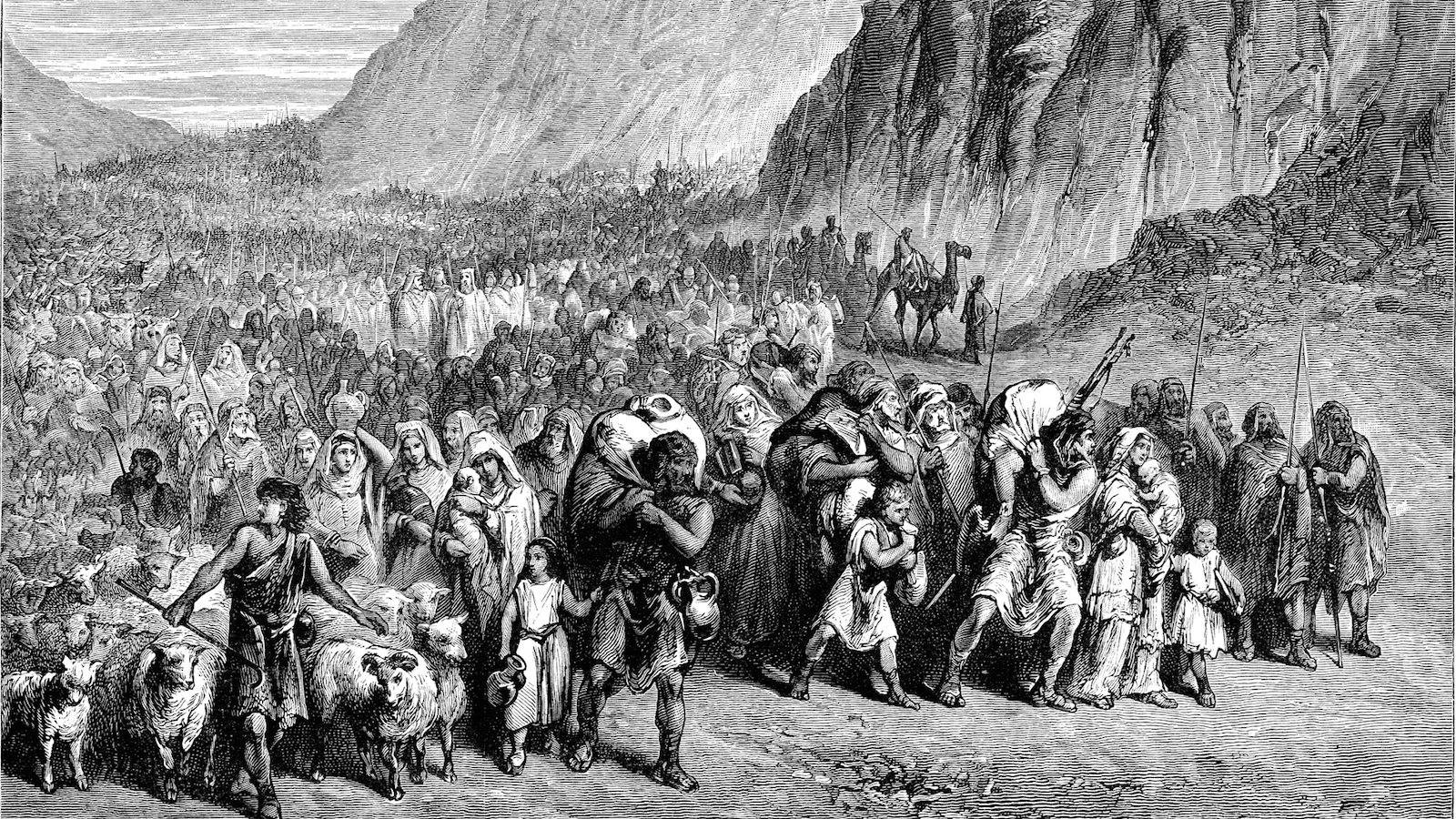
Second, if contexts are crucial for life, so is collective action; social action as we usually call it. There are times when the only way to get things changed is by working together—planning, organizing, and then acting in concert. The destiny of the Hebrew slaves in Egypt is not depicted as depending on the extent to which they individually “rose above” their slavery by cultivating a liberty of spirit that could tolerate physical chains. They needed to stand up collectively and break for the desert. 

Third, history was important for the Jews because they saw it as a field of opportunity. As it was ruled by God—the “theater of God’s glory,” John Calvin claimed, extrapolating from this Old Testament base—nothing in history happens accidentally. Yahweh’s hand was at work in every event—in Eden, the Flood, the Exodus, the Babylonian Exile—shaping each sequence into a teaching experience for his people.

Finally, history was important because life’s opportunities are not monotonously alike. Events, all of them important, are not equally important. It is not the case that anyone, anywhere and at any time, can turn to history and find awaiting an opportunity equivalent to all others in time and place. Each opportunity is unique, but some are decisive: “There is a tide in the affairs of men which, taken at the flood, leads on to fortune.” History must, therefore, be attended to carefully, for when opportunities pass they are gone forever. 

This uniqueness of events is epitomized in the Hebrew notions (a) of God’s direct intervention in history at certain critical points, and (b) of a chosen people as recipients of God’s unique challenges. Both are vividly illustrated in the epic of Abraham. This epic is introduced by a remarkable prologue, Genesis 1–11, which describes the steady deterioration of the world from its original, pristine goodness. Disobedience (eating the forbidden fruit) is followed by murder (Cain of Abel), promiscuity (the sons of God and the daughters of men), incest (the sons of Noah), until a flood is needed to sluice out the mess. In the midst of the corruption, God is not inactive. Against its backdrop, in the last days of the Sumeric universal state, God calls Abraham. He is to go forth into a new land to establish a new people. The moment is decisive. Because Abraham answers its call, he ceases to be anonymous. He becomes the first Hebrew, the first of a “chosen people.” 

We shall need to return to this “chosen people” theme, but for the present we must ask what gave the Jews their insight into history’s significance. We have noted the kind of meaning they found in history. What enabled them to see history as embodying this meaning? 

For India, human destiny lies outside history altogether. There the world that houses humanity is (as we have seen) the “middle world.” Good and evil, pleasure and pain, right and wrong are woven into it in relatively equal proportions as its warp and weft. And so things will remain. All thought of cleaning up the world and changing its character appreciably is mistaken in principle. The nature religions of Israel’s neighbors reached the same conclusion by a different route. For them, human destiny lay within history all right, but in history as currently constituted, not as it might become. We can see why change—specifically change for the better—did not suggest itself to nature religionists. If one’s eye is on nature preeminently, one does not look beyond it for fulfillment elsewhere. But neither—and this is the point—does one dream of improving nature or the social order that is its extension, for these are assumed to be ingrained in the nature of things and not subject to human alteration. The Egyptian no more asked whether the sun god Ra was shining as he should shine than the modern astronomer asks whether the sun is expending itself at a proper rate; for in nature the accent is on what is, not what should be—the is rather than the ought

The Israelites’ historical outlook differed from that of India and Middle Eastern polytheism because they had a different idea of God. Had the issue been raised to the level of conscious debate, they would have argued against India that God would not have created people as material beings if matter were adventitious to their destiny. Against the nature polytheists the Jews would have argued that nature is not self-sufficient. Because nature was created by God, God cannot be assimilated to it. The consequence of keeping God and nature distinct is momentous, for it means that the “ought” cannot be assimilated to the “is”—God’s will transcends (and can differ from) immanent actuality. By the double stroke of involving human life with the natural order but not confining it to that order, Judaism established history as both important and subject to critique. Those who do not learn from history are doomed to repeat it. 

The nature polytheisms that surrounded Judaism all buttressed the status quo. Conditions might not be all the heart desired, but what impressed the polytheist was that they could be a lot worse. For if the powers of nature reside in many gods—in Mesopotamia their number reached into the thousands—there was always the danger that these gods might fall out among themselves with resulting chaos. So religion’s attention was directed toward keeping things as they were. Egyptian religion repeatedly contrasted “passionate people” to “silent people,” extolling the latter because they didn’t cause trouble. Small wonder that no nature polytheism ever spawned a principled revolution. Traditionally, Indian religion likewise had a conservative cast; for if polytheisms feared change, Hinduism considered substantive social change to be impossible. 

In Judaism, by contrast, history is in tension between its divine possibilities and its manifest frustrations. A sharp tension exists between the ought and the is. Consequently, Judaism laid the groundwork for social protest. When things are not as they should be, change in some form is in order. The idea bore fruit. It is in the lands that have been affected by the Jewish historical perspective, one that influenced Christianity and to some extent Islam, that the chief thrusts for social betterment have occurred. The prophets set the pattern. “Protected by religious sanctions, the prophets of Judah were a reforming political force which has never been surpassed and perhaps never equalled in subsequent world history.” On fire with the conviction that things were not as they should be, they created in the name of the God for whom they spoke an atmosphere of reform that “put Hyde Park and the best days of muckraking newspapers to shame.”

.

HINDUISM: The Way to God through Love

Reference: Hinduism

Note: The original Text is provided below.
Previous / Next

To the bhakta, for whom feelings are more real than thoughts, God appears different.

.

Summary

.

Comments

.

Original Text

The yoga of knowledge is said to be the shortest path to divine realization. It is also the steepest. Requiring as it does a rare combination of rationality and spirituality, it is for a select few. 

By and large, life is powered less by reason than by emotion; and of the many emotions that crowd the human heart, the strongest is love. Even hate can be interpreted as a rebound from the thwarting of this impulse. Moreover, people tend to become like that which they love, with its name written on their brows. The aim of bhakti yoga is to direct toward God the love that lies at the base of every heart. “As the waters of the Ganges flow incessantly toward the ocean,” says God in the Bhagavata Purana,, “so do the minds of the bhakta move constantly toward Me, the Supreme Person residing in every heart, immediately they hear about My qualities.” 

In contrast to the way of knowledge, bhakti yoga has countless followers, being, indeed, the most popular of the four. Though it originated in antiquity, one of its best-known proponents was a sixteenth-century mystical poet named Tulsidas. During his early married life he was inordinately fond of his wife, to the point that he could not abide her absence even for a day. One day she went to visit her parents. Before the day was half over, Tulsidas turned up at her side, whereupon his wife exclaimed, “How passionately attached to me you are! If only you could shift your attachment to God, you would reach him in no time.” “So I would,” thought Tulsidas. He tried it, and it worked. 

All the basic principles of bhakti yoga are richly exemplified in Christianity. Indeed, from the Hindu point of view, Christianity is one great brilliantly lit bhakti highway toward God, other paths being not neglected, but less clearly marked. On this path God is conceived differently than in jnana. In jnana yoga the guiding image was of an infinite sea of being underlying the waves of our finite selves. This sea typified the all-pervading Self, which is as much within us as without, and with which we should seek to identify. Thus envisioned, God is impersonal, or rather transpersonal, for personality, being something definite, seems to be finite whereas the jnanic Godhead is infinite. To the bhakti, for whom feelings are more real than thoughts, God appears different on each of these counts. 

First, as healthy love is out-going, the bhakta will reject all suggestions that the God one loves is oneself, even one’s deepest Self, and insist on God’s otherness. As a Hindu devotional classic puts the point, “I want to taste sugar; I don’t want to be sugar.” 

Can water quaff itself?
Can trees taste of the fruit they bear?
He who worships God must stand distinct from Him,
So only shall he know the joyful love of God;
For if he say that God and he are one,
That joy, that love, shall vanish instantly away.
Pray no more for utter oneness with God:
Where were the beauty if jewel and setting were one?
The heat and the shade are two,
If not, where were the comfort of shade?
Mother and child are two,
If not, where were the love?
When after being sundered, they meet,
What joy do they feel, the mother and child!
Where were joy, if the two were one?
Pray, then, no more for utter oneness with God.

Second, being persuaded of God’s otherness, the bhakta’s goal, too, will differ from the jnani’s. The bhakta will strive not to identify with God, but to adore God with every element of his or her being. The words of Bede Frost, though written in another tradition, are directly applicable to this side of Hinduism: “The union is no Pantheist absorption of the man in the one, but is essentially personal in character. More, since it is preeminently a union of love, the kind of knowledge which is required is that of friendship in the very highest sense of the word.” Finally, in such a context God’s personality, far from being a limitation, is indispensable. Philosophers may be able to love pure being, infinite beyond all attributes, but they are exceptions. The normal object of human love is a person who possesses attributes. 

All we have to do in this yoga is to love God dearly—not just claim such love, but love God in fact; love God only (other things being loved in relation to God); and love God for no ulterior reason (not even from the desire for liberation, or to be loved in return) but for love’s sake alone. Insofar as we succeed in this we know joy, for no experience can compare with that of being fully and authentically in love. Moreover, every strengthening of our affections toward God will weaken the world’s grip. Saints may, indeed will, love the world more than do the profane; but they will love it in a very different way, seeing in it the reflected glory of the God they adore. 

How is such love to be engendered? Obviously, the task will not be easy. The things of this world clamor for our affection so incessantly that it may be marveled that a Being who can neither be seen nor heard can ever become their rival. 

Enter Hinduism’s myths, her magnificent symbols, her several hundred images of God, her rituals that keep turning night and day like never-ending prayer wheels. Valued as ends in themselves these could, of course, usurp God’s place, but this is not their intent. They are matchmakers whose vocation is to introduce the human heart to what they represent but themselves are not. It is obtuse to confuse Hinduism’s images with idolatry, and their multiplicity with polytheism. They are runways from which the sense-laden human spirit can rise for its “flight of the alone to the Alone.” Even village priests will frequently open their temple ceremonies with the following beloved invocation: 

O Lord, forgive three sins that are due to my human limitations:
Thou art everywhere, but I worship you here;
Thou art without form, but I worship you in these forms;
Thou needest no praise, yet I offer you these prayers and salutations.
Lord, forgive three sins that are due to my human limitations.

A symbol such as a multi-armed image, graphically portraying God’s astounding versatility and superhuman might, can epitomize an entire theology. Myths plumb depths that the intellect can see only obliquely. Parables and legends present ideals in ways that make hearers long to embody them—vivid support for Irwin Edman’s contention that “it is a myth, not a mandate, a fable, not a logic by which people are moved.” The value of these things lies in their power to recall our minds from the world’s distractions to the thought of God and God’s love. In singing God’s praises, in praying to God with wholehearted devotion, in meditating on God’s majesty and glory, in reading about God in the scriptures, in regarding the entire universe as God’s handiwork, we move our affections steadily in God’s direction. “Those who meditate on Me and worship Me without any attachment to anything else,” says Lord Krishna in the Bhagavad-Gita, “those I soon lift from the ocean of death.” 

Three features of the bhakta’s approach deserve mention: japam, ringing the changes on love, and the worship of one’s chosen ideal. 

Japam is the practice of repeating God’s name. It finds a Christian parallel in one of the classics of Russian spirituality, The Way of a Pilgrim. This is the story of an unnamed peasant whose first concern is to fulfill the biblical injunction to “pray without ceasing.” Seeking for someone who can explain how it is possible to do this, he wanders through Russia and Siberia with a knapsack of dried bread for food and the charity of locals for shelter, consulting many authorities, only to be disappointed until at last he meets an old man who teaches him “a constant, uninterrupted calling upon the divine Name of Jesus with the lips, in the spirit, in the heart, during every occupation, at all times, in all places, even during sleep.” The pilgrim’s teacher trains him until he can repeat the name of Jesus more than 12,000 times a day without strain. This frequent service of the lips imperceptibly becomes a genuine appeal of the heart. The prayer becomes a constant, warming presence within him that brings a bubbling joy. “Keep the name of the Lord spinning in the midst of all your activities” is a Hindu statement of the same point. Washing or weaving, planting or shopping, imperceptibly but indelibly these verbal droplets of aspiration soak down into the subconscious, loading it with the divine. 

Ringing the changes on love puts to religious use the fact that love assumes different nuances according to the relationship involved. The love of the parent for the child carries overtones of protectiveness, whereas a child’s love includes dependence. The love of friends is different from the conjugal love of woman and man. Different still is the love of a devoted servant for its master. Hinduism holds that all of these modes have their place in strengthening the love of God and encourages bhaktas to make use of them all. In practice Christianity does the same. Most frequently it envisions God as benevolent protector, symbolized as lord or parent, but other modes are not absent. “What a Friend we have in Jesus” is a familiar Christian hymn, and “my Master and my Friend” figures prominently in another Christian favorite. God figures as spouse in the Song of Songs and in Christian mystical writings where the marriage of the soul to Christ is a standing metaphor. The attitude of regarding God as one’s child sounds somewhat foreign to Western ears, yet much of the magic of Christmas derives from this being the one time in the year when God enters the heart as a child, eliciting thereby the tenderness of the parental instinct. 

We come finally to the worship of God in the form of one’s chosen ideal. The Hindus have represented God in innumerable forms. This, they say, is appropriate. Each is but a symbol that points to something beyond; and as none exhausts God’s actual nature, the entire array is needed to complete the picture of God’s aspects and manifestations. But though the representations point equally to God, it is advisable for each devotee to form a lifelong attachment to one of them. Only so can its meaning deepen and its full power become accessible. The representation selected will be one’s ishta, or adopted form of the divine. The bhakta need not shun other forms, but this one will never be displaced and will always enjoy a special place in its disciple’s heart. The ideal form for most people will be one of God’s incarnations, for God can be loved most readily in human form because our hearts are already attuned to loving people. Many Hindus acknowledge Christ as a God-man, while believing that there have been others, such as Rama, Krishna, and the Buddha. Whenever the stability of the world is seriously threatened, God descends to redress the imbalance.

When goodness grows weak,
When evil increases,
I make myself a body.
In every age I come back
To deliver the holy,
To destroy the sin of the sinner,
To establish the righteous. (Bhagavad-Gita, IV:7–8)

.

HINDUISM: The Way to God through Knowledge

Reference: Hinduism

Note: The original Text is provided below.
Previous / Next

The Omniscient Self is aware of all motion; because it itself is truly motionless.

.

Summary

.

Comments

.

Original Text

Jnana yoga, intended for spiritual aspirants who have a strong reflective bent, is the path to oneness with the Godhead through knowledge. Such knowledge—the Greeks’ gnosis and sophia—has nothing to do with factual information; it is not encyclopedic. It is, rather, an intuitive discernment that transforms, turning the knower eventually into that which she knows. (“She” is appropriate here because in the principal Western source-languages—Hebrew, Latin, and Greek—the words for knowledge in this mode are usually feminine in gender.) Thinking is important for such people. They live in their heads a lot because ideas have for them an almost palpable vitality; they dance and sing for them. And if such thinkers are parodied as philosophers who walk around with their heads in the clouds, it is because they sense Plato’s Sun shining above those clouds. Thoughts have consequences for such people; their minds animate their lives. Not many people are convinced by Socrates’ claim that “to know the good is to do it,” but in his own case he may have been reporting a straightforward fact. 

For people thus given to knowing, Hinduism proposes a series of demonstrations that are designed to convince the thinker that she possesses more than her finite self. The rationale is straightforward. Once the jnana yogi grasps this point, her sense of self will shift to a deeper level. 

The key to the project is discrimination, the power to distinguish between the surface self that crowds the foreground of attention and the larger self that is out of sight. Cultivating this power proceeds through three stages, the first of which is learning. Through listening to sages and scriptures and treatises on the order of Thomas Aquinas’s Summa Theologica, the aspirant is introduced to the prospect that her essential being is Being itself.

The second step is thinking. By prolonged, intensive reflection, that which the first step introduced as a hypothesis must assume life. The Atman (God within) must change from concept to realization. A number of lines of reflection are proposed for this project. For example, the disciple may be advised to examine our everyday language and ponder its implications. The word “my” always implies a distinction between the possessor and what is possessed; when I speak of my book or my jacket, I do not suppose that I am those things. But I also speak of my body, my mind, or my personality, giving evidence thereby that in some sense I consider myself as distinct from them as well. What is this “I” that possesses my body and mind, but is not their equivalent? 

Again, science tells me that there is nothing in my body that was there seven years ago, and my mind and my personality have undergone comparable changes. Yet, throughout their manifold revisions, I have remained in some way the same person, the person who believed now this, now that; who once was young and is now old. What is this something in my makeup, more constant than body or mind, that has endured the changes? Seriously pondered, this question can disentangle one’s Self from one’s lesser identifications. 

Our word “personality” comes from the Latin persona, which originally referred to the mask an actor donned as he stepped onto the stage to play his role, the mask through (per) which he sounded (sonare) his part. The mask registered the role, while behind it the actor remained hidden and anonymous, aloof from the emotions he enacted. This, say the Hindus, is perfect; for roles are precisely what our personalities are, the ones into which we have been cast for the moment in this greatest of all tragi-comedies, the drama of life itself in which we are simultaneously coauthors and actors. As a good actress gives her best to her part, we too should play ours to the hilt. Where we go wrong is in mistaking our presently assigned part for what we truly are. We fall under the spell of our lines, unable to remember previous roles we have played and blind to the prospect of future ones. The task of the yogi is to correct this false identification. Turning her awareness inward, she must pierce the innumerable layers of her personality until, having cut through them all, she reaches the anonymous, joyfully unconcerned actress who stands beneath. 

The distinction between self and Self can be assisted by another image. A man is playing chess. The board represents his world. There are pieces to be moved, bishops to be won and lost, an objective to be gained. The game can be won or lost, but not the player himself. If he has worked hard, he has improved his game and indeed his faculties; this happens in defeat fully as much as in victory. As the contestant is related to his total person, so is the finite self of any particular lifetime related to its underlying Atman

Metaphors continue. One of the most beautiful is found in the Upanishads, as also (by interesting coincidence) in Plato. There is a rider who sits serene and motionless in his chariot. Having delegated responsibility for the journey to his charioteer, he is free to sit back and give full attention to the passing landscape. In this image resides a metaphor for life. The body is the chariot. The road over which it travels are the sense objects. The horses that pull the chariot over the road are the senses themselves. The mind that controls the senses when they are disciplined is represented by the reins. The decisional faculty of the mind is the driver, and the master of the chariot, who is in full authority but need never lift a finger, is the Omniscient Self. 

If the yogi is able and diligent, such reflections will eventually induce a lively sense of the infinite Self that underlies one’s transient, finite self. The two will become increasingly distinct in one’s mind, separating like water and oil where formerly they mixed like water and milk. One is then ready for the third step on the path of knowledge, which consists in shifting her self-identification to her abiding part. The direct way for her to do this is to think of herself as Spirit, not only during periods of meditation that are reserved for this purpose, but also as much as possible while performing her daily tasks. This latter exercise, though, is not easy. She needs to drive a wedge between her skin-encapsulated ego and her Atman, and an aid in doing so is to think of the former in the third person. Instead of “I am walking down the street,” she thinks, “There goes Sybil walking down Fifth Avenue,” and tries to reinforce the assertion by visualizing herself from a distance. Neither agent nor patient, her approach to what happens is, “I am the Witness.” She watches her unsubstantial history with as much detachment as she lets her hair blow in the wind. Just as a lamp that lights a room is unconcerned with what goes on within it, even so the yogi watches what transpires in his house of protoplasm, the texts tell us. “Even the sun, with all its warmth, is marvelously detached” was found scribbled somewhere on a prison wall. Life’s events are simply allowed to proceed. Seated in the dentist’s chair, Sybil notes, “Poor Sybil. It will soon be over.” But she must play fair and adopt the same posture when fortune visits her and she would like nothing better than bask in the praise she is receiving.

Thinking of oneself in the third person does two things simultaneously. It drives a wedge between one’s self-identification and one’s surface self, and at the same time forces this self-identification to a deeper level until at last, through a knowledge identical with being, one becomes in full what one always was at heart. “That thou art, other than Whom there is no other seer, hearer, thinker, or agent.”

.

HINDUISM: Four Paths to the Goal

Reference: Hinduism

Note: The original Text is provided below.
Previous / Next

What is distinctive in Hinduism is the amount of attention it has devoted to identifying basic spiritual personality types.

.

Summary

.

Comments

.

Original Text

All of us dwell on the brink of the infinite ocean of life’s creative power. We carry it within us: supreme strength, the fullness of wisdom, unquenchable joy. It is never thwarted and cannot be destroyed. But it is hidden deep, which is what makes life a problem. The infinite is down in the darkest, profoundest vault of our being, in the forgotten well-house, the deep cistern. What if we could bring it to light and draw from it unceasingly?

This question became India’s obsession. Her people sought religious truth not simply to increase their store of general information; they sought it as a chart to guide them to higher states of being. Religious people were ones who were seeking to transform their natures, reshape them to a superhuman pattern through which the infinite could shine with fewer obstructions. One feels the urgency of the quest in a metaphor the Hindu texts present in many guises. Just as a man carrying on his head a load of wood that has caught fire would go rushing to a pond to quench the flames, even so will the seeker of truth, scorched by the fires of life—birth, death, self-deluding futility—go rushing to a teacher wise to the ways of the things that matter most. 

Hinduism’s specific directions for actualizing the human potential come under the heading of yoga. The word once conjured images of shaggy men in loincloths, twisting their bodies into human pretzels while brandishing occult powers. Now that the West has appropriated the term, however, we are more likely to think of lithe women exercising to retain their trim suppleness. Neither image is totally divorced from the real article, but they relate only to its bodily aspects. The word yoga derives from the same root as does the English word yoke, and yoke carries a double connotation: to unite (yoke together), and to place under disciplined training (to bring under the yoke, or “take my yoke upon you”). Both connotations are present in the Sanskrit word. Defined generally, then, yoga is a method of training designed to lead to integration or union. But integration of what? 

Some people are chiefly interested in their bodies. Needless to say, they have their Indian counterparts—people who make their bodies the prime objects of their concern and endeavor. For such people India, through centuries of experimentation, has devised the most fantastic school of physical culture the world has ever seen. Not that she has been more interested in the body than the West; her interest has simply taken a different turn. Whereas the West has sought strength and beauty, India has been interested in precision and control, ideally complete control over the body’s every function. How many of her incredible claims in this area can be scientifically corroborated remains to be seen. It is enough here to note that her extensive instructions on the subject comprise an authentic yoga, hatha yoga. Originally it was practiced as preliminary to spiritual yoga, but it has largely lost this connection so it need not concern us here. The judgment of the Hindu sages on this matter can be ours as well. Incredible things can be done with the body if you are willing to give your life to the project, but these things have little to do with enlightenment. If their cultivation stems from a desire to show off, they can actually impede spiritual growth. 

The yogas that do concern us are those designed to unite the human spirit with the God who lies concealed in its deepest recesses. “Since all the Indian spiritual [as distinct from bodily] exercises are devoted seriously to this practical aim—not to a merely fanciful contemplation or discussion of lofty and profound ideas—they may well be regarded as representing one of the most realistic, matter-of-fact, practical-minded systems of thought and training ever set up by the human mind. How to come to Brahman [God in Sanskrit] and remain in touch with Brahman; how to become identified with Brahman, living out of it; how to become divine while still on earth—transformed, reborn adamantine while on the earthly plane; that is the quest that has inspired and deified the human spirit in India throughout the ages.”

The spiritual trails that Hindus have blazed toward this goal are four. At first this may seem surprising. If there is one goal, should there not be one path to it? This might be the case if we were all starting from the same point, though even then different modes of transport—walking, driving, flying—might counsel alternate routes. As it is, people approach the goal from different directions, so there must be multiple trails to the common destination. 

Where one starts from depends on the kind of person one is. The point has not been lost on Western spiritual directors. One of the most noted of these, Father Surin, for example, criticized “directors who get a plan into their heads which they apply to all the souls who come to them, trying to bring them into line with it like one who should wish all to wear the same clothes.” St. John of the Cross called attention to the same danger when he wrote in The Living Flame that the aim of spiritual directors should “not be to guide souls by a way suitable to themselves, but to ascertain the way by which God Himself is pointing them.” What is distinctive in Hinduism is the amount of attention it has devoted to identifying basic spiritual personality types and the disciplines that are most likely to work for each. The result is a recognition, pervading the entire religion, that there are multiple paths to God, each calling for its distinctive mode of travel. 

The number of the basic spiritual personality types, by Hindu count, is four. (Carl Jung built his typology on the Indian model, while modifying it in certain respects.) Some people are primarily reflective. Others are basically emotional. Still others are essentially active. Finally, some are experimentally inclined. For each of these personality types Hinduism prescribes a distinct yoga that is designed to capitalize on the type’s distinctive strength. The types are not sealed in watertight compartments, for every human being possesses all four talents to some degree, just as most hands of cards contain all four suits. But it makes sense to lead with the suit that is strongest. 

All four paths begin with moral preliminaries. As the aim of the yogas is to render the surface self transparent to its underlying divinity, it must first be cleansed of its gross impurities. Religion is always more than morality, but if it lacks a moral base it will not stand. Selfish acts coagulate the finite self instead of dissolving it; ill-will perturbs the flow of consciousness. The first step of every yoga, therefore, involves the cultivation of such habits as non-injury, truthfulness, non-stealing, self-control, cleanliness, contentment, self-discipline, and a compelling desire to reach the goal. 

Keeping these common preliminaries in mind, we are ready for the yogas’ distinctive instructions.

.