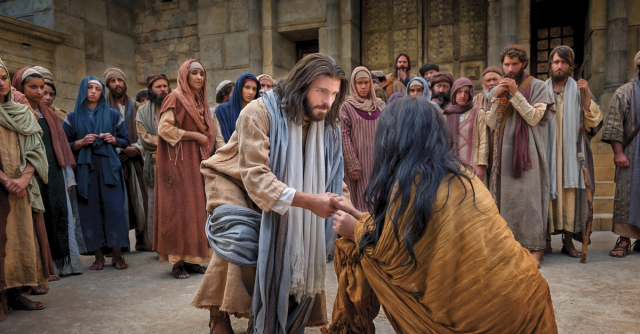
CHRISTIANITY: The Good News

Reference: Christianity

[NOTE: In color are Vinaire’s comments.]

The people who first heard Jesus’ disciples proclaiming the Good News were impressed by their tranquility, simplicity, and cheerfulness that was encountered nowhere else. 

The conviction that Jesus continued to live transformed a dozen or so disconsolate followers of a slain and discredited leader into one of the most dynamic groups in human history. We read that tongues of fire descended upon them. It was a fire destined to set the Mediterranean world aflame. People who were not speakers waxed eloquent. They exploded across the Greco-Roman world, preaching what has come to be called the Gospel but which, if translated literally, would be called the Good News. Starting in an upper room in Jerusalem, they spread their message with such fervor that in Jesus’ very generation it took root in every major city of the region.

The conviction that Jesus continued to live transformed a dozen or so disconsolate followers of a slain and discredited leader into one of the most dynamic groups in human history. 

And what was this Good News that snapped Western history like a dry twig, into B.C. and A.D. and left its impact through the Christian Church? Was it Jesus’ ethical teachings—the Golden Rule, the Sermon on the Mount? Not at all. We have already noted that every teaching of Jesus was already in the literature of his day. Paul, whose letters epitomize the concerns of the early Church, knew what Jesus had taught, but he almost never quotes him. Obviously, the news that transformed him was not Jesus’ ethical precepts nor even the way his life embodied them. It was something quite different.

The news that transformed Paul, the father of early church, was not Jesus’ ethical precepts nor even the way his life embodied them. It was something quite different.

What this other something was may be approached through a symbol. If we had been living around the eastern Mediterranean in the early centuries of the Christian era, we might have noticed scratched here and there on the sides of walls and houses or simply on the ground the crude outline of a fish. Even if we had seen it in several places, we would probably have dismissed it as innocuous graffiti or a doodle, for these were mainly seaport towns where fishing was a part of daily life. Had we been Christians, however, we would have seen these drawings as the logo for the Good News. The heads of the fish would have pointed us toward the place where the local Christian group held its underground meetings. For in those years of catacombs and arenas, when to be known as a Christian meant that one might be thrown to the lions or turned into a human torch, Christians were forced to more cryptic symbols than the cross. The fish was one of their favorites, for the Greek letters for the word fish are also the first letters of the Greek words for “Jesus Christ, Son of God, Savior.” This was the Good News, epitomized in the crude outline of an ordinary fish. 

The “Good News” was the cryptic symbol of fish that epitomized the phrase, “Jesus Christ, Son of God, Savior.”

But what does the phrase itself mean: Jesus Christ, Son of God, Savior? Those who have grown up with it may know the answer well. Our task, however, is to go behind the immense history of the phrase and try to work our way into what it meant to the men and women who first uttered it, for the entire subsequent history of Christianity grew out of their understanding of its significance. 

To the men and women who first uttered this phrase, it had a special significance.

In doing so one is tempted to plunge at once into ideas, definitions, and theology, but it will be wise to begin in another way. Ideas are important in life, but of themselves they seldom provide starting points. They grow out of facts and experiences and, torn from this soil, lose their life like uprooted trees. We shall find ourselves quite incapable of understanding Christian theology unless we manage to see clearly the experience it tried to account for. 

We shall find ourselves quite incapable of understanding Christian theology unless we manage to see clearly the experience it tried to account for. 

The people who first heard Jesus’ disciples proclaiming the Good News were as impressed by what they saw as by what they heard. They saw lives that had been transformed—men and women who were ordinary in every way except for the fact that they seemed to have found the secret of living. They evinced a tranquility, simplicity, and cheerfulness that their hearers had nowhere else encountered. Here were people who seemed to be making a success of the enterprise everyone would like to succeed at—that of life itself.

The people who first heard Jesus’ disciples proclaiming the Good News were impressed by their tranquility, simplicity, and cheerfulness that was encountered nowhere else. 

Specifically, there seemed to be two qualities in which their lives abounded. The first of these was mutual regard. One of the earliest observations about Christians that we have by an outsider is, “See how these Christians love one another.” Integral to this mutual regard was a total absence of social barriers; it was a “discipleship of equals,” as one New Testament scholar puts it. Here were men and women who not only said that everyone was equal in the sight of God but who lived as though they meant it. The conventional barriers of race, gender, and status meant nothing to them, for in Christ there was neither Jew nor Gentile, male nor female, slave nor free. As a consequence, in spite of differences in function or social position, their fellowship was marked by a sense of genuine equality. 

Here were men and women who not only said that everyone was equal in the sight of God but who lived as though they meant it. The conventional barriers of race, gender, and status meant nothing to them.

E. Schillebeeckx tells us that “being sad in Jesus’ presence [was] an existential impossibility,” and this takes us to the second quality that early Christians exhibited. Jesus once told his followers that his teachings were to the end “that my joy may be in you, and that your joy may be complete” (John 15:11), and to a remarkable degree that object appears to have been realized. Outsiders found this baffling. These scattered Christians were not numerous. They were not wealthy or powerful. If anything, they faced more adversity than the average man or woman. Yet, in the midst of their trials, they had laid hold of an inner peace that found expression in a joy that seemed exuberant. Perhaps radiant would be a better word. Radiance is hardly the word used to characterize the average religious life, but none other fits as well the life of these early Christians. Paul is an example. Here was a man who had been ridiculed, driven from town to town, shipwrecked, imprisoned, flogged until his back was covered with stripes. Yet here was a life in which joy was the constant refrain: “Joy unspeakable and full of glory.” “Thanks be to God who giveth us the victory.” “In all things we are more than conquerors.” “God who commanded the light to shine out of darkness has shined in our hearts.” “Thanks be to God for his unspeakable gift.” The joy of these early Christians was unspeakable. As the fifth chapter of Ephesians suggests, they sang not out of convention but from the irrepressible overflow of their direct experience. Life for them was no longer a matter of coping. It was glory discerned. 

These scattered early Christians had somehow laid hold of an inner peace that found expression in a joy that seemed exuberant, in spite of  life’s adversities.

What produced this love and joy in these early Christians? The qualities themselves are universally desired; the problem is how they are to be obtained. The explanation, insofar as we are able to gather from the New Testament record, is that three intolerable burdens had suddenly and dramatically been lifted from their shoulders. The first of these was fear, including the fear of death. We have the word of Carl Jung that he never met a patient over forty whose problems did not root back to fear of approaching death. The reason the Christians could not be intimidated by the lions and even sang as they entered the arena was that Jesus’ counsel, “Fear not, for I am with you,” worked for them. 

They had conquered the fear of death.

The second burden from which they had been released was guilt. Rationalists consider guilt a vanishing phenomenon, but psychologists do not agree. Recognized or repressed, guilt of some degree seems built into the human condition, for no one lives up to his or her ideals completely. It is not only that we behave less well toward others than conscience dictates; we also fail ourselves by leaving talents undeveloped and letting opportunities slip. We may manage to keep remorse at bay while the sun is up, but in sleepless hours of the night it visits us:

…the rending pain of re-enactment
Of all that you have done, and been; the shame
Of motives late revealed, and the awareness
Of things ill done and done to other’s harm
Which once you took as exercise of virtue.
(T. S. Eliot, “Little Gidding”)

Unrelieved guilt reduces creativity. In its acute form it can rise to a fury of self-condemnation that shuts life down. Paul had felt its force before he was released: “Wretched man that I am! Who will rescue me from this body of death?” (Romans 7:24). 

They were released from the burden of guilt.

The third release the Christians experienced was from the cramping confines of the ego. There is no reason to suppose that prior to their new life these men and women had been any more self-centered than the next person, but this was enough for them to know that their love was radically restricted. They knew that “the human curse is to love and sometimes to love well, but never well enough.” Now this curse had been dramatically lifted. 

They were released from the cramping confines of the ego. 

It is not difficult to see how release from guilt, fear, and self could feel like rebirth. If someone were to free us from these crippling impediments, we too would call that person savior. But this only pushes our question back a step. How did the Christians get free of these burdens? And what did a man named Jesus, now gone, have to do with the process that they should credit it as his doing? 

How did the Christians get free of these burdens? 

The only power that can effect transformations of the order we have described is love. It remained for the twentieth century to discover that locked within the atom is the energy of the sun itself. For this energy to be released, however, the atom must be bombarded from without. So too, locked in every human being is a store of love that partakes of the divine—the imago dei, image of God, it is sometimes called. And it too can be activated only through bombardment, in its case love’s bombardment. The process begins in infancy, where a mother’s initially unilateral loving smile awakens love in her baby and, as coordination develops, elicits its answering smile. The process continues into childhood. A loving human being is not produced by exhortations, rules, and threats. Love only takes root in children when it comes to them—initially and most importantly from nurturing parents. Ontogenetically speaking, love is an answering phenomenon. It is literally a response. 

The only power that can effect transformations of the order we have described is love. Love only takes root in children when it comes to them—initially and most importantly from nurturing parents.

An actual incident may help to bring this point home: 

He was a diffident freshman in a small midwestern college when one morning the instructor, one he idolized in the way the young idolize their role models, opened the class by saying, “Last evening I read some of the most significant sentences that I can recall.” As he proceeded to read them the boy’s heart leapt into his throat, for he was hearing his own words being read back to him from the paper he had submitted the preceding week. As he relates the incident: “I don’t remember another thing that occurred during that hour, but I shall never forget my feelings when the bell brought me to my senses. It was noon and October was never so beautiful. I was exultant. If anyone had asked me for anything, I would have given it gladly, for I wanted nothing. I ached only to give to the world that had given so much to me.” 

If a young man found himself changed to this extent by the interest a mere man had shown in him, it is not difficult to imagine the change that would have come over the early Christians if they knew that they were loved by God. Imagination may fail us here, but logic need not. If we too felt loved, not abstractly or in principle but vividly and personally, by one who unites all power and perfection, the experience could melt our fear, guilt, and self-concern permanently. As Kierkegaard said, if at every moment both present and future I were certain that nothing has happened or can ever happen that would separate us from the infinite love of the Infinite, that would be the reason for joy. 

The early Christians had a vivid experience of being loved by God. In other words, they felt one with the world around them.

God’s love is precisely what the first Christians did feel. They had experienced Jesus’ love and had became convinced that Jesus was God incarnate. Once that love reached them it could not be stopped. Melting the barriers of fear, guilt, and self, it poured through them as if they were sluice gates, augmenting the love they had hitherto felt for others until the difference in degree became a difference in kind and a new quality, which the world has come to call Christian love, was born. Conventional love is evoked by lovable qualities in the beloved, but the love people encountered from Christ embraced sinners and outcasts, Samaritans and enemies. It gave, not prudentially in order to receive, but because giving was its nature. Paul’s famous description of Christian love in the thirteenth chapter of First Corinthians ought not to be read as if he were commenting on an attitude we are already familiar with. His words point to the attribute of a specific person, Jesus Christ. In phrases of classic beauty it describes the divine love that Paul believed Christians would reflect toward others once they experienced Christ’s love for them. The reader should approach Paul’s words as if they define a novel capacity which, as it had been fully realized “in the flesh” only in Christ, Paul was describing for the first time.

The early Christians had experienced Jesus’ love and had became convinced that Jesus was God incarnate. To them love had taken new dimensions as described thus:

Love is patient; love is kind; love is not envious or arrogant or rude. It does not insist on its own way; it is not irritable or resentful; it does not rejoice in wrongdoing, but rejoices in the truth. It bears all things, believes all things, hopes all things, endures all things. Love never ends. (1 Corinthians 13:4–8)

So astonishing did the first Christians find this love and the fact that it had actually entered their lives that they had to appeal for help in describing it. Paul, in closing one of the earliest recorded sermons on the Good News, turned back to the words of one of the prophets, who in turn was speaking for God: “Look at this, you scornful souls, and lose yourselves in wonder; for in your days I do such a deed that, if men were to tell you this story, you would not believe it” (Acts 13:41).

It was a new and enlightening experience for people burdened with fear, guilt and self-concern.

.

Physics and Mathematics

Reference: A Conceptual Model of Inertia, Mass & Location 

The inconsistency I am faced with is “a continuous space being defined as a set of discrete points.” Mathematics fails to define the relationship between point and space properly. It seems that there is a better explanation underlying this inconsistency.

Science has progressed to a point where it is looking at the process of observation itself. It is difficult to come up with some absolute reference point, from which to look at the rest of existence. God seems to be a placeholder for what we do not understand. The only possible avenue to take is to take one inconsistency at a time and resolve it as best as one can, keeping in mind that one may have to come back to it later to resolve it further.

The universe is obviously finite in terms of what one is actually able to observe. We may postulate the universe to be infinite but that does not add anything more to our actual awareness or understanding. The idea of location is limited to the mechanical universe that we actually observe, independent of what one might postulate mathematically or otherwise.

We are now confronted with the idea of motion that goes beyond the classical concept of a physical body moving in space and time. A physical body consists of motion within itself at atomic levels. We cannot say if there is a point within the atom that is absolutely still. The stillness may be computed only in relative terms as difficulty involved in shifting a point. This is where the concept of inertia springs from. Thus, the idea of a location in space is intimately tied with the idea of inertia. This is what I meant by the concept of “centeredness” of CoM. I do not know if there is any limit to ideal centeredness. That is subject to observation.

An electromagnetic wave does not have its momentum concentrated at a point; rather it is evenly spread throughout. So, it has a physical presence that cannot be described as located at a point, as it can be done with mass. A photon may be described as having a physical presence as a wave packet, the size of which depends on its frequency. The higher is the frequency, the smaller is the region that describes its presence. One may say the location of a photon is spread-out in space, as opposed to being concentrated at a point as in case of mass. There is continuity that seems to exist within that “spread-out location”.

As frequency of the photon decreases, its location seems to “spread-out” further as proportional to its wavelength. This is looking at location in terms of inertia. The inertia lessens as frequency decreases. This spread may assume infinite proportions as frequency approaches zero. Here we achieve an approximation of space as a primitive concept that does not depend on the concept of point. In fact, space and point seem to appear at the opposite ends of a scale of inertia. The picture that I get is shown above.

So, an absence of “point location” does not mean “absence of location”. It means a location spread out in a manner of continuity that is very different from a “set of points.”

The statement, “A physical point location in space depends on the distribution of mass around it” means that there is the continuity of space corresponding to “zero inertia” that acts as the background. In this background exist point locations as “concentrated inertia.” I shall explain this as further questions arise.

Basically, I believe that physical space and location can be described more coherently in terms of inertia. This description bypasses the contradiction posed by a mathematical description of space as a set of points.

.

Inertia, Gravity and Charge in Life

Dimensions

  1. Cycles – T-1, Time – T,  Distance – L
  2. Speed – LT-1, Momentum – MLT-1
  3. Acceleration – LT-2, Force – MLT-2
  4. Energy – ML2T-2

,

Motion and Inertia

  1. Oscillation has period (T) and frequency (T-1). Frequency is inverse of period. 
  2. Motion adds wavelength to oscillation (LT-1). Inertia (mass) balances motion (L-1T).
  3. Momentum, therefore, has no unit. Momentum is naturally conserved.
  4. If mass has the dimensions of inertia (L-1T), then
    • Force has dimensions of frequency (T-1), and
    • Energy has dimensions of velocity (LT-1).

.

Space and Gravity

  1. Space is more the size of the particle that is increasing from matter to radiation.
  2. Gravity is more like the centeredness of particle that is decreasing from system of matter to system of radiation.
  3. Expansion of the universe indicates a transition from matter to radiation.

.

Sensations and Centeredness

  1. Total momentum of an isolated system remains unchanged in spite of interactions within it.
  2. The interactions within the isolated system shall consist of actions and reactions.
  3. Thus, sensations of substantiality come about.
  4. With mass (inertia) viewed as inverse of motion (velocity), force is seen as frequency (see above),
  5. Frequency is the core of centeredness. This is fixation of attention.

.

Charge

  1. A sudden change in centeredness manifests as charge. This is felt as shock.
  2. Charge manifests at the interface between the nucleus and the electronic region of the atom.

.

Gravity and Particles

So far, the physicists have been unable to find the “graviton,” the supposed quantum particle for the field of gravity. This could be because there is a good possibility that the graviton is about the size of the universe.

I make this speculation because gravity lies at the very bottom of the Spectrum of substance. Its wavelength is practically infinite. So, the particles of all other consistencies may be assumed to exist within the “particle of gravity,” just like the galaxies, stars and planets exist within the physical space.

We may compare the “particle of gravity” to the physical space of this universe. We may postulate that the “physical space” is continuous and it is described by gravity.

.

Particles within Particles

Within the physical space lie the particles of the spectrum of substance. The particles of lower consistency have much larger size that the particle of higher consistencies. We  may postulate that the particles of higher consistencies exist within the particles of lower consistencies. Thus, each particle has its own space that shrinks as one goes up the spectrum of substance. 

Thus, there is “light space,” “electron space” and “neutron and proton space.” All of these spaces exist within the continuous “gravity space.” The distances in space that we measure are consistent only with the “neutron and proton space.” The distances in “gravity space,” which contains all other spaces, are not always consistent.

.

Mathematical Physics

So, we can now see that infinity of discrete points do not make the continuous space in mathematical Physics. 

All these points of mathematical physics have the property of “centeredness.” The higher is the number of cycles, the more a physical point is “centered.” The ultimate “centeredness” of a physical point would be infinity. 

The inverse of “centeredness” would provide us with the “absolute speed” of the physical point. The absolute speed of a point with infinite “centeredness” shall be zero.

In Physics, as one goes up the spectrum of substance, the consistency and inertia increase; and the size and speed decrease. Therefore, the consistency, inertia, size and speed are all related. They all have values on an absolute scale. The reference point of this scale is Gravity.

.

Gravitational Force

The gravitational force may be viewed as the common denominator of the electromagnetic, weak and strong forces. It is the same force increasing as one moves up the spectrum of substance, and takes up different characteristics.

The basic gravitational force may be represented by the Planck’s constant for the frequency of 1. It is interesting to note that the dimensions of the Planck’s constant are the same as the dimensions for angular momentum.

.

What is a Particle?

In the mechanical universe we locate an object by its center of mass (CM). The CM is represented by a mathematical point that is dimensionless. Thus, we get the idea of a particle of matter as a dimensionless point in space. We call it a “point particle.”

But, then, we start visualizing all quantum particles, such as, the proton, electron and photon also as “point particles” too. The reality is that they are not point particles. A particle is a ‘physical entity’. It has a size. 

For example, according to The Spectrum of Substance, a comparison of wavelengths (or frequencies) shows that

an electron is about 2000 times the size of the proton,

and, a photon of light is more than 200,000 times the size of an electron.

The proton has a radius of about 1 x 10-15 meter. It has a CM, and the laws of mechanics apply to it. Therefore, a proton may be visualized as a point particle both mathematically and visually.

But neither the electron, nor the photon has a CM and the laws of mechanics do not apply to them. Therefore, neither of them may be treated as point particles. Their location in space cannot be calculated mathematically with precision.

Based on the above we reach the following conclusions:

  1. The notion of physical location is actually the size of the particle of that substance.
  2. A MATHEMATICAL POINT in space cannot always be equated with a PHYSICAL LOCATION.
  3. The physical location of quantum particles cannot be determined with precision.
  4. Space is continuous; whereas, points are discrete. 
  5. In physics, the mathematical space cannot be assumed to be made of mathematical points.
  6. Calculus assumes the size of the “points” to be uniform. This is not the case in the quantum region.
  7. The mathematics for Quantum Mechanics is very complex because calculus cannot be applied.
  8. Calculus may be applied to solve quantum mechanical problems using the relationship among varying particles sizes.
  9. Thus, it may be possible to simplify the mathematics of Quantum Mechanics.

We may assume particle sizes to be uniform in the mechanical universe as point particles. We cannot apply the same assumption in the quantum universe.

.