Reference: Islam
[NOTE: In color are Vinaire’s comments.]
Sufism was a movement within Islam to promote the inner message of Islam. Sufis donned coarse woolen garments to protest the silks and satins (the worldliness) of sultans and califs. Sufis have their rights, but—if we may venture the verdict of Islam as a whole—so have ordinary believers whose faith in unambiguous principles, fully adequate for salvation, could be undermined by teachings that seem to tamper with them.
We have been treating Islam as if it were monolithic, which of course it is not. Like every religious tradition it divides. Its main historical division is between the mainstream Sunnis (“Traditionalists” [from sunnah, tradition] who comprise 87 percent of all Muslims) and the Shi’ites (literally “partisans” of Ali, Muhammad’s son-in-law, whom Shi’ites believe should have directly succeeded Muhammad but who was thrice passed over and who, when he was finally appointed leader of the Muslims, was assassinated). Geographically, the Shi’ites cluster in and around Iraq and Iran, while the Sunnis flank them to the West (the Middle East, Turkey, and Africa) and to the East (through the Indian subcontinent, which includes Pakistan and Bangladesh, on through Malaysia, and into Indonesia, where alone there are more Muslims than in the entire Arab world). We shall pass over this historical split, which turns on an in-house dispute, and take up instead a division that has universal overtones. It is the vertical division between the mystics of Islam, called Sufis, and the remaining majority of the faith, who are equally good Muslims but are not mystics.
Islam is split into Shi’ites and Sunnis on the basis of politics. However, it also divided between the Sufis and the non-mystic Islam on the basis of its universality as a religion.
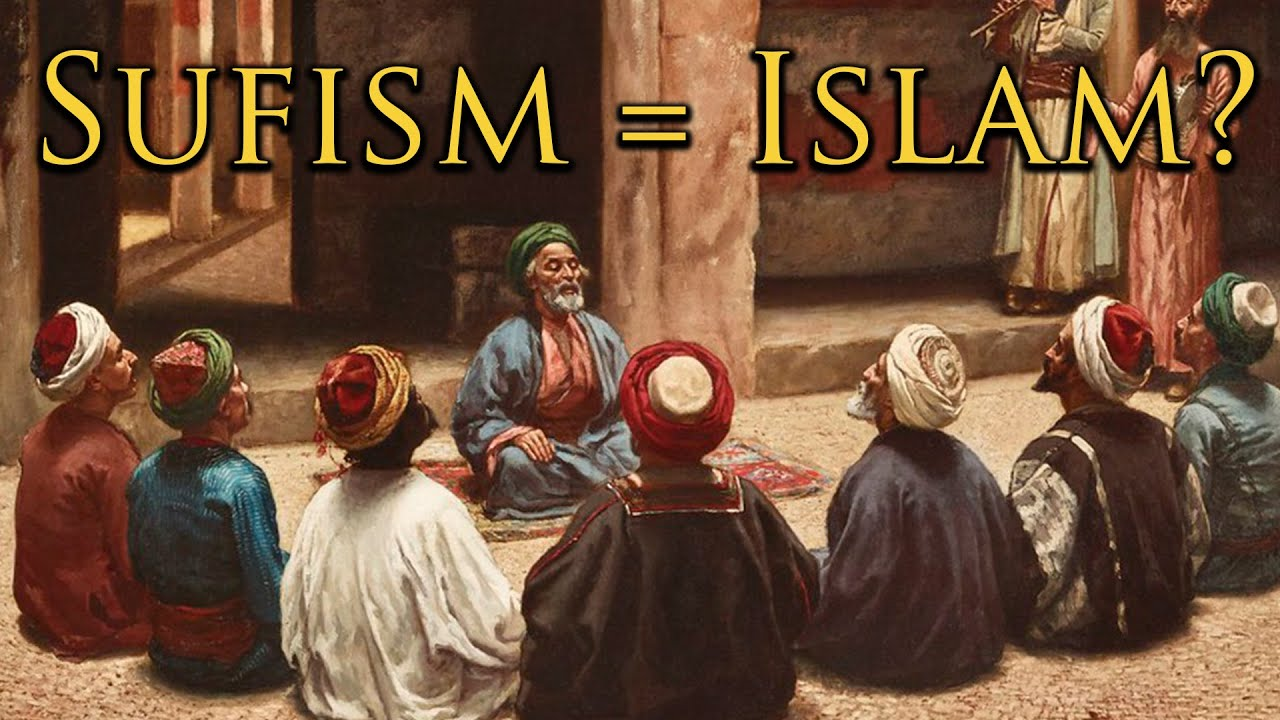
The root meaning of the word Sufi is wool, suf. A century or two after Muhammad’s death, those within the Islamic community who bore the inner message of Islam came to be known as Sufis. Many of them donned coarse woolen garments to protest the silks and satins of sultans and califs. Alarmed by the worldliness they saw overtaking Islam, they sought to purify and spiritualize it from within. They wanted to recover its liberty and love, and to restore to it its deeper, mystical tone. Externals should yield to internals, matter to meaning, outward symbol to inner reality. “Love the pitcher less,” they cried, “and the water more.”
Sufism was a movement within Islam to promote the inner message of Islam. Sufis donned coarse woolen garments to protest the silks and satins (the worldliness) of sultans and califs.
Sufis saw this distinction between the inner and the outer, the pitcher and what it contains, as deriving from the Koran itself, where Allah presents himself as both “the Outward [al-zahir] and the Inward [al-batin]” (57:3). Exoteric Muslims—we shall call them such because they were satisfied with the explicit meanings of the Koran’s teachings—passed over this distinction, but the Sufis (esoteric Muslims) found it important. Contemplation of God occupies a significant place in every Muslim’s life, but for most it must compete, pretty much on a par, with life’s other demands. When we add to this that life is demanding—people tend to be busy—it stands to reason that not many Muslims will have the time, if the inclination, to do more than keep up with the Divine Law that orders their lives. Their fidelity is not in vain; in the end their reward will be as great as the Sufis’. But the Sufis were impatient for their reward, if we may put the matter thus. They wanted to encounter God directly in this very lifetime. Now.
Contemplation of God occupies a significant place in every Muslim’s life, but for most it must compete, pretty much on a par, with life’s other demands. But the Sufis were impatient. They wanted to encounter God directly in this very lifetime.
This called for special methods, and to develop and practice them the Sufis gathered around spiritual masters (shaikhs), forming circles that, from the twelfth century onward, crystallized into Sufi orders (tariqahs). The word for the members of these orders is fakir—pronounced fakir; literally poor, but with the connotation of one who is “poor in spirit.” In some ways, however, they constituted a spiritual elite, aspiring higher than other Muslims, and willing to assume the heavier disciplines their extravagant goals required. We can liken their tariqahs to the contemplative orders of Roman Catholicism, with the difference that Sufis generally marry and are not cloistered. They engage in normal occupations and repair to their gathering places (zawiyahs, Arabic; khanaqahs, Persian) to sing, dance, pray, recite their rosaries in concert, and listen to the discourses of their Master, all to the end of reaching God directly. Someone who was ignorant of fire, they observe, could come to know it by degrees: first by hearing of it, then by seeing it, and finally by being burned by its heat. The Sufis wanted to be “burned” by God.
The Sufis gathered around spiritual masters (shaikhs), forming circles that, from the twelfth century onward, crystallized into Sufi orders (tariqahs). Sufis marry and engage in normal occupations. They repair to their gathering places to recite their rosaries in concert to the end of reaching God directly.
This required drawing close to him, and they developed three overlapping but distinguishable routes. We can call these the mysticisms of love, of ecstasy, and of intuition. To begin with the first of these, Sufi love poetry is world famous. A remarkable eighth-century woman saint, Rabi’a, discovered in her solitary vigils, often lasting all night, that God’s love was at the core of the universe; not to steep oneself in that love and reflect it to others was to forfeit life’s supreme beatitude. Because love is never more evident than when its object is absent, that being the time when the beloved’s importance cannot be overlooked, Persian poets in particular dwelt on the pangs of separation to deepen their love of God and thereby draw close to him. Jalal ad-Din Rumi used the plaintive sound of the reed flute to typify this theme.
Sufism developed the mysticisms of love, of ecstasy, and of intuition. A well-known exponent of sufism is Jalal ad-Din Rumi who is famous for his poetry.
Listen to the story told by the reed, of being seextractVerseted.
“Since I was cut from the reedbed, I have made this crying sound.
Anyone separated from someone he loves understands what I say, anyone
pulled from a source longs to go back.”
The lament of the flute, torn from its riverbank and symbol therefore for the soul’s severance from the divine, threw the Sufis into states of agitation and bewilderment. Nothing created could assuage those states; but its beloved, Allah, is so sublime, so dissimilar, that human love for him is like the nightingale’s for the rose, or the moth’s for the flame. Even so, Rumi assures us, that human love is returned:
Never does the lover seek without being sought by his beloved.
When the lightning of love has shot into this heart, know that there is
love in that heart….
Mark well the text: “He loves them and they love Him.” (Koran, 5:59).
The Sufi poetry dwelt on the soul’s severance from the divine, which threw the soul into states of agitation and bewilderment. The pangs of separation deepened its love of God and thereby drew it close to Allah.
But the full truth has still not been grasped, for Allah loves his creatures more than they love him. “God saith: Whoso seeketh to approach Me one span, I approach him one cubit; and whoso seeketh to approach Me one cubit, I approach him two fathoms; and whoever walks towards Me, I run towards him.” Rabi’a celebrates the eventual meeting of the two souls, one finite, the other Infinite, in her famous night prayer:
My God and my Lord: eyes are at rest, the stars are setting, hushed are the movements of birds in their nests, of monsters in the deep. And you are the Just who knows no change, the Equity that does not swerve, the Everlasting that never passes away. The doors of kings are locked and guarded by their henchmen, but your door is open to those who call upon you. My Lord, each lover is now alone with his beloved. And I am alone with you.
But the full truth has still not been grasped, for Allah loves his creatures more than they love him.
We are calling the second Sufi approach to the divine presence ecstatic (literally, “to stand outside oneself”) because it turns on experiences that differ, not just in degree but in kind, from usual ones. The presiding metaphor for ecstatic Sufis was the Prophet’s Night Journey through the seven heavens into the Divine Presence. What he perceived in those heavens no one can say, but we can be sure the visions were extraordinary—increasingly so with each level of ascent. Ecstatic Sufis do not claim that they come to see what Muhammad saw that night, but they move in his direction. At times the content of what they are experiencing engrosses them so completely that their states become trancelike because of their total abstraction from self. No attention remains for who they are, where they are, or what is happening to them. In psychological parlance they are “dissociated” from themselves, losing consciousness of the world as it is normally perceived. Journeying to meet such adepts, pilgrims reported finding themselves ignored—not out of discourtesy, but because literally they were not seen. Deliberate inducement of such states required practice; a pilgrim who sought out a revered ecstatic named Nuri reported finding him in such an intense state of concentration that not a hair of his body moved. “When I later asked him, ‘From whom did you learn this deep concentration?’ he replied, ‘From a cat watching by a mouse hole. But its concentration is much more intense than mine.’” Nevertheless, when the altered state arrives, it feels like a gift rather than an acquisition. The phrase that mystical theology uses, “infused grace,” feels right here; for Sufis report that as their consciousness begins to change, it feels as if their wills were placed in abeyance and a superior will takes over.
Ecstatic (literally, “to stand outside oneself”) is the second Sufi approach to the divine presence. Sufis report that as their consciousness begins to change, it feels as if their wills were placed in abeyance and a superior will takes over.
Sufis honor their ecstatics, but in calling them “drunken” they serve notice that they must bring the substance of their visions back with them when they find themselves “sober” again. In plain language, transcendence must be made immanent; the God who is encountered apart from the world must also be encountered within it. This latter does not require ecstasy as its preliminary, and the direct route to cultivating it carries us to the third Sufi approach: the way of intuitive discernment.
Sufis honor their ecstatics, but in calling them “drunken” they serve notice that they must bring the substance of their visions back with them when they find themselves “sober” again.
Like the other two methods this one brings knowledge, but of a distinct sort. Love mysticism yields “heart knowledge,” and ecstasy “visual or visionary knowledge,” because extraterrestrial realities are seen; but intuitive mysticism brings “mental knowledge,” which Sufis call ma’rifah, obtained through an organ of discernment called “the eye of the heart.” Because the realities attained through ma’rifah are immaterial, the eye of the heart is immaterial as well. It does not compete with the physical eye whose objects, the world’s normal objects, remain fully in view. What it does is clothe those objects in celestial light. Or to reverse the metaphor: It recognizes the world’s objects as garments that God dons to create a world. These garments become progressively more transparent as the eye of the heart gains strength. It would be false to say that the world is God—that would be pantheism. But to the eye of the heart, the world is God-in-disguise, God veiled.
Love mysticism yields “heart knowledge,” and ecstasy “visual or visionary knowledge”; but intuitive mysticism brings “mental knowledge,” which Sufis call ma’rifah, obtained through an organ of discernment called “the eye of the heart.”
The principal method the Sufis employed for penetrating the disguise is symbolism. In using visible objects to speak of invisible things, symbolism is the language of religion generally; it is to religion what numbers are to science. Mystics, however, employ it to exceptional degree; for instead of stopping with the first spiritual object a symbol points to, they use it as stepping stone to a more exalted object. This led al-Ghazali to define symbolism as “the science of the relation between multiple levels of reality.” Every verse of the Koran, the Sufis say, conceals a minimum of seven hidden significations, and the number can sometimes reach to seventy.
In using visible objects to speak of invisible things, symbolism is the language of religion generally; it is to religion what numbers are to science. Mystics, however, employ it to exceptional degree.
To illustrate this point: For all Muslims removing one’s shoes before stepping into a mosque is a mark of reverence; it signifies checking the clamoring world at the door and not admitting it into sacred precincts. The Sufi accepts this symbolism fully, but goes on to see in the act the additional meaning of removing everything that separates the soul from God. Or the act of asking forgiveness. All Muslims pray to be forgiven for specific transgressions, but when the Sufi pronounces the formula astaghfiru’llah, I ask forgiveness of God, he or she reads into the petition an added request: to be forgiven for his or her separate existence. This sounds strange, and indeed, exoteric Muslims find it incomprehensible. But the Sufis see it as an extension of Rabi’a’s teaching that “Your existence is a sin with which no other can be compared.” Because ex-istence is a standing out from something, which in this case is God, existence involves separation.
All Muslims pray to be forgiven for specific transgressions, but when the Sufi pronounces the formula astaghfiru’llah, I ask forgiveness of God, he or she reads into the petition an added request: to be forgiven for his or her separate existence.
To avoid it Sufis developed their doctrine of fana—extinction—as the logical term of their quest. Not that their consciousness was to be extinguished. It was their self-consciousness—their consciousness of themselves as separate selves replete with their private personal agendas—that was to be ended. If the ending was complete, they argued, when they looked inside the dry shells of their now-emptied selves they would find nothing but God. A Christian mystic put this point by writing:
God, whose boundless love and joy
Are present everywhere;
He cannot come to visit you
Unless you are not there. (Angelus Silesius)
Al-Hallaj’s version was: “I saw my Lord with the eye of the Heart. I said: ‘Who are you?’ He answered: ‘You.’”
Not that their consciousness was to be extinguished. It was their self-consciousness—their consciousness of themselves as separate selves replete with their private personal agendas—that was to be ended.
As a final example of the Sufis’ extravagant use of symbolism, we can note the way they tightened the creedal assertion “There is no god but God” to read, “There is nothing but God.” To exoteric Muslims this again sounded silly, if not blasphemous: silly because there are obviously lots of things—tables and chairs—that are not God; blasphemous because the mystic reading seemed to deny God as Creator. But the Sufis’ intent was to challenge the independence that people normally ascribe to things. Monotheism to them meant more than the theoretical point that there are not two Gods; that they considered obvious. Picking up on the existential meaning of theism—God is that to which we give (or should give) ourselves—they agreed that the initial meaning of “no god but God” is that we should give ourselves to nothing but God. But we do not catch the full significance of the phrase, they argued, until we see that we do give ourselves to other things when we let them occupy us as objects in their own right; objects that have the power to interest or repel us by being simply what they are. To think of light as caused by electricity—by electricity only and sufficiently, without asking where electricity comes from—is in principle to commit shirk; for because only God is self-sufficient, to consider other things as such is to liken them to God and thereby ascribe to him rivals.
We do give ourselves to other things when we let them occupy us as objects in their own right; objects that have the power to interest or repel us by being simply what they are. Such things have to be manifestation of God.
Symbolism, though powerful, works somewhat abstractly, so the Sufis supplement it with dhikr (to remember), the practice of remembering Allah through repeating his Name. “There is a means of polishing all things whereby rust may be removed,” a hadith asserts, adding: “That which polishes the heart is the invocation of Allah.” Remembrance of God is at the same time a forgetting of self, so Sufis consider the repetition of Allah’s Name the best way of directing their attention Godward. Whether they utter God’s Name alone or with others, silently or aloud, accenting its first syllable sharply or prolonging its second syllable as long as breath allows, they try to fill every free moment of the day with its music. Eventually, this practice kneads the syllables into the subconscious mind, from which it bubbles up with the spontaneity of a birdsong.
Remembrance of God is at the same time a forgetting of self, so Sufis consider the repetition of Allah’s Name the best way of directing their attention Godward.
The foregoing paragraphs sketch what Sufism is at heart, but they do not explain why this section opened by associating it with a division within Islam. The answer is that Muslims are of two minds about Sufism. This is partly because Sufism is itself a mixed bag. By the principle that the higher attracts the lower, Sufi orders have at times attracted riffraff who are Sufis in little more than name. For example, certain mendicant orders of Sufism have used poverty as a discipline, but it is only a step from authentic Sufis of this stripe to beggars who do no more than claim to be Sufis. Politics too has at times intruded. Most recently, groups have arisen in the West that call themselves Sufis, while professing no allegiance whatsoever to Islamic orthodoxy.
By the principle that the higher attracts the lower, Sufi orders have at times attracted riffraff who are Sufis in little more than name.
It is not surprising that these aberrations raise eyebrows, but even authentic Sufism (as we have tried to describe it) is controversial. Why? It is because Sufis take certain liberties that exoteric Muslims cannot in conscience condone. Having seen the sky through the skylight of Islamic orthodoxy, Sufis become persuaded that there is more sky than the aperture allows. When Rumi asserted, “I am neither Muslim nor Christian, Jew nor Zoroastrian; I am neither of the earth nor of the heavens, I am neither body nor soul,” we can understand the exoterics’ fear that orthodoxy was being strained beyond permissible limits. Ibn ‘Arabi’s declaration was even more unsettling:
My heart has opened unto every form. It is a pasture for gazelles, a cloister for Christian monks, a temple for idols, the Ka’ba of the pilgrim, the tablets of the Torah and the book of the Koran. I practice the religion of Love; in whatsoever directions its caravans advance, the religion of Love shall be my religion and my faith.
As for Al-Hallaj’s assertion that he was God, no explanation from the Sufis to the effect that he was referring to the divine Essence that was within him could keep exoterics from hearing this as outright blasphemy.
Even authentic Sufism is controversial because Sufis take certain liberties that exoteric Muslims cannot in conscience condone.
Mysticism breaks through the boundaries that protect the faith of the typical believer. In doing so it moves into an unconfined region that, fulfilling though it is for some, carries dangers for those who are unqualified for its teachings. Without their literal meaning being denied, dogmas and prescriptions that the ordinary believer sees as absolute are interpreted allegorically, or used as points of reference that may eventually be transcended. Particularly shocking to some is the fact that the Sufi often claims, if only by implication, an authority derived directly from God and a knowledge given from above rather than learned in the schools.
Mysticism breaks through the boundaries that protect the faith of the typical believer. In doing so it moves into an unconfined region that, fulfilling though it is for some, carries dangers for those who are unqualified for its teachings.
Sufis have their rights, but—if we may venture the verdict of Islam as a whole—so have ordinary believers whose faith in unambiguous principles, fully adequate for salvation, could be undermined by teachings that seem to tamper with them. For this reason many spiritual Masters have been discreet in their teachings, reserving parts of their doctrine for those who are suited to receive them. This is also why the exoteric authorities have regarded Sufism with understandable suspicion. Control has been exercised, partly by public opinion and partly by means of a kind of dynamic tension, maintained through the centuries, between the exoteric religious authorities on the one hand and Sufi shaikhs on the other. An undercurrent of opposition to Sufism within sections of the Islamic community has served as a necessary curb on the mystics, without this undercurrent having been strong enough to prevent those who have had a genuine vocation for a Sufi path from following their destiny.
Sufis have their rights, but—if we may venture the verdict of Islam as a whole—so have ordinary believers whose faith in unambiguous principles, fully adequate for salvation, could be undermined by teachings that seem to tamper with them.
On the whole, esoterism and exoterism have achieved a healthy balance in Islam, but in this section we shall let the exoterics have the last word. One of the teaching devices for which they are famous has not yet been mentioned; it is the Sufi tale. This one, “The Tale of the Sands,” relates to their doctrine of fana, the transcending, in God, of the finite self.
A stream, from its source in far-off mountains, passing through every kind and description of countryside, at last reached the sands of the desert. Just as it had crossed every other barrier, the stream tried to cross this one, but it found that as fast as it ran into the sand, its waters disappeared.
It was convinced, however, that its destiny was to cross this desert, and yet there was no way. Now a hidden voice, coming from the desert itself, whispered: “The Wind crosses the desert, and so can the stream.”
The stream objected that it was dashing itself against the sand, and only getting absorbed: that the wind could fly, and this was why it could cross a desert.
“By hurtling in your own accustomed way you cannot get across. You will either disappear or become a marsh. You must allow the wind to carry you over, to your destination.”
But how could this happen? “By allowing yourself to be absorbed in the wind.”
This idea was not acceptable to the stream. After all, it had never been absorbed before. It did not want to lose its individuality.
And, once having lost it, how was one to know that it could ever be regained?
“The wind,” said the sand, “performs this function. It takes up water, carries it over the desert, and then lets it fall again. Falling as rain, the water again becomes a river.”
“How can I know that this is true?” “It is so, and if you do not believe it, you cannot become more than a quagmire, and even that could take many, many years. And it certainly is not the same as a stream.”
“But can I not remain the same stream that I am today?”
“You cannot in either case remain so,” the whisper said. “Your essential part is carried away and forms a stream again. You are called what you are even today because you do not know which part of you is the essential one.”
When it heard this, certain echoes began to arise in the thoughts of the stream. Dimly it remembered a state in which it—or some part of it?—had been held in the arms of a wind. It also remembered—or did it?—that this was the real thing, not necessarily the obvious thing, to do.
And the stream raised its vapor into the welcoming arms of the wind, which gently and easily bore it upwards and along, letting it fall softly as soon as they reached the roof of a mountain, many, many, miles away. And because it had its doubts, the stream was able to remember and record more strongly in its mind the details of the experience. It reflected, “Yes, now I have learned my true identity.”
The stream was learning. But the sands whispered: “We know, because we see it happen day after day: and because we, the sands, extend from the riverside all the way to the mountain.”
And that is why it is said that the way in which the stream of Life is to continue on its journey is written in the Sands.
On the whole, esoterism and exoterism have achieved a healthy balance in Islam. This one, “The Tale of the Sands,” relates to their doctrine of fana, the transcending, in God, of the finite self.
.