Category Archives: Subject Clearing

The Human Aspiration

Reference: BOOK: The Life Divine

Book I, Chapter 1 – The Human Aspiration

This chapter looks at the human aspiration for the body-mind-spirit system to be immortal. The ultimate miracle would be an animal consciousness no longer seeking but possessed of Truth and Light. Matter is a form of veiled Life. Life is a form of veiled Consciousness. Consciousness may itself be only a form and a veil of higher states which are beyond Mind. The problem is that of reconciling the opposites, such as, spirit and matter. 

.

Summary

(By Perplexity AI)
Book 1, Chapter 1 of “The Life Divine” by Sri Aurobindo is titled “The Human Aspiration” and serves as the foundational introduction to the whole work.

Core Summary
Sri Aurobindo begins by exploring humanity’s deepest yearnings: the universal aspiration toward God, Light, Freedom, and Immortality. Despite these spiritual longings, human life is fraught with contradictions—Matter versus Spirit, Imperfection versus Perfection—which seem to obstruct their fulfillment. However, Aurobindo contends that these apparent conflicts are not obstacles but necessary means for evolution and progress, as Nature uses contradiction to foster advancement.

Key Ideas

  • The Human Aspiration: Humanity’s most fundamental drive is a pursuit of spiritual ideals: Truth, Light, Bliss, Immortality. This longing survives skepticism and periods of disbelief and continues to resurface across ages.
  • Progress Through Contradiction: The conflicting aspects of existence—such as the gulf between Matter and Spirit—function as complements from a higher perspective, driving evolution and inner growth rather than holding it back.
  • Nature’s Difficult Way: Life advances through struggle, division, and contradiction, but from the viewpoint of the Infinite, these are sanctioned as part of the divine process of manifestation.
  • A Higher Harmony: The way forward is not to remain stuck in contradictions, but to rise above them and discover a deeper harmony, revealing the concealed divine essence behind life’s phenomena.
  • Man as Laboratory of the Divine: Sri Aurobindo poetically presents man as the ‘laboratory’ in which Nature works to manifest the Supreme, with the ultimate goal being the full realization of God within and without.

Themes

  1. Aspiration: Deep yearning for the divine: God, Light, Freedom, Immortality
  2. Evolution Through Division: Contradictory forces foster advancement
  3. Harmony and Complementarity: Contradictions are reconciled as complements at a higher level
  4. Manifestation of the Divine: Man is destined to manifest divinity and actualize higher consciousness

Spiritual and Philosophical Context
Sri Aurobindo juxtaposes ancient Rishi wisdom with contemporary mental quests, suggesting that the earliest human preoccupations are also the highest aspirations of the mind. The chapter thus establishes a context for the rest of “The Life Divine”: the journey of consciousness from dividing ignorance toward unity and fulfillment in the Divine.

This opening sets the tone for the entire treatise, framing human existence as a meaningful passage from striving and contradiction toward divine realization and the harmonization of our deepest aspirations.

.
BOOK: The Life Divine

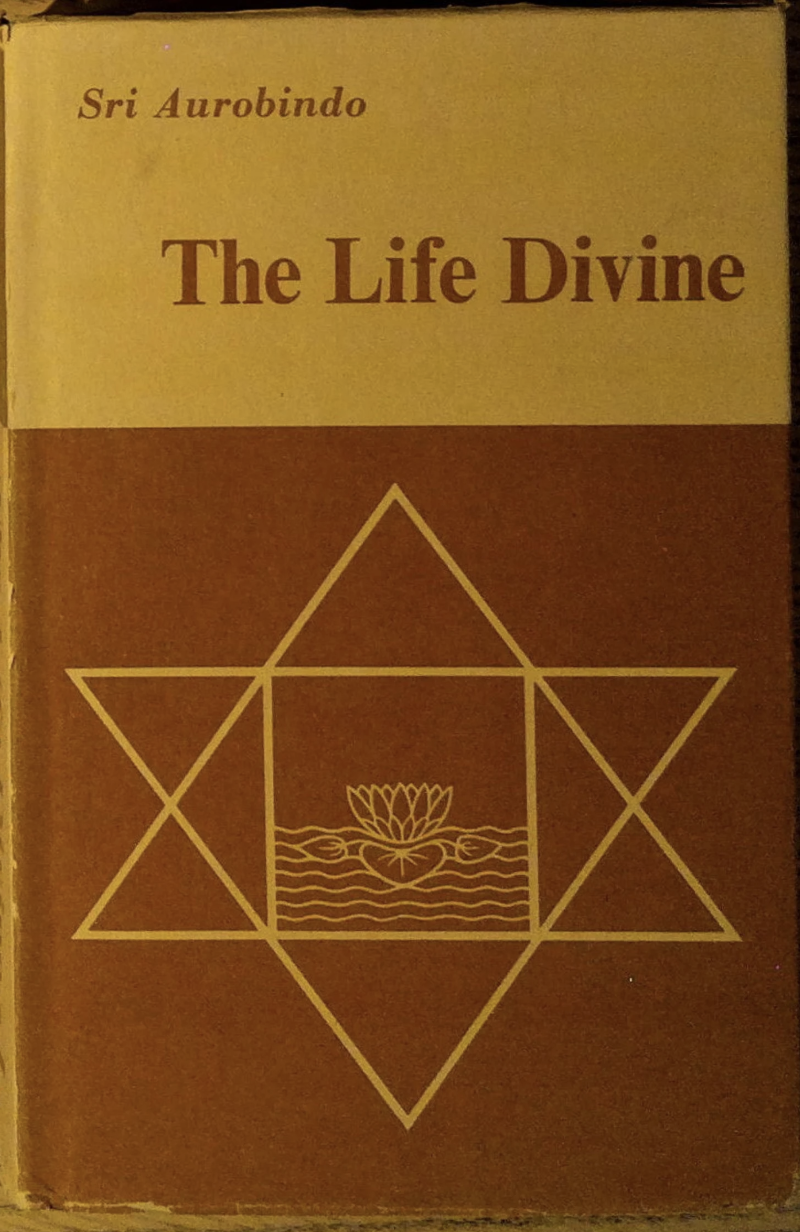
THE LIFE DIVINE by Sri Aurobindo was first written and published serially in the monthly review Arya between August 1914 and January 1919. The original language of composition was English.
1. The Life Divine Book I
2. The Life Divine Book II

BOOK 1 – OMNIPRESENT REALITY AND THE UNIVERSE 

  1. The Human Aspiration
    Impulse toward perfection.
  2. The Two Negations: The Materialist Denial
    The materialist negation denies spirit, and affirms that only matter or force is real.
  3. The Two Negations: The Refusal of the Ascetic
    The ascetic insists on pure spirit as the sole reality, free from change, death.
  4. Reality Omnipresent
    World and non-being are affirmations of omnipresent Reality.
  5. The Destiny of the Individual
    Liberation of the individual is the keynote of the definitive divine action.
  6. Man in the Universe
    Universe and individual are necessary to each other, and the conditions of the universe provide the means for our progress.
  7. The Ego and the Dualities
    Dualities (pain, etc.) are the first inevitable outcome of the attempt to realize unity through the self-limitation of the ego. [Dualities are two ends of a dimension. Ego-spirit is a dimension of the mind.]
  8. The Methods of Vedantic Knowledge
    Vedanta starts from reason but uses intuition as the final authority, in order to know truths that are beyond ordinary experience. [What is being referred to as intuition here are actually postulates.]
  9. The Pure Existent
    The pure existence can be known by identity, intuition, but not by thought. [Identity and intuition are postulates; but thought is reason.]
  10. Conscious Force
    The existent is also a self-aware force of consciousness, Chit. [Consciousness grows out of the assimilation of postulates.]
  11. Delight of Existence: The Problem
    If delight is the nature of existence, how can pain exist?… [Pain-delight is a dimension. Pain is force that indicates a lack of assimilation.]
  12. Delight of Existence: The Solution
    Delight is at the root of all experiences, hidden behind our superficial responses… [Delight is an outcome of assimilation]
  13. The Divine Maya
    The power of the self-existence to measure out and order itself is the higher Maya. At the level of mind, this is seen as a lower Maya… [Higher Maya points to greater assimilation. Mind, as lower Maya, is struggling to assimilate anomalies.]
  14. The Supermind as Creator
    Supermind is the intermediary creatrix between the one and the divided many. It puts forth forms out of its own substance. [Supermind is doing real-time assimilation.]
  15. The Supreme Truth-Consciousness
    The supermind is a cosmic vision and a power of projecting concentration, everywhere present as an ordering self-knowledge. [Supermind is focused on real-time assimilation.]
  16. The Triple Status of Supermind
    Supermind takes a triple status in its role as the intermediary between the absolute Sacchidananda and the separate mind. The triple status is: 1) equal self-extension, 2) individual divine, Jivatman, 3) divine projected into existence, the psychic. [The supermind is boring into the Unknowable by postulating and assimilating. 1) It is doing so evenly and impartially wherever anomalies appear. 2) This function is the constant of Individual divine. 3) The psychic being is the continual progress.]
  17. The Divine Soul
    The divine soul in itself, not descended into the ignorance. [It is real-time resolution of anomalies.]
  18. Mind and Supermind
    The fundamental error, Avidya, of mind lies in conceiving of things as separate. This is the final stage of the apprehending movement, Prajnana, of the supermind. [Avidya lies in the inability to spot anomalies.]
  19. Life
    Life is a universal operation of conscious-force, acting to create, maintain, and destroy forms. [Life is a universal operation of assimilation.]
  20. Death, Desire and Incapacity
    Death, desire, and incapacity are necessary processes of life as it is in a limited form. [Assimilation results in evolution of forms.]
  21. The Ascent of Life
    Life ascends through four statuses: physical matter; vitality; mind; and spirit. It has different expressions at each stage.
  22. The Problem of Life
    The problem of life is that it is an infinite force in a divided action, which results in the clash of forces. [As the violations of oneness among postulates are approached, a tremendous inertia towards assimilation is encountered. This is the inertia of fixed ideas.]
  23. The Double Soul in Man
    Like all principles, the soul has a surface form and a true form. The surface is the desire-soul, whereas the true form is the psychic being, the caitya purusha. [Here we have an anomaly inherent to the postulate. To solve it requires a technique like Subject Clearing.]
  24. Matter
    Matter is the result of the dividing action of cosmic mind, causing extreme fragmentation as the basis of evolution. In reality it is a form of conscious-force, but we know it only as the senses contact it. [Matter is in extreme violation of oneness, because it is closest to the raw postulates; and, therefore, it requires the most unpacking.]
  25. The Knot of Matter
    Matter presents a practical difficulty, due to three characteristics: its self-lost inconscience; its bondage to material law; and the principle of division and struggle. [Matter is utterly unconscious of its own source and unity, it is split into multiplicity of forms and opposing forces, and has become totally mechanical.]
  26. The Ascending Series of Substance
    Substance itself has an ascending series from matter to the spirit, and in each level there is less bondage to form, greater force, flexibility, and power of transmutation. [Substance has an ascending series from matter to radiation to thought in terms of increasing motion and flexibility.]
  27. The Sevenfold Chord of Being
    Mind, life, matter, supermind, sat-chit-ananda is the sevenfold chord. The nodus of the psyche adds an eighth. [This is mapping of the Divine Being into a graded hierarchy from pure Spirit down to physical existence.]
  28. Supermind, Mind and the Overmind Maya
    Overmind is the link between supermind and mind, and has ranges (higher mind, etc.). Overmind itself is still a realm of knowledge, the higher Maya. [There are many gradations of mind from ego to spirit.]

BOOK 2 – THE KNOWLEDGE AND THE IGNORANCE 

  1. Indeterminates, Cosmic Determinations and the Indeterminable
    Specific things (determinates) arise in the infinite (indeterminable) because a secret involved consciousness is behind the material universe. The freedom of the infinite from specific form is positive, not negative. [The “secret involved consciousness” is the Unknowable.]
  2. Brahman, Purusha, Ishwara—Maya, Prakriti, Shakti
    In each status of being, the spirit takes a poise proper to that level. Brahman meets us in three general modes of self (Brahman, Purusha, Ishwara) and power of self (Maya, Prakriti, Shakti). The Reality can simultaneously inhabit the individual and the cosmic, time and timelessness, etc.
  3. The Eternal and the Individual
    The question of the individual comes from the reason thinking of the temporary ego as the individual. In reality there is a Person (purusha) behind the individual, which has a spiritual unity with other selves and the world. All particulars have the absolute behind them, and the presence of the human individual is the key to the divine unfolding.
  4. The Divine and the Undivine
    The experience of what is undivine (suffering, limitation, etc.) is because consciousness is limited, not the divine being. It is a necessary consequence of the divine limiting itself, and of a progressive evolution. Even so, our revolt against them is necessary, and part of the adventure of the soul in self-concealing and self-finding.
  5. The Cosmic Illusion: Mind, Dream and Hallucination
    Dreams and hallucinations do not provide a valid analogy for the world, since they are themselves based on realities. Dreams are a transcript or symbol of reality, but so is the surface consciousness. It appears that mind is not an original creator, but rather an instrument of ignorance of a truth-consciousness. [The reality is an outcome of postulates and not an illusion by itself unless it is distorted.]
  6. Reality and the Cosmic Illusion
    Classical theory of illusion is that there is a sole reality, and the phenomenal world is an illusion. But the premises for this do not hold up. The true premise is that an eternal oneness supports an eternal dynamism, and there are multiple real statuses of being and consciousness. So the real question is how these statuses (knowledge and ignorance) arose, and what is the relation between them. [Natural laws are an outcome of oneness of postulates. They are not an illusion in themselves; but an ignorance of these laws may lead to illusion.]
  7. The Knowledge and the Ignorance
    If mind were the original form of consciousness, then illusion might be the source of the world. But the integral view (from the Vedas), is that ignorance is a limited form of knowledge. [The source of illusion is the ignorance of anomalies, that have remained unresolved.]
  8. Memory, Self-Consciousness and the Ignorance
    A consideration of memory leads us to see an eternal conscious being who supports the action of mind in time on a basis of stable consciousness free from time. Our surface being is really our deeper self adventuring through time, using memory as coin of experience.
  9. Memory, Ego and Self-Experience
    Memory and ego are devices used by the mental being; they do not constitute direct or continuous experience of past, present, future. There is in fact one being, but the immutable self is not experienced by the surface mental consciousness.
  10. Knowledge by Identity and Separative Knowledge
    Knowledge goes from identity in the absolute to separative ignorance on the surface. Opening to the subliminal is the critical movement in developing knowledge by direct contact, and the cosmic being.
  11. The Boundaries of the Ignorance
    In our surface mentality we are ignorant of our own inner being, of the world around, and of our superconscient being. The world currents run in us, but we think that these things take place separately.
  12. The Origin of the Ignorance
    Being is unitary, so ignorance must be a movement of the one conscious reality. Just as the experience of passive and active Brahman must be a seeming alternation, not a fundamental one, so the ignorance cannot be primal and original – it must be a partial and relative movement of the reality.
  13. Exclusive Concentration of Consciousness-Force and the Ignorance
    Ignorance is really a positive power of the infinite for exclusive concentration. It is required for the individual to exist and evolve in the cosmos. The ignorance of inconscient matter is complete, but superficial, and underneath it is the awareness of the eternal.
  14. The Origin and Remedy of Falsehood, Error, Wrong and Evil
    Origin of falsehood and evil is a limited consciousness growing out of nescience, personal attachment to the limitation, a consciousness governed by the life-ego. The true solution is to find the soul, become one with all beings, realize the divine, and heal the division between nature and supernature.
  15. Reality and the Integral Knowledge
    Integral conception sees finite/infinite, many/one, etc. as complementary. Both the subjective and the objective must be known, in their entirety, and we must have freedom in our methods. The sevenfold ignorance must be replaced by a sevenfold knowledge.
  16. The Integral Knowledge and the Aim of Life: Four Theories of Existence
    The four theories are the supracosmic; terrestrial; other-worldly; integral. Taking into account the absolute as the origin, and involution/evolution, the only sense of life must be that of an evolution in consciousness towards a perfect expression of the spirit here and elsewhere.
  17. The Progress to Knowledge—God, Man and Nature
    God, individual, nature are the three categories, approaches in our search for knowledge. In the conscious unity, all three are realized and harmonized.
  18. The Evolutionary Process—Ascent and Integration
    Evolution has the triple character of development of forms, progress of consciousness, and integration of previous elements. In each, a latent power of consciousness emerges. Human development so far has been on the surface; the next stage is the conscious and inner development.
  19. Out of the Sevenfold Ignorance Towards the Sevenfold Knowledge
    The method and result of a conscious spiritual evolution is a transformation of the ignorant mental life into the divine life of the truth-conscious spirit, a self-expansion. It is a heightening and a greatening of consciousness.
  20. The Philosophy of Rebirth
    If there is an evolution of consciousness in a body, and an individual soul inhabiting the body, then rebirth is a necessary machinery for progressive experience.
  21. The Order of the Worlds
    Inner experience indicates that there are other worlds, independent of the physical, which communicate with the physical and have influences here. They are based on the seven principles of the spirit (sat-chit-ananda-supermind-mind-life).
  22. Rebirth and Other Worlds; Karma, the Soul and Immortality
    The nature of evolution and other worlds necessitates an internatal period, and ultimately the soul goes to its own plane for assimilation of experiences. The processes of reincarnation involve all our energies and bodies, as well as the conscious will of the soul. What continues is the spiritual person, not the outer personality.
  23. Man and the Evolution
    The true meaning of evolution is the evolution of consciousness in matter. It has produced change in outward forms and in principles of consciousness. At the human level, change through consciousness becomes primary, instead of change of form. Human is an intermediate term, with a future supramental level yet to emerge.
  24. The Evolution of the Spiritual Man
    Spiritual first emerges in common activities, through the mind or emotions. Has been through religion, occultism, spiritual thought, and finally realization. Spiritual realization so far has not been transformative, but still it is to prepare the being. Though the lines are general, there must be a great variety.
  25. The Triple Transformation
    The first transformation comes by the emergence of the psychic being, which uses and then purifies our current instruments through the contact with the divine. It results in a guidance, and a free inflow of all kinds of spiritual experience. The second transformation is the descent from and ascent to the infinity and eternal spiritual consciousness above. The higher ranges of mind begin to form, but its work is still hampered by the disabilities of the lower consciousness. These are preparatory to the supramental transformation.
  26. The Ascent towards Supermind
    Inner awareness and a breaking down of the barrier between inner and outer are the first conditions of this transition. The psychic and spiritual transformations are crucial and prepare the being. The four main stages are higher, illumined, intuitive, and overmind. Each has its own substance, power. The actuality is more complex, owing to the necessity of integration, gradations, interpenetration of degrees, and the necessity to transform the outer, dynamic side of our nature.
  27. The Gnostic Being
    The emergence of the gnostic being will be gradual, and it will be continue to evolve, with a great diversity. It will be the consummation of the spiritual life, always having the experience of the divine, acting from the divine will, in perfect harmony with all forces and beings. Discovery (mind), growth (life), and the body will continue, but based on a divine identity. The person will not be a fixed set of qualities, but rather an index of the infinite behind. Standards of conduct will not be necessary, because the gnostic will automatically obey the inherent law in each instance.
  28. The Divine Life
    Consciousness and life are the keywords of evolution, but they are still imperfect. The foundation of the spiritual and divine life must be an inner growth; the outer is then transformed by that inner reality. A gnostic collectivity is held together by the same principle of oneness, mutuality, harmony as the gnostic individual. The supernature that we have to evolve includes new powers of consciousness, which are natural to it. The perfection of society comes by the perfection of the individuals within it. The gnostic collectivity will harmonize with the life of the ignorance around it, and will be the unfolding of a constant, creative miracle, not a monotone.

.

The Life Divine

Here are a set of lectures that expound on this wonderful book: The Life Divine.
1. The Life Divine Book I
2. The Life Divine Book II

The Life Divine Chapter I & II (Dec 1996)

  1. https://www.youtube.com/watch?v=Cx99EITuhSo Part-1 (12:58)
  2. https://www.youtube.com/watch?v=tZcAMOdz_xw Part-2 (13:23)
  3. https://www.youtube.com/watch?v=mG9nVQIjT6E Part-3 (13:05)
  4. https://www.youtube.com/watch?v=gmx2QqRbBig Part-4 (12:31)
  5. https://www.youtube.com/watch?v=H-unsli-QP0 Part-5 (14:33)
  6. https://www.youtube.com/watch?v=hzccXuRFFYw Part-6 (16:33)
  7. https://www.youtube.com/watch?v=coY6N15V0vE Part-7 (14:18)
  8. https://www.youtube.com/watch?v=5DgPpzC8dKg Part-8 (12:31)
  9. https://www.youtube.com/watch?v=ZbFwj1_p-tA Part-9 (13:45)
  10. https://www.youtube.com/watch?v=hMfnVxGWsvY Part-10 (24:52)
  11. https://www.youtube.com/watch?v=f3YaXDML2Nc Part-11 (10:31)

The Life Divine – Chapters 1 to 7 (April-May 2008)

  1. https://www.youtube.com/watch?v=2LOlJZYfK0g Part 1 (21:30)
  2. https://www.youtube.com/watch?v=dvwqI-Midek Part 2 (21:30)
  3. https://www.youtube.com/watch?v=xxWXHJp9DE4 Part 3 (18:29)
  4. https://www.youtube.com/watch?v=GqYr7zZmOqo Part 4 (21:30)
  5. https://www.youtube.com/watch?v=7ZUcftGAC9g Part 5 (21:30)
  6. https://www.youtube.com/watch?v=K8kRAfUvtX8 Part 6 (18:41)
  7. https://www.youtube.com/watch?v=70wRlbwNW-Y Part 7 (21:30)
  8. https://www.youtube.com/watch?v=mqP3YfUFP-s Part 8 (21:30)
  9. https://www.youtube.com/watch?v=VbyTemoZA0c Part 9 (7:33)
  10. https://www.youtube.com/watch?v=5_WQnUocf84 Part 10 (21:30)
  11. https://www.youtube.com/watch?v=MtS39kJKLg8 Part 11 (21:30)
  12. https://www.youtube.com/watch?v=oOYZ0drp-4M Part 12 (16:48)
  13. https://www.youtube.com/watch?v=AZbapNyR5fI Part 13 (29:41)
  14. https://www.youtube.com/watch?v=oh_iIcENeMg Part 14 (29:30)
  15. https://www.youtube.com/watch?v=mploH7L3XIM Part 15-16 (21:30)
  16. https://www.youtube.com/watch?v=7xmI5sjuaP0 Part 17 (21:30)
  17. https://www.youtube.com/watch?v=NcHDrzc7sPw Part 18 (10:00)
  18. https://www.youtube.com/watch?v=0FbVju94Hh0 Part 19 (21:30)
  19. https://www.youtube.com/watch?v=FHWZTUzNkUw Part 20 (21:30)
  20. https://www.youtube.com/watch?v=Kxinq7R_iOM Part 21 (17:28)
  21. https://www.youtube.com/watch?v=pHGqU05xVs0 Part 22 (21:30)
  22. https://www.youtube.com/watch?v=mKZnIeYdRZI Part 23 (21:30)
  23. https://www.youtube.com/watch?v=Beq_oyssu5w Part 24 (18:09)
  24. https://www.youtube.com/watch?v=aDEjaO5Plhs Part 25 (21:30)
  25. https://www.youtube.com/watch?v=54ziDq6Ag7A Part 26 (21:30)
  26. https://www.youtube.com/watch?v=nmiLwdT8mZY Part 27 (2:48)
  27. https://www.youtube.com/watch?v=JdIQ-jxb82M Part 28 (21:30)
  28. https://www.youtube.com/watch?v=QG4H7ux7WBA Part 29 (21:30)
  29. https://www.youtube.com/watch?v=LT4JrihRdPQ Part 30 (18:04)
  30. https://www.youtube.com/watch?v=8o6ME_S8SgI Part 31 (29:40)
  31. https://www.youtube.com/watch?v=4tvagx9pGcA Part 32 (29:43)
  32. https://www.youtube.com/watch?v=mQS5kdjjEb0 Part 33 (blank)
  33. https://www.youtube.com/watch?v=KGj6hHVE29I Part 34 (21:30)
  34. https://www.youtube.com/watch?v=aPKYjjjJtJk Part 35 (21:30)
  35. https://www.youtube.com/watch?v=lp74y8eoM7w Part 36 (10:53)
  36. https://www.youtube.com/watch?v=EPW1anBKn1I Part 37 (21:30)
  37. https://www.youtube.com/watch?v=JDUEVv_-ICc Part 38 (21:30)
  38. https://www.youtube.com/watch?v=lLdgdUPC_OY Part 39 (17:16)
  39. https://www.youtube.com/watch?v=xWmaC1PCx9g Part 40 (21:30)
  40. https://www.youtube.com/watch?v=QLB6E9kgKFA (Part 41) (21:30)
  41. https://www.youtube.com/watch?v=sKMrubdFXYI (Part 42) (18:46)
  42. https://www.youtube.com/watch?v=R74RRN3ArTQ (Part 43) (21:30)
  43. https://www.youtube.com/watch?v=tfiggu9DGwg (Part 44) (15:34)
  44. https://www.youtube.com/watch?v=47QoDSHEZQE (Part 45) (36:46)
  45. https://www.youtube.com/watch?v=GH8gqW8MKXk (Part 46) (50:38)

.

Gods in Rig Veda

Reference: Subject: The Vedas

What is the meaning of gods in Vedas?

(Perplexity AI response)
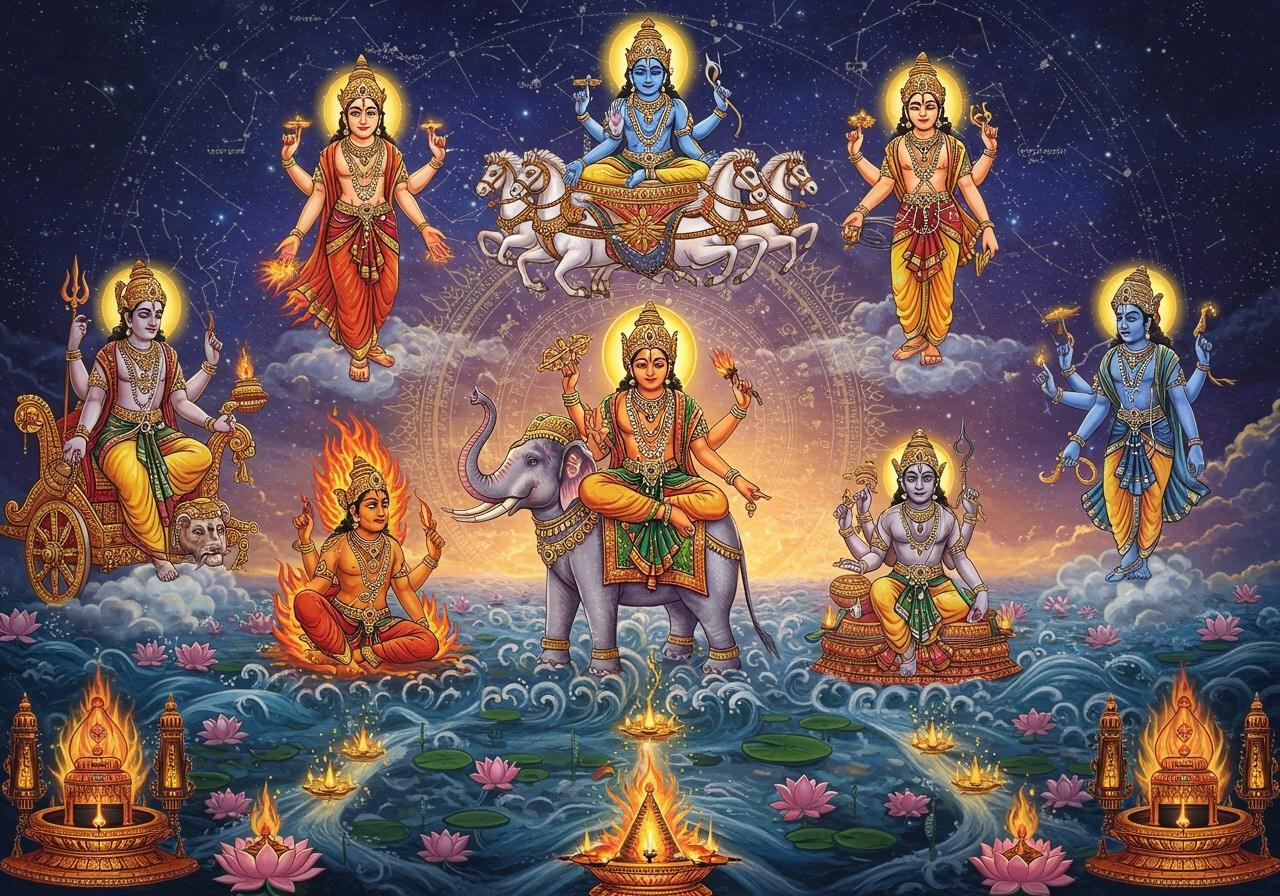
The meaning of god in the Vedas is deeply nuanced and centers on the idea of a supreme, all-pervading reality expressed through various forms and forces of nature. The Vedic texts generally use the term “deva,” which means “the shining one,” symbolizing beings or principles of excellence and brilliance that animate the cosmos and govern natural phenomena. Interpreted on different levels—literal, symbolic, and esoteric—the devas represent both concrete deities and abstract principles such as faith, knowledge, and speech, as well as the elements of creation like fire, water, and air.

Vedic Concept of Divinity
The Vedas describe god as both with attributes (saguna) and without attributes (nirguna), emphasizing a reality that cannot be fully captured by form or name. The primordial God of the Vedas is formless and infinite, manifesting as countless deities who function as the basic principles of cosmic and human existence. God is characterized as the source of light, life, and truth—present within and around every being, not separate from creation but immanent and transcendent. Vedic hymns state, “God is one, but sages call him by different names,” affirming the unity behind the multiplicity of divine forms.

The Term Deva
Deva in Vedic literature is derived etymologically from roots meaning “to shine,” “to give,” and “to be radiant.” Devas are not just supernatural beings; they embody virtues, powers, and cosmic functions. The Vedas recognize 33 main devas, grouped equally in the heavens, atmosphere, and earth, symbolizing the infinite number of forces active in creation. Abstract qualities such as charity, knowledge, and speech can also be worshipped as devas, indicating the evolving and inclusive view of divinity in the Vedas.

Unity and Diversity
While multiple gods are worshipped, the underlying Vedic philosophy points to one ultimate reality (Brahman or Parabrahman), out of which all manifestations arise. The Rig Veda affirms: “Truth is one; the wise call it by various names,” encapsulating the Vedic perspective on divinity—unity expressed through infinite diversity.

In essence, the Vedas conceive god not merely as a personal being but as the ground of all existence, manifesting through myriad forms, names, and principles, and accessible to human experience both within and without.

.

What is the root meaning of the word GOD?

(Perplexity AI response)
The root meaning of the word “God” in English traces back to Old English “god,” itself derived from the Proto-Germanic *gudą (or *guthan). Linguists propose two primary Indo-European roots: one is *ǵhu-tó-m, based on the verb *ǵheu(ə)-, which means “to call” or “to invoke,” and another links to the act of pouring libations or offerings. Thus, the earliest meaning of “god” implies “the one who is invoked,” “the one called upon,” or “the one sacrificed to,” which aligns with the ancient conception of divinity as a being called upon in prayer or ritual.

Etymological Lineage
• Old English: god
• Proto-Germanic: *gudą or *guthan
• Proto-Indo-European: *ǵhu-tó-m from *ǵheu(ə)- (“to call, invoke”), or related to the act of pouring libations
• Cognates: Found in Gothic (guþ), Old Norse (guð), German (Gott), Dutch (god), and Persian (khoda)

The word “god” was not present in the earliest Hebrew, Latin, or Greek scriptural manuscripts and emerged in European languages as a generic term for a deity after the spread of Christianity.

In summary, etymological evidence points to “God” originally meaning “one who is invoked or called upon,” reflecting early ritual practices of addressing the divine in prayer and sacrifice.

Comment on “invoke”
“Invoke” means to call for, petition, or bring about something, such as calling on a spirit, a law, or a tool. It can also refer to causing something to happen, implementing a rule, or using a specific function on a computer or in a program. The term has a variety of uses, from formal legal contexts to informal computer commands.

.

GODS
In deep meditation, the Vedic rishis felt wonderful powers come over them. It gave them new insights never before seen or imagined. They postulated those powers and insights to be gods and deities. Later they invoked these powers in meditation.

.

Agni in Rig Veda

Reference: Subject: The Vedas

AGNI
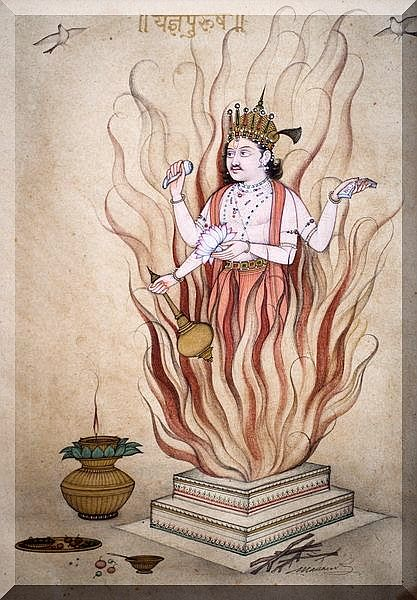
Agni represents divine illumination. It is the excitement of discovery, and the key to all knowledge. Agni is the active power of looking and attaining insight through meditation. 

.

Agni in Mandala 1, Sukta 1

(From Perplexity AI)
The main themes and symbols in Rig Veda Mandala 1, Sukta 1 center on the spiritual, psychological, and cosmic attributes of Agni, moving far beyond ritual fire and touching on the foundational ideas of Vedic thought.

Main Themes

  • Agni as Power of Will: Agni represents willpower and direction, the force that introduces all other powers within the human soul to aid spiritual evolution and fulfillment.
  • Collaboration of Divinity and Humanity: A recurring Vedic idea is that humans and devas (gods) are co-creators, collaborating in realizing higher truths and spiritual progress.
  • Spiritual Progress and Plenitude: Agni is seen not just as a bestower of material wealth, but as the conduit for “inner plentitude,” inspiring and guiding seekers toward heroism, knowledge, and the fullness of being.
  • Truth and Illumination: Agni is the “guardian of Truth”, symbolizing psychological illumination and the protection of divine order, rather than mere ritualistic functionality.
  • Fatherly Guidance: Agni is invoked as a father figure, approachable and benevolent, reflecting seeds of later Bhakti traditions of emotional devotion and surrender.

Key Symbols

  • Agni (Fire): Symbolizes both actual sacrificial fire and the internal spark of inspiration, consciousness, and transformation.
  • Hota, Ritvik, Purohita: Agni embodies multiple priestly roles—invoker, knower of truth, and foremost guide in the ritual—which are metaphorical for guidance of thought and aspiration.
  • Wealth (Ratna, Rayi): These terms represent not only material prosperity, but spiritual abundance, divine joy, and the richness of higher consciousness.
  • Day and Night: Serve as symbols for the alternation of ignorance and illumination within the aspirant, underpinning the path to enlightenment.

Symbolic Interpretation
The language and imagery of Sukta 1 suggest that rituals themselves are metaphors for internal spiritual practices: kindling Agni inside oneself means awakening the will, aspiration, and the power to access higher consciousness and truth.

.

Evolution of Agni’ symbolism across Mandala 1

(From Perplexity AI)
Agni’s symbolism in Mandala 1 of the Rig Veda evolves from being the ritual fire and cosmic medium to embodying deeper spiritual, psychological, and metaphysical principles. Across the Mandala, Agni is described and invoked in several overlapping yet expanding roles that chart a journey from external ritual to inner realization and cosmic consciousness.

Early Hymns: Ritual and Spiritual Will

  • In Sukta 1, Agni represents the presiding priest (purohita) and the Hotar, bridging humans and gods—a channel for offerings and blessings.
  • He emerges as the psychological power of will—the force of aspiration and inspiration vital for spiritual progress, not merely a ritual symbol.
  • Agni is the guardian of Truth (ṛta), simultaneously instilling order and illumination within the seeker.

Expansion of Symbolism: Cosmic and Psychological

  • As the Mandala progresses, Agni’s symbolism deepens:
    • Agni is described as present in three realms: earthly fire, lightning in the atmosphere, and the sun in the heavens—a messenger uniting all worlds.
    • He is invoked as Jātaveda (“knower of all births and forms”), being the divine witness, carrier of wisdom, and guardian—connecting fire, knowledge, and divine order.
    • Agni as Kravyād (the funeral fire) symbolizes transition, creative/destructive power, and purification—marking existence, transformation, and rebirth.
    • Agni comes to represent consciousness, discernment, life force, and the mind’s swiftness—as well as the principle of tapas (spiritual heat/energy).

Internalization and Mystical Symbolism

  • Later in Mandala 1, Agni is less an external force and more an internal principle—the spiritual fire kindled by the gods within the soul, not by human hands.
  • There is frequent invocation of Agni as father, friend, and guide, with increasing emotional (Bhakti) resonance, encouraging surrender and inner union.
  • Agni’s iconography and mythology expand; he is depicted with both beneficent and destructive aspects, reborn daily, yet immortal—pervasive in all forms of existence.

Agni evolves from external sacrificial fire to internalized divine principle—the transformative force uniting the ritual, the cosmos, and the inner journey of the seeker towards illumination and truth.

.