Category Archives: Scientology

Scientology’s Fixation on Self

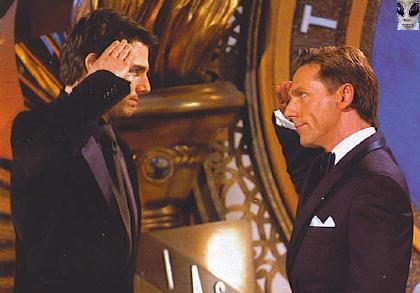
cruise-salute

The key concept in Scientology is that of a “bank” or “reactive mind.” Let’s take a closer look at it. I shall be using definitions from the Technical Dictionary of Scientology.

BANK: (definition #2) A colloquial name for the reactive mind. This is what the procedures of Scn are devoted to disposing of, for it is only a burden to an individual and he is much better off without it.

REACTIVE MIND: (definition #1) a portion of a person’s mind which works on a totally stimulus-response basis, which is not under his volitional control, and which exerts force and the power of command over his awareness, purposes, thoughts, body and actions. Stored in the reactive mind are engrams, and here we find the single source of aberrations and psychosomatic ills.

So, the problem boils down to rigid association among thoughts that channels action only in certain pre-selected manner. There is no flexibility or little room to maneuver. This inflexibility is the Reactive Mind. The solution is to remove this inflexibility.

.

Hubbard ascertained this “inflexibility” to exist at the perceptual level. This became Dianetics. Hubbard reasoned that too much perception coming in at a rapid rate, as in an accident or in a forceful event, would jam up the reasoning faculty of the mind. One would then end up with a jumble of perception waiting to be processed.

Hubbard called this jumble of perception an “engram.” This proved out to be correct. However, after clearing of a few engrams on a case, no more engrams could be found, but case problems still existed. Dianetics hit a brick wall. Per Hubbard’s theory there were supposed to be more engrams, and so it was assumed that the problem was with inaccessibility of these engrams. There was something wrong with the theory, “Stored in the reactive mind are engrams, and here we find the single source of aberrations and psychosomatic ills.” Actually, there were no more engrams. So it was not the engram that was the single source of aberration.

It was the principle of inflexibility that was the source of aberrations and psychosomatic ills.

An engram was only one type of inflexibility. There were other types of inflexibility.

Data gets processed in the mind in the form of following layers (see Perception & Knowledge).

  1. Perception
  2. Experience
  3. Information
  4. Hypothesis
  5. Theory
  6. Principles
  7. Axioms
  8. Self

Inflexibility may generate inconsistencies on each of these layers as follows (see Knowledge & Inconsistency).

  1. Inconsistency in Perception: Engram 
  2. Inconsistency in Experience: Unwanted feeling or emotion 
  3. Inconsistency in Information: Indoctrination
  4. Inconsistency in Hypothesis: Belief
  5. Inconsistency in Theory: Doctrine
  6. Inconsistency in Principles: Fixed ideas
  7. Inconsistency in Axioms: Fixed viewpoints
  8. Inconsistency in Self: Fixed identity 

Thus, engram was one of many type of inconsistencies generated by the general principle of inflexibility. But Hubbard assumed engram to underlie all other type of inconsistencies.  Hubbard brought e-meter to his aid and created hundreds of processes to overcome that assumed lack of accessibility to engrams.

Hubbard made self, or individuality, the foundation of his theory of Scientology. (see Scientology Axiom # 1). His goal became the strengthening of self by searching for and eliminating engrams.

This goal of Hubbard also gave birth to the OT levels. This was same as the age-old search for siddhis that Buddha examined and discarded.

The analysis of inconsistencies above shows that engrams are only at the surface of inconsistencies, which go a lot deeper.  At the deepest level we find the inconsistency of a fixation on self, just as Buddha had preached 2600 years ago. Thus the theory of Scientology seems to look at inconsistencies in the reverse order.

The single source of aberrations and psychosomatic ills is not the engram but a fixation on self. Scientology promotes this fixation on self through its OT Levels.

Until one realizes that looking at self as “something fixed” is the basic inconsistency there is no spiritual freedom.
.

The above is the culmination of the search, for me, of what is wrong with Scientology. Now I can focus on those aspects of Scientology that are beneficial.

The beneficial aspects of Scientology shall be preserved in KHTK.

.

Modern Scientology OT

Here is an example of a modern Scientology OT:

A Scientology OT seems to be fixated on the salvation of the self. He treats self as something that needs to be boosted up, made powerful and glorified. But self is relative, conditioned and impermanent.

“The Absolute Truth is that there is nothing absolute in the world, that everything is relative, conditioned and impermanent, and that there is no unchanging, everlasting, absolute substance like Self, Soul, or Ātman within or without.” ~ Buddha

This fixation on self is one of the problems with Scientology. This is also pertinent to the manipulation of self, as in brainwashing.

.

Comments on Scientology Axioms 1, 2 and 3

Here are some comments on first three axioms of Scientology:

SCIENTOLOGY AXIOM 1: LIFE IS BASICALLY A STATIC.
Definition: a Life Static has no mass, no motion, no wavelength, no location in space or in time. It has the ability to postulate and to perceive.

Static expresses itself as individuality, as explained by Hubbard. [See Scientology Axiom #1.] However, individuality is an aspect of existence same as matter, energy, space and time. It is not a source of existence as implied in Scientology Axiom 3 below.

.

SCIENTOLOGY AXIOM 2: THE STATIC IS CAPABLE OF CONSIDERATIONS, POSTULATES, AND OPINIONS.

The capabilities of considering, postulating and having opinions may be assigned to individuality, which is part of existence. Thus, these capabilities are manifested along with matter, energy, space and time, as aspects of existence.

.

SCIENTOLOGY AXIOM 3: SPACE, ENERGY, OBJECTS, FORM AND TIME ARE THE RESULT OF CONSIDERATIONS MADE AND/OR AGREED UPON OR NOT BY THE STATIC, AND ARE PERCEIVED SOLELY BECAUSE THE STATIC CONSIDERS THAT IT CAN PERCEIVE THEM.

Here Static is being expressed as an individuality. It is being considered to be the cause of existence. But cause and effect are also aspects of existence. [See Scientology Factor #1.]

Space, energy, objects, form, time, individuality and its capabilities are simply the aspects of existence.

.

Energy: A Definition

Hubbard says in THE PHOENIX LECTURES:

AXIOM FIVE: ENERGY CONSISTS OF POSTULATED PARTICLES IN SPACE.

Now, we’ve got space: a viewpoint of dimension.

You say: “I am here looking in a direction.” We’ve actually got to have three points out there to look at, to have three dimensional space. If we only had linear space we would have only one dimension point. One point to view. And energy consists of postulated particles in space, so we’ll demark these three points out there to have some three dimensional space and we’ll have these particles which we will call Anchor Points, and we’ll have energy.

To have 3-dimensional space, we need three directions that are independent and cannot be projected on each other. These directions are as follows:

(1) Back to front
(2) Left to right
(3) Bottom to top

When we move a point from back to front, a one-dimensional line is produced. When we move this line from left to right, a two-dimensional surface is produced. When we move this surface from bottom to top, a three-dimensional block of space is produced.

Additional independent considerations, such as, time, shall add more dimensions to this space. For example, two cars may cross the same point at an intersection, but may not crash when times are different.

There may be any number of independent “directions,” or considerations, added, and each such consideration shall introduce a new dimension to space.

Energy would be the shifting and vibrating of considerations that make up the space. The most fundamental of these considerations would be the point or location in space and the shifting of this location in the three spatial dimensions. An electromagnetic wave may be the result of spatial locations shifting and vibrating as such. The electromagnetic wave may be looked upon as a ripple in the very fabric of space.

Space is made up of considerations that are NOT nothing. It is the shifting and vibrating of space, which manifests as energy. The conjecture introduced here postulates the relationship of space to energy. 

Vibrating space shall have the fundamental dimension of frequency associated with it. The higher the frequency, the more solid the ripple in space may appear to be. The constraints generated by spatial dimensions may make this energy wave appear as a particle like electron and others that make up protons and neutrons.

What is presented here is a wild conjecture that may come to nothing. But we do know from Einstein’s research that  energy condenses as matter. So the ideas presented here need to be looked at more closely for consistency or inconsistencies.

.

Space: A Definition

Hubbard, the founder of Scientology, says in THE PHOENIX LECTURES:

AXIOM FOUR: SPACE IS A VIEWPOINT OF DIMENSION.

Do you know that physics has gone on since the time of Aristotle without knowing that! Yet we read in the Encyclopedia Britannica of many years ago (the Eleventh Edition, published in 1911) that space and time are not a problem of the physicist. They are the problem of one working in the field of the mind. And it says that when the field of psychology solves the existence of space and time why then physics will be able to do something with it. And all those fellows with their Ph.D.’s — not for centuries actually but a number of decades (it seems like centuries if you’ve ever listened to their lectures) — going back to the days of Wundt, The Only Wundt — about 1867 — they didn’t read the Encyclopedia Britannica and find out that they held the responsibility for identifying space and time so that physics could get on its way.

And because they avoided this responsibility we have to pitch in here and discover and develop Scientology — not to work in the field of physics, however, but to work in the field of the Humanities. But it so happened that I discovered very, very early while I was studying nuclear physics at George Washington University that physics did not have a definition for space, time and energy. It defined energy in terms of space and time. It defined space in terms of time and energy, and it defined time in terms of energy and space. It was going around in a circle. I first moved out of that circle by putting it into human behavior — be, do and have, which you’ll find in Scientology: 8-8008, but the point is here that without a definition for space, physics was and is adrift. One of our auditors was recently talking to an engineer in an Atomic Energy Commission plant, and happened to remark, “Well, we have a definition for space.” This engineer said, “Uh, you do?” and got instantly interested. Of course we didn’t make this definition for nuclear physics, but they could certainly use one. The engineer asked, “What is the definition of space?” and the auditor said, “Space is viewpoint of dimension.” This fellow just sat there for a moment, and he sat there, and then all of a sudden he rushed to the phone and dialed a number and he said, “Close down number five.!” He had suddenly realized that an experiment in progress was about to explode and one of the reasons he knew it was about to explode is that he had found out what space was. This is of great interest to nuclear physicists, but they will get one of these definitions and then they will start to figure, figure, figure, figure, figure. They don’t take the definition as such and use it as such. They figure-figure, and they lose it.

.

Hubbard implies that space is generated by viewpoint. But a viewpoint, being a point, must itself be part of space. It appears that space has both physical and mental (spiritual) aspects to it. The following seems to be the characteristics of space:

  1. Space is basically a field, or an expanse, made up of points or locations.

  2. This expanse of points is infinite having no limits.

  3. Each point is recognized by considerations attached to it.

  4. The primary consideration is that of being part of a matrix.

  5. The consideration at a point may acquire the dimension of being a “point of reference.”

  6. That point then becomes a viewpoint from which other points may be viewed or considered.

  7. The points in space may have considerations of their own as matter, energy, space and time (MEST).

  8. These points may also be viewed through considerations generated at the viewpoint, such as, perceptions, experience, information, hypothesis, theory, principles, axioms, and self.

  9. A point in space is known by its considerations, and the considerations that are attached to it by the viewpoint.

  10. The points become unknowable as they move farther and farther away from the viewpoint.

.