Category Archives: Physics Book

The Physics Book.

The Quantum Particle (old)

A quantum was, at first, proposed as a mathematical concept by Max Planck that explained the distribution of the Black body radiation. It was a groundbreaking concept in the sense that it expressed energy as a function of frequency instead of amplitude of the waveform.

Einstein, in his groundbreaking paper on Light quanta, was able to show that the entropy of monochromatic radiation follows the same rules as the entropy of a perfect gas. Einstein thus showed that Planck’s postulate of energy quanta was more than a mathematical device. It was real in a physical sense.

In the classical view, wave represents a motion traveling through a medium. In this view the particles of medium simply oscillate about a stationary location and do not move with the wave. But this is not so with light. Einstein showed that there was no stationary aether in which light moved as a disturbance. Instead light approximated the motion of the particles of gas in which the particles themselves move. This meant that light was its own substance that moved like a wave.The frequency of light represents its density as a substance. The substance of light becomes denser as its frequency increases.

Energy of light is a function of its frequency because light is a substance that is in motion. Light is not a classical wave that represents pure motion in a medium.

.

The Model for a Quantum Particle

A material particle is like a “point particle” with all its mass concentrated at one point. A material object is made up of discrete point particles rigidly structured relative to each other. Because of this rigid structure, a large material body, like the earth also has a center of mass.

The uncertainty principle essentially says that the location of a quantum particle cannot be pinned. In other words, a quantum particle has dimensions. At the same time a quantum particle is not structured because it does not have a center of mass. But it has a density. We shall refer to this density as “mass density” instead of energy density to emphasize that light has substance that is in motion.

If we assume a point particle to have the mass and dimensions of the nucleus of the hydrogen atom, then an electron of the same mass shall be about 1900 times the size of the nucleus (about the size of the hydrogen atom), and a photon of the same mass shall be 270 million times the size of the hydrogen nucleus. So, it is incorrect to think of a quantum particle as a point, or rigid particle like that of matter.

As explained in the chapter Mass Density and Motion, the electronic region is in rapid motion around the nucleus because of its low density. An electron roughly the size of an atom shall serve as a model for a quantum particle. But a photon as a quantum particle shall be millions of time larger in size compared to an electron with corresponding reduction in its density and increase in velocity.

The quantum particles do not have individual centers of mass. Therefore, they are not discrete like material particles; instead they form a fluid like continuum of substance. This substance moves very rapidly with wave-like characteristics.

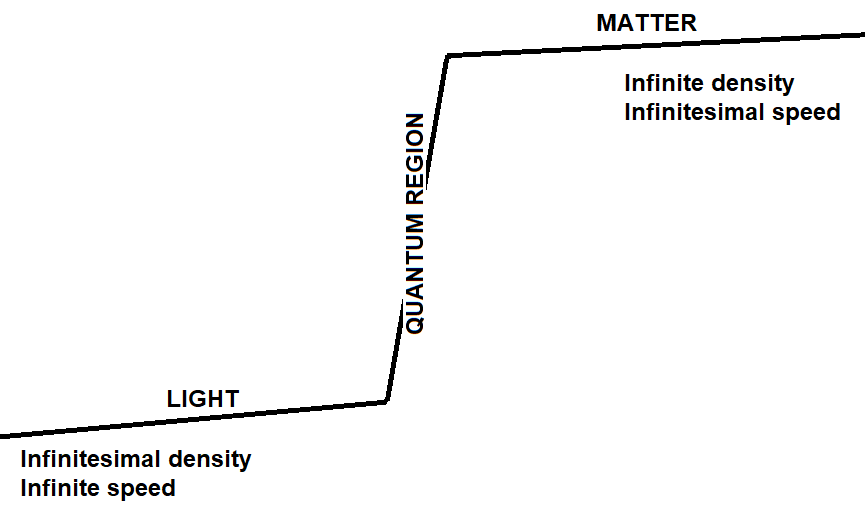
The lower is the density of the quantum particle, the larger is its size and the greater is its velocity. The quantum particles combine to form a fluid like continuum with wave-like characteristics.

.

Limitation of Quantum Mechanics

In the absence of a realistic model of a quantum particle, quantum mechanics has become unreal and mathematically abstract.

In his 1905 paper on light quanta,  Einstein makes the assumption: “the energy of a ponderable body cannot be split into arbitrarily many, arbitrarily small parts”. In other words, Einstein assumes that the solidity of a particle is fixed in terms of its density. It cannot be cut into smaller particles indefinitely, while its density remains fixed.

The truth is that the solidity of a particle can become less solid without limit.

In the essay, Relativity & Problem of Space, Einstein interpreted Newton as follows,

But in this [Newton’s] theory, acceleration can only denote “acceleration with respect to space”. Newton’s space must thus be thought of as “at rest”, or at least as “unaccelerated”, in order that one can consider the acceleration, which appears in the law of motion, as being a magnitude with any meaning.

But acceleration is a change in velocity of an object, which relates to its density. Space cannot be at rest as it has no substance. If the density of space is zero then its velocity is infinite.

This confusion of basic concepts essentially derailed quantum mechanics theoretically.

.
Mass Density and Motion

As shown in the chapter on Mass Density and Field, the range of mass density was extended greatly with the discovery of the nuclear and electronic regions in the atom.

The density of ordinary matter is the average of the nuclear and electronic mass densities. This is so for solids and liquids. For gases the atoms and molecules are separated by space filled with electromagnetic and gravitational fields.

The mass density of electronic and other fields is beyond the range of material densities. In fact the mass density of field, in general, is so low that it is replaced by an equivalent “energy” value. 

.

Equivalency of Mass and Energy

Einstein’s famous equation, E = mc2 shows that the energy to mass ratio is c2 to 1. Therefore, it is practical to represent infinitesimal measures of mass by an equivalent energy value that can be measured.

The mass density of the electronic region is so small that we represent it by an equivalent energy value. But that does not mean that the electronic field is not a substance.

The electronic field does not stop being a substance, just because its mass is represented by equivalent energy value.

.

Motion of Electrons

Motion exists because substance changes its location in space. The greater is the duration of substance the longer it stays at a location and the lesser is its motion. That means the more enduring a substance is the smaller is its inherent motion.

We notice that ephemeral substances do not have as much endurance as solid objects. Therefore, mass density is a direct measure of the endurance and inherent motion of a substance. The lesser is the mass density, the greater is its inherent motion. We see this in the inherent motion of the electronic substance relative to the nucleus.

In the atom, the electronic region is in rapid motion relative to the nucleus because of the large mass density differential.

.

Motion: Matter versus Field

The mass density of electromagnetic (EM) radiation is much less than the mass density of the electronic region in the atom. In general, the mass densities in the field region are many orders of magnitude less than the mass densities in the material region. This is reflected in the velocity of light being many orders of magnitude greater than the velocity of a material body, such as, the earth.

It appears that the lesser is the mass density of a substance, the greater is its velocity. This velocity is indicative of an intrinsic motion, and not of relative motions. There are many examples of intrinsic motion in the macroscopic material world in the form of the brownian motion and in the agitation of gas molecules.

There exists instrinsic motion in substances due to differences in their mass densities.

.

Motion of Matter

The mass density in the material region may be called inertia. This is so with solid and liquids where atoms are concentrated. Gases shall be excluded from this consideration unless they are liquefied or frozen.

We may, therefore, expect a material object to be fixed in its natural velocity. If the material object is forced to accelerate by the application of external force, it will return to its natural velocity when that force is removed. This conclusion modifies what Newton proposed.

If a material object is continually accelerated by the application of a constant force (as in a gravitational field), then its inertia might decrease. This change, however, may be imperceptible because of energy to mass ratio is c2 to 1.

The following conclusions of the theory of special relativity become questionable.

  • Does mass increases with increasing velocity? The opposite appears to be true.
  • Can a material object be accelerated to the velocity of light without reducing its inertia? This doesn’t seem to be so.

Many scientific beliefs have been inspired by incorrect interpretations of mathematics, as in the case of the special theory of relativity.

.

Motion of Field

The mass density of the EM radiation may be approximated by its frequency. The higher is the frequency the greater seems to be the mass density of the field. We may, therefore, expect the velocity of the field substance to decrease with increasing frequency.

The velocity of light that has been measured is essentially the velocity of visible light. We assume this velocity to be the same throughout the EM spectrum, but that may not be so. This assumption is the outcome of Maxwell’s theory, which, by default, assumes constant mass density for aether, the medium of whole EM spectrum.

The gravitational field is expected to have much lesser mass density and frequency than those in the EM spectrum. Therefore, its velocity is expected to be much higher than the velocity of light

On the basis of mass density the speed of gravitational field is expected to be much greater than the velocity of light.

.

Absolute Motion

Absolute motion is the motion that does not depend on anything external to the moving object for its existence or specific nature. Thus, the motion, which depends only on the mass density of the substance, may be deemed absolute.

A substance of infinite inertia is expected to be at absolute rest. In other words, any substance at absolute rest shall have infinite inertia. If there is stationary aether, its inertia would be infinite. The empty space has zero inertia. Therefore, empty space shall have infinie velocity.

Einstein was right to discard the notion of stationary aether.

Acceleration is the change in velocity relative to the velocity of the object. Therefore, acceleration shall also fall under the category of absolute motion. Acceleration may also be seen as change in relative velocity. Relative velocity however, cannot be determined without an external reference. But acceleration can be sensed in one’s bones without an external reference.

Absolute motion exists.

.

The Logic of Field

As shown in the chapter on The Logic of Substance, both matter and light are substance, which means they have mass. The range of mass density of matter is from 1.93 x 10⁴ kg/m3 for Gold to 9.0 x 10⁻² kg/mfor Hydrogen (at Standard Temperature and Pressure). Compared to this range, the mass density of light is so small that it is replaced by an equivalent “energy” value. The unfortunate result of this has been that light is no longer looked upon as a substance, but as energy.

When it comes to light and other non-atomic particles, mass density may be referred to as mass concentration.

.

Mass Concentration

Much of the differences in mass concentration, in the case of matter, come from differences in the concentration of atoms. Atoms are highly concentrated in solids and liquids, but not so concentrated in gases. Atoms themselves seem to have a much narrower range of mass concentrations.

When we look at the mass concentration within atoms, it is an average of the mass concentrations of the nucleus and surrounding electrons. The nucleus is made up of a discrete number of protons and neutrons, that have about the same mass concentration. We may say that that the mass concentration of all nuclei is just about constant. The nucleus occupies about 0.01% of the atomic volume. Electrons fill rest of the space of the atom around the nucleus. The masses of electron and proton are in the ratio 1:1840. So the mass concentration of the nucleus is very high—much higher than the mass concentration of matter.

The mass concentration of an atom is practically constant. The mass concentration of matter reduces as space between the atoms increases.

.

The Atom

The atom divides sharply into nuclear and electronic regions. The mass concentration declines suddenly from the nuclear to electronic region in the ratio 1840 to 1. The sharp gradient at the interface of the two regions is seen as CHARGE. More on this later.

The nuclear region is populated by “material particles” that have center of mass. The property of center of mass makes one particle distinct from another. This property underlies the discreteness of material particles.

When the center of mass is not there as in the fast moving electronic region, the “particles” cannot be perceived as discrete. The electrons, therefore, appear to form a fluid ring around the nucleus, much like the ring of the Saturn. The old “solar system” model of the atom has long been discarded.

The atom is like a point nucleus encircled by a large Saturnian ring made of rapidly moving electronic fluid.

.

The Field Concept

The large Saturnian ring of electronic fluid around the nucleus gives us the first realistic concept of the field. This field is not abstract. It is substantial with appreciable mass concentration. There are no centers of mass in field particles. So the field is a continuum of substance in motion, much like a flowing fluid.

The electronic field has substance of very low mass concentration compared to the nucleus. The substance of the nucleus is considered as matter, but the substance of electronic field is not. The electronic field is very thin, almost ephemeral, flowing around the nucleus.

The fundamental property of a field is that it is a fast moving fluid substance with no center of mass type particles.

.

Electron and Photon Fields

Electrons and photons are not excitations jumping out of their respective fields. They are rapidly moving fields of substance. There is no stationary field just like there is no stationary aether. The motion of field arises from its low mass concentration as explained later.

Light is the “photon field”. Its mass concentration is still less than that of electron field. Therefore, its velocity is much greater. Light is classified as an electromagnetic (EM) radiation. Its spread in space is much wider than that of electronic field.

The wavelengths of light are much larger than that of electron field. The impact of light is much lesser than that of electron field.

The rapid flow of field gives it wave-like properties. The mass concentration of field gives it quantum (particle-like) properties.

.

The Gravitational Field

As the field spreads wider its becomes thinner and it substance is recognized only because of its impact or force. The gravitational field is spread out over the whole universe. Its substance is so thinned out that we may conceive it simply as force. Thus, gravity may be thought of as a very rapidly flowing force.

The speed and wavelengths of the gravitational field are yet to be determined, but they are expected to be much greater than those of light. This logical view is very different from what is generally believed in quantum physics.

.

Physics & Objectivity

In Chapter 1: Objective & Subjective Reality the criterion for objectivity was defined as the consistency among all perceptions. Einstein’s stated this principle in mathematical terms as follows.

Natural laws must be covariant with respect to arbitrary continuous transformations of the co-ordinates.

We start in this book with the following postulate.

The UNIVERSE is a single system that is intrinsically continuous, harmonious and consistent.

Any perceived discontinuity among objects, disharmony among relatinships, or inconsistency among concepts hides some truth to be discovered.

Newton came up with fundamental concepts, such as, mass, force, inertia, and energy that applied to the macroscopic domain of matter. These concepts underwent drastic revision and expansion as the microscopic domain of field and quanta was discovered. New observations required the revision of even the concepts of space and time.

The science of physics thus examines all physical phenomena and comes up with a description that is consistent. As observations are refined through experimentation, hypotheses develop into theories, and theories lead to principles. This development follows a continual reduction of known and discovered inconsistencies.

The science of Physics uses the criterion of logical and mathematical consistency to investigate and build upon the objective reality of the universe.

Logic deals with consistency of real observations. Mathematics uses abstraction to further refine logical consistency. When mathematical results cannot be translated back into a consistent logic then mathematics itself has become inconsistent due to its assumptions and approximations.

When mathematical results are inconsistent with logic then mathematics has employed assumptions that are not consistent with reality.

.

Nucleus, Electrons and Light

As shown in Chapter 3: Matter and Substantiality, both matter and light are substantial. Matter, however, is considered to have mass, but light is not. Matter has solidity and density, but light does not.

The fundamental difference between matter and light is that matter consists of atoms, and light does not. Atoms were at first depicted as solid globules, but now they are determined to be 99.99% space, with a speck of a solid nucleus at the center. The atomic space, however, is filled with electrons whose mass density is 1/1840th of the mass density of the nucleus.

.

The Nucleus

The nucleus is like a material particle that is solid and rigid, and has a center of mass. It is surrounded by electrons that do not have a center of mass. Electrons are depicted as having a probabilistic distribution in a very large volume compared to the volume of the nucleus.

This is mathematical, of course, but it tells us that electrons are thin in terms of mass, and are spread out in a large volume. They lack a rigid structure like the nucleus. We may conclude:

The substance (mass) is not rigid, solid, and concentrated except in the nucleus. It is ephemeral, flexible and sparse in electrons and elsewhere.

.

The Electron

A proton or a neutron is like a mass contained in an point-like volume. If that volume is blown up 1840 times, the mass density in that volume shall also thin out 1840 times. This shall roughly be the volume and mass density of an electron.

Electrons have neither solidity nor structure, and they move rapidly making its thin mass slosh like a fluid. That is why they do not have a center of mass. This gives electron a wave-like characteristic. The electrons are discrete in terms of energy interactions because they have mass density, but in space, they seem to form a fluid-like continuum. This explains the results from the double-slit phenomenon.

Electrons are not particles that behave as waves in some medium. They are a dense fluid-like substance with a wave-like sloshing motion.

.

Light

Light is an electromagnetic (EM) radiation. It has much larger spread in space compared even to the electrons. Therefore, it has much smaller mass density. The sloshing speed of photons of light is much greater. Without mass there shall neither be wave-like motion, nor discrete energy interactions. This logical view is different from what is generally assumed in science.

This is the real explanation of why the quantum of electron (and, more so, the quantum of light) cannot be pin pointed in space. Only particles with center of mass may be pinpointed. This explains the reality underlying Heisenberg’s uncertainty principle.

Light is very low density and extremely fast moving fluid-like sloshing substance.  Its momentum and energy comes from its mass density and velocity.

.

Summary

Matter is an atomic substance. The density of matter depends on how densely the atoms are packed. But even then, this density is averaged over the atom in which the heavy nucleus exists only as a tiny speck. The highest density of substance exists in the nucleus of an atom. The rigid structure of matter gives it a center of mass

Electrons and the electromagnetic radiation (light) are non-atomic substances. There is a very sharply declining density gradient from nucleus to the surrounding electrons. The density decreases farther away from the nucleus in the electronic region. Photons surrounding the electronic region of atoms have still lesser mass density and greater volume. One may say that mass is becoming increasingly thinner from neutron/proton to electron to photon. The mass density of photon may be estimated from its wavelength.

The mass becomes more fluid-like as it thins and spreads out in greater volume. At the same time, it increases in its dynamic characteristic and gains wave-like properties.

Matter and light are substances with mass density. The mass density gives them particle-like properties.

.