Category Archives: Physics Book

The Physics Book.

Physics & Reality

Our reality is determined by what we sense. We have five primary senses that we call physical and a mental sense that gives meaning to the physical senses. Logic and mathematics are part of the mental sense. The coordination among these six senses, such that there are no inconsistencies, determines the most optimum reality. See Objective & Subjective Reality.

To improve reality from a scientific perspective, we must locate inconsistencies in our scientific theories and resolve them.

.

Classical versus Quantum Reality

Currently, we have inconsistency between classical and quantum realities. There is a sudden discontinuity of reality from classical to quantum.

The starting concept in classical physics is SUBSTANCE. All other concepts are derived from the idea of substance. For example, kinetic energy is the motion of substance; potential energy is the tension of substance; momentum is the impact of substance.

The primary characteristic of this substance is mass. We can detect mass through our physical senses as “force”. This forms the basis of our classical reality. The concept of substance, however, stops at the idea of atom, which is considered to be indivisible.

The starting concept in quantum physics is the LIGHT QUANTUM. All other concepts seem to be borrowed from classical physics but presented as an extension of the idea of quantum. For example, quantum is defined as an “energy particle”, with no substance (mass). This jars our classical sensibilities. How can there be kinetic energy without any substance in motion? Or, how can there be potential energy without any substance in tension?

When we dig further, we find that, in quantum physics, the concept of substance is replaced by a Standard Model of Elementary Particles. But these particles do not have the classical characteristic of mass and volume. Instead, those characteristics are replaced by all manner of quantum numbers.

In Quantum physics, the reality of mass and volume of substance, is replaced by quantum numbers that can be sensed mentally (mathematically) only.

In other words, we no longer have our physical senses participating in the determination of quantum reality. This is the inconsistency that we are confronted with in physics today.

.

Resolving the Inconsistency

Our ideas of physical phenomena are based on our interactions with it. These interactions are perceived as FORCE by our physical and mental senses. These forces are interpreted as substance (mass) at the most basic level. This forms the basis of the classical reality.

If matter is substance then light is no less a substance, because both interact with our senses the same way. Newton’s corpuscular theory treated light as a substance that flowed very rapidly. Matter, being a substance, obviously had mass. Light was also a substance, but of ephemeral type, that had infinitesimal mass.

Quantum physics, on the other hand, drops the concept of substance (mass) beyond the idea of atom. Instead of mass, it employs a mathematical principle of “mass-energy equivalence” to define quantum as an “energy particle”.  Thus, quantum reality builds itself up on the basis of energy that consists of a mathematical interpretation of the physical forces of interactions that we sense. Light, therefore, is considered to have no mass.

The basis of classical reality is the interpretation of forces that interact with our senses as substance (mass). The basis of quantum reality is the interpretation of the same forces as a mathematical formulation of “energy”.

It may be possible to resolve the inconsistency in reality by relating this mathematical formulation of “energy” back to the concept of substance (mass).

.
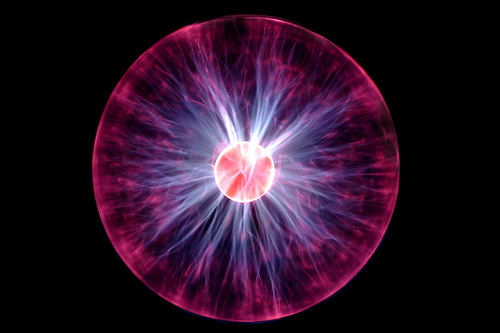
The Structure of Electron

There is quite a bit of experimental data obtained about the phenomenon that is referred to as a single electron. But all this data is mathematical. Problem lies in interpreting this data with proper reality.

.

Particle or Wave

We are not even sure if the electron is a particle or a wave. On this determination depends the correct interpretation of the rest of data about electron. Mathematical numbers don’t mean much even if you give them the labels like spin, charge, etc., because none of these labels have been clearly defined.

The problem lies in the fact that “substance” is defined for matter only and not for the constituents of the atom of matter. The substance of atom is thought of as having a constant density. It is supposed that there is no substance if it doesn’t meet certain arbitrary criterion of density as “matter”.

The fact of the matter is that the substance can have decreasing density without limit. Substance starts out as atomic matter; but it acts more like a non-atomic fluid inside the atom as its density decreases. This is the case with the electronic substance.

.

Particle is the Substance

An electron is not rigid and structured like the nucleus. The substance density of electron is 1840th of the proton or the neutron. The electron as a “particle” is moving very fast and its center of mass cannot be determined. Since there is no center of mass to differntiate electrons as particles, all electrons form a fluid-like continuum that is flowing extremely fast.

A very fast flowing fluid acquires wave-like characteristics. This answers the wave-particle question about the electron. An electron is a particle because it has substance. It does not necessarily exist as a discrete (single) particle in space.

.

Energy is the Waving Substance

All interactions in chemistry or in quantum mechanics have precise energy values. This discreteness of energy values does not mean that substances involved are discrete particles in space. Therefore, a continuum of electronic fluid can have discrete energy values of interactions.

Discrete value of interaction is what Einstein called “energy particle”. This doesn’t mean that electrons and photons are discrete entities in space. Both electrons and photons form a continuum of substance as a non-atomic fluid, yet they have discrete energy values of interaction.

This wave-particle confusion has been the greatest inconsistency in the science of physics. It arises because of the substance-energy confusion as outlined above. Unfortumately, this confusion entered the science through Einstein’s 1905 paper on Liqht Quanta, where he said,

“According to the assumption considered here, when a light ray starting from a point is propagated, the energy is not continuously distributed over an ever increasing volume, but it consists of a finite number of energy quanta, localised in space, which move without being divided and which can be absorbed or emitted only as a whole.”

.

Einstein’s Real Discovery

The most important discovery of Einstein is that light is not a motion in some arbitrarily considered stationary aether; instead light is a substance that is moving at an extremely rapid rate. It is this extreme rapid movement, which imparts wave characteristics to light and electrons.

Light is an extremely fast moving waving substance.

.

Substance and Relativity

Space and time are not the primary concepts in science. Space appears as the external characteristic of size, and the internal characteristic of force. Time appears as the external characteristic of velocity, and the internal characteristic of duration. Therefore, space and time are the characteristics of some primary concept.

The primary concept of this universe is aether (substance).

NOTE: The 19th century concept of “stationary aether” was discredited, and correctly so. There is no stationary and uniform aether. But there is aether in the original sense of substance. Currently physics narrowly identifies the word “substance” with matter. Light is not matter, but, more correctly, light is a substance.

.

Aether as Substance

From ancient times, aether has denoted the ‘substance that permeated the cosmos’, from which the stars and planets were made. Aether expresses itself as light and the stars that shine so brightly. As shown in the last chapter, aether may be presented as the following spectrum of substance.

  1. Black Hole material
  2. Nuclear matter
  3. Electronic particles
  4. Gamma radiation
  5. X-ray radiation
  6. Ultraviolet radiation
  7. Visible radiation
  8. Infrared radiation
  9. Terahertz radiation
  10. Microwave radiation
  11. Radio waves
  12. Gravity
  13. Space
  14. Void
  15. Emptiness

Emptiness is the reference point for all phenomena. Void is the reference point for the physical phenomena only. Anything that can be detected physically is substance with innate force. For example, light can be detected; therefore, light is a substance with innate force. Once there is force there is also momentum and energy, but those are secondary concepts.

The primary concept is the innate force of substance. Substance of minimum density appears as space. Substance of maximum density appears as matter.

Aether is correctly interpreted as SUBSTANCE that has the innate characteristic of FORCE. Substance is not limited to matter.

.

The Scale of Substance

Minimum density represents the flimsiest of force fields. As density increases this force field gets stronger and appears as electromagnetic fluid. The density of this “fluid” increases with frequency until it forms the electronic “particles” inside the atom. The density of these “particles” increases very rapidly inside the atom to form the material nucleus. Parallel to increasing density is the increasing duration of substance.

The physical substance starts with space and ends in matter. This gives us a scale of substance.

.

Einstein’s Relativity

Einstein’s theory of Relativity looks at this scale from the viewpoint of matter. It gives us a scale of velocity increasing from matter to light. From this viewpoint, the speed of the flimsiest of force fields shall be the highest reaching an infinite value for space.

Einstein’s theory, however, interprets space shrinking and duration increasing with increasing velocity. This means that density increases with increasing velocity. This contradicts the logical view given above. The theory of relativity also contradicts the fact that as the velocity increases, the size of the quantum particle increases also.

The interpretation of Einstein’s theory of relativity is quite opposite to the reality of this primary concept as the scale of substance.

.

Einstein’s Mathematical Object

Einstein replaced the classical concept of stationary aether of uniform density by a mathematical object that is neither stationary nor in motion, and which has no substance. If correct results are obtained from the mathematics of relativity, then Einstein’s mathematical object is likely equivalent to a fast moving substance of variable density.

The general notion of substance is anything that can be felt or detected because it has “innate force”. The substance may, therefore, be expressed as matter, the flowing electronic fluid, or the rapidly traveling light. Even the far reaching gravitational force may be classified as substance.

Einstein replaced the classical concept of stationary aether of uniform density by a mathematical object of no substance.

NOTE: The 19th century concept of “stationary aether” was discredited, and correctly so. There is no stationary and uniform aether. But there is aether in the original sense of substance. Currently physics narrowly identifies the word “substance” with matter. Light is not matter, but, more correctly, light is a substance.

.

The Original Aether

The word aether denoted the ‘upper atmosphere’ and by extension the ‘substance that permeated the cosmos,’ from which the stars and planets were made. The word substance denoted the ‘essence’ of something substantial; and the word cosmos denoted ‘order’ pointing to the orderliness of creation. Aether, in this sense, is the substance of this universe. Aether then expresses itself as light and also as the stars that shine so brightly.

The original aether may be described by the following spectrum of substance:

  1. Black Hole material
  2. Nuclear matter
  3. Electronic particles
  4. Gamma radiation
  5. X-ray radiation
  6. Ultraviolet radiation
  7. Visible radiation
  8. Infrared radiation
  9. Terahertz radiation
  10. Microwave radiation
  11. Radio waves
  12. Gravity
  13. Space
  14. Void
  15. Emptiness

The material objects are described in terms of their mass. The electromagnetic substance is described in terms of its frequency. Matter at the upper end is made up of very high frequencies. Space at the lower end denotes very low frequency. As frequency approaches zero we approach the void.

The physical substance thins out continually from Black hole to Emptiness.

.

Substance and Geometry

Accompanying the idea of substance is the mathematical abstraction of geometry. Space represents the boundaries of matter. Void represents the boundaries of all substance.

The centers of mass of material bodies are represented by geometrical points. The centers “touch” each other through their intervening force, represented by geometrical distances.

The geometric distances are filled with forces and substances of variable density. The variable density is represented by interplay of durations, or motion.

The fourth dimension is not time but “duration” of substance, which may be represented objectively by mass density (or force density).

Each point in a space-duration reference frame has three spatial dimensions and a dimension of duration represented by density, frequency or inverse of velocity. This tells us that distances shall be much shorter if all densities are uniform and equal to the density of matter.

The space-duration reference frame is a more objective representation of the mathematically subjective space-time reference frame of Einstein.

.

The Classical Assumption

Since ancient times, aether has been theorized as a substance that permeates the cosmos. Aether did not play any part in Newton’s corpuscular theory of light. But when light was discovered to have wave properties, physicist started to consider light as a disturbance that traveled through aether. This meant that light was pure motion, or “pure energy”. This was contrary to Newton’s corpuscular theory that treated light as rapidly moving particles (substance in motion).

The classical assumption was that light was a wave motion (pure energy) traveling in aether.

.

Faraday

Faraday saw that atomic particles touched each other through force that existed between them. The lines of force became a powerful reality to him in the electrical and magnetic phenomena. He saw force as an extension of matter. Matter was concentrated lines of force. This was consistent with Newton’s view that equated matter with an “innate force”. To Faraday, force became a much finer form of substance.

In his paper on Thoughts on Ray Vibrations (1846), Faraday says,

“The view which I am so bold to put forth considers, therefore, radiation as a kind of species of vibration in the lines of force which are known to connect particles and also masses of matter together. It endeavors to dismiss the aether, but not the vibration.”

According to Faraday light was a vibration in the lines of force that connected particles of matter. Force was the substance of light.

Thus Faraday returned to Newton’s idea of light as “substance in motion”.

.

Maxwell

Maxwell focused on the mathematical description of the electromagnetic force outlined by Faraday. He saw electromagnetism as a study in states of stress and strain. In seeking consistency with Newtonian dynamics, Maxwell basically treated electrical lines of potential as having uniform density same as material particles. He used the concept of aether, which is uniform throughout space.

Maxwell did not fully implement Faraday’s conception of lines of force. These lines, through their varying thickness, represented varying density of “force substance”. He, therefore, missed the phenomenon of quantization discovered later by Einstein.

Thus, Maxwell adhered to wave theory and popularized the concept of pure energy. According to this theory, the energy density of light was proportional to the square of the amplitude. Maxwell’s equations do not describe the motion of charged particles but the effect that passes through them at the speed of light.

In Maxwell’s model, light remained a wave motion (pure energy) traveling in aether.

.

Einstein

In his 1905 paper on light quanta, Einstein set up a model of blackbody radiation similar to the model in kinetic theory of gases. He then reached the following conclusion.

“We thus reach the conclusion: the higher the energy density and the longer the wavelengths of radiation, the more usable is the theoretical basis used by us; for short wavelengths and low radiation densities, however, the basis fails completely”.

Einstein showed that Maxwell’s classical assumption is valid at longer wavelengths (low frequencies). As frequency increases the energy distribution becomes more discontinuous in space like particles. Einstein thus showed that Planck’s postulate of energy quanta was more than just a mathematical device.

But Einstein also assumed radiation to be vibrations in aether. As variable frequency required a medium of variable density, aether of constant density could not serve. Einstein, therefore, dropped the idea of aether, and decided that light was “vibrations in mathematical space”.

Einstein kept the classical concept that light is “pure energy”, except he replaced Maxwell’s constant aether by a variable mathematical space.

.

Quantum Mechanics

Einstein concludes in his 1905 paper:

“According to the assumption considered here, when a light ray starting from a point is propagated, the energy is not continuously distributed over an ever increasing volume, but it consists of a finite number of energy quanta, localised in space, which move without being divided and which can be absorbed or emitted only as a whole”.

This is the view of light quanta as “pure energy” in a mathematical space of variable density. Contrast this with light as a substance of variable density moving in real space. The latter is the proposal of Faraday of vibrating lines of force of variable thickness in real space.

Like Maxwell, Einstein also couldn’t see light to be made up of a “force field” that had variable density in real space (see the chapter The Quantum Particle). This created confusion between real and mathematical space, and placed quantum mechanics on a firm mathematical footing. 

Both classical and quantum mechanics view light as “pure energy” that requires either aether or mathematical “substance” for its existence.

The actual breakdown of classical mechanics occurred when the idea of quantum confirmed light to be a “substance in motion” and not a “motion in hypothetical aether”.

.