This paper presents Chapter IV section 6 from the book THE EVOLUTION OF PHYSICS by A. EINSTEIN and L. INFELD. The contents are from the original publication of this book by Simon and Schuster, New York (1942).
The paragraphs of the original material (in black) are accompanied by brief comments (in color) based on the present understanding. Feedback on these comments is appreciated.
The heading below is linked to the original materials.
.
If, according to classical mechanics, we know the position and velocity of a given material point and also what external forces are acting, we can predict, from the mechanical laws, the whole of its future path. The sentence: “The material point has such-and-such position and velocity at such-and-such an instant,” has a definite meaning in classical mechanics. If this statement were to lose its sense, our argument (p. 32) about foretelling the future path would fail.
In the early nineteenth century, scientists wanted to reduce all physics to simple forces acting on material particles that have definite positions and velocities at any instant. Let us recall how we described motion when discussing mechanics at the beginning of our journey through the realm of physical problems. We drew points along a definite path showing the exact positions of the body at certain instants and then tangent vectors showing the direction and magnitude of the velocities. This was both simple and convincing. But it cannot be repeated for our elementary quanta of matter, that is electrons, or for quanta of energy, that is photons. We cannot picture the journey of a photon or electron in the way we imagined motion in classical mechanics. The example of the two pinholes shows this clearly. Electron and photon seem to pass through the two holes. It is thus impossible to explain the effect by picturing the path of an electron or a photon in the old classical way.
We must, of course, assume the presence of elementary actions, such as the passing of electrons or photons through the holes. The existence of elementary quanta of matter and energy cannot be doubted. But the elementary laws certainly cannot be formulated by specifying positions and velocities at any instant in the simple manner of classical mechanics.
We cannot picture the journey of a photon or electron in the way we imagined motion in classical mechanics by specifying positions and velocities at any instant.
Let us, therefore, try something different. Let us continually repeat the same elementary processes. One after the other, the electrons are sent in the direction of the pinholes. The word “electron” is used here for the sake of definiteness; our argument is also valid for photons.
The same experiment is repeated over and over again in exactly the same way; the electrons all have the same velocity and move in the direction of the two pinholes. It need hardly be mentioned that this is an idealized experiment which cannot be carried out in reality but may well be imagined. We cannot shoot out single photons or electrons at given instants, like bullets from a gun.
The outcome of repeated experiments must again be dark and light rings for one hole and dark and light stripes for two. But there is one essential difference. In the case of one individual electron, the experimental result was incomprehensible. It is more easily understood when the experiment is repeated many times. We can now say: light stripes appear where many electrons fall. The stripes become darker at the place where fewer electrons are falling. A completely dark spot means that there are no electrons. We are not, of course, allowed to assume that all the electrons pass through one of the holes. If this were so, it could not make the slightest difference whether or not the other is covered. But we already know that covering the second hole does make a difference. Since one particle is indivisible, we cannot imagine that it passes through both the holes. The fact that the experiment was repeated many times points to another way out. Some of the electrons may pass through the first hole and others through the second. We do not know why individual electrons choose particular holes, but the net result of repeated experiments must be that both pinholes participate in transmitting the electrons from the source to the screen. If we state only what happens to the crowd of electrons when the experiment is repeated, not bothering about the behaviour of individual particles, the difference between the ringed and the striped pictures becomes comprehensible. By the discussion of a sequence of experiments a new idea was born, that of a crowd with the individuals behaving in an unpredictable way. We cannot foretell the course of one single electron, but we can predict that, in the net result, the light and dark stripes will appear on the screen.
Let us leave quantum physics for the moment.
We have seen in classical physics that if we know the position and velocity of a material point at a certain instant and the forces acting upon it, we can predict its future path. We also saw how the mechanical point of view was applied to the kinetic theory of matter. But in this theory a new idea arose from our reasoning. It will be helpful in understanding later arguments to grasp this idea thoroughly.
There is a vessel containing gas. In attempting to trace the motion of every particle one would have to commence by finding the initial states, that is, the initial positions and velocities of all the particles. Even if this were possible, it would take more than a human lifetime to set down the result on paper, owing to the enormous number of particles which would have to be considered. If one then tried to employ the known methods of classical mechanics for calculating the final positions of the particles, the difficulties would be insurmountable. In principle, it is possible to use the method applied for the motion of planets, but in practice this is useless and must give way to the method of statistics. This method dispenses with any exact knowledge of initial states. We know less about the system at any given moment and are thus less able to say anything about its past or future. We become indifferent to the fate of the individual gas particles. Our problem is of a different nature. For example: we do not ask, “What is the speed of every particle at this moment?” But we may ask: “How many particles have a speed between 1000 and 1100 feet per second?” We care nothing for individuals. What we seek to determine are average values typifying the whole aggregation. It is clear that there can be some point in a statistical method of reasoning only when the system consists of a large number of individuals.
By applying the statistical method we cannot foretell the behaviour of an individual in a crowd. We can only foretell the chance, the probability, that it will behave in some particular manner. If our statistical laws tell us that one-third of the particles have a speed between 1000 and 1100 feet per second, it means that by repeating our observations for many particles, we shall really obtain this average, or in other words, that the probability of finding a particle within this limit is equal to one-third.
Similarly, to know the birth rate of a great community does not mean knowing whether any particular family is blessed with a child. It means a knowledge of statistical results in which the contributing personalities play no role.
By observing the registration plates of a great many cars we can soon discover that one-third of their numbers are divisible by three. But we cannot foretell whether the car which will pass in the next moment will have this property. Statistical laws can be applied only to big aggregations, but not to their individual members.
We can now return to our quantum problem.
The laws of quantum physics are of a statistical character. This means: they concern not one single system but an aggregation of identical systems; they cannot be verified by measurement of one individual, but only by a series of repeated measurements.
We cannot foretell the course of one single electron, but we can predict that, in the net result, the light and dark stripes will appear on the screen. For this we use the method of statistics. The laws of quantum physics are of a statistical character.
Radioactive disintegration is one of the many events for which quantum physics tries to formulate laws governing the spontaneous transmutation from one element to another. We know, for example, that in 1600 years half of one gram of radium will disintegrate, and half will remain. We can foretell approximately how many atoms will disintegrate during the next half-hour, but we cannot say, even in our theoretical descriptions, why just these particular atoms are doomed. According to our present knowledge, we have no power to designate the individual atoms condemned to disintegration. The fate of an atom does not depend on its age. There is not the slightest trace of a law governing their individual behaviour. Only statistical laws can be formulated, laws governing large aggregations of atoms.
Take another example. The luminous gas of some element placed before a spectroscope shows lines of definite wave-length. The appearance of a discontinuous set of definite wave-lengths is characteristic of the atomic phenomena in which the existence of elementary quanta is revealed. But there is still another aspect of this problem. Some of the spectrum lines are very distinct, others are fainter. A distinct line means that a comparatively large number of photons belonging to this particular wave-length are emitted; a faint line means that a comparatively small number of photons belonging to this wave-length are emitted. Theory again gives us statements of a statistical nature only. Every line corresponds to a transition from higher to lower energy level. Theory tells us only about the probability of each of these possible transitions, but nothing about the actual transition of an individual atom. The theory works splendidly because all these phenomena involve large aggregations and not single individuals.
The theory works splendidly because all these phenomena involve large aggregations and not single individuals.
It seems that the new quantum physics resembles somewhat the kinetic theory of matter, since both are of a statistical nature and both refer to great aggregations. But this is not so! In this analogy an understanding not only of the similarities but also of the differences is most important. The similarity between the kinetic theory of matter and quantum physics lies chiefly in their statistical character. But what are the differences?
If we wish to know how many men and women over the age of twenty live in a city, we must get every citizen to fill up a form under the headings “male”, “female”, and “age”. Provided every answer is correct, we can obtain, by counting and segregating them, a result of a statistical nature. The individual names and addresses on the forms are of no account. Our statistical view is gained by the knowledge of individual cases. Similarly, in the kinetic theory of matter, we have statistical laws governing the aggregation, gained on the basis of individual laws.
But in quantum physics the state of affairs is entirely different. Here the statistical laws are given immediately. The individual laws are discarded. In the example of a photon or an electron and two pinholes we have seen that we cannot describe the possible motion of elementary particles in space and time as we did in classical physics. Quantum physics abandons individual laws of elementary particles and states directly the statistical laws governing aggregations. It is impossible, on the basis of quantum physics, to describe positions and velocities of an elementary particle or to predict its future path as in classical physics. Quantum physics deals only with aggregations, and its laws are for crowds and not for individuals.
In the kinetic theory of matter, we have statistical laws governing the aggregation, gained on the basis of individual laws. Quantum physics abandons individual laws of elementary particles and states directly the statistical laws governing aggregations.
It is hard necessity and not speculation or a desire for novelty which forces us to change the old classical view. The difficulties of applying the old view have been outlined for one instance only, that of diffraction phenomena. But many others, equally convincing, could be quoted. Changes of view are continually forced upon us by our attempts to understand reality. But it always remains for the future to decide whether we chose the only possible way out and whether or not a better solution of our difficulties could have been found.
We have had to forsake the description of individual cases as objective happenings in space and time; we have had to introduce laws of a statistical nature. These are the chief characteristics of modern quantum physics.
Previously, when introducing new physical realities, such as the electromagnetic and gravitational field, we tried to indicate in general terms the characteristic features of the equations through which the ideas have been mathematically formulated. We shall now do the same with quantum physics, referring only very briefly to the work of Bohr, de Broglie, Schrodinger, Heisenberg, Dirac and Born.
Let us consider the case of one electron. The electron may be under the influence of an arbitrary foreign electromagnetic field, or free from all external influences. It may move, for instance, in the field of an atomic nucleus or it may diffract on a crystal. Quantum physics teaches us how to formulate the mathematical equations for any of these problems.
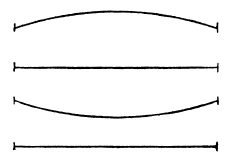
We have already recognized the similarity between an oscillating cord, the membrane of a drum, a wind instrument, or any other acoustical instrument on the one hand, and a radiating atom on the other. There is also some similarity between the mathematical equations governing the acoustical problem and those governing the problem of quantum physics. But again the physical interpretation of the quantities determined in these two cases is quite different. The physical quantities describing the oscillating cord and the radiating atom have quite a different meaning, despite some formal likeness in the equations. In the case of the cord, we ask about the deviation of an arbitrary point from its normal position at an arbitrary moment. Knowing the form of the oscillating cord at a given instant, we know everything we wish. The deviation from the normal can thus be calculated for any other moment from the mathematical equations for the oscillating cord. The fact that some definite deviation from the normal position corresponds to every point of the cord is expressed more rigorously as follows: for any instant, the deviation from the normal value is a function of the co-ordinates of the cord. All points of the cord form a one-dimensional continuum, and the deviation is a function defined in this one-dimensional continuum, to be calculated from the equations of the oscillating cord.
Analogously, in the case of an electron a certain function is determined for any point in space and for any moment. We shall call this function the probability wave. In our analogy the probability wave corresponds to the deviation from the normal position in the acoustical problem. The probability wave is, at a given instant, a function of a three-dimensional continuum, whereas, in the case of the cord the deviation was, at a given moment, a function of the one-dimensional continuum. The probability wave forms the catalogue of our knowledge of the quantum system under consideration and will enable us to answer all sensible statistical questions concerning this system. It does not tell us the position and velocity of the electron at any moment because such a question has no sense in quantum physics. But it will tell us the probability of meeting the electron on a particular spot, or where we have the greatest chance of meeting an electron. The result does not refer to one, but to many repeated measurements. Thus the equations of quantum physics determine the probability wave just as Maxwell’s equations determine the electromagnetic field and the gravitational equations determine the gravitational field. The laws of quantum physics are again structure laws. But the meaning of physical concepts determined by these equations of quantum physics is much more abstract than in the case of electromagnetic and gravitational fields; they provide only the mathematical means of answering questions of a statistical nature.
The equations of quantum physics determine the probability wave just as Maxwell’s equations determine the electromagnetic field and the gravitational equations determine the gravitational field; but the meaning of physical concepts determined by these equations of quantum physics is much more abstract.
So far we have considered the electron in some external field. If it were not the electron, the smallest possible charge, but some respectable charge containing billions of electrons, we could disregard the whole quantum theory and treat the problem according to our old pre-quantum physics. Speaking of currents in a wire, of charged conductors, of electromagnetic waves, we can apply our old simple physics contained in Maxwell’s equations. But we cannot do this when speaking of the photoelectric effect, intensity of spectral lines, radioactivity, diffraction of electric waves and many other phenomena in which the quantum character of matter and energy is revealed. We must then, so to speak, go one floor higher. Whereas in classical physics we spoke of positions and velocities of one particle, we must now consider probability waves, in a three-dimensional continuum corresponding to this one-particle problem.
Quantum physics gives its own prescription for treating a problem if we have previously been taught how to treat an analogous problem from the point of view of classical physics.
For one elementary particle, electron or photon, we have probability waves in a three-dimensional continuum, characterizing the statistical behaviour of the system if the experiments are often repeated. But what about the case of not one but two interacting particles, for instance, two electrons, electron and photon, or electron and nucleus? We cannot treat them separately and describe each of them through a probability wave in three dimensions, just because of their mutual interaction. Indeed, it is not very difficult to guess how to describe in quantum physics a system composed of two interacting particles. We have to descend one floor, to return for a moment to classical physics. The position of two material points in space, at any moment, is characterized by six numbers, three for each of the points. All possible positions of the two material points form a six-dimensional continuum and not a three-dimensional one as in the case of one point. If we now again ascend one floor, to quantum physics, we shall have probability waves in a six-dimensional continuum and not in a three-dimensional continuum as in the case of one particle. Similarly, for three, four, and more particles the probability waves will be functions in a continuum of nine, twelve, and more dimensions.
In dealing with quantum phenomenon, we cannot apply our old simple physics contained in Maxwell’s equations. We must now consider probability waves, in a three-dimensional continuum corresponding to positions and velocities of one particle. For two, three, four, and more particles the probability waves will be functions in a continuum of six, nine, twelve, and more dimensions.
This shows clearly that the probability waves are more abstract than the electromagnetic and gravitational field existing and spreading in our three-dimensional space. The continuum of many dimensions forms the background for the probability waves, and only for one particle does the number of dimensions equal that of physical space. The only physical significance of the probability wave is that it enables us to answer sensible statistical questions in the case of many particles as well as of one. Thus, for instance, for one electron we could ask about the probability of meeting an electron in some particular spot. For two particles our question could be: what is the probability of meeting the two particles at two definite spots at a given instant?
The probability waves are more abstract than the electromagnetic and gravitational field existing and spreading in our three-dimensional space. But they enable us to answer sensible statistical questions in the case of many particles as well as of one.
Our first step away from classical physics was abandoning the description of individual cases as objective events in space and time. We were forced to apply the statistical method provided by the probability waves. Once having chosen this way, we are obliged to go further toward abstraction. Probability waves in many dimensions corresponding to the many-particle problem must be introduced.
Let us, for the sake of briefness, call everything except quantum physics, classical physics. Classical and quantum physics differ radically. Classical physics aims at a description of objects existing in space, and the formulation of laws governing their changes in time. But the phenomena revealing the particle and wave nature of matter and radiation, the apparently statistical character of elementary events such as radioactive disintegration, diffraction, emission of spectral lines, and many others, forced us to give up this view. Quantum physics does not aim at the description of individual objects in space and their changes in time. There is no place in quantum physics for statements such as: “This object is so-and-so, has this-and-this property.” Instead we have statements of this kind: “There is such-and-such a probability that the individual object is so-and-so and has this-and-this property.” There is no place in quantum physics for laws governing the changes in time of the individual object. Instead, we have laws governing the changes in time of the probability. Only this fundamental change, brought into physics by the quantum theory, made possible an adequate explanation of the apparently discontinuous and statistical character of events in the realm of phenomena in which the elementary quanta of matter and radiation reveal their existence.
There is no place in quantum physics for laws governing the changes in time of the individual object. Instead, we have laws governing the changes in time of the probability. For example, “There is such-and-such a probability that the individual object is so-and-so and has this-and-this property.”
Yet new, still more difficult problems arise which have not been definitely settled as yet. We shall mention only some of these unsolved problems. Science is not and will never be a closed book. Every important advance brings new questions. Every development reveals, in the long run, new and deeper difficulties.
We already know that in the simple case of one or many particles we can rise from the classical to the quantum description, from the objective description of events in space and time to probability waves. But we remember the all-important field concept in classical physics. How can we describe interaction between elementary quanta of matter and field? If a probability wave in thirty dimensions is needed for the quantum description of ten particles, then a probability wave with an infinite number of dimensions would be needed for the quantum description of a field. The transition from the classical field concept to the corresponding problem of probability waves in quantum physics is a very difficult step. Ascending one floor is here no easy task and all attempts so far made to solve the problem must be regarded as unsatisfactory. There is also one other fundamental problem. In all our arguments about the transition from classical physics to quantum physics we used the old pre-relativistic description in which space and time are treated differently. If, however, we try to begin from the classical description as proposed by the relativity theory, then our ascent to the quantum problem seems much more complicated. This is another problem tackled by modern physics, but still far from a complete and satisfactory solution. There is still a further difficulty in forming a consistent physics for heavy particles, constituting the nuclei. In spite of the many experimental data and the many attempts to throw light on the nuclear problem, we are still in the dark about some of the most fundamental questions in this domain.
If a probability wave in thirty dimensions is needed for the quantum description of ten particles, then a probability wave with an infinite number of dimensions would be needed for the quantum description of a field. This presents a difficult problem. Further complications arise due to relativistic considerations of changing character of space and time. There is still a further difficulty in forming a consistent physics for heavy particles, constituting the nuclei.
There is no doubt that quantum physics explained a very rich variety of facts, achieving, for the most part, splendid agreement between theory and observation. The new quantum physics removes us still further from the old mechanical view, and a retreat to the former position seems, more than ever, unlikely. But there is also no doubt that quantum physics must still be based on the two concepts: matter and field. It is, in this sense, a dualistic theory and does not bring our old problem of reducing everything to the field concept even one step nearer realization.
Will the further development be along the line chosen in quantum physics, or is it more likely that new revolutionary ideas will be introduced into physics? Will the road of advance again make a sharp turn, as it has so often done in the past?
During the last few years all the difficulties of quantum physics have been concentrated around a few principal points. Physics awaits their solution impatiently. But there is no way of foreseeing when and where the clarification of these difficulties will be brought about.
The quantum physics must still be based on the two concepts of matter and field. It does not bring our old problem of reducing everything to the field concept.
.
Final Comment
The current physics assumes space and time being independent of the inertia of substance. Space as “extents” expands as inertia reduces. Time as “duration” also decreases as inertia reduces. This is the essence of relativistic phenomena.
The current physics assumes that the elementary quanta is an indivisible, dimensionless point, whose location requires a probabilistic determination. What if the elementary quanta is like a drop of water that has a finite size and which can split and combine back. The electrons and photons cannot be treated like point particles. Their actual size grows, and duration reduces, with decrease in inertia. We can no longer pinpoint their location and presence mathematically. The method of statistics hides this erroneous assumption of “point particle.” The probability approach is used because we are assuming point locations and permanent presence for particles of appreciable dimension and transient durations.
The awareness of these assumption gives physics a new direction.
.