Reference: Einstein’s 1920 Book
Section XXII (Part 2)
A Few Inferences from the General Theory of Relativity
Please see Section XXII at the link above.
.
Summary
Gravitational field exists along with the fact of acceleration. We may now study its influence theoretically. We notice that a body at rest, or with uniform motion otherwise, would be accelerating in this gravitational field. In general it would have a curvilinear motion instead of a straight line motion. This would then apply to a ray of light as well when it passes through a gravitational field.
Theoretical calculations show that the light from stars that reach earth would acquire a curvature of 1.7 seconds of arc as they pass the sun at a grazing incidence. This would mean that the velocity of light must also change as it passes through a gravitational field. We then conclude that the results of the special theory of relativity hold only so long as we are able to disregard the influences of gravitational fields on light.
We may consider the special theory of relativity to be contained within the general theory of relativity as a limiting case. The general theory of relativity also tells us about the laws satisfied by the gravitational field itself.
We may visualize space-time domains where no gravitational fields exist as Galilean domains. The general theory of relativity considers those space-time domains where the gravitational field is present. We hope that the general theory of relativity leads to laws that are applicable to all gravitational fields. This will extend our ideas of the space-time continuum still farther.
.
Final Comments
The most natural condition in this universe is the presence of gravitational fields. The general theory of relativity considers the effect of this condition on the space-time continuum.
The space-time continuum essentially describes the continuum of energy in which the matter is floating. Our knowledge of this energy extends to the electromagnetic spectrum. The flexible structure of this electromagnetic spectrum manifests in the form of gravitational fields. The gravitational fields are expected to be made up of curvilinear motions in the sea of energy.
The gravitational fields may be visualized as rotating motions much like whirlpools in the sea of energy. The substance in gravitational fields accelerates toward a center, where it collects and condenses.
.
Reference: Einstein’s 1920 Book
Section XXI (Part 2)
In What Respects Are the Foundations of Classical Mechanics and of the Special Theory of Relativity Unsatisfactory?
Please see Section XXI at the link above.
.
Summary
In Classical Mechanics, and also in the special theory of relativity, reference bodies that maintain inherent uniform rotation are disregarded. Therefore, a new basis for physics is required that includes uniformly rotating reference bodies.
In rotating bodies radial acceleration is involved. Such a basis would obviously be conformable to the general principle of relativity.
.
Final Comments
Classical mechanics refers to motion in a straight line only. But its laws may be generalized for curved motion. Curved motion exists in rotation that involves radial acceleration. Because there is acceleration, it must be balanced by inertia. When there is natural inertia there is also a field. Therefore, the curved motion shall bring a gravitational field into existence.
.
Reference: Einstein’s 1920 Book
Section XX (Part 2)
The Equality of Inertial and Gravitational Mass as an Argument for the General Postulate of Relativity
Please see Section XX at the link above.
.
Summary
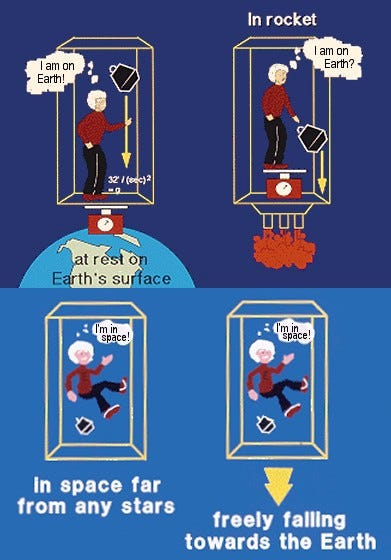
In a Galilean space, bodies are either at rest or moving at uniform velocity. There is neither acceleration, nor any sense of gravity. But, when uniformly accelerated motion is applied to a body, the velocity of the body will increase to enormous values in course of time. However, from the reference point of the body, it would appear to be at rest; but, as its inertia resists the acceleration, it would acquire weight, as if it is in a gravitational field. We have thus good grounds for extending the principle of relativity to include bodies of reference which are accelerated with respect to each other.
From the viewpoint of the accelerating body, bodies that are at rest or in uniform motion will appear to accelerate uniformly in the opposite direction irrespective of their masses. This is the fundamental property of the gravitational field of giving all bodies the same acceleration. Guided by this example, we see that our extension of the principle of relativity implies the necessity of the law of the equality of inertial and gravitational mass.
Thus, we see that a general theory of relativity must yield important results on the laws of gravitation. But it is not so straightforward, because we cannot always choose another reference-body such that no gravitational field exists with reference to it. It is, for instance, impossible to choose a body of reference such that, as judged from it, the gravitational field of the earth (in its entirety) vanishes.
.
Final Comments
A uniformly moving body appears at rest relative to itself. But, a uniformly accelerating body appears at rest relative to itself too; except, in this case, there is also a sense of mass or consistency.
.
Reference: Einstein’s 1920 Book
Section XIX (Part 2)
The Gravitational Field
Please see Section XIX at the link above.
.
Summary
Current science regards action at a distance as a process impossible without the intervention of some intermediary medium. With the aid of this conception electromagnetic phenomena can be theoretically represented much more satisfactorily than without it, and this applies particularly to the transmission of electromagnetic waves.
We may apply this conception also to the gravitational phenomena. We may regard the earth to produce a field in its immediate neighborhood directly. The intensity and direction of the field at points farther removed from the earth are determined by the law which governs the properties in space of the gravitational fields themselves.
The gravitational field exhibits a most remarkable property. Bodies which are moving under the sole influence of a gravitational field receive an acceleration, which does not in the least depend either on the material or on the physical state of the body.
Inertial mass relates to an object’s resistance to acceleration, while gravitational mass relates to its interaction with gravitational fields. Inertial mass is measured by applying a known force and measuring acceleration (F/a), while gravitational mass is typically measured by comparing gravitational forces using a balance scale. These two masses are found to be equal.
The same quality of a body manifests itself according to circumstances as “inertia” or as “weight” (lit. “heaviness”).
.
Final Comments
The gravitational phenomenon is directly related to the property of inertia.
.
Reference: Einstein’s 1920 Book
Section XVIII (Part 2)
Special and General Principle of Relativity
Please see Section XVIII at the link above.
.
Summary
To detect or describe motion we may choose any body as our reference. But, according to the principle of relativity, the general laws of nature must have exactly the same form regardless of the body we choose as our reference.
So far, we have chosen only those bodies as our reference, which are limited to having uniform and non-rotary motion. This provides us only with some special cases of the laws of nature. To obtain the general laws of nature that apply to all cases, we should be able to choose bodies of reference regardless of their state of motion.
As long as the body of reference is moving uniformly, its own motion does not influence the facts of the motion being observed. However, when the body of reference moves non-uniformly, then the facts of the motion being observed also change, and the same laws as before cannot be expected to hold.
.
Final Comments
The non-uniform motion of the body of reference brings in additional factors into play that must be taken into account to determine the form of the laws of nature. Such forms would be more general.
.