Category Archives: Religion

Islam

Reference: The World’s Religions

  1. Background
  2. The Seal of the Prophets
  3. The Migration That Led to Victory
  4. The Standing Miracle
  5. Basic Theological Concepts
  6. The Five Pillars
  7. Social Teachings
  8. Sufism
  9. Whither Islam?
  10. Suggestions for Further Reading

.

TAOISM: Conclusion

Reference: Taoism

[NOTE: In color are Vinaire’s comments.]

Circling around each other like yin and yang themselves, Taoism and Confucianism represent the two indigenous poles of the Chinese character. Confucius represents the classical, Lao Tzu the romantic.

Circling around each other like yin and yang themselves, Taoism and Confucianism represent the two indigenous poles of the Chinese character. Confucius represents the classical, Lao Tzu the romantic. Confucius stresses social responsibility, Lao Tzu praises spontaneity and naturalness. Confucius’ focus is on the human, Lao Tzu’s on what transcends the human. As the Chinese themselves say, Confucius roams within society, Lao Tzu wanders beyond. Something in life reaches out in each of these directions, and Chinese civilization would certainly have been poorer if either had not appeared.

Confucius stresses social responsibility, Lao Tzu praises spontaneity and naturalness. Confucius’ focus is on the human, Lao Tzu’s on what transcends the human. 

There are books whose first reading casts a spell that is never quite undone, the reason being that they speak to the deepest “me” in the reader. For all who quicken at the thought that anywhere, at every time, the Tao is within us, the Tao Te Ching is such a book. Mostly it has been so for the Chinese, but an American poet can equally find it “the straightest, most logical explanation as yet advanced for the continuance of life, the most logical use yet advised for enjoying it.” Though obviously never practiced to perfection, its lessons of simplicity, openness, and wisdom have been for millions of Chinese a joyful guide.

There is a being, wonderful, perfect;
It existed before heaven and earth.
How quiet it is!
How spiritual it is!
It stands alone and it does not change.
It moves around and around, but does not on this account suffer.
All life comes from it.
It wraps everything with its love as in a garment, and
yet it claims no honor, it does not demand to be Lord.
I do not know its name, and so I call it Tao, the Way,
and I rejoice in its power.

Though obviously never practiced to perfection, its lessons of simplicity, openness, and wisdom have been for millions of Chinese a joyful guide.

.

TAOISM: Other Taoist Values

Reference: Taoism

[NOTE: In color are Vinaire’s comments.]

In the context of the wholeness of Tao, the opposites identified by the yin/yang symbol appear as no more than phases in an endless cycling process. Life does not move onward and upward toward a fixed pinnacle or pole. It bends back upon itself to come, full circle, to the realization that all is one and all is well. 

Still following the analogy of water, the Taoists rejected all forms of self-assertiveness and competition. The world is full of people who are determined to be somebody or give trouble. They want to get ahead, to stand out. Taoism has little use for such ambitions. “The ax falls first on the tallest tree.”

He who stands on tiptoe
doesn’t stand firm.
He who rushes ahead
doesn’t go far.
He who tries to shine
dims his own light. (ch. 24)

Still following the analogy of water, the Taoists rejected all forms of self-assertiveness and competition. 

Their almost reverential attitude toward humility led the Taoists to honor hunchbacks and cripples because of the way they typified meekness and self-effacement. They were fond of pointing out that the value of cups, windows, and doorways lies in the parts of them that are not there. “Selfless as melting ice” is one of their descriptive figures. The Taoists’ refusal to clamber for position sprang from a profound disinterest in the things the world prizes. The point comes out in the story of Chuang Tzu’s visit to the minister of a neighboring state. Someone told the minister that Chuang Tzu was coming in the hope of replacing him. The minister was alarmed. But when Chuang Tzu heard of the rumor he said to the minister:

In the South there is a bird. It is called yuan-ch’u. Have you heard of it? This yuan ch’u starts from the southern ocean and flies to the northern ocean. During its whole journey it perches on no tree save the sacred Wo-tung, eats no fruit save that of the Persian Lilac, drinks only at the Magic Well. It happened that an owl that had got hold of the rotting carcass of a rat looked up as this bird flew by, and terrified lest the yuan ch’u should stop and snatch at the succulent morsel, it screamed, “Shoo! Shoo!” And now I am told that you are trying to “shoo” me off from this precious Ministry of yours.

The Taoists’ refusal to clamber for position sprang from a profound disinterest in the things the world prizes. 

So it is with most of the world’s prides. They are not the true values they are thought to be. What is the point of competition or assertiveness? The Tao seems to get along very well without them.

Nature does not have to insist,
Can blow for only half a morning,
Rain for only half a day. (ch. 23)

What is the point of competition or assertiveness? The Tao seems to get along very well without them.

People should avoid being strident and aggressive not only toward other people but also toward nature. On the whole, the modern Western attitude has been to regard nature as an antagonist, an object to be squared off against, dominated, controlled, conquered. Taoism’s attitude is the opposite of this. There is a profound naturalism in Taoist thought, but it is the naturalism of a Rousseau, a Wordsworth, a Thoreau, not that of a Galileo or Bacon.

Those who would take over the earth
And shape it to their will
Never, I notice, succeed.
The earth is like a vessel so sacred
That at the mere approach of the profane
It is marred
And when they reach out their fingers it is gone. (ch. 29)

People should avoid being strident and aggressive not only toward other people but also toward nature. 

Nature is to be befriended. When the British scaled earth’s highest peak, the exploit was widely hailed as “the conquest of Everest.” D. T. Suzuki remarked: “We orientals would have spoken of befriending Everest.” The Japanese team that scaled Anapurna, the second highest peak, climbed to within fifty feet of the summit and deliberately stopped, provoking a Western mountaineer to exclaim in disbelief, “That’s class!” Taoism seeks attunement with nature, not dominance. Its approach is ecological, a characteristic that led Joseph Needham to point out that despite China’s backwardness in scientific theory she early developed “an organic philosophy of nature closely resembling that which modern science has been forced to adopt after three centuries of mechanical materialism.” The ecological approach of Taoism has inspired many Western architects, most notably Frank Lloyd Wright. Taoist temples do not stand out from their surroundings. They nestle against the hills, back under the trees, blending in with the environment. At best, human beings do likewise. Their highest achievement is to identify themselves with the Tao and let it work its magic through them.

Taoism seeks attunement with nature, not dominance. Its approach is ecological that has inspired many Western architects. At best, human beings do likewise. Their highest achievement is to identify themselves with the Tao and let it work its magic through them.

This Taoist approach to nature deeply affected Chinese art. It is no accident that the greatest periods of Chinese art have coincided with upsurges of Taoist influence. Before assuming brush and silk, painters would go out to nature and lose themselves in it, to become, say, the bamboo that they would paint. They would sit for half a day or fourteen years before making a stroke. The Chinese word for landscape painting is composed of the radicals for mountain and water, one of which suggests vastness and solitude, the other pliability, endurance, and continuous movement. The human part in the vastness is small, so we have to look closely for human beings in the paintings if we find them at all. Usually, they are climbing with their bundles, riding a buffalo, or poling a boat—the self with its journey to make, its burden to carry, its hill to climb, but surrounded by beauty on every side. People are not as formidable as mountains; they do not live as long as the pines. Yet they too belong in the scheme of things as surely as do the birds and the clouds. And through them, as through the rest of the world, flows the everlasting Tao

This Taoist approach to nature deeply affected Chinese art. Before assuming brush and silk, painters would go out to nature and lose themselves in it, to become, say, the bamboo that they would paint. 

Taoist naturalism combined with a propensity for naturalness as well. Pomp and extravagance were regarded as silly. When Chuang Tzu’s followers asked permission to give him a grand funeral, he replied: “Heaven and earth are my inner and outer coffins. The sun, moon, and stars are my drapery, and the whole creation my funeral procession. What more do I want?” Civilization was ridiculed and the primitive idealized. “Let us have a small country with few inhabitants,” Lao Tzu proposed. “Let the people return to the use of knotted cords [for keeping records]. Let them obtain their food sweet, their clothing beautiful, their homes comfortable, their rustic tasks pleasurable.” Travel was discouraged as pointless and conducive to idle curiosity. “The neighboring state might be so near at hand that one could hear the cocks crowing in it and dogs barking. But the people would grow old and die without ever having been there.”

Taoist naturalism combined with a propensity for naturalness as well. Pomp and extravagance were regarded as silly. Civilization was ridiculed and the primitive idealized. Travel was discouraged as pointless and conducive to idle curiosity. 

It was this preference for naturalness and simplicity that most separated the Taoist from the Confucian. The basic objectives of the two schools did not differ widely, but the Taoists had small patience with the Confucian approach to them. All formalism, show, and ceremony left them cold. What could be hoped for from punctiliousness or the meticulous observance of propriety? The whole approach was artificial, a lacquered surface that was bound to prove brittle and repressive. Confucianism here was but one instance of the human tendency to approach life in regulated mode. All calculated systems, the very attempt to arrange life in shipshape order, is pointless. As different ways of slicing the same reality, none of them amounts to more than Three in the Morning. And what is Three in the Morning? Once, in the state of Sung, hard times forced a keeper of monkeys to reduce their rations. “From now on,” he announced, “it will be three in the morning and four in the evening.” Faced with howls of rebellion, the keeper agreed to negotiate, and eventually accepted his monkeys’ demand that it be four in the morning and three in the evening. The monkeys gloried in their triumph. 

It was this preference for naturalness and simplicity that most separated the Taoist from the Confucian. All formalism, show, and ceremony left them cold. Confucianism here was but one instance of the human tendency to approach life in regulated mode. 

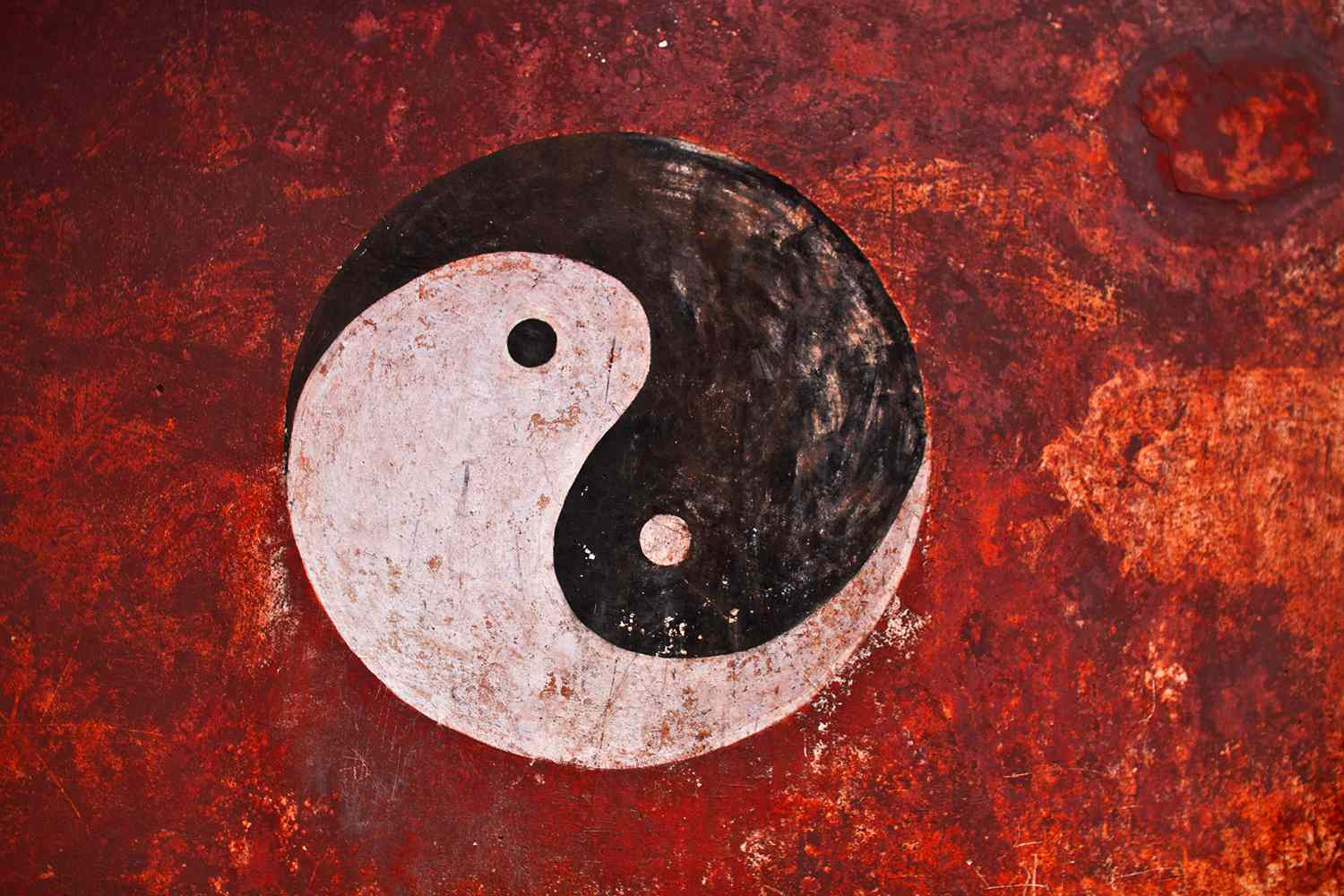
Another feature of Taoism is its notion of the relativity of all values and, as its correlative, the identity of opposites. Here Taoism tied in with the traditional Chinese yin/yang symbol, which is pictured thus: [see above] This polarity sums up all of life’s basic oppositions: good/evil, active/passive, positive/negative, light/dark, summer/winter, male/female. But though the halves are in tension, they are not flatly opposed; they complement and balance each other. Each invades the other’s hemisphere and takes up its abode in the deepest recess of its partner’s domain. And in the end both find themselves resolved by the circle that surrounds them, the Tao in its eternal wholeness. In the context of that wholeness, the opposites appear as no more than phases in an endless cycling process, for each turns incessantly into its opposite, exchanging places with it. Life does not move onward and upward toward a fixed pinnacle or pole. It bends back upon itself to come, full circle, to the realization that all is one and all is well. 

In the context of that wholeness, the opposites identified by the yin/yang symbol appear as no more than phases in an endless cycling process. Life does not move onward and upward toward a fixed pinnacle or pole. It bends back upon itself to come, full circle, to the realization that all is one and all is well. 

Those who meditate on this profound symbol, Taoists maintain, will find that it affords better access to the world’s secrets than any length of words and discussion. Faithful to its import, Taoism eschews all sharp dichotomies. No perspective in this relative world can be considered as absolute. Who knows when the longest way ’round might not prove to be the shortest way home? Or consider the relativity of dream and wakefulness. Chuang Tzu dreamed that he was a butterfly, and during the dream had no notion that he had ever been anything else. When he awoke, however, he was astonished to find that he was Chuang Tzu. But this left him with a question. Was he really Chuang Tzu who had dreamed that he was a butterfly, or was he a butterfly that was now dreaming that it was Chuang Tzu? 

Taoism eschews all sharp dichotomies. No perspective in this relative world can be considered as absolute. 

All values and concepts, then, are ultimately relative to the mind that entertains them. When it was suggested to the wren and the cicada that there are birds that fly hundreds of miles without alighting, both quickly agreed that such a thing was impossible. “You and I know very well,” they nodded, “that the furthest one can ever get, even by the most tremendous effort, is to that elm tree over there, and even this one cannot be sure of reaching every time. Often one finds oneself dragged back to earth long before one gets there. All these stories about flying hundreds of miles at a stretch are sheer nonsense.” 

All values and concepts, then, are ultimately relative to the mind that entertains them.

In the Taoist perspective even good and evil are not head-on opposites. The West has tended to dichotomize the two, but Taoists are less categorical. They buttress their reserve with the story of a farmer whose horse ran away. His neighbor commiserated, only to be told, “Who knows what’s good or bad?” It was true, for the next day the horse returned, bringing with it a drove of wild horses it had befriended. The neighbor reappeared, this time with congratulations for the windfall. He received the same response: “Who knows what is good or bad?” Again this proved true, for the next day the farmer’s son tried to mount one of the wild horses and fell, breaking his leg. More commiserations from the neighbor, which elicited the question: “Who knows what is good or bad?” And for a fourth time the farmer’s point prevailed, for the following day soldiers came by commandeering for the army, and the son was exempted because of his injury. If this all sounds very much like Zen, it should; for Buddhism processed through Taoism became Zen. 

In the Taoist perspective even good and evil are not head-on opposites. Buddhism processed through Taoism became Zen. 

Taoism follows its principle of relativity to its logical limit by positioning life and death as complementing cycles in the Tao’s rhythm. When Chuang Tzu’s wife died, his friend Hui-tzu visited him to express his condolences, only to find Chuang Tzu sitting on the ground with his legs spread wide apart, singing away and whacking out a tune on the back of a wooden bowl. 

“After all,” said his friend, “she lived with you devotedly all these years, watched your eldest son grow to manhood, and grew old along with you. For you not to have shed a tear over her remains would have been bad enough, but singing and drumming away on a bowl—this is just too much!” 

“You misjudge,” said Chuang Tzu. “When she died I was in despair, as any man well might be. But then I realized that before she was born she had no body, and it became clear to me that the same process of change that brought her to birth eventually brought her to death. If someone is tired and has gone to lie down, we do not pursue her with hooting and bawling. She whom I have lost has lain down to sleep for a while in the chamber between heaven and earth. To wail and groan while my wife is sleeping would be to deny nature’s sovereign law. So I refrain.” 

Taoism follows its principle of relativity to its logical limit by positioning life and death as complementing cycles in the Tao’s rhythm. 

Elsewhere Chuang Tzu expressed his confidence in the face of death directly: 

There is the globe,
The foundation of my bodily existence.
It wears me out with work and duties,
It gives me rest in old age,
It gives me peace in death.
For the one who supplied me with what I needed in life
Will also give me what I need in death.

Death brings about peace. One will get what one needs in death.

It is no surprise to find an outlook as averse to violence as Taoism verging on pacifism. There are passages in the Tao Te Ching that read almost like the Sermon on the Mount.

One who would guide a leader of men in the uses of life
Will warn him against the use of arms for conquest.
Even the finest arms are an instrument of evil:
An army’s harvest is a waste of thorns. (ch. 30)

Weapons are the tools of violence;
all decent men detest them.
Weapons are the tools of fear;
a decent man will avoid them
except in the direst necessity
and, if compelled, will use them
only with the utmost restraint.
Peace is the highest value….
He enters a battle gravely,
with sorrow and with great compassion,
as if he were attending a funeral. (ch. 31)

It is no surprise to find an outlook as averse to violence as Taoism verging on pacifism.

That in China the scholar ranked at the top of the social scale may have been Confucius’ doing, but Taoism is fully as responsible for placing the soldier at the bottom. “The way for a vital person to go is not the way of a soldier.” Only one “who recognizes all people as members of his or her own body is qualified to guard them…. Heaven arms with compassion those whom she would not see destroyed.” 

Taoism is fully as responsible for placing the soldier at the bottom of the social scale.

War is a somber matter, and Taoism spoke to life’s solemn, somber issues. Yet it always retained a quality of lightness verging on gaiety. There is a sophistication, an urbanity, a charm about the perspective that is infectious. “He who feels punctured,” notes the Tao Te Ching, “must once have been a bubble.” The economy, directness, and good humor in such a statement is typical of its entire outlook. In its freedom from a heavy-booted approach to life, Taoism is at one with the rest of China; but it is also, as we have seen, free of the Confucian tendency toward rigidity and formalism. Taoist literature is full of dialogues with Confucianists in which the latter come off as stuffy and pompous. An instance is the story of the Taoist Chuang Tzu and the Confucian Hui Tzu, who on an afternoon’s stroll came to a bridge over the Hao River. “Look how the minnows dart hither and thither at will. Such is the pleasure fish enjoy,” Chuang Tzu remarked.

“You are not a fish,” responded Hui Tzu. “How do you know what gives pleasure to fish?” 

“You are not I,” said Chuang Tzu. “How do you know I don’t know what gives pleasure to fish?”

Taoism has always retained a quality of lightness verging on gaiety. There is a sophistication, an urbanity, a charm about the perspective that is infectious. 

.

TAOISM: Creative Quietude

Reference: Taoism

[NOTE: In color are Vinaire’s comments.]

Taoism’s approach is the opposite of Confucianism—to get the foundations of the self in tune with Tao and let behavior flow spontaneously. Action follows being; new action will follow new being, wiser being, stronger being.

The object of Philosophical Taoism is to align one’s daily life to the Tao, to ride its boundless tide and delight in its flow. The basic way to do this, we earlier noted, is to perfect a life of wu wei. We have seen that wu wei should not be translated as do-nothingness or inaction, for those words suggest a vacant attitude of idleness or abstention. Better renderings are pure effectiveness and creative quietude. 

Wu Wei is a life of pure effectiveness and creative quietude. This is accomplished by aligning  one’s daily life to the Tao.

Creative quietude combines within a single individual two seemingly incompatible conditions—supreme activity and supreme relaxation. These seeming incompatibles can coexist because human beings are not self-enclosed entities. They ride an unbounded sea of Tao that sustains them, as we would say, through their subliminal minds. One way to create is through following the calculated directives of the conscious mind. The results of this mode of action, however, are seldom impressive; they tend to smack more of sorting and arranging than of inspiration. Genuine creation, as every artist knows, comes when the more abundant resources of the subliminal self are somehow tapped. But for this to happen a certain dissociation from the surface self is needed. The conscious mind must relax, stop standing in its own light, let go. Only so is it possible to break through the law of reversed effort in which the more we try the more our efforts boomerang. 

Creative quietude combines within a single individual two seemingly incompatible conditions—supreme activity and supreme relaxation. For this to happen a certain dissociation from the surface self is needed. The conscious mind must relax, stop standing in its own light, let go.

Wu wei is the supreme action, the precious suppleness, simplicity, and freedom that flows from us, or rather through us, when our private egos and conscious efforts yield to a power not their own. In a way it is virtue approached from a direction diametrically opposite to that of Confucius. Confucius turned every effort to building a pattern of ideal responses that might be consciously imitated. Taoism’s approach is the opposite—to get the foundations of the self in tune with Tao and let behavior flow spontaneously. Action follows being; new action will follow new being, wiser being, stronger being. The Tao Te Ching puts this point without wasting a word. “The way to do,” it says, “is to be.” 

Taoism’s approach is the opposite of Confucianism—to get the foundations of the self in tune with Tao and let behavior flow spontaneously. The Tao Te Ching puts this point without wasting a word. “The way to do,” it says, “is to be.” 

How are we to describe the action that flows from a life that is grounded directly in Tao? Nurtured by a force that is infinitely subtle, infinitely intricate, it is a consummate gracefulness born from an abundant vitality that has no need for abruptness or violence. One simply lets the Tao flow in and flow out again until all life becomes a dance in which there is neither feverishness nor imbalance. Wu wei is life lived above tension:

Keep stretching a bow
You repent of the pull,
A whetted saw
Grows thin and dull. (ch. 9)

One simply lets the Tao flow in and flow out again until all life becomes a dance in which there is neither feverishness nor imbalance.

Far from inaction, however, it is the embodiment of suppleness, simplicity, and freedom—a kind of pure effectiveness in which no motion is wasted on bickering or outward show.

One may move so well that a foot-print never shows,
Speak so well that the tongue never slips,
Reckon so well that no counter is needed. (ch. 27)

Far from inaction, however, it is the embodiment of suppleness, simplicity, and freedom.

Effectiveness of this order obviously requires an extraordinary skill, a point conveyed in the Taoist story of the fisherman who was able to land enormous fish with a thread because it was so delicately made that it had no weakest point at which to break. But Taoist skill is seldom noticed, for viewed externally wu wei—never forcing, never under strain—seems quite effortless. The secret here lies in the way it seeks out the empty spaces in life and nature and moves through these. Chuang Tzu, the greatest popularizer of Philosophical Taoism, makes this point with his story of Prince Wen Hui’s cook whose cleaver seemed never to lose its edge. When he cut up an ox, out went a hand, down went a shoulder. He planted a foot, he pressed with a knee, and the ox fell apart with a whisper. The bright cleaver murmured like a gentle wind. Rhythm! Timing! Like a sacred dance. Like “The Mulberry Grove,” like ancient harmonies! Pressed for his secret, the cook replied: “There are spaces in the joints; the blade is thin and keen. When this thinness finds that space, there is all the room you need! It goes like a breeze! Hence I have this cleaver nineteen years as if newly sharpened!

Taoist skill is seldom noticed, for viewed externally wu wei—never forcing, never under strain—seems quite effortless. 

The natural phenomenon that the Taoists saw as bearing the closest resemblance to Tao was water. They were struck by the way it would support objects and carry them effortlessly on its tide. The Chinese characters for swimmer, deciphered, mean literally “one who knows the nature of water.” Similarly, one who understands the basic life force knows that it will sustain one if one stops thrashing and flailing and trusts oneself to its support.

Do you have the patience to wait
till your mud settles and the water is clear?
Can you remain unmoving
till the right action arises by itself? (ch. 15)

One who understands the basic life force knows that it will sustain one if one stops thrashing and flailing and trusts oneself to its support.

Water, then, was the closest parallel to the Tao in the natural world. But it was also the prototype of wu wei. They noticed the way water adapts itself to its surroundings and seeks out the lowest places. So too,

The supreme good is like water,
which nourishes all things without trying to.
It is content with the low places that people disdain.
Thus it is like the Tao. (ch. 8)

Water, then, was the closest parallel to the Tao in the natural world. 

Yet despite its accommodation, water holds a power unknown to hard and brittle things. In a stream it follows the stones’ sharp edges, only to turn them into pebbles, rounded to conform to its streamlined flow. It works its way past frontiers and under dividing walls. Its gentle current melts rocks and carries away the proud hills we call eternal.

Nothing in the world
is as soft and yielding as water.
Yet for dissolving the hard and inflexible,
nothing can surpass it.
The soft overcomes the hard;
the gentle overcomes the rigid.
Everyone knows this is true,
but few can put it into practice. (ch. 78)

Water’s gentle current melts rocks and carries away the proud hills we call eternal.

Infinitely supple, yet incomparably strong—these virtues of water are precisely those of wu wei as well. The person who embodies this condition, says the Tao Te Ching, “works without working.” Such a one acts without strain, persuades without argument, is eloquent without flourish, and achieves results without violence, coercion, or pressure. Though the agent may be scarcely noticed, his or her influence is in fact decisive.

A leader is best
When people barely know that he exists.
Of a good leader, who talks little,
When his work is done, his aim fulfilled,
They will say, “We did this ourselves.” (ch. 17)

The person who embodies these virtues of water works without working. Such a one acts without strain, persuades without argument, is eloquent without flourish, and achieves results without violence, coercion, or pressure.

A final characteristic of water that makes it an appropriate analogue to wu wei is the clarity it attains through being still. “Muddy water let stand,” says the Tao Te Ching, “will clear.” If you want to study the stars after being in a brightly lit room, you must wait twenty minutes for your eyes to dilate for their new assignment. There must be similar periods of waiting if the focal length of the mind is to readjust, withdrawing from the world’s glare to the internal recesses of the soul.

The five colors can blind,
The five tones deafen,
The five tastes cloy.
The race, the hunt, can drive men mad
And their booty leave them no peace.
Therefore a sensible man
Prefers the inner to the outer eye. (ch. 12)

Clarity can come to the inner eye, however, only insofar as life attains a quiet that equals that of a deep and silent pool.

Muddy water attains through being still. There must be similar periods of waiting if the focal length of the mind is to readjust, withdrawing from the world’s glare to the internal recesses of the soul.

.

TAOISM: The Mingling of the Powers

Reference: Taoism

[NOTE: In color are Vinaire’s comments.]

A life has substance to the degree that it incorporates the profundity of mysticism (Taoist yoga), the direct wisdom of gnosis (Philosophical Taoism), and the productive power of magic (Religious Taoism).

Philosophical Taoism, vitalizing programs for increasing one’s individual ch’i, and the Taoist church: the three branches of Taoism, which at first seemed to have little in common, now show their family resemblances. All have the same concern—how to maximize the Tao’s animating te—and the specifics of their concerns fall on a continuum. The continuum begins with interest in how life’s normal allotment of ch’i can be deployed to best effect (Philosophical Taoism). From there it moves on to ask if that normal quotient can be increased (Taoist vitalizing programs). Finally, it asks if cosmic energies can be gathered, as if by a burning glass, to be deployed vicariously for the welfare of people who need help (popular or Religious Taoism). 

Philosophical Taoism, vitalizing programs for increasing one’s individual ch’i, and the Taoist church: the three branches of Taoism, all have the same concern—how to maximize the Tao’s animating te.

The danger in this arrangement is that in the interest of clarity the lines between the three divisions have been drawn too sharply. No solid walls separate them; the three are better regarded as currents in a common river. Throughout history each has interacted with the other two, right down to Taoism in Hong Kong and Taiwan today. John Blofeld, who lived in China for the twenty years preceding the Communist revolution, reported that he had never met a Taoist who was not involved to some degree with all three schools. 

No solid walls separate the three divisions of Taoism; the three are better regarded as currents in a common river.

We can summarize. To be something, to know something, and to be capable of something is to rise above the superficial. A life has substance to the degree that it incorporates the profundity of mysticism (Taoist yoga), the direct wisdom of gnosis (Philosophical Taoism), and the productive power of magic (Religious Taoism). Where these three things come together there is a “school,” and in China the school this chapter describes is Taoism. 

It is now time to return to Philosophical Taoism and give it its due hearing.

A life has substance to the degree that it incorporates the profundity of mysticism (Taoist yoga), the direct wisdom of gnosis (Philosophical Taoism), and the productive power of magic (Religious Taoism).

.