Category Archives: Religion

JUDAISM: Meaning in Justice

Reference: Judaism

Note: The original text is provided below.
Previous / Next

The Prophetic Principle can be put as follows: The prerequisite of political stability is social justice, for it is in the nature of things that injustice will not endure.

.

Summary

.

Comments

.

Original Text

It is to a remarkable group of men whom we call the prophets more than to any others that Western civilization owes its convictions (1) that the future of any people depends in large part on the justice of its social order, and (2) that individuals are responsible for the social structures of their society as well as for their direct personal dealings. 

When someone today is referred to as a prophet or is said to prophesy, we think of a soothsayer—someone who foretells the future. This was not the original meaning of the world. “Prophet” comes from the Greek word prophetes, in which pro means “for” and phetes means “to speak.” Thus, in its original Greek, a prophet is someone who “speaks for” someone else. This meaning is faithful to the original Hebrew. When God commissions Moses to demand from Pharaoh the release of his people and Moses protests that he cannot speak, God says, “Your brother Aaron shall be your prophet” (Exodus 7:1). 

If for the Hebrews the generic meaning of the word prophet was “one who speaks on the authority of another,” its specific meaning (as used to refer to a distinctive group of people in the biblical period) was “one who speaks for God.” A prophet differed from other men in that his mind, his speech, and occasionally even his body could become a conduit through which God addressed immediate historical conditions.

A review of the prophetic movement in Israel shows it not to have been a single phenomenon. Moses stands in a class by himself, but the prophetic movement passed through three stages, with the divine working differently in each of them. 

The first is the stage of the Prophetic Guilds, of which the ninth and tenth chapters of First Samuel provide one of the best glimpses. In this stage prophecy is a group phenomenon. Prophets are not here identified as individuals because their talent is not an individual possession. Traveling in bands or schools, prophecy for them was a field phenomenon that required a critical mass. Contemporary psychologists would consider it a form of collective, self-induced ecstasy. With the help of music and dancing, a prophetic band would work itself into a state of frenzy. Its members would lose their self-consciousness in a collective sea of divine intoxication. 

There was no ethical dimension to prophecy in this guild stage. The prophets assumed that they were possessed by the divine only because the experience brought an inrush of ecstatic power. In the second stage, ethics entered. This was the stage of the Individual Pre-Writing Prophets. Being alive and in motion, prophecy now began to launch individuals like rockets from the bands that formed their base. Their names have come down to us—Elijah, Elisha, Nathan, Micaiah, Ahijah, and others—but as they were still in the pre-writing stage, no books of the Bible carry their names. Ecstasy still figured large in their prophetic experience, and power, too, for when “the hand of the Lord” visited these men they outran chariots for thirty miles and were caught up from the plains and cast on mountaintops. But two things were different. Though these prophets too had a guild base, they could receive the divine visitation while they were alone. And second, the divine spoke through them more clearly. No longer did it manifest itself as an overpowering emotion only. Emotion backed God’s demand for justice. 

Two episodes from the Bible may be drawn from many to make this point. One is the story of Naboth who, because he refused to turn over his family vineyard to King Ahab, was framed on false charges of blasphemy and subversion and then stoned; as blasphemy was a capital crime, his property then reverted to the throne. When news of this travesty reached Elijah, the word of the Lord came to him, saying, “Go down to meet Ahab king of Israel. Say to him, ‘Thus says the Lord. You have killed and taken possession. In the place where dogs licked up the blood of Naboth, dogs will also lick up your blood’” (1 Kings 21:18–19). 

The story carries revolutionary significance for human history, for it is the story of how someone without official position took the side of a wronged man and denounced a king to his face on grounds of injustice. One will search the annals of history in vain for its parallel. Elijah was not a priest. He had no formal authority for the terrible judgment he delivered. The normal pattern of the day would have called for him to be struck down by bodyguards on the spot. But the fact that he was “speaking for” an authority not his own was so transparent that the king accepted Elijah’s pronouncement as just. 

The same striking sequence recurred in the incident of David and Bathsheba. From the top of his roof David glimpsed Bathsheba bathing and wanted her. There was an obstacle, however: she was married. To the royalty of those days this was a small matter; David simply moved to get rid of her husband. Uriah was ordered to the front lines, carrying instructions that he be placed in the thick of the fighting and support withdrawn so he would be killed. Everything went as planned; indeed, the procedure seemed routine until Nathan the prophet got wind of it. Sensing immediately that “the thing that David had done displeased the Lord,” he went straight to the king, who had absolute power over his life, and said to him: 

Thus says the Lord, the God of Israel: “You have struck down Uriah with the sword, and have taken his wife to be your wife, [so] I will raise up trouble against you within your own house; and I will take your wives before your eyes, and give them to your neighbor, and he shall lie with your wives in the sight of this very sun. For you did it secretly; but I will do this thing before all Israel. Because you have utterly scorned the Lord, the child that is born to you shall die.” (2 Samuel 12:7, 9, 11–12, 14) 

The surprising point in each of these accounts is not what the kings do, for they were merely exercising the universally accepted prerogatives of royalty in their day. The revolutionary and unprecedented fact is the way the prophets challenged their actions. 

We have spoken of the Prophetic Guilds and the Individual Pre-Writing Prophets. The third and climactic phase of the prophetic movement arrived with the great Writing Prophets: Amos, Hosea, Micah, Jeremiah, Isaiah, and the rest. Again at this stage, ecstasy was not absent from the prophetic experience; Ezekiel 1–3, Jeremiah 1, and Isaiah 6 (where the prophet “saw the Lord, high and exalted”) are among the most impressive theophanies on record. The Pre-Writing Prophets’ ethical emphasis, too, continued, but here there was an important development. Whereas a Nathan or an Elijah perceived God’s displeasure at individual acts of flagrant injustice, an Amos or an Isaiah could sense God’s disapproval of injustices that were less conspicuous because they were perpetrated not by individuals through specific acts but were concealed in the social fabric. Whereas the Pre-Writing Prophets challenged individuals, the Writing Prophets challenged corruptions in the social order and oppressive institutions. 

The Writing Prophets found themselves in a time that was shot through with inequities, special privilege, and injustices of the most flagrant sort. Wealth was concentrated in the hands of rich grandees, paupers were branded like cattle and sold as slaves, and debtors were traded for a pair of shoes. It was a world in which masters punished their slaves at will, women were subjugated to men, and unwanted children were abandoned to die in lonely places. 

As a threat to the contemporary social health of the body politic, this moral delinquency was one important fact of Jewish political life at the time, but there was another. Danger within was matched by danger from without; for, sandwiched between the colossal empires of Assyria and Babylonia to the east, Egypt to the south, and Phoenicia and Syria to the north, Israel and Judah were in danger of being crushed. In similar situations the other peoples of the region assumed that outcomes rested on the relative strengths of the national gods involved—in other words, on a simple calculus of power in which questions of morality were irrelevant. Such an interpretation, however, drains opportunity, and hence meaning, from such situations. If eventualities are strictly determined by power, there is little that a small nation can do. The Jews resisted this reading, out of what we have targeted as their unquenchable passion for meaning. Even where it seemed almost impossible to do otherwise, they refused to concede that any event was meaningless in the sense of leaving no room for a creative response involving a moral choice. Thus, what other nations would have interpreted as simply a power squeeze, they saw as God’s warning to clean up their national life: establish justice throughout the land, or be destroyed.

Stated abstractly, the Prophetic Principle can be put as follows: The prerequisite of political stability is social justice, for it is in the nature of things that injustice will not endure. Stated theologically the point reads: God has high standards. Divinity will not put up forever with exploitation, corruption, and mediocrity. This principle does not contradict what was said earlier about Yahweh’s love. On the whole the prophets join the psalmists in speaking more of love than of justice. Later, a Rabbi was to describe the relationship between the two as follows: 

A king had some empty glasses. He said: “If I pour hot water into them they will crack; if I pour ice-cold water into them they will also crack!” What did the king do? He mixed the hot and the cold water together and poured it into them and they did not crack. Even so did the Holy One, blessed be He, say: “If I create the world on the basis of the attribute of mercy alone, the world’s sins will greatly multiply. If I create it on the basis of the attribute of justice alone, how could the world endure? I will therefore create it with both the attributes of mercy and justice, and may it endure!”

The prophets of Israel and Judah are one of the most amazing groups of individuals in all history. In the midst of the moral desert in which they found themselves, they spoke words the world has never been able to forget. Amos, a simple shepherd but no straw blown north by accident; instead, a man with a mission, stern and rugged as the desert from which he came; a man with all his wits about him and every faculty alert, crying in the crass marketplace of Bethel, “Let justice roll down like waters, and righteousness like a mighty stream.” Isaiah, city-bred, stately, urbane, eloquent, but no less aflame with moral passion, crying out for one “who will bring forth justice in all the earth.” Hosea, Micah, Jeremiah—what a company they make! The prophets come from all classes. Some are sophisticated, others as plain and natural as the hillsides from which they come. Some hear God roaring like a lion; others hear the divine decree in the ghostly stillness that follows the storm. 

Yet one thing is common to them all: the conviction that every human being, simply by virtue of his or her humanity, is a child of God and therefore in possession of rights that even kings must respect. The prophets enter the stage of history like a strange, elemental, explosive force. They live in a vaster world than their compatriots, a world in which pomp and ceremony, wealth and splendor count for nothing, where kings seem small and the power of the mighty is as nothing compared with purity, justice, and mercy. So it is that wherever men and women have gone to history for encouragement and inspiration in the age-long struggle for justice, they have found it more than anywhere else in the ringing proclamations of the prophets.

.

HINDUISM: The Way to God through Psychophysical Exercises

Reference: Hinduism

Note: The original Text is provided below.
Previous / Next

The normal pattern will be for individuals to cast their religion in either a philosophical (jnana) or a devotional (bhakti) mold, adapt their work (karma) to the one that is chosen, and meditate to whatever extent is practicable. 

.

Summary

.

Comments

.

Original Text

Because of the dazzling heights to which it leads, raja yoga has been known in India as “the royal (raj) road to reintegration.” Designed for people who are of scientific bent, it is the way to God through psychophysical experiments.

The West has honored empiricism in the laboratory but has often distrusted it in spiritual matters, on grounds that it deifies personal experience by making it the final test of truth. India has not had such misgivings. Arguing that affairs of the spirit can be approached as empirically as can outer nature, she encourages people who possess the requisite inclination and willpower to seek God in laboratory fashion. The approach calls for a strong suspicion that our true selves are more than we now realize and a passion to plumb their full extent. For those who possess these qualifications, raja yoga outlines a series of steps that are to be followed as rigorously as the steps in a physics experiment. If these do not produce the expected consequences, the hypothesis has been disproved, at least for this experimenter. The claim, however, is that the experiences that unfold will confirm the hypothesis in question. 

Unlike most experiments in the natural sciences, those of raja yoga are on one’s self, not external nature. Even where science does turn to self-experiment—as in medicine, where ethics prescribes that dangerous experiments may be performed only on oneself—the Indic emphasis is different. The yogi experiments not on his body (though we shall find the body definitely involved) but on his mind. The experiments take the form of practicing prescribed mental exercises and observing their subjective effects. 

No dogmas need be accepted, but experiments require hypotheses they are designed to confirm or negate. The hypothesis that underlies raja yoga is the Hindu doctrine of the human self; and though it has been described several times already, it needs to be restated as the background against which the steps of raja yoga proceed. 

The theory postulates that the human self is a layered entity. We need not go into the detailed Hindu analyses of these layers; the accounts are technical, and future science may show them to be more metaphorical than literally accurate. For our purposes it is enough to summarize the hypothesis by reducing the principal layers to four. First and most obviously, we have bodies. Next comes the conscious layer of our minds. Underlying these two is a third region, the realm of the individual subconscious. This has been built up through our individual histories. Most of our past experiences have been lost to our conscious memory, but those experiences continue to shape our lives in ways that contemporary psychoanalysis tries to understand. With these three parts of the self, the West is in full agreement. What is distinctive in the Hindu hypothesis is its postulation of a fourth component. Underlying the other three, less perceived by the conscious mind than even its private subconscious (though related to it fully as much), stands Being Itself, infinite, unthwarted, eternal. “I am smaller than the minutest atom, likewise greater than the greatest. I am the whole, the diversified-multicolored-lovely-strange universe. I am the Ancient One. I am Man, the Lord. I am the Being-of-Gold. I am the very state of divine beatitude.”

Hinduism agrees with psychoanalysis that if only we could dredge up portions of our individual unconscious—the third layer of our being—we would experience a remarkable expansion of our powers, a vivid freshening of life. But if we could uncover something forgotten not only by ourselves but by humanity as a whole, something that provides clues not simply to our individual personalities and quirks but to all life and all existence, what then? Would this not be momentous? 

The call, clearly, is to retreat from the world’s inconsequential panorama to the deep-lying causal zones of the psyche where the real problems and answers lie. Beyond this, however, raja yoga’s response cannot be described, quite, as an answer to any articulated call. Rather, it is a determined refusal to allow the pitter-patter of daily existence to distract from the unknown demands of some waiting urgency within: a kind of total strike against the terms of routine, prosaic existence. The successful yogi succeeds in carrying life’s problem to this plane of new magnitude and there resolving it. The insights of such people will pertain not so much to passing personal and social predicaments as to the unquenchable source by which all peoples and societies are renewed, for their inspiration will be drawn from direct contact with this primary spring. In body they will remain individuals. In spirit each will have become unspecific, universal, perfected. 

The purpose of raja yoga is to demonstrate the validity of this fourfold estimate of the human self by leading the inquirer to direct personal experience of “the beyond that is within.” Its method is willed introversion, one of the classic implements of creative genius in any line of endeavor, here carried to its logical term. Its intent is to drive the psychic energy of the self to its deepest part to activate the lost continent of the true self. Risks are of course involved; if the venture is bungled, at best considerable time will have been lost, and at worst consciousness can disintegrate into psychosis. Rightly done, however, under a director who knows the terrain, the yogi will be able to integrate the insights and experiences that come into view and will emerge with heightened self-knowledge and greater self-control. 

With the hypothesis raja yoga proposes to test before us, we are prepared to indicate the eight steps of the experiment itself. 

1 and 2. The first two concern the moral preliminaries with which all four yogas begin. Anyone who sits down to this task of self-discovery discovers that distractions lie in wait. Two of the most obvious are bodily cravings and mental inquietude. Just as concentration is about to begin in earnest, the yogi may experience an urge for a cigarette or drink of water. Or resentments, envies, and pangs of conscience obtrude. The first two steps of raja yoga seek to clear the field of such static and to lock the door against further intrusions. The first involves the practice of five abstentions: from injury, lying, stealing, sensuality, and greed. The second involves the practice of five observances: cleanliness, contentment, self-control, studiousness, and contemplation of the divine. Together they constitute the five finger exercises of the human spirit in anticipation of more intricate studies to come. Chinese and Japanese officers who used to practice variations of raja yoga in Buddhist monasteries with no religious interest whatsoever—simply to increase their mental clarity and vitality—discovered that even in their case a certain amount of moral comportment was a necessary condition for success. 

3. Raja yoga works with the body even while being ultimately concerned with the mind. More precisely, it works through the body to the mind. Beyond general health, its chief object here is to keep the body from distracting the mind while it concentrates. This is no small object, for an untrained body cannot go for long without itching or fidgeting. Each sensation is a bid for attention that distracts from the project at hand. The object of this third step is to exclude such distractions—to get Brother Ass, as Saint Francis called his body, properly tethered and out of the way. What is attempted is a bodily state midway between discomfort, which rouses and disturbs, and at the opposite pole a relaxation so complete that it sinks into drowsiness. The Hindu discoveries for achieving this balance are called asanas, a word usually translated “postures” but which carries connotations of balance and ease. The physical and psychological benefits of at least some of these postures are now widely recognized. That the Hindu texts describe eighty-four postures indicates extensive experimentation in the area, but only about five are considered important for meditation. 

Of these, the one that has proved most important is the world-renowned lotus position in which the yogi sits—ideally on a tiger skin, symbolizing energy, overlaid with a deerskin, symbolizing calm—with legs crossed in such a way that each foot rests sole up on its opposing thigh. The spine, with allowance for its natural curvature, is erect. Hands are placed, palms up, in the lap, one atop the other with thumbs touching lightly. The eyes may be closed or allowed to gaze unfocused on the ground or floor. People who undertake this position after their bodies have reached maturity find it painful, for it imposes strains on the tendons which require months of conditioning to be accommodated. When the position has been mastered, however, it is surprisingly comfortable and seems to place the mind in a state that conduces to meditation. Given that standing induces fatigue, chairs invite slumping, and reclining encourages sleep, there may be no other position in which the body can remain for as long a stretch both still and alert. 

4. Yogic postures protect the meditator from disruptions from the body in its static aspects, but there remain bodily activities, such as breathing. The yogi must breathe, but untrained breathing can shatter the mind’s repose. Newcomers to meditation are surprised by the extent to which unbridled breathing can intrude upon the task. Bronchial irritations and congestions trigger coughs and clearings of the throat. Each time the breath sinks too low, a deep sigh erupts to shatter the spell. Nor are such obvious irregularities the sole offenders; through concentrated silence, a “normal” breath can rip like a crosscut, sending the hush shivering, flying. The purpose of raja yoga’s fourth step is to prevent such disruptions through the mastery of respiration. The exercises prescribed toward this end are numerous and varied. Some, like learning to breathe in through one nostril and out through the other, sound bizarre, but studies suggest that they may help to balance the brain’s two hemispheres. On the whole the exercises work toward slowing the breath, evening it, and reducing the amount of air required. A typical exercise calls for breathing so gently across goose down touching the nostrils that an observer cannot tell if air is moving in or out. Breath suspension is particularly important, for the body is most still when it is not breathing. When, for example, the yogi is doing a cycle of sixteen counts inhaling, sixty-four holding, and thirty-two exhaling, there is a stretch during which animation is reduced to the point that the mind seems disembodied. These are cherished moments for the task at hand. “The light of a lamp,” says the Bhagavad-Gita, “does not flicker in a windless place.” 

5. Composed, body at ease, its breathing regular, the yogi sits absorbed in contemplation. Suddenly, a door creaks, a sliver of moonlight shimmers on the ground ahead, a mosquito whines, and he is back in the world.

Restless the mind is,
So strongly shaken
In the grip of the senses.
Truly I think
The wind is no wilder. (Bhagavad-Gita, VI:34)

The senses turn outward. As bridges to the physical world they are invaluable, but the yogi is seeking something else. On the track of more interesting prey—the interior universe in which (according to reports) is to be found the final secret of life’s mystery—the yogi wants no sense bombardments. Fascinating in its own way, the outer world has nothing to contribute to the present task. For the yogi is tracking the underpinning of life’s facade. Behind its physical front, where we experience the play of life and death, the yogi seeks a deeper life that knows no death. Is there, beneath our surface accounting of objects and things, a dimension of awareness that is different not just in degree but in kind? The yogi is testing a hypothesis: that the deepest truth is opened only to those who turn their attention inward, and in this experiment the physical senses can be nothing but busybodies. “The senses turn outward,” observe the Upanishads. “People, therefore, look toward what is outside and see not the inward being. Rare are the wise who shut their eyes to outward things and behold the glory of the Atman within.” Five hundred years later the Bhagavad-Gita repeats that refrain:

Only that yogi
Whose joy is inward,
Inward his peace,
And his vision inward
Shall come to Brahman
And know Nirvana.

It is against the background of three millennia of this postulate that Mahatma Gandhi proposed to our extroverted century: “Turn the spotlight inward.” 

The final, transitional step in the process of effecting this turn from the external to the internal world is to close the doors of perception, for only so can the clatter of the world’s boiler factory be effectively shut out. That this can be done, and without bodily mutilation, is a common experience. A man calls his wife to remind her that they should leave for a social engagement. Five minutes later she insists that she did not hear him; he insists that she must have heard him, for he was in the adjoining room and spoke distinctly. Who is right? It is a matter of definition. If hearing means that sound waves of sufficient amplitude beat on healthy eardrums, she heard; if it means that they were noticed, she did not. There is nothing esoteric about such occurrences; their explanation is simply concentration—the woman was at her computer and deeply engrossed. Similarly, there is no catch in this fifth step in raja yoga. It seeks to carry the yogi beyond the point the wife had reached, first, by turning concentration from a chance occurrence into a power that is controlled; and second, by raising the talent to a point where drumbeats in the same room can escape notice. The technique, though, is identical. Concentration on one thing excludes other things. 

6. At last the yogi is alone with his mind. The five steps enumerated thus far all point to this eventuality; one by one the intrusions of cravings, a troubled conscience, body, breath, and the senses have been stopped. But the battle is not yet won; at close quarters it is just beginning. For the mind’s fiercest antagonist is itself. Alone with itself it still shows not the slightest inclination to settle down or obey. Memories, anticipations, daydreams, chains of reverie held together by the flimsiest, most unexpected links imaginable close in from all sides, causing the mind to ripple like a lake beneath a breeze, alive with ever-changing, self-shattering reflections. Left to itself the mind never stays still, smooth as a mirror, crystal clear, reflecting the Sun of all life in perfect replica. For such a condition to prevail, it is not enough that entering rivulets be dammed; this the five preceding steps effectively accomplished. There remain lake-bottom springs to be stopped and fantasies to be curbed. Obviously, much remains to be done. 

Or switch the metaphor to one less serene. The motions of the average mind, say the Hindus, are about as orderly as those of a crazed monkey cavorting about its cage. Nay, more; like the prancings of a drunk, crazed monkey. Even so we have not conveyed its restlessness; the mind is like a drunken, crazed monkey that has St. Vitus’ Dance. To do justice to our theme, however, we must go a final step. The mind is like a drunken crazed monkey with St. Vitus’ Dance who has just been stung by a wasp. 

Few who have seriously tried to meditate will find this metaphor extreme. The trouble with the advice to “leave your mind alone” is the unimpressive spectacle that remains. I tell my hand to rise and it obeys. I tell my mind to be still and it mocks my command. How long can the average mind think about one thing—one thing only, without slipping first into thinking about thinking about that thing and taking off from there on a senseless chain of irrelevancies? About three and a half seconds, psychologists tell us. Like a ping-pong ball, the mind will alight where its owner directs it, but only to take off immediately on a jittery flight of staccato bounces that are completely out of hand.

What if the mind could be turned from a ping-pong ball into a lump of dough, which when thrown sticks to a wall until deliberately removed? Would not its power increase if it could be thus held in focus? Would not its strength be compounded, like the strength of a light bulb when ringed by reflectors? A normal mind can be held to a reasonable extent by the world’s objects. A psychotic mind cannot; it slips at once into uncontrollable fantasy. What if a third condition of mind could be developed, as much above the normal mind as the psychotic mind is below it, a condition in which the mind could be induced to focus protractedly on an object to fathom it deeply? This is the aim of concentration, the sixth step of raja yoga. An elephant’s trunk that sways to and fro as the elephant walks and reaches out for objects on either side will settle down if it is given an iron ball to hold. The purpose of concentration is comparable: to teach the restless mind to hold unswervingly to the object it is directed to. “When all the senses are stilled, when the mind is at rest, when the intellect wavers not—that, say the wise, is the highest state.”

The method proposed for reaching this state is not exotic, only arduous. One begins by relaxing the mind to allow thoughts that need release to exorcize themselves from the subconscious. Then one selects something to concentrate on—the glowing tip of a joss stick, the tip of one’s nose, an imaged sea of infinite light, the object does not much matter—and practices keeping the mind on the object until success increases. 

7. The last two steps are stages in which this process of concentration progressively deepens. In the preceding step the mind was brought to the point where it would flow steadily toward its object, but it did not lose consciousness of itself as an object distinct from the one it was focusing on. In this seventh step, in which concentration deepens into meditation, the union between the two is tightened to the point where separateness vanishes: “The subject and the object are completely merged so that the self-consciousness of the individual subject has disappeared altogether.” In this moment the duality of knower and known is resolved into a perfect unity. In the words of Schelling, “the perceiving self merges in the self-perceived. At that moment we annihilate time and the duration of time; we are no longer in time, but time, or rather eternity itself, is in us.” 

8. There remains the final, climactic state for which the Sanskrit word samadhi should be retained. Etymologically sam parallels the Greek prefix syn, as in synthesis, synopsis, and syndrome. It means “together with.” Adhi in Sanskrit is usually translated Lord, paralleling the Hebrew word for Lord in the Old Testament, Adon or Adonai. Samadhi, then, names the state in which the human mind is completely absorbed in God. In the seventh step—that of meditation—concentration had deepened to the point where the self dropped out of sight entirely, all attention being riveted on the object being known. The distinctive feature of samadhi is that all of the object’s forms fall away. For forms are limiting boundaries; to be one form others must be excluded, and what is to be known in raja yoga’s final stage is without limits. The mind continues to think—if that is the right word—but of no thing. This does not mean that it is thinking of nothing, that it is a total blank. It has perfected the paradox of seeing the invisible. It is filled with that which is “separated from all qualities, neither this nor that, without form, without a name.”

We have come a long way from Lord Kelvin’s assertion that he could not imagine anything of which he could not construct a mechanical model. By that mode in which the knower is united with what is known, the knower has been brought to the knowledge of total being and, for a spell, been dissolved into it. That which the experiment was designed to test has been determined. The yogi has attained to the insight “That, verily, That thou art.” 

We have presented the four yogas as alternatives but, to conclude with a point that was made at the start, Hinduism does not consider them as exclusive of one another. No individual is solely reflective, emotional, active, or experimental, and different life situations call for different resources to be brought into play. Most people will, on the whole, find travel on one road more satisfactory than on others and will consequently tend to keep close to it; but Hinduism encourages people to test all four and combine them as best suits their needs. The major division is between jnana and bhakti, the reflective and the emotional types. We have seen that work can be adapted to either of these modes, and some meditation is valuable in any case. The normal pattern, therefore, will be for individuals to cast their religion in either a philosophical or a devotional mold, adapt their work to the one that is chosen, and meditate to whatever extent is practicable. We read in the Bhagavad-Gita that some “realize the Atman through contemplation. Some realize the Atman philosophically. Others realize it by following the yoga of right action. Others worship God as their teachers have taught them. If these faithfully practice what they have learned, they will pass beyond death’s power.”

.

JUDAISM: Meaning in Morality

Reference: Judaism

Note: The original text is provided below.
Previous / Next

The importance of the Ten Commandments in their ethical dimensions lies not in their uniqueness but in their universality.

.

Summary

.

Comments

.

Original Text

Human beings are social creatures. Separated from their kind at birth, they never become human; yet living with others, they are often barbaric. The need for morality stems from this double fact. Nobody likes moral rules any more than they like stop lights or “no left turn” signs. But without moral constraints, human relations would become as snarled as traffic in the Chicago loop if everyone drove at will. 

The Jewish formulation of “those wise restraints that make men free” is contained in her Law. We shall have occasion to note that this Law contains ritualistic as well as ethical prescriptions, but for the present we are concerned with the latter. According to the rabbinic view, the Hebrew Bible contains no less than 613 commandments that regulate human behavior. Four of these will suffice for our purposes: the four ethical precepts of the Ten Commandments, for it is through these that Hebraic morality has had its greatest impact. Appropriated by Christianity and Islam, the Ten Commandments constitute the moral foundation of most of the Western world. 

There are four danger zones in human life that can cause unlimited trouble if they get out of hand: force, wealth, sex, and speech. On the animal level these are well contained. Two scarcely surface as problems at all. The spoken word does not, for animals cannot communicate enough to seriously deceive. Neither, really, does wealth, for to become a serious social problem the drive for possessions requires foresight and sustained greed at levels unknown in the animal kingdom. As for sex and force, they too pose no serious problems. Periodicity keeps sex from becoming obsessive, and inbuilt restraints hold violence in check. With the curious exception of ants, intraspecial warfare is seldom found. Where it has broken out, the species has usually destroyed itself. 

With human beings things are different. Jealousies, hatreds, and revenge can lead to violence that, unless checked, rips communities to pieces. Murder instigates blood feuds that drag on indefinitely. Sex, if it violates certain restraints, can rouse passions so intense as to destroy entire communities. Similarly with theft and prevarication. We can imagine societies in which people do exactly as they please on these counts, but none have been found and anthropologists have now covered the globe. Apparently, if total permissiveness has ever been tried, its inventors have not survived for anthropologists to study. Perhaps here, more than anywhere else, we encounter human constants. Parisians are cousins to Bongolanders; twentieth-century sophisticates are related to aborigines. All must contain their appetites if history is to continue. 

What the Ten Commandments prescribe in these areas are the minimum standards that make collective life possible. In this sense the Ten Commandments are to the social order what the opening chapter of Genesis is to the natural order; without each there is only a formless void. Whereas Genesis structures (and thereby creates) the physical world, the Ten Commandments structure (and thereby make possible) a social world. Regarding force, they say in effect: You can bicker and fight, but killing within the in-group will not be permitted, for it instigates blood feuds that shred community. Therefore thou shalt not murder. Similarly with sex. You can be a rounder, flirtatious, even promiscuous, and though we do not commend such behavior, we will not get the law after you. But at one point we draw the line: Sexual indulgence of married persons outside the nuptial bond will not be allowed, for it rouses passions the community cannot tolerate. Therefore thou shalt not commit adultery. As for possessions, you may make your pile as large as you please and be shrewd and cunning in the enterprise. One thing, though, you may not do, and that is pilfer directly off someone else’s pile, for this outrages the sense of fair play and builds animosities that become ungovernable. Therefore thou shalt not steal. Finally, regarding the spoken word, you may dissemble and equivocate, but there is one time when we require that you tell the truth, the whole truth, and nothing but the truth. If a dispute reaches such proportions as to be brought before a tribunal, on such occasions the judges must know what happened. If you lie then, while under oath to tell the truth, the penalty will be severe. Thou shalt not bear false witness.

The importance of the Ten Commandments in their ethical dimensions lies not in their uniqueness but in their universality, not in their finality but in their foundational priority. They do not speak the final word on the topics they touch; they speak the words that must be spoken if other words are to follow. This is why, over three thousand years after Mount Sinai, they continue as the “moral esperanto” of the world. This led Heine to exclaim of the man who received them: “How tiny does Sinai appear when Moses stands upon it,” and the biblical writers to assert categorically, “There arose not in Israel [another] prophet like Moses” (Deuteronomy 34:10).

.

HINDUISM: The Way to God through Work

Reference: Hinduism

Note: The original Text is provided below.
Previous / Next

The point of life is to evolve beyond its current limits. Work without thought of self can be a vehicle for self-transcendence.

.

Summary

.

Comments

.

Original Text

The third path toward God, intended for persons of active bent, is karma yoga, the path to God through work. 

An examination of the anatomy and physiology of human bodies discloses an interesting fact. All organs of digestion and respiration serve to feed the blood with nutritive materials. The circulatory apparatus delivers this nourishing blood throughout the body, maintaining bones, joints, and muscles. Bones provide a framework without which the muscles could not operate, while joints supply the flexibility needed for movement. The brain envisions the movements that are to be made, and the spinal nervous system executes them. The vegetative nervous system, helped by the endocrine system, maintains the harmony of the viscera on which the motor muscles depend. In short, the entire body, except for the reproductive apparatus, converges on action. “The human machine,” a physician writes, “seems indeed to be made for action.”

Work is the staple of human life. The point is not simply that all but a few people must work to survive. Ultimately, the drive to work is psychological rather than economic. Forced to be idle, most people become irritable; forced to retire, they decline. Included here are compulsive housekeepers as well as great scientists, such as Mme. Curie. To such people Hinduism says, You don’t have to retire to a cloister to realize God. You can find God in the world of everyday affairs as readily as anywhere. Throw yourself into your work with everything you have; only do so wisely, in a way that will bring the highest rewards, not just trivia. Learn the secret of work by which every movement can carry you Godward even while other things are being accomplished, like a wristwatch that winds itself as other duties are performed. 

How this is to be done depends on the other components in the worker’s nature. By choosing the path of work, the karma yogi has already shown an inclination toward activity, but there remains the question of whether the supporting disposition is predominantly affective or reflective. The answer to that question determines whether the yogi approaches work intellectually or in the spirit of love. In the language of the four yogas, karma yoga can be practiced in either mode: jnana (knowledge), or bhakti (devoted service).

As we have seen, the point of life is to transcend the smallness of the finite self. This can be done either by identifying oneself with the transpersonal Absolute that resides at the core of one’s being, or by shifting one’s interest and affection to a personal God who is experienced as distinct from oneself. The first is the way of jnana, the second of bhakti. Work can be a vehicle for self-transcendence in either approach, for according to Hindu doctrine every action performed upon the external world reacts on the doer. If I chop down a tree that blocks my view, each stroke of the ax unsettles the tree; but it leaves its mark on me as well, driving deeper into my being my determination to have my way in the world. Everything I do for my private wellbeing adds another layer to my ego, and in thickening it insulates me more from God. Conversely, every act done without thought for myself diminishes my self-centeredness until finally no barrier remains to separate me from the Divine. 

The best way for the emotionally inclined to render work selfless is to bring their ardent and affectionate natures into play and work for God’s sake instead of their own. “He who performs actions without attachment, resigning them to God, is untainted by their effects as the lotus leaf by water.” Such a one is as active as before, but works for a different reason, out of dedication. Acts are no longer undertaken for their personal rewards. Not only are they now performed as service to God; they are regarded as prompted by God’s will and enacted by God’s energy as channeled through the devotee. “Thou art the Doer, I the instrument.” Performed in this spirit, actions lighten the ego instead of encumbering it. Each task becomes a sacred ritual, lovingly fulfilled as a living sacrifice to God’s glory. “Whatsoever you do, whatever you eat, whatever you offer in sacrifice, whatever you give, whatever austerity you practice, O Son of Kunti, do this as an offering to Me. Thus shall you be free from the bondages of actions that bear good and evil results,” says the Bhagavad-Gita. “They have no desire for the fruits of their actions,” echoes the Bhagavata Purana. “These persons would not accept even the state of union with Me; they would always prefer My service.” 

A young woman, newly married and in love, works not for herself alone. As she works the thought of her beloved is in the back of her mind, giving meaning and purpose to her labors. So too with a devoted servant. He claims nothing for himself. Regardless of personal cost he does his duty for his master’s satisfaction. Just so is God’s will the joy and satisfaction of the devotee. Surrendering to the Lord of all, he remains untouched by life’s vicissitudes. Such people are not broken by discouragements, for winning is not what motivates them; they want only to be on the right side. They know that if history changes it will not be human beings that change it but its Author—when human hearts are ready. Historical figures lose their center when they become anxious over the outcome of their actions. “Do without attachment the work you have to do. Surrendering all action to Me, freeing yourself from longing and selfishness, fight—unperturbed by grief” (Bhagavad-Gita)

Once all claims on work have been renounced, including whether it will succeed in its intent, the karma yogi’s actions no longer swell the ego. They leave on the mind no mark that could vector its subsequent responses. In this way the yogi works out the accumulated impressions of previous deeds without acquiring new ones. Whatever one thinks of this karmic way of putting the matter, the psychological truth involved is readily apparent. A person who is completely at the disposal of others barely exists. The Spanish ask wryly: “Would you like to become invisible? Have no thought of yourself for two years and no one will notice you.” 

Work as a path toward God takes a different turn for people whose dispositions are more reflective than emotional. For these too the key is work done unselfishly, but they approach the project differently. Philosophers tend to find the idea of Infinite Being at the center of one’s self more meaningful than the thought of a divine Creator who watches over the world with love. It follows, therefore, that their approach to work should be adapted to the way they see things. 

The way that leads to enlightenment is work performed in detachment from the empirical self. Specifically, it consists in drawing a line between the finite self that acts, on the one hand, and on the other the eternal Self that observes the action. People usually approach work in terms of its consequences for their empirical selves—the pay or acclaim it will bring. This inflates the ego. It thickens its insulation and thereby its isolation. 

The alternative is work performed detachedly, almost in dissociation from the empirical self. Identifying with the Eternal, the worker works; but as the deeds are being performed by the empirical self, the True Self has nothing to do with them. “The knower of Truth, being centered in the Self should think, ‘I do nothing at all.’ While seeing, breathing, speaking, letting go, holding, opening and closing the eyes, he observes only senses moving among sense objects.”

As the yogi’s identification shifts from her finite to her infinite Self, she will become increasingly indifferent to the consequences that flow from her finite actions. More and more she will recognize the truth of the Gita’s dictum: “To work you have the right, but not to the fruits thereof.” Duty for duty’s sake becomes her watchword.

He who does the task
Dictated by duty,
Caring nothing
For the fruit of the action,
He is a yogi. (Bhagavad-Gita, VI:I)

Hence the story of the yogi who, as he sat meditating on the banks of the Ganges, saw a scorpion fall into the water. He scooped it out, only to have it bite him. Presently, the scorpion fell into the river again. Once more the yogi rescued it, only again to be bitten. The sequence repeated itself twice more, whereupon a bystander asked the yogi, “Why do you keep rescuing that scorpion when its only gratitude is to bite you?” The yogi replied: “It is the nature of scorpions to bite. It is the nature of yogis to help others when they can.” 

Karma yogis will try to do each thing as it comes as if it were the only thing to be done and, having done it, turn to the next duty in similar spirit. Concentrating fully and calmly on each duty as it presents itself, they will resist impatience, excitement, and the vain attempt to do or think of half a dozen things at once. Into the various tasks that fall their lot they will put all the strokes they can, for to do otherwise would be to yield to laziness, which is another form of selfishness. Once they have done this, however, they will dissociate themselves from the act and let the chips fall where they may.

One to me is loss or gain,
One to me is fame or shame,
One to me is pleasure, pain. (Bhagavad-Gita, XII)

Mature individuals do not resent correction, for they identify more with their long-range selves that profit from correction than with the momentary self that is being advised. Similarly, the yogi accepts loss, pain, and shame with equanimity, knowing that these too are teachers. To the degree that yogis repose in the Eternal, they experience calm in the midst of intense activity. Like the center of a rapidly spinning wheel, they seem still—emotionally still—even when they are intensely busy. It is like the stillness of absolute motion.

Though the conceptual frameworks within which philosophical and affectionate natures practice karma yoga are different, it is not difficult to perceive their common pursuit. Both are engaged in a radical reducing diet, designed to starve the finite ego by depriving it of the consequences of action on which it feeds. Neither gives the slightest purchase to that native egoism that the world considers healthy self-regard. The bhakta seeks “self-naughting” by giving heart and will to the Eternal Companion and finding them enriched a thousandfold thereby. The jnani is equally intent on shrinking the ego, being convinced that to the degree that the venture succeeds there will come into view a nucleus of selfhood that differs radically from its surface mask, “a sublime inhabitant and onlooker, transcending the spheres of the former conscious-unconscious system, aloofly unconcerned with the tendencies that formerly supported the individual biography. This anonymous ‘diamond being’ is not at all what we were cherishing as our character and cultivating as our faculties, inclinations, virtues, and ideals; for it transcends every horizon of unclarified consciousness. It was enwrapped within the sheaths of the body and personality; yet the dark, turbid, thick [layers of the surface self] could not disclose its image. Only the translucent essence of [a self in which all private wants have been dispersed] permits it to become visible—as through a glass, or in a quiet pond. And then, the moment it is recognized, its manifestation bestows an immediate knowledge that this is our true identity. The life-monad is remembered and greeted, even though it is distinct from everything in this phenomenal composite of body and psyche, which, under the delusion caused by our usual ignorance and undiscriminating consciousness we had crudely mistaken for the real and lasting essence of our being.”

.

JUDAISM: Meaning in History

Reference: Judaism

Note: The original text is provided below.
Previous / Next

Judaism focused on evolution in this world from a historical perspective; while, Hinduism focused on spiritual evolution from the perspective of infinity.

.

Summary

.

Comments

.

Original Text

Let us begin with a contrast. “According to most classical philosophies and religions,” a historian writes, “ultimate reality is disclosed when man, either by rational contemplation or mystic ascent, goes beyond the flow of events which we call ‘history.’ The goal is the apprehension of an order of reality unaffected by the unpredictable fortunes of mankind. In Hinduism, for instance, the world of sense experience is regarded as maya, illusion; the religious man, therefore, seeks release from the wheel of life in order that his individuality may fade out into the World-Soul, Brahma. Or, Greek philosophers looked upon the world as a natural process which, like the rotation of the seasons, always follows the same rational scheme. The philosopher, however, could soar above the recurring cycles of history by fixing his mind upon the unchanging absolute which belongs to the eternal order. Both of these views are vastly different from the Biblical claim that God is found within the limitations of the world of change and struggle, and especially that he reveals himself in events which are unique, particular, and unrepeatable. For the Bible, history is neither maya nor a circular process of nature; it is the arena of God’s purposive activity.”

What is at stake when we ask if there is meaning in history? At stake is our whole attitude toward the social order and collective life within it. If we decide that history is meaningless, it follows that the social, political, and cultural contexts of life do not warrant active concern. Life’s pivotal problems will be judged to lie elsewhere, in the extent to which we can rise above circumstances and triumph over them. To the extent that we see things this way, we shall take little interest in, and feel little responsibility for, the problems that beset societies, cultures, and civilizations. 

The Hebrew estimate of history was the exact opposite of this attitude of indifference. To the Jews history was of towering significance. It was important, first, because they were convinced that the context in which life is lived affects that life in every way, setting up its problems, delineating its opportunities, conditioning its outcomes. It is impossible to talk about Adam and Noah (the same may be said of every major biblical character) apart from the particular circumstances—in this case Eden and the Flood—that enveloped them and in response to which their lives took form. The events the Hebrew Bible relates are profoundly contextual. 

Second, if contexts are crucial for life, so is collective action; social action as we usually call it. There are times when the only way to get things changed is by working together—planning, organizing, and then acting in concert. The destiny of the Hebrew slaves in Egypt is not depicted as depending on the extent to which they individually “rose above” their slavery by cultivating a liberty of spirit that could tolerate physical chains. They needed to stand up collectively and break for the desert. 

Third, history was important for the Jews because they saw it as a field of opportunity. As it was ruled by God—the “theater of God’s glory,” John Calvin claimed, extrapolating from this Old Testament base—nothing in history happens accidentally. Yahweh’s hand was at work in every event—in Eden, the Flood, the Exodus, the Babylonian Exile—shaping each sequence into a teaching experience for his people.

Finally, history was important because life’s opportunities are not monotonously alike. Events, all of them important, are not equally important. It is not the case that anyone, anywhere and at any time, can turn to history and find awaiting an opportunity equivalent to all others in time and place. Each opportunity is unique, but some are decisive: “There is a tide in the affairs of men which, taken at the flood, leads on to fortune.” History must, therefore, be attended to carefully, for when opportunities pass they are gone forever. 

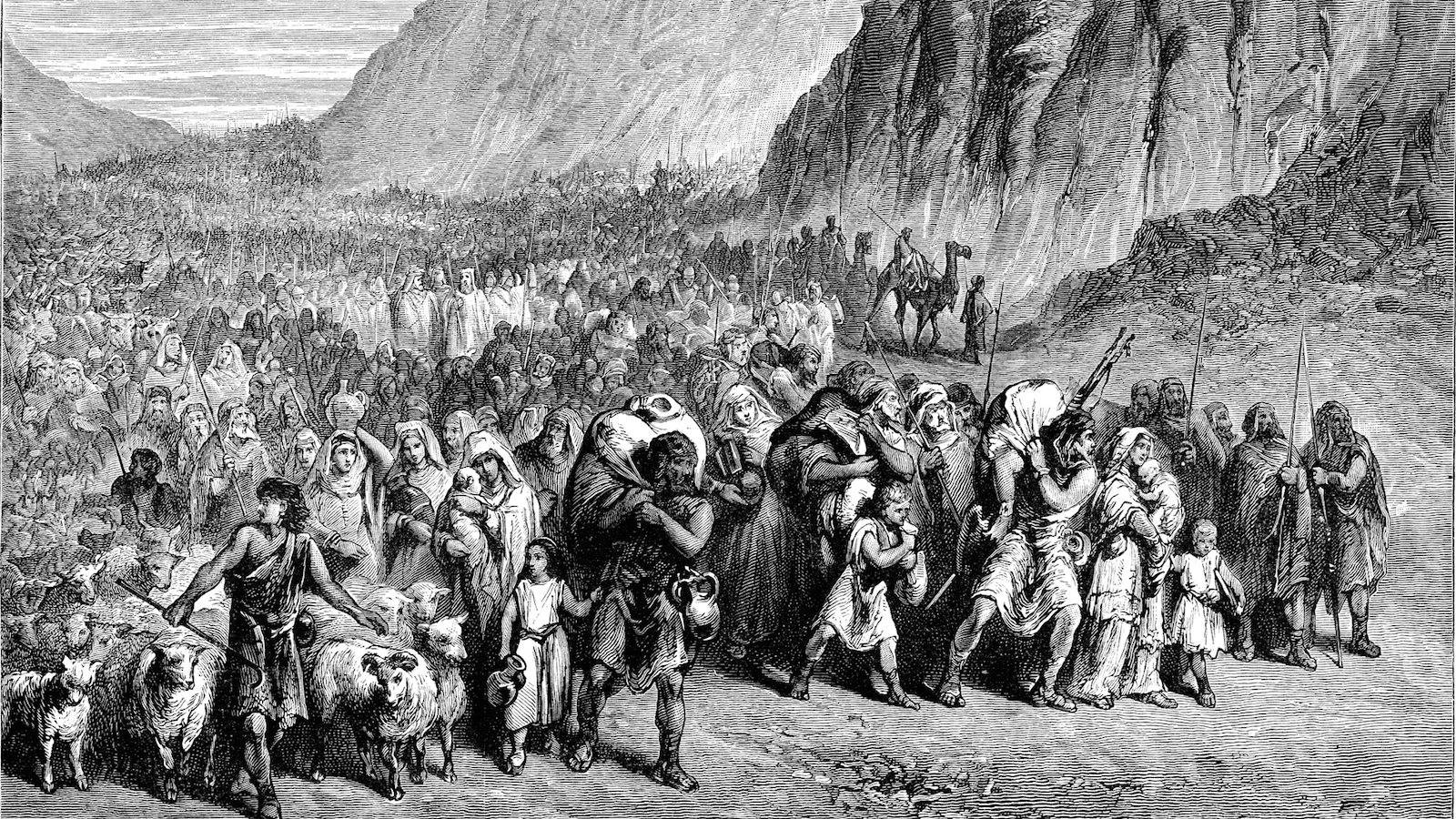
This uniqueness of events is epitomized in the Hebrew notions (a) of God’s direct intervention in history at certain critical points, and (b) of a chosen people as recipients of God’s unique challenges. Both are vividly illustrated in the epic of Abraham. This epic is introduced by a remarkable prologue, Genesis 1–11, which describes the steady deterioration of the world from its original, pristine goodness. Disobedience (eating the forbidden fruit) is followed by murder (Cain of Abel), promiscuity (the sons of God and the daughters of men), incest (the sons of Noah), until a flood is needed to sluice out the mess. In the midst of the corruption, God is not inactive. Against its backdrop, in the last days of the Sumeric universal state, God calls Abraham. He is to go forth into a new land to establish a new people. The moment is decisive. Because Abraham answers its call, he ceases to be anonymous. He becomes the first Hebrew, the first of a “chosen people.” 

We shall need to return to this “chosen people” theme, but for the present we must ask what gave the Jews their insight into history’s significance. We have noted the kind of meaning they found in history. What enabled them to see history as embodying this meaning? 

For India, human destiny lies outside history altogether. There the world that houses humanity is (as we have seen) the “middle world.” Good and evil, pleasure and pain, right and wrong are woven into it in relatively equal proportions as its warp and weft. And so things will remain. All thought of cleaning up the world and changing its character appreciably is mistaken in principle. The nature religions of Israel’s neighbors reached the same conclusion by a different route. For them, human destiny lay within history all right, but in history as currently constituted, not as it might become. We can see why change—specifically change for the better—did not suggest itself to nature religionists. If one’s eye is on nature preeminently, one does not look beyond it for fulfillment elsewhere. But neither—and this is the point—does one dream of improving nature or the social order that is its extension, for these are assumed to be ingrained in the nature of things and not subject to human alteration. The Egyptian no more asked whether the sun god Ra was shining as he should shine than the modern astronomer asks whether the sun is expending itself at a proper rate; for in nature the accent is on what is, not what should be—the is rather than the ought

The Israelites’ historical outlook differed from that of India and Middle Eastern polytheism because they had a different idea of God. Had the issue been raised to the level of conscious debate, they would have argued against India that God would not have created people as material beings if matter were adventitious to their destiny. Against the nature polytheists the Jews would have argued that nature is not self-sufficient. Because nature was created by God, God cannot be assimilated to it. The consequence of keeping God and nature distinct is momentous, for it means that the “ought” cannot be assimilated to the “is”—God’s will transcends (and can differ from) immanent actuality. By the double stroke of involving human life with the natural order but not confining it to that order, Judaism established history as both important and subject to critique. Those who do not learn from history are doomed to repeat it. 

The nature polytheisms that surrounded Judaism all buttressed the status quo. Conditions might not be all the heart desired, but what impressed the polytheist was that they could be a lot worse. For if the powers of nature reside in many gods—in Mesopotamia their number reached into the thousands—there was always the danger that these gods might fall out among themselves with resulting chaos. So religion’s attention was directed toward keeping things as they were. Egyptian religion repeatedly contrasted “passionate people” to “silent people,” extolling the latter because they didn’t cause trouble. Small wonder that no nature polytheism ever spawned a principled revolution. Traditionally, Indian religion likewise had a conservative cast; for if polytheisms feared change, Hinduism considered substantive social change to be impossible. 

In Judaism, by contrast, history is in tension between its divine possibilities and its manifest frustrations. A sharp tension exists between the ought and the is. Consequently, Judaism laid the groundwork for social protest. When things are not as they should be, change in some form is in order. The idea bore fruit. It is in the lands that have been affected by the Jewish historical perspective, one that influenced Christianity and to some extent Islam, that the chief thrusts for social betterment have occurred. The prophets set the pattern. “Protected by religious sanctions, the prophets of Judah were a reforming political force which has never been surpassed and perhaps never equalled in subsequent world history.” On fire with the conviction that things were not as they should be, they created in the name of the God for whom they spoke an atmosphere of reform that “put Hyde Park and the best days of muckraking newspapers to shame.”

.