Category Archives: Religion

CHRISTIANITY: Roman Catholicism

Reference: Christianity

[NOTE: In color are Vinaire’s comments.]

Catholics see Christ as having explicitly joined the sacramental agency of the Church to its teaching authority in his closing commission to his disciples. 

We have been speaking of Christianity as a whole. This does not mean that every Christian will agree with all that has been said. Christianity is such a complex phenomenon that it is difficult to say anything significant about it that will carry the assent of all Christians. So it must be stressed that what has gone before is an interpretation. Nevertheless, it has sought to be an interpretation of the points that, substantially at least, Christians hold in common. 

Christianity has become very complex with many different interpretations.

When we turn from the early Christianity we have been considering thus far to Christendom today, we find the Church divided into three great branches. Roman Catholicism focuses in the Vatican in Rome and spreads from there, being dominant, on the whole, through central and southern Europe, Ireland, and South America. Eastern Orthodoxy has its major influence in Greece, the Slavic countries, and the Soviet Union. Protestantism dominates Northern Europe, England, Scotland, and North America. 

Today’s Christianity is divided into three main branches: Roman Catholicism, Eastern Orthodoxy, and Protestantism.

Up to 313 the Church struggled in the face of official Roman persecution. In that year it became legally recognized and enjoyed equal rights with other religions of the empire. Before the century was out, in 380, it became the official religion of the Roman Empire. With a few minor splinterings, such as the Nestorians, it continued as a united body up to 1054. This means that for roughly half its history the Church remained substantially one institution. In 1054, however, its first great division occurred, between the Eastern Orthodox Church in the East and the Roman Catholic Church in the West. The reasons for the break were complex—geography, culture, language, and politics as well as religion were involved—but it is not our concern to detail them here. Instead we move to the next great division, which occurred in the Western Church with the Protestant Reformation in the sixteenth century. Protestantism follows four main courses—Baptist, Lutheran, Calvinists, and Anglican—which themselves subdivide until the current census lists over 900 denominations in the United States alone. Currently, the ecumenical movement is bringing some of these denominations back together again. With these minimum facts at our disposal, we can proceed to our real concern, which is to try to understand the central perspectives of Christendom’s three great branches. Beginning with the Roman Catholic Church, we shall confine ourselves to what are perhaps the two most important concepts for the understanding of this branch of Christendom: the Church as teaching authority, and the Church as sacramental agent.

First Christianity came to be recognized as one of the religions. Then it became THE religion under one administration. Then it split into Roman Catholicism and Eastern Orthodoxy based on cultural and geographical factors. In the West, Protestantism splintered off Roman Catholicism in big way. Then Protestantism came to be divided into four main courses and over 900 denominations.

The Church as Teaching Authority. First, the Church as teaching authority. This concept begins with the premise that God came to earth in the person of Jesus Christ to teach people the way to salvation—how they should live in this world so as to inherit eternal life in the next. If this is true, if his teachings really are the door to salvation and if the opening of this door was one of the prime reasons why he came to earth, it seems unlikely that he would have held this door ajar for his generation only. Would he not want his saving teachings to continue to be available to the world? 

An important aspect of the Roman Catholic Church is being a teaching authority. It teaches how to achieve eternal life in the next world. The anomaly is that why God has not appeared again and again in other generations and other places to bring his teachings to the whole world.

The reader might agree but add, “Do we not have his teachings—in the Bible?” This, however, raises the question of interpretation. The Constitution of the United States is a reasonably unambiguous document, but our social life would be chaos without an authority, the Supreme Court, to interpret it. Equally with the Bible. Leave it to private interpretation and whirlwind is the sure harvest. Unguided by the Church as teaching authority, Bible study is certain to lead different students to different conclusions, even on subjects of the highest moment. And since the net effect of proposing alternative answers to the same question is to make it impossible to believe any answer confidently, this approach would reduce the Christian faith to hesitation and stammer. 

The Roman Catholic Church acts to interpret the teachings in the Bible. Otherwise, there will be different interpretations and chaos in the Christian world.

Let us take a specific issue for illustration. Is divorce moral? Surely, on a question as important as this, any religion that proposes to guide the conscience of its members may be expected to have a definite view. But suppose we try to draw that view directly from the Bible? Mark 10:11 tells us that “Whoever divorces his wife and marries another commits adultery.” Luke 16:18 concurs. But Matthew 5:32 enters a reservation: “except on the ground of unchastity.” What is the Christian to think? What are the probabilities that the Matthew text has been tampered with? May an unwronged party remarry or not? 

There are different teachings in the Bible that give rise to doubt in important matters; for example, on the subject of divorce being moral. It makes one wonder if certain texts in the Bible has been tampered with.

The question is only a sample of the many that must remain forever in doubt if our only guides are the Bible and private conscience. Was Christ born of a virgin? Did his body ascend after death? Is the fourth Gospel authentic? Without a sure court of appeal, moral and theological disintegration seem inevitable. It was precisely to avert such disintegration that Christ established the Church to be his continuing representative on earth, that there might be one completely competent authority to adjudicate between truth and error on life-and-death matters. Only so could the “dead letter” of scripture be continually revivified by the living instinct of God’s own person. This is the meaning of the words, attributed to Jesus, “I tell you, you are Peter, and on this rock I will build my Church…. I will give you the keys of the Kingdom of heaven, and whatever you bind on earth shall be bound in heaven, and whatever you loose on earth shall be loosed in heaven” (Matthew 16:18–19). 

Christ established the Church to be his continuing representative on earth, that there might be one completely competent authority to adjudicate between truth and error on life-and-death matters. 

Ultimately, this idea of the Church as teaching authority shapes the idea of papal infallibility. Every nation has its ruler, be he emperor, king, or president. The earthly head of the Church is the pope, successor to St. Peter in the bishopric of Rome. The doctrine of papal infallibility asserts that when the pope speaks officially on matters of faith or morals, God stays him against error. 

Ultimately, this idea of the Church as teaching authority shapes the idea of papal infallibility. God stays the pope against error. 

This doctrine is so often misunderstood that we must emphasize that infallibility is a strictly limited gift. It does not assert that the pope is endowed with extraordinary intelligence. It does not mean that God helps him to know the answer to every conceivable question. Emphatically, it does not mean that Catholics have to accept the pope’s view on politics. The pope can make mistakes. He can fall into sin. The scientific or historical opinions he holds may be mistaken. He may write books that contain errors. Only in two limited spheres, faith and morals, is he infallible, and in these only when he speaks officially as the supreme teacher and lawgiver of the Church, defining a doctrine that should be held by all its members. When, after studying a problem that relates to faith or morals as carefully as possible and with all available help from expert consultants, he emerges with the Church’s answer—on these rare occasions it is not strictly speaking an answer, it is the answer. For on such occasions the Holy Spirit protects him from the possibility of error. These answers constitute the infallible teachings of the Church and as such are binding on Roman Catholics. 

But pope’s infallibility is limited to the spheres of faith and morals, only when he speaks officially as the supreme teacher and lawgiver of the Church, defining a doctrine that should be held by all its members. The Holy Spirit protects the pope  from the possibility of error.

The Church as Sacramental Agent. The second idea central to Roman Catholicism is the idea of the Church as sacramental agent. This supplements the idea of the Church as teaching authority. It is one thing to know what we should do; it is quite another to be able to do it, which is why there is a need for the Sacraments. The Church helps with both problems. It points the way in which we should live, and empowers us to live accordingly. 

The second idea central to Roman Catholicism is the idea of the Church as sacramental agent.

The second gift is as important as the first. Christ called his followers to live lives far above the average in charity and service. No one would claim that this is easy. The Catholic, however, insists that we have not faced our situation squarely until we realize that without help such a life is impossible. For the life to which Christ called people is supernatural in the exact sense of being contrary to the pull of natural human instincts. By their own efforts people can no more live above human nature than an elephant can live a life of reason. Help, therefore, is needed. The Church, as God’s representative on earth, is the agency to provide it, and the Sacraments its means for doing so. 

Sacraments are the means through which the Church enables its members to live a life of charity and service as called for by Christ.

Since the twelfth century the number of Sacraments in the Roman Catholic Church has been fixed at seven. In a striking way these parallel the great moments and needs of human life. People are born, they come of age, they marry or dedicate themselves completely to some life-purpose, and they die. Meanwhile, they must be reintegrated into society when they deviate, and they must eat. The Sacraments provide the spiritual counterparts of these natural events. As birth brings a child into the natural world, Baptism (by planting God’s first special grace in its soul) draws the infant into the supernatural order of existence. When the child reaches the age of reason and needs to be strengthened for mature reflection and responsible action, it is Confirmed. Usually, there comes a solemn moment during which an adult is joined to a human companion in Holy Matrimony, or dedicates his or her life entirely to God in Holy Orders. At life’s close the Sacrament of the Sick (extreme unction) closes earthly eyes and prepares the soul for its last passage. 

People are born, they come of age, they marry or dedicate themselves completely to some life-purpose, and they die. The Sacraments provide the spiritual counterparts of these natural events of human life.

Meanwhile two Sacraments need to be repeated frequently. One of these is Reconciliation (confession). Being what we are, people cannot live without falling into error and straying from the right. These aberrations make necessary definite steps by which they may be restored to the human community and divine fellowship. The Church teaches that if one confesses one’s sin to God in the presence of one of God’s delegates, a priest, and truly repents of the sin committed and honestly resolves (whether or not this resolve proves effective) to avoid it in the future, one will be forgiven. God’s forgiveness depends on the sinner’s penitence and resolve being genuine, but the priest has no infallible means for determining whether they are or not. If the penitent deceives himself or herself and the priest, the absolution pronounced is inoperative. 

Reconciliation (confession) is a Sacrament that needs to be repeated frequently to restore a person to the human community and divine fellowship. 

The central Sacrament of the Catholic Church is the Mass, known also as the Holy Eucharist, Holy Communion, or the Lord’s Supper. The word Mass derives from the Latin missa, which is a form of the verb “to send.” The ancient liturgy contained two dismissals, one for people interested in Christianity but not yet baptized, which preceded the sacrament of the Eucharist, and a second for fully initiated Christians after it had been celebrated. Coming as it did between these two dismissals, the rite came first to be called missa and then, by transliteration, the Mass. 

The central Sacrament of the Catholic Church is the Mass, known also as the Holy Eucharist, Holy Communion, or the Lord’s Supper.

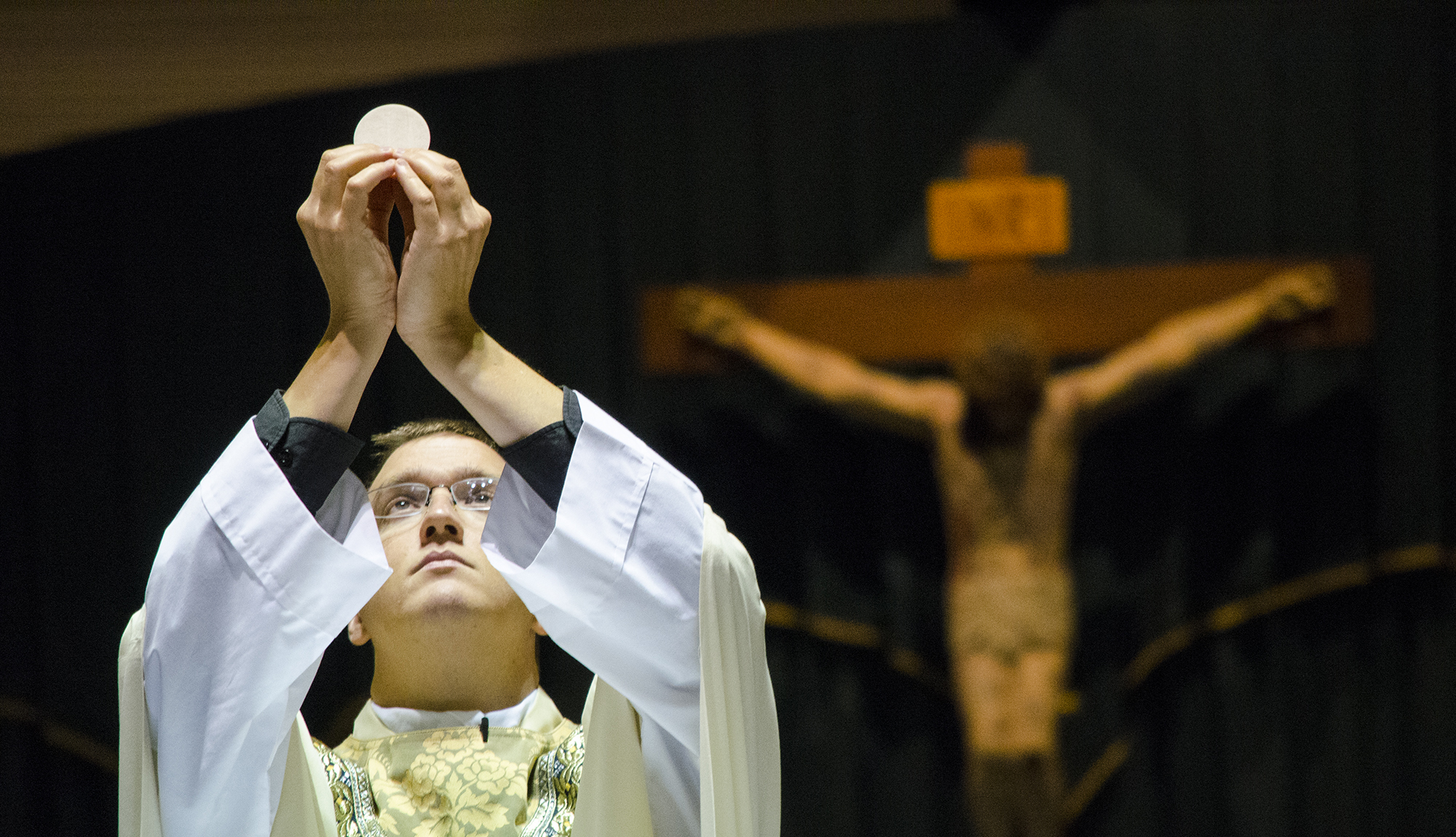
The central feature of the Mass is the reenactment of Christ’s Last Supper in which, as he gave his disciples bread and wine, he said, “This is my blood that is shed for you.” It is false to the Catholic concept of this Sacrament to think of it as a commemoration through which priest and communicants elevate their spirits by symbolic remembrance of Christ’s example. The Mass provides an actual transfusion of spiritual energy from God to human souls. In a general way this holds for all the Sacraments, but for the Mass it holds uniquely. For the Catholic Church teaches that in the host and the chalice, the consecrated bread and wine, Christ’s human body and blood are actually present. They consider his words, “This is my body…. This is my blood,” explicit on this point. When a priest utters these words of consecration, therefore, the change that they effect in the elements is not one of significance only. The elements may not appear different afterward; analysis would register no chemical change. In technical language this means that their “accidents” remain as they were, but their “substance” is transubstantiated. We might say the Eucharist conveys God’s grace as a boat conveys its passengers, whereas the other sacraments convey grace as a letter conveys meaning. For the letter to have meaning, intelligence is required in addition to the paper and ink marks; so too in Sacraments other than the Eucharist God’s power is necessary in addition to the instruments of the sacrament. But in the Mass spiritual nourishment is literally to be had from the elements themselves. It is exactly as important for the Christians’ spiritual life to feast upon them as it is for their bodily lives to partake of food. Opening your mouth for the Bread of Life, writes Saint Francis de Sales,

full of faith, hope and charity, receive Him, in whom, by whom, and for whom, you believe, hope and love…. Represent to yourself that as the bee, after gathering from the flowers the dew of heaven and the choicest juice of the earth, reduces them into honey and carries it into her hive, so the priest, having taken from the altar the Savior of the world, the true Son of God, who, as the dew, is descended from heaven, and the true Son of the Virgin, who, as a flower is sprung from the earth of our humanity, puts him as delicious food into your mouth and into your body.

The central feature of the Mass is the reenactment of Christ’s Last Supper in which, as he gave his disciples bread and wine, he said, “This is my blood that is shed for you.” It is not a commemoration through which priest and communicants elevate their spirits by symbolic remembrance of Christ’s example. The Mass provides an actual transfusion of spiritual energy from God to human souls. In the Mass spiritual nourishment is literally to be had from the elements themselves.

This personal presence of God in the elements of the Mass distinguishes it significantly from the other Sacraments, but it does not vitiate the common bond that unites them all. Each is a means by which God, through Christ’s mystical body, literally infuses into human souls the supernatural power that enables them so to live in this world that in the world to come they may have life everlasting.

All Sacraments infuse into human souls the supernatural power that enables them so to live in this world that in the world to come they may have life everlasting.

Catholics see Christ as having explicitly joined the sacramental agency of the Church to its teaching authority in his closing commission to his disciples. “Go and make disciples of all nations, baptizing them in the name of the Father and of the Son and of the Holy Spirit, teaching them to observe all that I have commanded you; and lo, I am with you always, to the close of the age” (Matthew 28:19–20).

Catholics see Christ as having explicitly joined the sacramental agency of the Church to its teaching authority in his closing commission to his disciples. 

.
CHRISTIANITY: The Mind of the Church

Reference: Christianity

[NOTE: In color are Vinaire’s comments.]

Christian theology was born to explain the mystery of the preternatural power of selfless love and crystalline joy, which the disciples experienced in the presence of Jesus.

It was not the disciples’ minds that were first drawn to Jesus. Rather, we have seen, it was their experience—the experience of living in the presence of someone whose selfless love, crystalline joy, and preternatural power came together in a way his disciples found divinely mysterious. It was only a matter of time, however, before Christians felt the need to understand this mystery in order to explain it to themselves and to others. Christian theology was born, and from then on the Church was head as well as heart. 

Christian theology was born to explain the mystery of the preternatural power of selfless love and crystalline joy, which the disciples experienced in the presence of Jesus.

Forced in this brief survey to choose, we shall confine ourselves to Christianity’s three most distinctive tenets: the Incarnation, the Atonement, and the Trinity. The very names of these doctrines warn that our discussion will be theological, so before going further we should say something about this discipline. The modern mind is more interested in psychology and ethics than theology and metaphysics. This means that people, Christians among them, tend to appreciate the ethical teachings of Jesus more than the theological arguments of Saint Paul. However little they may care to live by the Sermon on the Mount, they at least respect it. Doctrines like those we are about to discuss, on the other hand, seem tedious if not incredible and at times annoying. Even New Testament scholars sometimes fall into step with this mood to the extent of trying to draw a sharp line between the “religion of Jesus” and “the religion about Jesus,” between the forthright ethics of Jesus and the convoluted theology of Paul, between the human Jesus and the cosmic Christ, with strong insinuations that in each case the former is the nobler. 

The Christian theology puts forth the doctrines of the Incarnation, the Atonement, and the Trinity. These are quite convoluted compared to the forthright ethics of Jesus.

Notwithstanding the fact that even scholars can succumb to the view that religion’s essence is ethics, the view is mistaken. High religion always includes a summons to the upright life, but its eyes are not fixed primarily on that summons. Faith’s focal attention is on a vision of reality that sets morality in motion, often as a by-product almost. Religion begins with experience; “belief, ritual, and spiritual experience, and the greatest of these is the last.” Because the experience is of things that are invisible, it gives rise to symbols as the mind tries to think about invisible things. Symbols are ambiguous, however, so eventually the mind introduces thoughts to resolve the ambiguities of symbols and systematize their intuitions. Reading this sequence backwards we can define theology as the systematization of thoughts about the symbols that religious experience gives rise to. The Christian Creeds are the bedrock of Christian theology for being the earliest attempts by Christians to understand systematically the events that had changed their lives. 

Theology is the systematization of thoughts about the symbols that religious experience gives rise to. Faith’s focal attention is on a vision of reality that sets morality in motion.

We may begin with the doctrine of the Incarnation, which took several centuries to fix into place. Holding as it does that in Christ God assumed a human body, it affirms that Christ was God-Man; simultaneously both fully God and fully man. To say that such a contention is paradoxical seems a charitable way to put the matter—it looks more like a blatant contradiction. If the doctrine held that Christ was half human and half divine, or that he was divine in certain respects while being human in others, our minds would not balk. But such concessions are precisely what the Creeds refuse to grant. In the words of the Creed of Chalcedon, Jesus Christ was “at once complete in Godhead and complete in manhood, truly God and truly man…of one essence with the Father as regards his Godhead, and at the same time of one essence with us as regards his manhood, in all respects like us, apart from sin.” 

The doctrine of the Incarnation holds that in Christ God assumed a human body, it affirms that Christ was God-Man; simultaneously both fully God and fully man.

The Church has always admitted that such assertions are opaque; the question is whether this is the last word on the matter. Actually, we can ask the same question of science. The anomalies of frontier physics provoked Haldane to his famous mutterance that “the universe is not only queerer than we suppose, but queerer than we can suppose.” In more than one field, it appears, reality can be too strange for logic to comprehend. And where logic and evidence clash, it seems prudent to stick with evidence, for this holds the prospect of leading to a wider logic, whereas the opposite approach closes the door to discovery. 

Where logic and evidence clash, it seems prudent to stick with evidence, for this holds the prospect of leading to a wider logic.

In suggesting that it was evidence that forced Christians to their logictaxing assertion that Christ was both human and divine, we are of course speaking of religious experience—intuitions of the soul concerning ultimate issues of existence. Such evidence cannot be presented with an obviousness that will compel assent, for it does not turn on sense reports. But if we try we can arrive at at least an intimation of the experiential leads that the Christians were following. When in the year 325 the Emperor Constantine convened the Council of Nicea to decide whether Christ was of the same substance as God or only of like substance, three hundred bishops and their attendants came rushing in a frenzy of excitement from all over the empire. They must have presented a strange sight, for many of them bore empty eye sockets, disfigured faces, and limbs that were twisted and paralyzed from the Diocletian persecution they had endured. Obviously, more than forensics was involved in their deliberations. 

The evidence in this case is the interpretation of the religious experience that made Christians declare that Christ was both human and divine.

The Nicene decision that Christ was “of one substance with the Father” claimed something about both Jesus and God. Note first its initial claim about Jesus. Among the many possible meanings the word “God” carries, none is more important than “that to which one gives oneself without reservation.” In saying that Jesus was God, one of the things the Church was saying was that his life provides the perfect model by which to order human life. Slavish imitation of details is never creative, but insofar as Christ’s love, his freedom, and the daily beauty of his life can find their authentic parallels in our own we are carried Godward, for the traits are authentically divine. 

In saying that Jesus was God, one of the things the Church was saying was that his life provides the perfect model by which to order human life.

This much is obvious. But as we enter more deeply into the doctrine of the Incarnation we must prepare ourselves for surprises. To begin with, though the Christian announcement of the Incarnation—a God-man—was as startling to its day as it is to ours, the shock attaches to different poles. Because we find disturbing the thought that a human being can be divine, we find the shocking feature of the Incarnation to be what it says about Jesus, that he was God. But in its own world, where the dividing line between the human and the Divine was perforated to the point that even emperors routinely claimed to be divine, a struggling sect’s claim that its founder was divine raised few eyebrows. What else is new? would have been the common retort. 

We find the shocking feature of the Incarnation to be what it says about Jesus, that he was God.

The Incarnation claimed that there was something newsworthy in the Christian message; namely, its proclamation of the kind of God that God was, as demonstrated by God’s willingness to assume a human life of the form that Jesus exemplified. That willingness, together with the character of Jesus’ life, added up to a different understanding of divinity than the Mediterranean world had known. In the Christian view God was concerned about humanity; concerned enough to suffer in its behalf. This was unheard of, to the point that the reaction to it was disbelief followed by alarm. In the eyes of threatened conservatives, such blasphemy, coupled with the Christians’ radically egalitarian social views, justified persecution to stamp out this new sect. That Christians were aware of the novelty of their theology is illustrated by the fact that they seldom referred to God without stipulating that it was “the God and Father of our Lord Jesus Christ” that they were talking about. 

In the Christian view God was concerned about humanity; concerned enough to suffer in its behalf. This added up to a different understanding of divinity.

As for what the Incarnation asserts about Christ, here too we are surprised. For what we find is that instead of wasting many words on Jesus’ divinity, the Creeds assume that their primary task is to argue his full humanity. This ties in with what was just said about the casual overlap of divine and human in Greco-Roman understanding—the Olympic deities, quasi-human, quasi-divine, formed the religious backdrop. The Christian Jesus did not fit into this framework. We have seen that in his case the divine/human overlap was not one of compromise—somewhat human, somewhat divine. It was the conjunction of stark opposites: absolute divinity overlapping complete humanity. And because in the Church’s experience it was Jesus’ full humanity that was in danger of slipping from their grasp, so rapidly was his divinity moving to the fore, it was that humanity that the Church’s first Creed set out to affirm.

I believe in God the Father Almighty, Maker of heaven and earth; and in Jesus Christ our Lord, who was conceived by the Holy Ghost, born of the Virgin Mary, suffered under Pontius Pilate, was crucified, died, and buried….

It is most surprising to see God attributed with full humanity.

How casually this Apostles’ Creed touches on Christ’s divinity! As early as the second century this point no longer had to be argued; it was assumed. The burden of the Apostles’ Creed, carried by the words we have romanized, was to insist that Christ was man as well. He really was born, it says; he really suffered, he really died and was buried. These incidents were not just make-believe, a sequence through which God merely feigned to brush with the human estate; that notion was later targeted as the Docetic Heresy. Christ endured these experiences as fully as we do. He was “truly man.”

And is it true? And is it true,
This most tremendous tale of all…
That God was Man in Palestine
And lives today in Bread and Wine.

(John Betjeman, Christman)

God was not feigning to be man. God, as Christ, really was born; he really suffered, he really died and was buried. 

It is not difficult to see why (at cost of immense logical awkwardness) the Church felt that it needed to retain Christ’s humanity. A bridge must touch both banks, and Christ was the bridge that joined humanity to God. “God became man that man might become God,” was Irenaeus’ way of putting the matter. To have said that Christ was man but not God would have been to deny that his life was fully normative and to concede that other ways might be as good. To have said that he was God but not man would have been to deny that his example was fully relevant; it might be a realistic standard for God but not for human beings. The Christians could have relaxed one claim or the other and salvaged logic, but at the cost of betraying their core experience. 

The  core experience of Christians required that it needed to retain Christ’s humanity.

Turning to the doctrine of the Atonement, we know that its root meaning is reconciliation, the recovery of wholeness or at-one-ment. Christians were convinced that Christ’s life and death had effected an unparalleled rapprochement between God and humanity. In the words of Saint Paul, “In Christ God was reconciling the world to himself” (2 Corinthians 5:19). Two metaphors have dominated the Church’s understanding of this occurrence. One, legalistic, runs as follows: By voluntarily disobeying God’s order not to eat of the forbidden fruit in Eden, Adam sinned. As his sin was directed against God, it was of infinite proportion. Sins must be compensated for, otherwise God’s justice would be compromised. An infinite sin demands infinite recompense, and this could only be effected by God’s vicarious assumption of our guilt and payment of the ultimate penalty it required, namely death. God made this payment through the Person of Christ and the debt is canceled. 

The doctrine of the Atonement is about reconciliation. God’s vicarious assumption of our guilt and payment of the ultimate penalty through the Person of Christ has brought about this reconciliation between him and humanity.

Where the mind had a different cast—in the Middle Ages especially—this understanding of the Atonement carried weight, but Christendom’s presiding metaphor on this topic has been release from bondage. The bondage Christ released humanity from was sin, which means that we have no choice but to tackle this unpalatable subject.

Christendom’s presiding metaphor on this topic has been release from the bondage of sin.

We can begin by noting that though the word is usually used in the plural, suggesting thereby specific acts—a catalogue of misdeeds or rules that have been broken, perhaps those of the Ten Commandments—Christians find in its singular, “sin,” something deeper: a disconnectedness or estrangement from God. It is the heart’s misplacement; a disalignment of our affections. Augustine, making this point in a positive vein, said, “Love [God] and do what you will.” When there is wholehearted love for the All, for the universal good we might say, then the will wants that good and needs no rules. For the most part matters are otherwise; concern for ourselves sabotages our love for others. And yet we do not truly like ourselves very much. Our hearts are drawn to something larger, beyond the narrow confines of the ego. 

When there is wholehearted love for the All, for the universal good we might say, then the will wants that good and needs no rules. 

Thus the bondage that imprisons us is attachment to ourselves, with the fear and guilt that trail in its wake. Put the other way around, our bondage results from our estrangement, our sin or sunderment, from full participation in the divine life. Being excluded from such participation doesn’t feel good. Paul had the openness and honesty first to see this and then to admit it: I feel wretched, he said. Prisoners always do. A good part of their wretchedness springs from their helplessness; by definition they can’t free themselves. So Paul continues: “I do not do what I want, but I do the very thing I hate” (Romans 14:15). He is admitting that he is trapped, which realization leads to his desperate cry that we have already quoted, “Who will rescue me from this body of death?” (Romans 14:24). In whatever words it is the cry that every alcoholic has repeated. If there is to be a liberation, it will have to come from without, or better, from above: a higher power. It was the Christian witness that the Power that works the liberation, and restores the self to the ground of its being, is Christ. One could equally say that it is God, but Christians add that in this instance God’s purpose was accomplished by Christ.

It was the Christian witness that the Power that works the liberation, and restores the self to the ground of its being, is Christ.  

The third key Christian doctrine that we shall consider is the Trinity. It holds that while God is fully one, God is also three. The latter half of this claim leads Jews and Muslims to wonder if Christians are truly monotheists, but Christians are confident that they are. As water, ice, and steam, H2O assumes states that are liquid, solid, and gaseous while retaining its chemical identity. 

The third key Christian doctrine is the Trinity. It holds that while God is fully one, God is also three.

What prompted the Christians to this atypical view that God is Three-in-One? As always in such matters, the notion had an experiential base. The theological doctrine of the Trinity was not set in place until the fourth century, but the experiences that it impounds are those of the earliest Church; indeed, they generated that Church. As full-fledged Jews, Jesus’ disciples affirmed Yahweh unquestioningly. But as we have seen, they came to see Jesus as Yahweh’s extension in the world, and as his life and mission grew in vividness they began to accord to his person a distinct region within the divine. This meant that in their religious imaginings they could now apprehend God either directly or by way of his Son, though in fact the two were so closely joined that the result was the same. And then came Pentecost, which brought a third visitation. While they were all together in one place,

suddenly from heaven there came a sound like the rush of a violent wind, and it filled the entire house where they were sitting. Divided tongues, as of fire, appeared among them, and a tongue rested on each of them. All of them were filled with the Holy Spirit. (Acts 2:1–4)

Early Christens came to see Jesus as Yahweh’s extension in the world, and while they were all together in one place, the felt themselves filled with the Holy Spirit.

The secular mind would say that the disciples first reified this experience, turning it into a thing, the Holy Spirit, and then personified that reification, thereby generating the third Person of the Trinity, but the disciples would have rejected this explanation. Jesus may not have said, “the Father will give you another Counselor, to be with you forever, even the Spirit of truth”; the assertion appears in the last of the Gospels to be written, in John, and is therefore disputed. But if the words were attributed to Jesus, it was because they reflected the disciples’ understanding of their Pentecost experience. What they there witnessed, they were persuaded, was the dramatic arrival of a third party to the divine assembly, the Holy Spirit. 

It was through God’s extension as Jesus that one was filled with this Spirit of truth that stayed with one forever.

This is how the disciples were brought to their understanding of God in three Persons; but once that understanding was in place, they projected it back to the beginning of time. If the divine “triangle” has three “sides” now, it must always have had three sides. The Son and the Holy Spirit had indeed proceeded principally from the Father, but not temporally. The three were together from the start; for after the multiplicity in the divine nature was brought home to them, Christians could no longer think of God as complete without it. We have noted that the other two Abrahamic religions, Judaism and Islam, object to this theology, but Christians love it. For love is a relationship, they say, and love is incomplete without others to love. If, then, love is not just one of God’s attributes but instead God’s very essence—and it may be the Christian mission in history to claim just this point—at no point could God have been truly God without having relationships, a requirement that was met “before the foundation of the world” (Ephesians 1:4) through the three Persons’ of the Triune God loving one another. “The Godhead is a society of three divine persons, knowing and loving each other so entirely that not merely can none exist without the others, but in some mysterious way each is what the other is,” a theologian has written. 

The other two Abrahamic religions, Judaism and Islam, object to this theology, but Christians love it. 

The Nicene Creed put it this way:

We believe in one God the Father almighty,…
and in one Lord Jesus Christ, the only-begotten Son of God,…
and in the Holy Spirit, the Lord, the Life-giver,…
who with the Father and the Son together
is worshipped and glorified.

Goodness and love are inherent to the concept of divine.

.

Theta, MEST and Death

Static implies that Theta and MEST are substances in two different dimensions. Theta is the potential that becomes actual only when manifested in MEST. This manifestation results in motion which is life. In Hubbard’s Theta-MEST theory, theta may separate from MEST and survive as pure potential.

Hubbard postulated the Theta-MEST theory to explain the phenomena of Death. Most of the conscious life leaves the body at the moment of death. So, Hubbard postulated a unit of theta (thetan) leaving the body at death. But life in the organs of the body takes another 14 days to leave completely. So Hubbard postulated a Genetic Entity to explain that. But even when the body disintegrates completely, some motion still remains at the atomic level. This presents an anomaly because if theta leaves the MEST, then no motion should be left at all in MEST.

We find that motion is inherent to MEST at the atomic level and it can never be separated. Motion becomes more sophisticated as MEST becomes more complex at the molecular level. As molecules increase in complexity they act like computers. A DNA molecule is so complex that it can store the whole blue print of the body within itself. The sophisticated motion at the level of the body expresses itself as thought. Throughout this increasing complexity of MEST, the increasingly sophisticated motion cannot be separated from MEST.

So, at the moment of death, most of the sophisticated motion of life ceases, because the overall system of the body breaks down. The remaining motion of the body ceases over the next 14 days as body’s sub-systems break down one by one. Subsequently, any sophisticated motion goes dormant in the DNA molecules. So, we can explain death in terms of an integrated Theta-MEST system gradually breaking down and becoming dormant, instead of “theta leaving MEST.” This is more consistent.

Lets’ look at the phenomenon of exteriorization where, in Hubbard’s model, the thetan leaves the body, and the genetic entity is left in the body to maintain its functions. We may explain the phenomenon of exteriorization in terms of shift in consideration. When the person is interiorized, his attention is, actually, fixated on the body. When this attention suddenly frees itself up, we have exteriorization. The body, actually, extends as an aura around the solid part. The attention units, when freed up, can be focused in the aura away from the solid part. This makes one feel that one is outside the body, when in fact the Theta-MEST remains integrated. This is more consistent than the hypothesis of “theta leaving MEST.”

.

BUDDHISM: Basic Buddhist Concepts

Reference: Buddhism

[NOTE: In color are Vinaire’s comments.]

The Buddha listed his Three Marks of Existence  as impermanence (anicca), suffering (dukkha) and the absence of permanent identity or a soul (anatta). We are freed from the pain of clutching for permanence only if the acceptance of continual change is driven into our very marrow.

The Buddha’s total outlook on life is as difficult to be certain of as that of any personage in history. Part of the problem stems from the fact that, like most ancient teachers, he wrote nothing. There is a gap of almost a century and a half between his spoken words and the first written records, and though memory in those times appears to have been incredibly faithful, a gap of that length is certain to raise questions. A second problem arises from the wealth of material in the texts themselves. Buddha taught for forty-five years, and a staggering corpus has come down to us in one form or another. While the net result is doubtless a blessing, the sheer quantity of materials is bewildering; for though his teachings remained remarkably consistent over the years, it was impossible to say things for many minds and in many ways without creating problems of interpretation. These interpretations constitute the third barrier. By the time texts began to appear, partisan schools had sprung up, some intent on minimizing the Buddha’s break with Brahmanic Hinduism, others intent on sharpening it. This makes scholars wonder how much in what they are reading is the Buddha’s actual thought and how much is partisan interpolation.

We are not certain how much we are reading is the Buddha’s actual thought and how much is partisan interpolation.

Undoubtedly, the most serious obstacle to the recovery of the Buddha’s rounded philosophy, however, is his own silence at crucial points. We have seen that his burning concerns were practical and therapeutic, not speculative and theoretical. Instead of debating cosmologies, he wanted to introduce people to a different kind of life. It would be wrong to say that theory did not interest him. His dialogues show that he analyzed certain abstract problems meticulously; that he possessed, indeed, a brilliant metaphysical mind. It was on principle that he resisted philosophy, as someone with a sense of mission might shun hobbies as a waste of time. 

Buddha’s burning concerns were practical and therapeutic, not speculative and theoretical. But his silence at crucial points is puzzling.

His decision makes so much sense that it may seem a betrayal to insert a section like this one, which tries forthrightly to identify—and to some extent define—certain key notions in the Buddha’s outlook. In the end, however, the task is unavoidable for the simple reason that metaphysics is unavoidable. Everyone harbors some notions about ultimate questions, and these notions affect interpretations of subsidiary issues. The Buddha was no exception. He refused to initiate philosophical discussions, and only occasionally did he let himself be pried from his “noble silence” to engage in them, but certainly he had views. No one who wishes to understand him can escape the hazardous task of trying to discover what they were. 

Buddha refused to initiate philosophical discussions, and only occasionally did he let himself be pried from his “noble silence” to engage in them, but certainly he had views.

We may begin with nirvana, the word the Buddha used to name life’s goal as he saw it. Etymologically it means “to blow out,” or “to extinguish,” not transitively, but as a fire ceases to draw. Deprived of fuel, the fire goes out, and this is nirvana. From such imagery it has been widely supposed that the extinction to which Buddhism points is complete, total annihilation. If this were so there would be grounds for the accusation that Buddhism is life-denying and pessimistic. As it is, scholars of the last half-century have exploded this view. Nirvana is the highest destiny of the human spirit and its literal meaning is extinction, but we must be precise as to what is to be extinguished. It is the boundaries of the finite self. It does not follow that what is left will be nothing. Negatively, nirvana is the state in which the faggots of private desire have been completely consumed and everything that restricts the boundless life has died. Affirmatively, it is that boundless life itself. Buddha parried every request for a positive description of the unconditioned, insisting that it was “incomprehensible, indescribable, inconceivable, unutterable”; for after we eliminate every aspect of the only consciousness we have known, how can we speak of what is left? One of Buddha’s heirs, Nagasena, preserves this point in the following dialogue. Asked what nirvana is like, Nagasena countered with a question of his own: 

“Is there such a thing as wind?”
“Yes, revered sir.”
“Please, sir, show the wind by its color or configuration or as thin or thick or long or short.”
“But it is not possible, revered Nagasena, for the wind to be shown; for the wind cannot be grasped in the hand or touched; yet wind exists.”
“If, sir, it is not possible for the wind to be shown, well then, there is no wind.”
“I, revered Nagasena, know that there is wind; I am convinced of it, but I am not able to show the wind.”
“Even so, sir, nirvana exists; but it is not possible to show nirvana.”

Buddha maintained that Nirvana is incomprehensible, indescribable, inconceivable, unutterable. [NOTE: Etymologically nirvana means “to blow out,” or “to extinguish.” This could refer to the “blowing out of all prior considerations or preconceived notions.”]

Our final ignorance is to imagine that our final destiny is conceivable. All we can know is that it is a condition that is beyond—beyond the limitations of mind, thoughts, feelings, and will, all these (not to mention bodily things) being confinements. The Buddha would venture only one affirmative characterization. “Bliss, yes bliss, my friends, is nirvana.” 

The Buddha would venture only one affirmative characterization. “Bliss, yes bliss, my friends, is nirvana.” 

Is nirvana God? When answered in the negative, this question has led to opposite conclusions. Some conclude that since Buddhism professes no God, it cannot be a religion; others, that since Buddhism obviously is a religion, religion doesn’t require God. The dispute requires that we take a quick look at what the word “God” means. 

Buddhism forces one to look carefully at the meaning of “God”.

Its meaning is not single, much less simple. Two meanings must be distinguished for its place in Buddhism to be understood. 

One meaning of God is that of a personal being who created the universe by deliberate design. Defined in this sense, nirvana is not God. The Buddha did not consider it personal because personality requires definition, which nirvana excludes. And while he did not expressly deny creation, he clearly exempted nirvana from responsibility for it. If absence of a personal Creator God is atheism, Buddhism is atheistic. 

If God is defined as a “personal creator” then Buddhism is atheistic. 

There is a second meaning of God, however, which (to distinguish it from the first) has been called the Godhead. The idea of personality is not part of this concept, which appears in mystical traditions throughout the world. When the Buddha declared, “There is, O monks, an Unborn, neither become nor created nor formed…. Were there not, there would be no deliverance from the formed, the made, the compounded,” he seemed to be speaking in this tradition. Impressed by similarities between nirvana and the Godhead, Edward Conze has compiled from Buddhist texts a series of attributes that apply to both. We are told

that Nirvana is permanent, stable, imperishable, immovable, ageless, deathless, unborn, and unbecome, that it is power, bliss and happiness, the secure refuge, the shelter, and the place of unassailable safety; that it is the real Truth and the supreme Reality; that it is the Good, the supreme goal and the one and only consummation of our life, the eternal, hidden and incomprehensible Peace.

We may conclude with Conze that nirvana is not God defined as personal creator, but that it stands sufficiently close to the concept of God as Godhead to warrant the name in that sense.

If God is defined as “Godhead” (the idea of personality is not part of this concept) that is unborn, uncreated and without form, then Buddhism is the truest religion.

The most startling thing the Buddha said about the human self is that it has no soul. This anatta (no soul) doctrine has again caused Buddhism to seem religiously peculiar. But again the word must be examined. What was the atta (Pali for the Sanskrit Atman or soul) that the Buddha denied? At the time it had come to signify (a) a spiritual substance that, in keeping with the dualistic position in Hinduism, (b) retains its separate identity forever. 

Buddha denied the existence of soul—that aspect of self, which retains its separate identity forever.

Buddha denied both these features. His denial of spiritual substance—the soul as homunculus, a ghostly wraith within the body that animates the body and outlasts it—appears to have been the chief point that distinguished his concept of transmigration from prevailing Hindu interpretations. Authentic child of India, the Buddha did not doubt that reincarnation was in some sense a fact, but he was openly critical of the way his Brahmanic contemporaries interpreted the concept. The crux of his criticism may be gathered from the clearest description he gave of his own view on the subject. He used the image of a flame being passed from candle to candle. As it is difficult to think of the flame on the final candle as being the original flame, the connection would seem to be a causal one, in which influence was transmitted by chain reaction but without a perduring substance. 

The Buddha did not doubt that reincarnation was in some sense a fact, but to him it was like a flame being passed from candle to candle. Here influence was transmitted by chain reaction but without a perduring substance, much like the DNA passing various characteristics from one generation to the next.

When to this image of the flame we add the Buddha’s acceptance of karma, we have the gist of what he said about transmigration. A summary of his position would run something like this: (1) There is a chain of causation threading each life to those that have led up to it, and to those that will follow. Each life is in its present condition because of the way the lives that led up to it were lived. (2) Throughout this causal sequence the will remains free. The lawfulness of things makes the present state the product of prior acts, but within the present the will is influenced but not controlled. People remain at liberty to shape their destinies. (3) The two preceding points affirm the causal connectedness of life, but they do not entail that a substance of some sort be transmitted. Ideas, impressions, feelings, streams of consciousness, present moments—these are all that we find, no spiritual substrate. Hume and James were right: If there is an enduring self, subject always, never object, it never shows itself.

Buddha’s acceptance of karma is consistent with the transmission of influence from one life to the next, as in the sense of the transmission of DNA programming.

An analogy can suggest the Buddha’s views of karma and reincarnation in a supporting way. (1) The desires and dislikes that influence the contents of my mind—what I pay attention to and what I ignore—have not appeared by accident; they have definite lineages. In addition to attitudes that I have taken over from my culture, I have formed mental habits. These include cravings of various sorts, tendencies to compare myself with others in pride or envy, and dispositions toward contentment and its opposite, aversion. (2) Although habitual reactions tend to become fixed, I am not bound by my personal history; I can have new ideas and changes of heart. (3) Neither the continuity nor the freedom these two points affirm requires that thoughts or feelings be considered entities—things, or mental substances that are transported from mind to mind, or from moment to moment. Acquiring a concern for justice from my parents did not mean that a substance, however ethereal and ghostlike, leapt from their heads into mine. 

Our tendencies, attitudes and mental habits have lineages, but these are not permanent substances that are transported from mind to mind. We are not bound by them.

This denial of spiritual substance was only an aspect of Buddha’s wider denial of substance of every sort. Substance carries both a general and a specific connotation. Generally, it refers to something relatively permanent that underlies surface changes in the thing in question; specifically, this more basic something is thought to be matter. The psychologist in Buddha rebelled against the latter notion, for to him mind was more basic than matter. The empiricist in him, for its part, challenged the implications of a generalized notion of substance. It is impossible to read much Buddhist literature without catching its sense of the transitoriness (anicca) of everything finite, its recognition of the perpetual perishing of every natural object. It is this that gives Buddhist descriptions of the natural world their poignancy. “The waves follow one after another in an eternal pursuit.” Or,

Life is a journey.
Death is a return to the earth.
The universe is like an inn.
The passing years are like dust.

Substance refers to something relatively permanent that underlies surface changes in the thing in question, but there is no substance that may be considered absolutely permanent or everlasting. The only thing that comes closest to being permanent is the impulse to evolve.

The Buddha listed impermanence (anicca) as the first of his Three Marks of Existence—characteristics that apply to everything in the natural order—the other two being suffering (dukkha) and the absence of permanent identity or a soul (anatta). Nothing in nature is identical with what it was the moment before; in this the Buddha was close to modern science, which has discovered that the relatively stable objects of the macro-world derive from particles that barely exist. To underscore life’s fleetingness the Buddha called the components of the human self skandas—skeins that hang together as loosely as yarn—and the body a “heap,” its elements no more solidly assembled than grains in a sandpile. But why did the Buddha belabor a point that may seem obvious? Because, he believed, we are freed from the pain of clutching for permanence only if the acceptance of continual change is driven into our very marrow. Followers of the Buddha know well his advice:

Regard this phantom world
As a star at dawn, a bubble in a stream,
A flash of lightning in a summer cloud,
A flickering lamp—a phantom—and a dream.

The Buddha listed his Three Marks of Existence  as impermanence (anicca), suffering (dukkha) and the absence of permanent identity or a soul (anatta). We are freed from the pain of clutching for permanence only if the acceptance of continual change is driven into our very marrow.

Given this sense of the radical impermanence of all things finite, we might expect the Buddha’s answer to the question “Do human beings survive bodily death?” to be a flat no, but actually his answer was equivocal. Ordinary people when they die leave strands of finite desire that can only be realized in other incarnations; in this sense at least these persons live on. But what about the Arhat, the holy one who has extinguished all such desires; does such a one continue to exist? When a wandering ascetic put this question, the Buddha said:

“The word reborn does not apply to him.”
“Then he is not reborn?”
“The term not-reborn does not apply to him.”
“To each and all of my questions, Gotama, you have replied in the negative. I am at a loss and bewildered.”
“You ought to be at a loss and bewildered, Vaccha. For this doctrine is profound, recondite, hard to comprehend, rare, excellent, beyond dialectic, subtle, only to be understood by the wise. Let me therefore question you. If there were a fire blazing in front of you, would you know it?”
“Yes, Gotama.”
“If the fire went out, would you know it had gone out?”
“Yes.”
“If now you were asked in what direction the fire had gone, whether to east, west, north, or south, could you give an answer?”
“The question is not rightly put, Gotama.”

Whereupon Buddha brought the discussion to a close by pointing out that “in just the same way” the ascetic had not rightly put his question. “Feelings, perceptions, forces, consciousness—everything by which the Arhat might be denoted has passed away for him. Profound, measureless, unfathomable, is the Arhat even as the mighty ocean; reborn does not apply to him nor not-reborn, nor any combination of such terms.”

Born and not-reborn are the two ends of a dimension that applies to the average person. This dimension simply does not apply to an Arhat, who has extinguished all desires, feelings, perceptions, forces, and consciousness.

It contributes to the understanding of this conversation to know that the Indians of that day thought that expiring flames do not really go out but return to the pure, invisible condition of fire they shared before they visibly appeared. But the real force of the dialogue lies elsewhere. In asking where the fire, conceded to have gone out, had gone, the Buddha was calling attention to the fact that some problems are posed so clumsily by our language as to preclude solution by their very formulation. The question of the illumined soul’s existence after death is such a case. If the Buddha had said, “Yes, it does live on,” his listeners would have assumed the persistence of our present mode of experiencing, which the Buddha did not intend. On the other hand, if he had said, “The enlightened soul ceases to exist,” his hearers would have assumed that he was consigning it to total extinction, which too he did not intend. On the basis of this rejection of extremes we cannot say much with certainty, but we can venture something. The ultimate destiny of the human spirit is a condition in which all identification with the historical experience of the finite self will disappear, while experience as such not only remains but is heightened beyond recognition. As an inconsequential dream vanishes completely on awakening, as the stars go out in deference to the morning sun, so individual awareness will be eclipsed in the blazing light of total awareness. Some say, “The dewdrop slips into the shining sea.” Others prefer to think of the dewdrop as opening to receive the sea itself. 

The ultimate destiny of the human spirit is a condition in which all identification with the historical experience of the finite self will disappear, while experience as such not only remains but is heightened beyond recognition.

If we try to form a more detailed picture of the state of nirvana, we shall have to proceed without the Buddha’s help, not only because he realized almost to despair how far the condition transcends the power of words, but also because he refused to wheedle his hearers with previews of coming attractions. Even so, it is possible to form some notion of the logical goal toward which his Path points. We have seen that the Buddha regarded the world as one of lawful order in which events are governed by the pervading law of cause and effect. The life of the Arhat, however, is one of increasing independence from the causal order of nature. It does not violate that order, but the Arhat’s spirit grows in autonomy as the world’s hold decreases. In this sense the Arhat is increasingly free not only from the passions and worries of the world but also from its happenings in general. With every growth of inwardness, peace and freedom replace the turbulent bondage of those whose lives are prey to circumstance. As long as spirit remains tied to body, its freedom from the particular, the temporal, and the changing cannot be complete. But sever this connection with the Arhat’s final death, and freedom from the finite will be complete. We cannot imagine what the state would be like, but the trajectory toward it is discernible. 

We cannot imagine what the state would be like, but the trajectory toward it is discernible. The Arhat’s spirit grows in autonomy as the world’s hold decreases.

Spiritual freedom brings largeness of life. The Buddha’s disciples sensed that he embodied immeasurably more of reality—and in that sense was more real—than anyone else they knew; and they testified from their own experience that advance along his path enlarged their lives as well. Their worlds seemed to expand, and with each step they felt themselves more alive than they had been before. As long as they were limited by their bodies, there were limits beyond which they could not go; but if all ties were loosed, might not they be completely free? Once more, we cannot concretely imagine such a state, but the logic of the progression seems clear. If increased freedom brings increased being, total freedom should be being itself.

A thousand questions remain, but the Buddha is silent.
Others abide our questions. Thou are free.
We ask and ask; thou smilest and art still.

If increased freedom brings increased being, total freedom should be being itself.

.

CHRISTIANITY: The Mystical Body of Christ

Reference: Christianity

[NOTE: In color are Vinaire’s comments.]

If Christ was the head of this body and the Holy Spirit its soul, individual Christians were its cells, few at first but increasing as the body came of age. 

The first Christians who spread the Good News throughout the Mediterranean world did not feel themselves to be alone. They were not even alone together, for they believed that Jesus was in their midst as a concrete, energizing power. They remembered that he had said, “Where two or three are gathered in my name, I am there among them” (Matthew 18:20). So, while their contemporaries were nicknaming them Christians (literally the Messiah-folk, because they believed Jesus to be the Redeemer the prophets foretold), they began to call themselves an ekklesia, a Greek word that means literally “called out,” or “called apart.” The choice of this name points up how unlike a self-help society the early Christian community thought it was. It was no human association in which people of goodwill banded together to encourage one another in good works and lift themselves by their collective bootstraps. Human members constituted it, but it was powered by Christ’s—which is to say God’s—presence within it, though that presence was now spiritual and no longer visible. 

The first Christians, who spread the Good News throughout the Mediterranean world, believed that Jesus was in their midst as a concrete, energizing power. 

Completely convinced of this, the disciples went out to possess a world they believed God had already possessed for them. Images came to mind to characterize the intense corporate identity they felt. One of these came from Christ himself: “I am the vine, you are the branches.” This is obviously a metaphor, but we shall miss its force unless we see the exact sense in which the early Church read it. Just as a physical substance flows through the vine, entering its branches, leaves, and fruit to bring life to them, so a spiritual substance, the Holy Spirit, was flowing from the resurrected Christ into his followers, empowering them with the love that bore good works as its fruit. (The earliest Christians regarded the Holy Spirit as Christ/God’s empowering presence in the world. By the fourth century that presence had assumed a spiritual identity of its own and was identified as the third person of the triune God and was judged to be consubstantial and co-eternal with God the Father and God the Son, Christ.) This was the way Jesus’ followers read his own statement of the matter: “I am the true vine…. Abide in me as I abide in you. Just as the branch cannot bear fruit by itself unless it abides in the vine, neither can you unless you abide in me” (John 15:1, 4). 

It was believed that a spiritual substance, the Holy Spirit, was flowing from the resurrected Christ into his followers, empowering them with the love that bore good works as its fruit. 

Saint Paul adapted Christ’s image by using the human body instead of a vine to symbolize the Church. This preserved the vine’s image of a central life-substance that animated its parts, while allowing for greater diversity than branches and leaves suggest. Though the offices and talents of individual Christians might differ as much as eyes and feet, Paul argued, all are animated by a single source. “For as in one body we have many members, so we who are many, are one body in Christ”–Christ and Church being synonymous here (Romans 12:4–5). 

Christ’s image was adapted to symbolize the whole body of Christian believers, the Church.

This seemed to the early Christians to be the completely apposite image for their corporate life. The Church was the Mystical Body of Christ. Mystical here meant supernatural and mysterious, but not unreal. The human form of Christ had left the earth, but he was continuing his uncompleted mission through a new physical body, his Church, of which he remained the head. This Mystical Body came to life in the “upper room” in Jerusalem at Pentecost through the animating power of the Holy Spirit. For “what the soul is to the body of man,” Saint Augustine was to write, “that the Holy Spirit is to the Body of Christ, which is the Church.” 

For “what the soul is to the body of man,” Saint Augustine was to write, “that the Holy Spirit is to the Body of Christ, which is the Church.” 

If Christ was the head of this body and the Holy Spirit its soul, individual Christians were its cells, few at first but increasing as the body came of age. The cells of an organism are not isolates; they draw their life from the enveloping vitality of their hosts, while at the same time contributing to that vitality. The analogy is exact. The aim of Christian worship was to say those words and do those things that kept the Mystical Body alive, while at the same time opening individual cells, souls, to its inflowing vitality. The transaction literally “incorporated” Christians into Christ’s person, for in an important sense Christ now was the Church. In any given Christian the divine life might be flowing fully, partially, or not at all according to whether his or her faith was vital, perfunctory, or apostate, the latter condition being comparable to paralysis. Some cells might even turn cancerous and turn on their host—these are the Christians Paul speaks of as bringing disrepute upon the Church by falling into scandal. But to the degree that members were in Christian health, the pulse of the Holy Spirit coursed through them. This bound Christians to one another and at the same time placed them in the closest conceivable relation to Christ himself. “Do you not know that your bodies are members of Christ?” (1 Corinthians 6:15). “It is no longer I who live, but it is Christ who lives in me” (Galatians 2:20). 

The aim of Christian worship was to say those words and do those things that kept the Mystical Body alive, while at the same time opening individual cells, souls, to its inflowing vitality. 

Building upon this early conception of the Church, Christians came to think of it as having a double aspect. Insofar as it consists of Christ and the Holy Spirit dwelling in people and suffusing them with grace and love, it is perfect. Insofar as it consists of fallible human members, it always falls short of perfection. The worldly face of the Church is always open to criticism. But its mistakes, Christians hold, have been due to the human material through which it works. 

The worldly face of the Church is always open to criticism. But its mistakes, Christians hold, have been due to the human material through which it works. 

In what sense there is salvation apart from the Body of Christ is a question on which Christians differ. Some Protestant liberals reject completely Christianity’s historic claim that “there is no salvation outside the Church” as indicative of religious imperialism. At the other extreme are fundamentalists who insist that no one but those who are knowingly and formally Christians will be saved. Other Christians, however, answer the question by drawing a distinction between the Church Visible and the Church Invisible. The Church Visible is composed of those who are formally members of the Church as an earthly institution. Pope Pius IX spoke the views of the majority of Christians when he rejected membership in the Church Visible as indispensable to salvation. “Those who are hampered by invincible ignorance about our Holy Religion,” he said,

and, keeping the natural law, with its commands that are written by God in every human heart, and being ready to obey him, live honorably and uprightly, can, with the power of Divine light and grace helping them, attain eternal life. For God, who clearly sees, searches out, and knows the minds, hearts, thoughts, and dispositions of all, in his great goodness and mercy does not by any means suffer a man to be punished with eternal torments, who is not guilty of voluntary faults.

Pope Pius IX spoke the views of the majority of Christians when he rejected membership in the Church Visible as indispensable to salvation.

This statement clearly allows for those who are not members of the Church Visible to be saved. Beyond the Church Visible stands the Church Invisible, composed of all who, whatever their formal persuasion, follow as best they are able the lights they have. Most Christians continue to affirm that in this second meaning of the Church there is no salvation apart from it. Most of them would add to this their belief that the divine life pulses more strongly through the Church Visible than through any alternative institution. For they concur with the thought John Donne put poetically in his sonnet on the Resurrection, where he says of Christ,

He was all gold when He lay down, but rose All tincture….

Beyond the Church Visible stands the Church Invisible, composed of all who, whatever their formal persuasion, follow as best they are able the lights they have.

Donne was referring to the alchemists, whose ultimate hope was to discover not a way of making gold but a tincture that would transmute into gold all the baser metals it touched. A Christian is someone who has found no tincture equal to Christ.

A Christian is someone who has found no tincture equal to Christ.

.