Category Archives: Psychology

Psychology Timeline West (1st–10th century CE)

Reference: SC: Psychology

.

1st–10th century CE

  • c. 50 – Aulus Cornelius Celsus died, leaving De Medicina, a medical encyclopedia; Book 3 covers mental diseases. The term insania, insanity, was first used by him. The methods of treatment included bleeding, frightening the patient, emetics, enemas, total darkness, and decoctions of poppy or henbane, and pleasant ones such as music therapy, travel, sport, reading aloud, and massage. He was aware of the importance of the doctor-patient relationship.
  • c. 100 – Rufus of Ephesus believed that the nervous system was instrumental in voluntary movement and sensation. He discovered the optic chiasma by anatomical studies of the brain. He stressed taking a history of both physical and mental disorders. He gave a detailed account of melancholia, and was quoted by Galen.
  • 93–138 – Soranus of Ephesus advised kind treatment in healthy and comfortable conditions, including light, warm rooms.
  • c. 130–200 – Galen “was schooled in all the psychological systems of the day: Platonic, Aristotelian, Stoic, and Epicurean” He advanced medicine by offering anatomic investigations and was a skilled physician. Galen developed further the theory of temperaments suggested by Hippocrates, that people’s characters were determined by the balance among four bodily substances. He also distinguished sensory from motor nerves and showed that the brain controls the muscles.
  • c. 150–200 – Aretaeus of Cappadocia
  • 155–220 Tertullian
  • 205–270 Plotinus wrote Enneads a systematic account of Neoplatonist philosophy, also nature of visual perception and how memory might work.
  • c. 323–403 – Oribasius compiled medical writings based on the works of AristotleAsclepiades, and Soranus of Ephesus, and wrote on melancholia in Galenic terms.
  • 345–399 – Evagrius Ponticus described a rigorous way of introspection within the early Christian monastic tradition. Through introspection, monks could acquire self-knowledge and control their stream of thought which signified potentially demonic influences. Ponticus developed this view in Praktikos, his guide to ascetic life.
  • c. 390 – Nemesius wrote De Natura Hominis (On Human Nature); large sections were incorporated in Saint John Damascene‘s De Fide Orthodoxia in the eighth century. Nemesius’ book De Placitis Hippocratis et Platonis (On the Doctrines of Hippocrates and Plato) contains many passages concerning Galen’s anatomy and physiology, believing that different cavities of the brain were responsible for different functions.
  • 397–398 – St. Augustine of Hippo published Confessions, which anticipated Freud by near-discovery of the subconscious. Augustine’s most complete account of the soul is in De Quantitate Animae (The Greatness of the Soul). The work assumes a Platonic model of the soul.
  • 5th century – Caelius Aurelianus opposed harsh methods of handling the insane, and advocated humane treatment.
  • c. 423–529 – Theodosius the Cenobiarch founded a monastery at Kathismus, near Bethlehem. Three hospitals were built by the side of the monastery: one for the sick, one for the aged, and one for the insane.
  • c. 451 – Patriarch Nestorius of Constantinople: his followers dedicated themselves to the sick and became physicians of great repute. They brought the works of HippocratesAristotle, and Galen, and influenced the approach to physical and mental disorders in Persia and Arabia.
  • 625–690 – Paul of Aegina suggested that hysteria should be treated by ligature of the limbs, and mania by tying the patient to a mattress placed inside a wicker basket and suspended from the ceiling. He also recommended baths, wine, special diets, and sedatives for the mentally ill. He described the following mental disorders: phrenitis, delirium, lethargus, melancholia, mania, incubus, lycanthropy, and epilepsy
  • c. 800 – The first bimaristan was built in Baghdad. By the 13th century, bimaristans grew into hospitals with specialized wards, including wards for mentally ill patients.
  • c. 850 – Ali ibn Sahl Rabban al-Tabari wrote a work emphasizing the need for psychotherapy.
  • c. 900 – Ahmed ibn Sahl al-Balkhi urged doctors to ensure that they evaluated the state of both their patients’ bodies and souls, and highlighted the link between spiritual or mental health and overall health.
  • c. 900 – al-Razi (Rhazes) promoted psychotherapy and an understanding attitude towards those with psychological distress.

.
Psychology Timeline West (Ancient history – BCE)

Reference: SC: Psychology

.

Ancient history – BCE

  • c. 1550 BCE – The Ebers Papyrus mentioned depression and thought disorders.
  • c. 600 BCE – Many cities in Greece had temples to Asklepios that provided cures for psychosomatic illnesses.
  • 540–475 Heraclitus
  • c. 500 Alcmaeon[3] – suggested theory of humors as regulating human behavior (similar to Empedocles‘ elements)
  • 500–428 Anaxagoras
  • 490–430 Empedocles proposed a first natural, non-religious system of factors that create things around, including human characters. In his model he used four elements (water, fire, earth, air) and four seasons to derive diversity of natural systems.
  • 490–421 Protagoras
  • 470–399 Socrates – Socrates has been called the father of western philosophy, if only via his influence on Plato and Aristotle. Socrates made a major contribution to pedagogy via his dialectical method and to epistemology via his definition of true knowledge as true belief buttressed by some rational justification.
  • 470–370 Democritus – Democritus distinguished between insufficient knowledge gained through the senses and legitimate knowledge gained through the intellect—an early stance on epistemology.
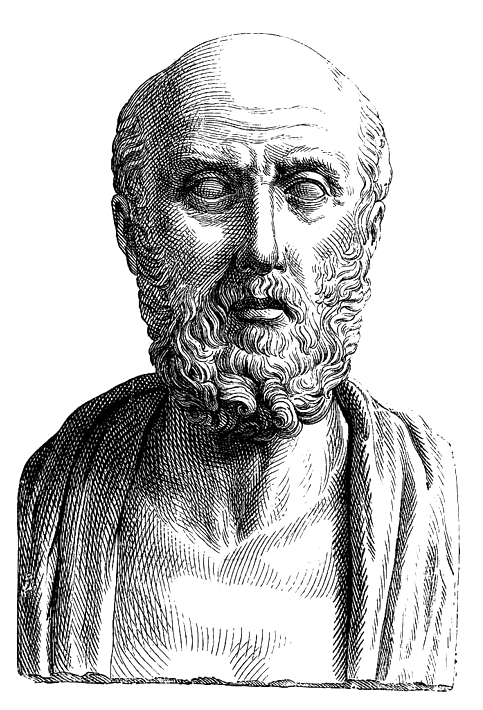
  • 460 BC – 370 BCE – Hippocrates introduced principles of scientific medicine based upon naturalistic observation and logic, and denied the influence of spirits and demons in diseases. Introduced the concept of “temperamentum”(“mixture”, i.e. 4 temperament types based on a ratio between chemical bodily systems. Hippocrates was among the first physicians to argue that brain, and not the heart is the organ of psychic processes.
  • 387 BCE – Plato suggested that the brain is the seat of mental processes. Plato’s view of the “soul” (self) is that the body exists to serve the soul: “God created the soul before the body and gave it precedence both in time and value, and made it the dominating and controlling partner.” from Timaeus
  • c. 350 BCE – Aristotle wrote on the psuchê (soul) in De Anima, first mentioning the tabula rasa concept of the mind.
  • c. 340 BCE – Praxagoras
  • 371–288 Theophrastus
  • 341–270 Epicurus
  • c. 320 Herophilus
  • c. 300–30 Zeno of Citium taught the philosophy of Stoicism, involving logic and ethics. In logic, he distinguished between imperfect knowledge offered by the senses and superior knowledge offered by reason. In ethics, he taught that virtue lay in reason and vice in rejection of reason. Stoicism inspired Aaron Beck to introduce cognitive behavioral therapy in the 1970s.
  • 304–250 Erasistratus
  • 123–43 BCE – Themison of Laodicea was a pupil of Asclepiades of Bithynia and founded a school of medical thought known as “methodism.” He was criticized by Soranus for his cruel handling of mental patients. Among his prescriptions were darkness, restraint by chains, and deprivation of food and drink. Juvenal satirized him and suggested that he killed more patients than he cured.
  • c. 100 BCE – The Dead Sea Scrolls noted the division of human nature into two temperaments.

.

Behaviorism (Psychology)

In Psychology, Behaviorism is a systematic approach to understand the behavior of humans and other animals. A tenet of behavioral research is that a large part of behavior is learned. This leads to a “treatment” that brings about behavior modification through the use of conditioning. The theory has been influential in education, therapy, and animal training, while also being critiqued for ignoring inner cognitive and emotional processes.

Here is a Q&A on basic tenets of Behaviorism:

.

Behaviorism

QUESTION: What are the basic tenets of Behaviorism?

ANSWER: (By Perplexity AI)

The basic tenets of Behaviorism are as follows:

  • Observable Behavior as the Focus: Behaviorism posits that psychology should study only observable and measurable behaviors, not internal mental states such as thoughts or emotions. This allows for more objective, scientific study.
  • Learning Through Conditioning: All behaviors are learned through interactions with the environment via conditioning.
    • Classical Conditioning: This involves learning by association, where a neutral stimulus becomes associated with a meaningful stimulus, resulting in a learned response (e.g., Pavlov’s dog salivating at the sound of a bell).
    • Operant Conditioning: Behaviors are shaped by their consequences. Behaviors followed by positive reinforcement (rewards) are likely to be repeated, while those followed by punishment are less likely to recur.
  • Role of Reinforcement and Punishment: Behavior is shaped and maintained through reinforcements (positive or negative) and can be weakened or extinguished by punishment or lack of reinforcement.
  • Environmental Determinism: The environment, not biological traits or internal processes, is seen as the chief determinant of behavior. Essentially, people (and animals) are products of their surroundings and experiences.
  • Reductionism: Complex behaviors can be broken down into simple stimulus–response (S-R) units.
  • Scientific Approach: Behavior should be studied using controlled, systematic experiments on both humans and animals. The laws that govern learning are assumed to apply across all species.
  • Emphasis on Present Behavior and Environment: Behaviorists focus on current observable behaviors and immediate environmental factors rather than past experiences or unconscious motives.

These principles form the foundation of behaviorism, a theory credited to key figures such as John B. Watson, Ivan Pavlov, and B.F. Skinner. The theory has been influential in education, therapy, and animal training, while also being critiqued for ignoring inner cognitive and emotional processes.

.

Conditioning

Behaviorism is based on Experimental Psychology. It is considered to be “scientific” when one can observe a direct, mechanical response to a stimulus. That may be true for matter; but it is not true for life.

The scientific method is based on observing CONSISTENCY of experimental results with what is there in the broad universe. Our observations of the universe show that the behavior of MATTER is a mechanical reaction and, therefore, quite simple to predict. In comparison, the behavior of QUANTUM PARTICLES AND RADIATION is complex; and it takes higher mathematics (based on statistical mechanics) to predict with some certainty. Finally, when it comes to LIFE AND THOUGHT, the behavior is so complex that it cannot be predicted, even when you use higher mathematics, or the “symbolic” logic of computers.

Where life is concerned, the results of any experiment must be consistent with how live logic would function under those experimental conditions; and not like some matter-like simple reaction.

The premise of Behaviorism that “a direct, mechanical response to a stimulus is scientific” is completely false when applied to life. Operating on this false premise has been quite harmful, specially in the field of education. But the psychologists who are stuck in their matter-centric viewpoint remain quite oblivious. Such psychologists are quite aberrated and harmful in their fixed ideas and close-mindedness.

.