Category Archives: Philosophy

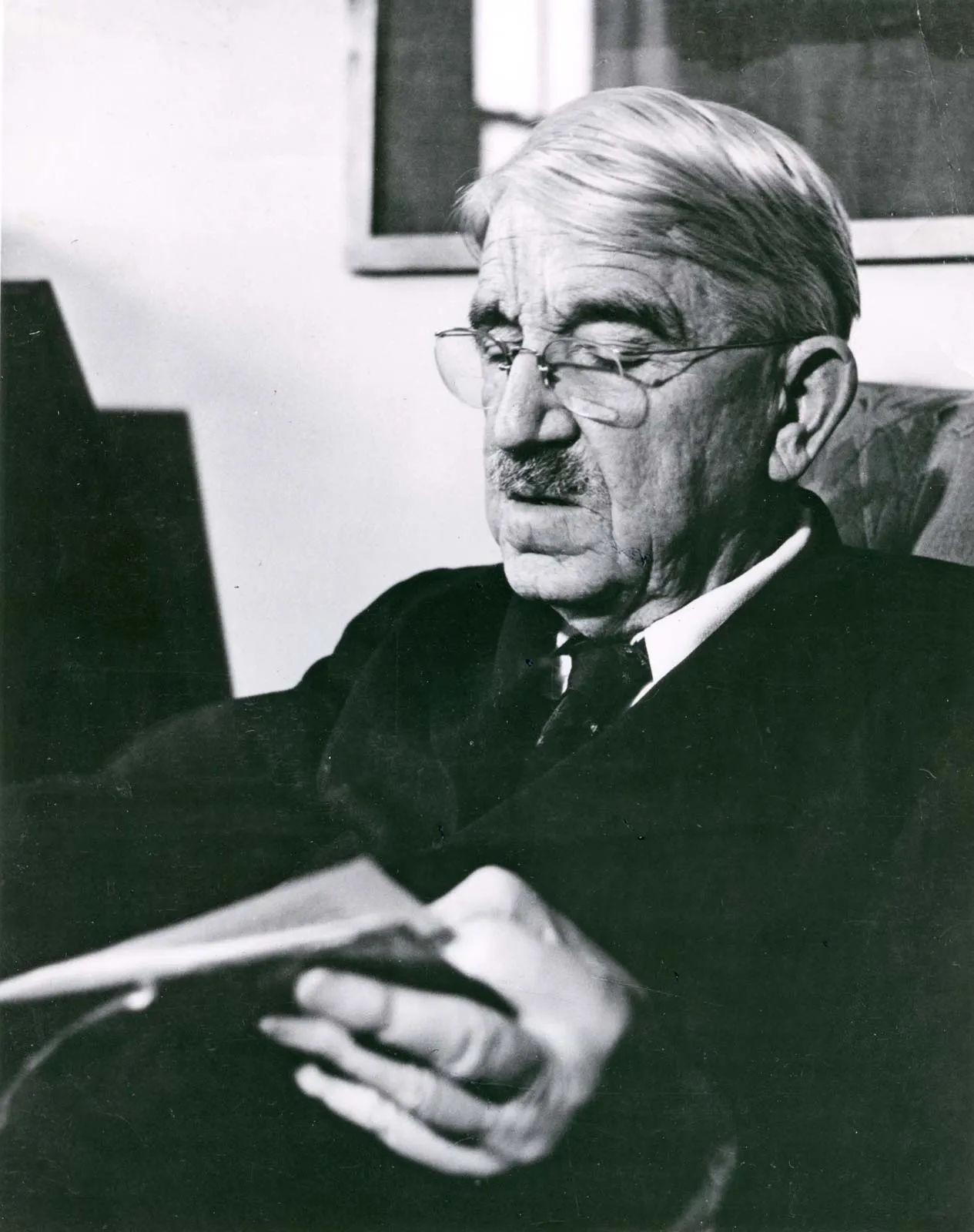
JOHN DEWEY: Instrumentalism

Reference: The Story of Philosophy

This paper presents Chapter XI Section 3.2 from the book THE STORY OF PHILOSOPHY by WILL DURANT. The  contents are from the 1933 reprint of this book by TIME INCORPORATED by arrangement with Simon and Schuster, Inc.

The paragraphs of the original material (in black) are accompanied by brief comments (in color) based on the present understanding.

.

III. JOHN DEWEY

2. Instrumentalism

What distinguishes Dewey is the undisguised completeness with which he accepts the evolution theory. Mind as well as body is to him an organ evolved, in the struggle for existence, from lower forms. His starting-point in every field is Darwinian.

When Descartes said, “The nature of physical things IS much more easily conceived when they are beheld coming gradually into existence, than when they are only considered as produced at once in a finished and perfect state,” the modern world became self-conscious of the logic that was henceforth to control it, the logic of which Darwin’s Origin of Species, is the latest scientific achievement. … When Darwin said of species what Galileo had said of the earth, e pur si muove [and yet it moves], he emancipated, once for all, genetic and experimental ideas as an organon of asking questions and looking for explanations.

What distinguishes Dewey is the undisguised completeness with which he accepts the evolution theory. Mind as well as body is to him an organ evolved, in the struggle for existence, from lower forms. His starting-point in every field is Darwinian.

Things are to be explained, then, not by supernatural causation, but by their place and function in the environment. Dewey is frankly naturalistic; he protests that “to idealize and rationalize the universe at large is a confession of inability to master the courses of things that specifically concern us.” He distrusts, too, the Schopenhauerian Will and the Bergsonian élan; these may exist, but there is no need to worship them; for these world-forces are as often as not destructive of everything that man creates and reverences. Divinity is within us, not in these neutral cosmic powers. “Intelligence has descended from its lonely isolation at the remote edge of things, whence it operated as unmoved mover and ultimate good, to take its seat in the moving affairs of men.” We must be faithful to the earth.

Things are to be explained, then, not by supernatural causation, but by their place and function in the environment. We need to master the courses of things that specifically concern us. Divinity is within us, not in these neutral cosmic powers.

Like a good positivist, scion of the stock of Bacon and Hobbes and Spencer and Mill, Dewey rejects metaphysics as the echo and disguise of theology. The trouble with philosophy has always been that its problems were confused with those of religion. “As I read Plato, philosophy began with some sense of its essentially political basis and mission—a recognition that its problems were those of the organization of a just social order. But it soon got lost in dreams of another world.” In German philosophy the interest in religious problems deflected the course of philosophic development; in English philosophy the social interest outweighed the supernatural. For two centuries the war raged between an idealism that reflected authoritarian religion and feudal aristocracy, and a sensationalism that reflected the liberal faith of a progressive democracy.

The trouble with philosophy has always been that its problems were confused with those of religion. Philosophy began with the problem of the organization of a just social order. But it soon got lost in dreams of another world.

This war is not yet ended; and therefore we have not quite emerged from the Middle Ages. The modern era will begin only when the naturalist point of view shall be adopted in every field. This does not mean that mind is reduced to matter, but only that mind and life are to be understood not in theological but in biological terms, as an organ or an organism in an environment, acted upon and reacting, moulded and moulding. We must study not “states of consciousness” but modes of response. “The brain is primarily an organ of a certain kind of behavior, not of knowing the world.” Thought is an instrument of re-adaptation; it is an organ as much as limbs and teeth. Ideas are imagined contacts, experiments in adjustment. But this is no passive adjustment, no merely Spencerian adaptation. “Complete adaptation to environment means death. The essential point in all response is the desire to control the environment.” The problem of philosophy is not how we can come to know an external world, but how we can learn to control it and remake it, and for what goals. Philosophy is not the analysis of sensation and knowledge (for that is psychology), but the synthesis and coordination of knowledge and desire.

The problem of philosophy is not how we can come to know an external world, but how we can learn to control it and remake it, and for what goals. Philosophy is not the analysis of sensation and knowledge, but the synthesis and coordination of knowledge and desire.

To understand thought we must watch it arise in specific situations. Reasoning, we perceive, begins not with premises, but with difficulties; then it conceives an hypothesis which becomes the conclusion for which it seeks the premises; finally it puts the hypothesis to the test of observation or experiment. “The first distinguishing characteristic of thinking is facing the facts—inquiry, minute and extensive scrutinizing, observation.” There is small comfort for mysticism here.

The first distinguishing characteristic of thinking is facing the facts—inquiry, minute and extensive scrutinizing, observation.

And then again, thinking is social; it occurs not only in specific situations, but in a given cultural milieu. The individual is as much a product of society as society is a product of the individual; a vast network of customs, manners, conventions, language, and traditional ideas lies ready to pounce upon every new-born child, to mould it into the image of the people among whom it has appeared. So rapid and thorough is the operation of this social heredity that it is often mistaken for physical or biological heredity. Even Spencer believed that the Kantian categories, or habits and forms of thought, were native to tne individual, whereas in all probability they are merely the product of the social transmission of mental habits from adults to chlIdren. In general the role of instinct has been exaggerated, and that of early training under-rated; the most powerful instincts, such as sex and pugnacity, have been considerably modified and controlled by social training; and there is no reason why other instincts, like those of acquisition and mastery, should not be similarly modified by social influence and education. We must unlearn our ideas about an unchangeable human nature and an omnipotent environment. There is no knowable limit to change or growth; and perhaps there is nothing impossible but thinking makes it so.

The individual is as much a product of society as society is a product of the individual. So rapid and thorough is the operation of this social heredity that it is often mistaken for physical or biological heredity. We must unlearn our ideas about an unchangeable human nature and an omnipotent environment.

.

JOHN DEWEY: Education

Reference: The Story of Philosophy

This paper presents Chapter XI Section 3.1 from the book THE STORY OF PHILOSOPHY by WILL DURANT. The  contents are from the 1933 reprint of this book by TIME INCORPORATED by arrangement with Simon and Schuster, Inc.

The paragraphs of the original material (in black) are accompanied by brief comments (in color) based on the present understanding.

.

III. JOHN DEWEY

1. Education

After all, pragmatism was “not quite” an American philosophy; it did not catch the spirit of the greater America that lay south and west of the New England states. It was a highly moralistic philosophy, and betrayed the Puritanic origins of its author. It talked in one breath of practical results and matters of fact, and in the next it leaped, with the speed of hope, from earth to heaven. It began with a healthy reaction against metaphysics and epistemology, and one expected from it a philosophy of nature and of society; but it ended as an almost apologetic plea for the intellectual respectability of every dear belief. When would philosophy learn to leave to religion these perplexing problems of another life, and to psychology these subtle difficulties of the knowledge-process, and give itself with all its strength to the illumination of human purposes and the coordination and elevation of human life?

Pragmatism was “not quite” an American philosophy. It betrayed the Puritanic origins of its author. It did not give itself with all its strength to the illumination of human purposes and the coordination and elevation of human life.

Circumstances left nothing undone to prepare John Dewey to satisfy, this need, and to outline a philosophy that should express the spirit of an informed and conscious America. He was born in the “effete East” (in Burlington, Vermont, 1859), and had his schooling there, as if to absorb the old culture before adventuring into the new. But soon he took Greeley’s counsel and went west, teaching philosophy at the universities of Minnesota (1888-9), Michigan (1889-94), and Chicago (1894-1904). Only then did he return east, to join-and later to head-the department of philosophy at Columbia University. In his first twenty years the Vermont environment gave him that almost rustic simplicity which characterizes him even now that all the world acclaims him. And then, in his twenty years in the Middle West, he saw that vast America of which the Eastern mind is so proudly ignorant; he learned its limitations and its powers; and when he came to write his own philosophy he gave to his students and his readers an interpretation of the sound and simple naturalism which underlies the superficial superstitions of the “provinces” of America. He wrote the philosophy, as Whitman wrote the poetry, not of one New-English state, but of the continent. *

* The most important of Dewey’s books are: The School and Society (1900); Studies in Logical Theory (1903); Ethics (with Tufts, 1908); How We Think (1909); The influence of Darwin on Philosophy (1910); Democracy and Education (1913); Schools of Tomorrow (with his daughter Evelyn, 1915); Essays in Experimental Logic (1916); Creative Intelligence (1917); Reconstruction in Philosophy (1920); Human Nature and Conduct (1922). The last two are the easiest approaches to his thought.

Dewey’ philosophy expresses the spirit of an informed and conscious America. It gives an interpretation of the sound and simple naturalism which underlies the superficial superstitions of the “provinces” of America. 

Dewey first caught the eyes of the world by his work in the School of Education at Chicago. It was in those years that he revealed the resolute experimental bent of his thought; and now, thirty years later, his mind is still open to every new move in education, and his interest in the “schools of tomorrow” never flags. Perhaps his greatest book is Democracy and Education; here he draws the varied lines of his philosophy to a point, and centres them all on the task of developing a better generation. All progressive teachers acknowledge his leadership; and there is hardly a school in America that has not felt his influence. We find him active everywhere in the task of remaking the schools of the world; he spent two years in China lecturing to teachers on the reform of education, and made a report to the Turkish Government on the reorganization of their national schools.

Dewey first caught the eyes of the world by his work in the School of Education at Chicago. His philosophy centers on the task of developing a better generation. There is hardly a school in America that has not felt his influence. 

Following up Spencer’s demand for more science, and less literature, in education, Dewey adds that even the science should not be book-learning, but should come to the pupil from the actual practice of useful occupations. He has no great regard for a “liberal” education; the term was used, originally, to denote the culture of a “free man,”—i. e., a man who never worked; and it was natural that such an education should be fitted rather to a leisure class in an aristocracy than to an industrial and democratic life. Now that we are nearly all of us caught up in the industrialization of Europe and America, the lessons we must learn are those that come through occupation rather than through books. Scholastic culture makes for snobbishness, but fellowship in occupations makes for democracy. In an industrial society the school should be a miniature workshop and a miniature community; it should teach through practice, and through trial and error, the arts and discipline necessary for economic and social order. And finally, education must be re-conceived, not as merely a preparation for maturity (whence our absurd idea that it should stop after adolescence), but as a continuous growth of the mind and a continuous illumination of life. In a sense, the schools can give us only the instrumentalities of mental growth; the rest depends upon our absorption and interpretation of experience. Real education comes after we leave school; and there is no reason why it should stop before our death.

In an industrial society the school should be a miniature workshop and a miniature community; it should teach through practice, and through trial and error, the arts and discipline necessary for economic and social order. Education must be re-conceived as a continuous growth of the mind and a continuous illumination of life.

.

WILLIAM JAMES: Comment

Reference: The Story of Philosophy

This paper presents Chapter XI Section 2.4 from the book THE STORY OF PHILOSOPHY by WILL DURANT. The  contents are from the 1933 reprint of this book by TIME INCORPORATED by arrangement with Simon and Schuster, Inc.

The paragraphs of the original material (in black) are accompanied by brief comments (in color) based on the present understanding.

.

II. WILLIAM JAMES

4. Comment

The reader needs no guide to the new and the old elements in this philosophy. It is part of the modern war between science and religion; another effort, like Kant’s and Bergson’s, to rescue faith from the universalized mechanics of materialism. Pragmatism has its roots in Kant’s “practical reason”; in Schopenhauer’s exaltation of the will; in Darwin’s notion that the fittest (and therefore also the fittest and truest idea) is that which survives; in utilitarianism, which measured all goods in terms of use; in the empirical and inductive traditions of English philosophy; and finally in the suggestions of the American scene.

James’ philosophy is another effort, like Kant’s and Bergson’s, to rescue faith from the universalized mechanics of materialism. 

Certainly, as everyone has pointed out, the manner, if not the substance, of James’s thinking was specifically and uniquely American. The American lust for movement and acquisition fills the sails of his style and thought, and gives them a buoyant and almost aerial motility. Huneker calls it “a philosophy for philistines,” and indeed there is something that smacks of salesmanship in it: James talks of God as of an article to be sold to a materialistically-minded consumer by every device of optimistic advertising; and he counsels us to believe as if he were recommending long-term jnvestments, with high dividends, in which there was nothing to lose, and all the (other) world to win. It was young America’s defense-reaction against European metaphysics and European science.

The manner of James’s thinking is specifically and uniquely American. The American lust for movement and acquisition fills the sails of his style and thought. Indeed there is something that smacks of salesmanship in it.

The new test of truth was of course an ancient one; and the honest philosopher described pragmatism modestly as “a new name for old ways of thinking.” If the new test means that truth is that which has been tried, by experience and experiment, the answer is, Of course. If it means that personal utility is a test of truth, the answer is, Of course not; personal utility is merely personal utility; only universal permanent utility would constitute truth. When some pragmatists speak of a belief having been true once because then useful (though now disproved), they utter nonsense learnedly; it was a useful error, not a truth. Pragmatism is correct only if it is a platitude.

Truth is that which has been tried, by experience and experiment. Only universal permanent utility would constitute truth. 

What James meant to do, however, was to dispel the cobwebs that had entangled philosophy; he wished to reiterate in a new and startling way the old English attitude towards theory and ideology. He was but carrying on the work of Bacon in turning the face of philosophy once more towards the inescapable world of things. He will be remembered for this empirical emphasis, this, new realism, rather than for his theory of truth; and he will be honored perhaps more as a psychologist than as a philosopher. He knew that he had found no solution for the old questions; he frankly admitted that he had expressed only another guess, another faith. On his desk, when he died, there lay a paper on which he had written his last, and perhaps his most characteristic, sentences: “There is no conclusion. What has concluded that we might conclude in regard to it? There are no fortunes to be told and there is no advice to be given. Farewell.”

James wished to reiterate in a new and startling way the old English attitude towards theory and ideology. He was but carrying on the work of Bacon in turning the face of philosophy once more towards the inescapable world of things. He knew that he had found no solution for the old questions.

.

WILLIAM JAMES: Pluralism

Reference: The Story of Philosophy

This paper presents Chapter XI Section 2.3 from the book THE STORY OF PHILOSOPHY by WILL DURANT. The  contents are from the 1933 reprint of this book by TIME INCORPORATED by arrangement with Simon and Schuster, Inc.

The paragraphs of the original material (in black) are accompanied by brief comments (in color) based on the present understanding.

.

II. WILLIAM JAMES

3. Pluralism

Let us apply this method to the oldest problem in philosophy—the existence and nature of God. The Scholastic philosophers described the deity as “Ens a se extra et supra omne genus, necessarium, unum, infinite, perfectum, simplex, immutabile, immensum, eternum, intelligens.” (Being from itself outside and above every genus, necessary, one, infinite, perfect, simple, unchangeable, immense, eternal, intelligent.) This is magnificent; what deity would not be proud of such a definition? But what does it mean?—what are its consequences for mankind? If God is omniscient and omnIpotent, we are puppets; there is nothing that we can do to change the course of destiny which His will has from the beginning delineated and decreed; Calvinism and fatalism are the logical corollaries of such a definition. The same test applied to mechanistic determinism issues in the same results: if we really believed in determinism we would become Hindu mystics and abandon ourselves at once to the immense fatality which uses us as marionettes. Of course we do not accept these sombre philosophies; the human intellect repeatedly proposes them because of their logical simplicity and symmetry, but life ignores and overflows them, and passes on.

A philosophy may be unimpeachable in other respects, but either of two defects will be fatal to its universal adoption. First, its ultimate principle must not be one that essentially baffles and disappoints our dearest desires and most cherished hopes. … But a second and worse defect in a philosophy than contradicting our active propensities is to give them no object whatever to press against. A philosophy whose principle is so incommensurate with our most intimate powers as to deny them all relevancy in universal affairs, as to annihilate their motives at one blow, will be even more unpopular than pessimism. …That is why materialism will always fail of universal adoption.

God is the earliest generalization of the fact of this universe. But if you assign to it an ultimate cause, its effect is to turn man into a puppet, subject to a predetermined destiny. The same test applied to mechanistic determinism issues in the same results. This universe is not entirely mechanical.

Men accept or reject philosophies, then, according to their needs and their temperaments, not according to “objective truth”; they do not ask, Is this logical?—they ask, What will the actual practice or this philosophy mean for our lives and our interests? Arguments for and against may serve to illuminate, but they never prove.

Logic and sermons never convince;
The damp of the night drives deeper into my soul. …
Now I re-examine philosophies and religions.
They may prove well in lecture rooms, yet not prove at
all under the spacious clouds, and along the landscape and
flowing currents.

The “objective truth” of philosophy arrived at by logic is trumped over by what the actual practice of that philosophy mean for the lives and interests of men.

We know that arguments are dictated by our needs, and that our needs cannot be dictated to by arguments.

The history of philosophy is to a great extent that of a certain clash of human temperaments. … Of whatever temperament a professional philosopher is, he tries, when philosophizing, to sink the fact of his temperament. Temperament is no conventionally recognized reason, so he urges impersonal reasons only for his conclusions. Yet his temperament really gives him a stronger bias than any of his more strictly objective premises.

We know that arguments are dictated by our needs, and that our needs cannot be dictated to by arguments.

These temperaments which select and dictate philosophies may be divided into the tender-minded and the tough-minded. The tender-minded temperament is religious, it likes to have definite and unchanging dogmas and a priori truths; it takes naturally to free will, idealism, monism, and optimism. The tough-minded temperament is materialistic, irreligious, empiricist (going only on “facts”), sensationalistic (tracing all knowledge to sensation), fatalistic, pluralistic, pessimistic, sceptical. In each group there are gaping contradictions; and no doubt there are temperaments that select their theories partly from one group and partly from the other. There are people (William James, for example) who are “tough-minded” in their addiction to facts and in their reliance on the senses, and yet “tender-minded” in their horror of determinism and their need for religious belief. Can a philosophy be found that will harmonize these apparently contradictory demands?

There is demand to have religious beliefs, and yet there is also a demand to be skeptical. Can a philosophy be found that will harmonize these apparently contradictory demands?

James believes that pluralistic theism affords us such a synthesis. He offers a finite God, not an Olympian thunderer sitting aloof on a cloud, “but one helper, primus inter pares (first among equals), in the midst of all the shapers of the great world’s fate.” The cosmos is not a closed and harmonious system; it is a battle-ground of cross-currents and conflicting purposes; it shows itself, with pathetic obviousness, as not a uni- but a multi-verse. It is useless to say that this chaos in which we live and move is the result of one consistent will; it gives every sign of contradiction and division within itself. Perhaps the ancients were wiser than we, and polytheism may be truer than monotheism to the astonishing diversity of the world. Such polytheism ”has always been the real religion of common people, and is so still today.” The people are right, and the philosophers are wrong. Monism is the natural disease of philosophers, who hunger and thirst not (as they think) for truth, but for unity. “‘The world is One!’—the formula may become a sort of number-worship. ‘Three’ and ‘seven’ have, it is true, been reckoned as sacred numbers; but abstractly taken, why is ‘one’ more excellent than ‘forty-three,’ or than ‘two million and ten’?” *

* Pragmatism, p. 812. The answer, of course, is that unity, or one system of laws holding throughout the universe, facilitates explanation, predictIon, and control.

These apparently contradictory demands cannot be the result of one consistent will.  It gives every sign of contradiction and division within itself. Harmonization may be accomplished by accepting the pluralistic universe of the polytheist.

The value of a multiverse, as compared with a universe, lies in this, that where there are cross-currents and warring forces our own strength and will may count and help decide the issue; it is a world where nothing is irrevocably settled, and all action matters. A monistic world is for us a dead world; in such a universe we carry out, willy-nilly, the parts assigned to us by an omnipotent deity or a primeval nebula; and not all our tears can wipe out one word of the eternal script. In a finished universe individuality is a delusion; “in reality,” the monist assures us, we are all bits of one mosaic substance. But in an unfinished world we can write some lines of the parts we play, and our choices mould in some measure the future in which we have to live. In such a world we can be free; it is a world of chance, and not of fate; everything is “not quite”; and what we are or do may alter everything. If Cleopatra’s nose, said Pascal, had been an inch longer or shorter, all history would have been changed.

This is an unfinished world where we can write some lines of the parts we play, and our choices mould in some measure the future in which we have to live. In such a world we can be free; it is a world of chance, and not of fate; everything is “not quite”; and what we are or do may alter everything.

The theoretical evidence for such free will, or such a multiverse, or such a finite God, is as lacking as for the opposite philosophies. Even the practical evidence may vary from person to person; it is conceivable that some may find better results, for their lives, from a deterministic than from a libertarian philosophy. But where the evidence is indecisive, our vital and moral interests should make the choice.

If there be any life that it is really better that we should lead, and if there be any idea which, if believed in, would help us to lead that life, then it would be really better for us to believe in that idea, unless, indeed, belief in it incidentally clashed with, other greater vital benefits.

It is conceivable that some may find better results, for their lives, from a deterministic than from a libertarian philosophy. But where the evidence is indecisive, our vital and moral interests should make the choice.

Now the persistence of the belief in God, is the best proof of its almost universal vital and moral value. James was amazed and attracted by the endless varieties of religious experience and belief; he described them with an artist’s sympathy, even where he most disagreed from them. He saw some truth in everyone of them, and demanded an open mind toward every new hope. He did not hesitate to affiliate himself with the Society for Psychical Research; why should not such phenomena, as well as others, be the object of patient examination? In the end, James was convinced of the reality of another—a spiritual—world.

I firmly disbelieve, myself, that our human experience is the highest form of experience extant in the universe. I believe rather that we stand in much the same relation to the whole of the universe as our canine and feline pets do to the whole of human life. They inhabit our drawing rooms and libraries. They take part in scenes of whose significance they have no inkling. They are merely tangent to curves of history, the beginnings and ends and forms of which pass wholly beyond their ken. So we are tangent to the wider life of things.

There are endless varieties of religious experience and belief. There is some truth in everyone of them. They all should be an object of patient examination. There is much more to this universe than what we understand.

Nevertheless he did not think of philosophy as a meditation on death; no problems had value for him unless they could guide and stimulate our terrestrial career. “It was with the excellencies, not the duration, of our natures, that he occupied himself.” He did not live in his study so much as in the current of life; he was an active worker in a hundred efforts for human betterment; he was always helping somebody, lifting men up with the contagion of his courage. He believed that in every individual there were “reserve energies” which the occasional midwifery of circumstance would bring forth; and his constant sermon, to the individual and to society, was a plea that these resources should be entirely used. He was horrified at the waste of human energy in war; and he suggested that these mighty impulses of combat and mastery could find a better outlet in a “war against nature.” Why should not every man, rich or poor, give two years of his life to the state, not for the purpose of killing other people, but to conquer the plagues, and drain the marshes, and irrigate the deserts, and dig the canals, and democratically do the physical and social engineering which builds up so slowly and painfully what war so quickly destroys?

James did not live in his study so much as in the current of life. He believed that in every individual there were “reserve energies” which the occasional midwifery of circumstance would bring forth. Such energies must be put to productive use.

He sympathized with socialism, but he disliked its deprecation of the individual and the genius. Taine’s formula, which reduced all cultural manifestations to “race, environment, and time,” was inadequate precisely because it left out the individual. But only the individual has value; everything else is a means—even philosophy. And so we need on the one hand a state which shall understand that it is the trustee and servant of the interests of individual men and women; and on the other a philosophy and a faith which shall “offer the universe as an adventure rather than a scheme,” and shall stimulate every energy by holding up the world as a place where, though there are many defeats, there are also victories waiting to be won.

A shipwrecked sailor, buried on this coast,
Bids you set sail.
Full many a gallant bark, when we were lost,
Weathered the gale. *

* Quoted by James (Pragmatism, p. 297) from the Greek Anthology.

We need a state which shall understand that it is the trustee and servant of the interests of individual men and women. But we also need a philosophy and a faith which shall offer the universe as an adventure rather than a scheme.

.

WILLIAM JAMES: Pragmatism

Reference: The Story of Philosophy

This paper presents Chapter XI Section 2.2 from the book THE STORY OF PHILOSOPHY by WILL DURANT. The  contents are from the 1933 reprint of this book by TIME INCORPORATED by arrangement with Simon and Schuster, Inc.

The paragraphs of the original material (in black) are accompanied by brief comments (in color) based on the present understanding.

.

II. WILLIAM JAMES

2. Pragmatism

The direction of his thought is always to things; and if he begins with psychology it is not as a metaphysician who loves to lose himself in ethereal obscurities, but as a realist to whom thought, however distinct it may be from matter, is essentially a mirror of external and physical reality. And, it is a better mirror than some have believed; it perceives and reflects not merely separate things, as Hume supposed, but their relations too; it sees everything in a context; and the context is as immediately given in perception as the shape and touch and odor of the thing. Hence the meaninglessness of Kant’s “problem of knowledge” (how do we put sense and order into our sensations?)—the sense and the order, in outline at least, are already there. The old atomistic psychology of the English school, which conceived thought as a series of separate ideas mechanically associated, is a misleading copy of physics and chemistry; thought is not a series, it is a stream, a continuity of perception and feeling, in which ideas are passing nodules like corpuscles in the blood. We have mental “states” (though this is again a misleadingly static term) that correspond to prepositions, verbs, adverbs and conjunctions, as well as “states” that reflect the nouns and pronouns of our speech; we have feelings of for and to and against and because and behind and after as well as of matter and men. It is these “transitive” elements in the flow of thought that constitute the thread of our mental life, and give us some measure of the continuity of things.

William James is a realist to whom thought, however distinct it may be from matter, is essentially a mirror of external and physical reality. It perceives and reflects not merely separate things but their relations too. It sees everything in a context; and the context is as immediately given in perception as the shape and touch and odor of the thing. 

Consciousness is not an entity, not a thing, but a flux and system of relations; it is a point at which the sequence and relationship of thoughts coincide illuminatingly with the sequence of events and the relationship of things. In such moments it is reality itself, and no mere “phenomenon,” that flashes into thought; for beyond phenomena and “appearances” there is nothing. Nor is there any need of going beyond the experience-process to a soul; the soul is merely the sum of our mental life, as the “Noumenon” is simply the total of all phenomena, and the “Absolute” the web of the relationships of the world.

Consciousness is a flux and system of relations; it is reality itself that flashes into thought. The soul is merely the sum of our mental life. The “Noumenon” is simply the total of all phenomena. The “Absolute” is the web of the relationships of the world.

It is this same passion for the immediate and actual and real that led James to pragmatism. Brought up in the school of French clarity, he abominated the obscurities and pedantic terminology of German metaphysics; and when Harris and others began to import a moribund Hegelianism into America, James reacted like a quarantine officer who has detected an immigrant infection. He was convinced that both the terms and the problems of German metaphysics were unreal; and he cast about him for some test of meaning which would show, to every candid mind, the emptiness of these abstractions.

Brought up in the school of French clarity, James abominated the obscurities and pedantic terminology of German metaphysics.

He found the weapon which he sought when, in 1878, he came upon an essay by Charles Peirce, in the Popular Science Monthly. on “How to Make Our Ideas Clear.” To find the meaning of an idea, said Peirce, we must examine the consequences to which it leads in action; otherwise dispute about it may be without end, and will surely be without fruit. This was a lead which James was glad to follow; he tried the problems and ideas of the old metaphysics by this test, and they fell to pieces at its touch like chemical compounds suddenly shot through with a current of electricity. And such problems as had meaning took on a clearness and a reality as if, in Plato’s famous figure, they had passed out of the shadows of a cave into the brilliance of a sun-lit noon.

To find the meaning of an idea, we must examine the consequences to which it leads in action; otherwise dispute about it may be without end, and will surely be without fruit. 

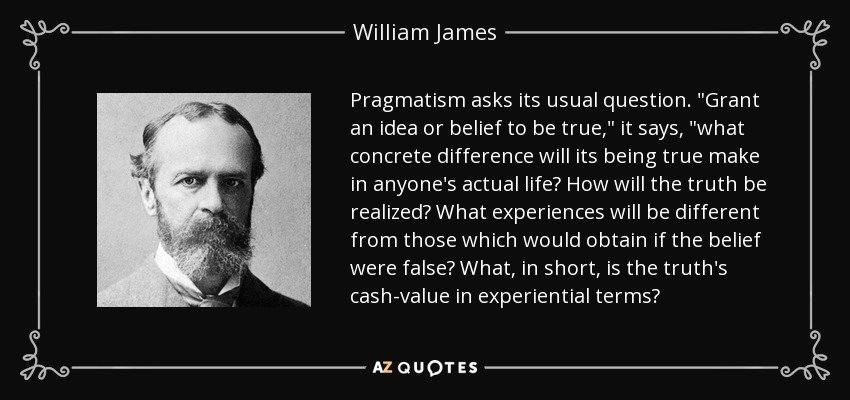
This simple and old-fashioned test led James on to a new definition of truth. Truth had been conceived as an objective relation, as once good and beauty had been; now what if truth, like these, were also relative to human judgment and human needs? “Natural laws” had been taken as “objective” truths, eternal and unchangeable; Spinoza had made them the very substance of his philosophy; and yet what were these truths but formulations of experience, convenient and successful in practice; not copies of an object, but correct calculations of specific consequences? Truth is the “cash-value” of an idea.

The true … is only the expedient in the way of our thinking, just as “the right” is only the expedient in the way of our behaving. Expedient is almost any fashion; and expedient in the long run and on the whole, of course; for what meets expediently all the experiences in sight won’t necessarily meet all further experiences equally satisfactorily. … Truth is one species of good, and not, as is usually supposed, a category distinct from good, and coordinate with it. The true is the name of whatever proves itself to be good in the way of belief.

Truths are but formulations of experience, convenient and successful in practice; not copies of an object, but correct calculations of specific consequences. Truth is the “cash-value” of an idea.

Truth is a process, and “happens to an idea”; verity is verification. Instead of asking whence an idea is derived, or what are its premises, pragmatism examines its results; it “shifts the emphasis and looks forward”; it is “the attitude of looking away from first things, principles, ‘categories,’ supposed necessities, and of looking towards last things, fruits, consequences, facts.” Scholasticism asked, What is the thing,—and lost itself in “quiddities”; Darwinism asked, What is its origin?—and lost itself in nebulas; pragmatism asks, What are its consequences?—and turns the face of thought to action and the future.

Truth is a process, and “happens to an idea”; verity is verification. Instead of asking whence an idea is derived, or what are its premises, pragmatism examines its results.

.