Category Archives: Philosophy

SCHOPENHAUER: The Will to Live

Reference: The Story of Philosophy

This paper presents Chapter VII Section 4.1 from the book THE STORY OF PHILOSOPHY by WILL DURANT. The  contents are from the 1933 reprint of this book by TIME INCORPORATED by arrangement with Simon and Schuster, Inc.

The paragraphs of the original material (in black) are accompanied by brief comments (in color) based on the present understanding.

.

IV. The World as Will

1. The Will to Live

Almost without exception, philosophers have placed the essence of mind in thought and consciousness; man was the knowing animal, the animal rationale. “This ancient and universal radical error, this enormous proton pseudos, [first lie, Initial mistake] … must before everything be set aside.”* “Consciousness is the mere surface of our minds, of which, as of the earth, we do not know the inside but only the crust.” Under the conscious intellect is the conscious or unconscious will, a striving, persistent vital force, a spontaneous activity, a will of imperious desire. The intellect may seem at times to lead the will, but only as a guide leads his master; the will “is the strong blind man who carries on his shoulders the lame man who can see.” We do not want a thing because we have found reasons for it, we find reasons for it because we want it; we even elaborate philosophies and theologies to cloak our desires. Hence Schopenhauer calls man the “metaphysical animal”: other animals desire without metaphysics. “Nothing is more provoking, when we are arguing against a man with reasons and explanations, and taking all pains to convince him, than to discover at last that he will not understand, that ‘We have to do with his will.” Hence the uselessness of logic: no one ever convinced anybody by logic; and even logicians use logic only as a source of income. To convince a man, you must appeal to his self-interest, his desires, his will. Observe how long we remember our victories, and how soon we forget our defeats; memory is the menial of will.” “In doing accounts we make mistakes much oftener in our own favor than to our disadvantage; and this without the slightest dishonest intention.” “On the other hand, the understanding of the stupidest man becomes keen when objects are in question that closely concern his wishes”; in general, the intellect is developed by danger, as in the fox, or by want, as in the criminal. But always it seems subordinate and instrumental to desire; when it attempts to displace the will, confusion follows. No one is more liable to mistakes than he who acts only on reflection. 

*Schopenhauer forgets (or does he take his lead from?) Spinoza’s emphatic statement: “Desire is the very essence of man.” Fichte had also emphasized the will. 

We do not want a thing because we have found reasons for it, we find reasons for it because we want it. Hence the uselessness of logic: no one ever convinced anybody by logic. To convince a man, you must appeal to his self-interest, his desires, his will. Schopenhauer’s will appears to be the same thing as the reactive mind of Hubbard. 

Consider the agitated strife of men for food, mates, or children; can this be the work of reflection? Certainly not; the cause is the half conscious will to live, and to live fully. “Men are only apparently drawn from in front; in reality they are pushed from behind”; they think they are led on by what they see, when in truth they are driven on by what they feel,—by instincts of whose operation they are half the time unconscious. Intellect is merely the minister of foreign affairs; “nature has ‘Produced it for the service of the individual will. Therefore it is only designed to know things so far as they afford motives for the will, but not to fathom them or to comprehend their true being.” “The will is the only permanent and unchangeable element in the mind; … it is the will which,” through continuity of purpose, “gives unity to consciousness and holds together all its ideas and thoughts, ac- companying them like a continuous harmony.” It is the organ-point of thought. 

The cause of the agitated strife of men for food, mates, or children is the half conscious will to live. They are driven on by instincts of whose operation they are half the time unconscious. “The will is the only permanent and unchangeable element in the mind.”

Character lies in the will, and not in the intellect; character too is continuity of purpose and attitude: and these are will. Popular language is correct when it prefers the ”heart” to the “head”; it knows (because it has not reasoned about it) that a “good will” is profounder and more reliable than a clear mind; and when it calls a man “shrewd,” “knowing,” or “cunning” it implies its suspicion and dislike. “Brilliant qualities of mind win admiration, but never affection”; and “all religions promise a reward … for excellences of the Will or heart, but none for excellences of the head or understanding.” 

Popular language correctly prefers the ”heart” (will) to the “head” (intellect). A “good will” is profounder and more reliable than a clear mind.

Even the body is the product of the will. The blood, pushed on by that will which we vaguely call life, builds its own vessels by wearing grooves in the body of the embryo; the grooves deepen and close up, and become arteries and veins. The will to know builds the brain just as the will to grasp forms the hand, or as the will to eat develops the digestive. tract.* Indeed, these pairs—these forms of will and these forms of flesh—are but two sides of one process and reality. The relation is best seen in emotion, where the feeling and the internal bodily changes form one complex unit.** 

*This is the Lamarckian view of growth and evolution as due to desires and functions compelling structures and begetting organs. 
**A source for the James-Lange theory of emotion?

The act of will and the movement of the body are not two different things objectively known, which the bond of causality unites; they do not stand in the relation of cause and effect; they are one and the same, but they are given in entirely different ways,—immediately, and again in perception. … The action of the body is nothing but the act of the will objectified. This is true of every movement of the body; … the whole body is nothing but objectified will. … The parts of the body must therefore completely correspond to the principal desires through which the will manifests itself; they must be the visible expression of these desires. Teeth, throat and bowels are objectified hunger; the organs of generation are objectified sexual desire. … The whole nervous system constitutes the antennae of the will, which it stretches within and without. … As the human body generally corresponds to the human will generally, so the individual bodily structure corresponds to the individually modified will, the character of the individual.

Even the body is the product of the will. 

The intellect tires, the will never; the intellect needs sleep, but the will works even in sleep. Fatigue, like pain, has its seat in the brain; muscles not connected with the cerebrum (like the heart) never tire.* In sleep the brain feeds; but the will requires no food. Hence the need for sleep is greatest in brain-workers. (This fact, however, “must not mislead us into extending sleep unduly; for then it loses in intensity … and becomes mere loss of time.”) In sleep the life of man sinks to the vegetative level, and then “the will works according to its original and essential nature, undisturbed from without, with no diminution of its power through the activity of the brain and the exertion of knowing, which is the heaviest organic function; … therefore in sleep the whole power of the will is directed to the maintenance and improvement of the organism. Hence all healing, all favorable crises, take place in sleep.” Burdach was right when he declared sleep to be the original state. The embryo sleeps almost continuously, and the infant most of the time. Life is “a struggle against sleep: at first we win ground from it, which in the end it recovers. Sleep is a morsel of death borrowed to keep up and renew that part of life which has been exhausted by the day.” It is our eternal foe; even when we are awake it possesses us partly. After all, what is to be expected of heads even the wisest of which is every night the scene of the strangest and the most senseless dreams, and which has to take up its meditations again on awakening from them?”

*But is there no such thing as the satiation or exhaustion of desire? In profound fatigue or sickness even the wlll to live fades. 

The intellect tires, the will never; the intellect needs sleep, but the will works even in sleep.

Will, then, is the essence of man. Now what if it is also the essence of life in all its forms, and even of “inanimate” matter? What if will is the long-sought-for, the long-despaired-of, “thing-in-itself,”—the ultimate inner reality and secret essence of all things? 

Let us try, then, to interpret the external world in terms of will. And let us go at once to the bottom; where others have said that will is a form of force let us say that force is a form of will. To Hume’s question—What is causality?—we shall answer, Will. As will is the universal cause in ourselves, so is it in things; and unless we so understand cause as will, causality will remain only a magic and mystic formula, really meaningless. Without this secret we are driven to mere occult qualities like “force,” or “gravity,” or “affinity”; we do not know what these forces are, but we know—at least a little more clearly—what will is; let us say, then, that repulsion and attraction, combination and decomposition, magnetism and electricity, gravity and crystallization, are Will. Goethe expressed this idea in the title of one of his novels, when he called the irresistible attraction of lovers die Wahlverwandschaften—“elective affinities.” The force which draws the lover, and the force which draws the planet, are one. 

As will is the universal cause in ourselves, so is it in things. Repulsion and attraction, combination and decomposition, magnetism and electricity, gravity and crystallization, are Will. The force which draws the lover, and the force which draws the planet, are one. 

So in plant life. The lower we go among the forms of life the smaller we find the role of intellect; but not so with will. 

That which in us pursues its ends by the light of knowledge, but here … only strives blindly and dumbly in a one-sided and unchangeable manner, must yet in both cases come under the name of Will. … Unconsciousness is the original and natural condition of all things, and therefore also the basis from which, in particular species of beings, consciousness results as their highest efflorescence; wherefore even then unconsciousness always continues to predominate. Accordingly, most existences are without consciousness; but yet they act according to the laws of their nature,—i. e., of their will. Plants have at most a very weak analogue of consciousness; the lowest species of animals only the dawn of it. But even after it has ascended through the whole series of animals to man and his reason; the unconsciousness of plants, from which it started, still remains the foundation, and may be traced in the necessity, for sleep.

The lower we go among the forms of life the smaller we find the role of intellect; but not so with will. Consciousness appears only in the highest forms of life.

Aristotle was right: there is a power within that moulds every form, in plants and planets, in animals and men. “The instinct of animals in general gives us the best illustration of what remains of teleology in nature. For as instinct is an action similar to that which is guided by the conception of an end, and yet is entirely without this; so all construction in nature resembles that which is guided by the conception of an end, and yet is entirely without it.” The marvelous mechanical skill of animals shows how prior the will is to the intellect. An elephant which had been led through Europe, and had crossed hundreds of bridges, refused to advance upon a weak bridge, though it had seen many horses and men crossing it. A young dog fears to jump down from the table; it foresees the effect of the fall not by reasoning (for it has no experience of such a fall) but by instinct. Orangoutangs warm themselves by a fire which they find, but they do not feed the fire; obviously, then, such actions are instinctive, and not the result of reasoning; they are the expression not of intellect but of will.

Instincts are the expression not of intellect but of will. The marvelous mechanical skill of animals shows how prior the will is to the intellect. 

The will, of course, is a will to live, and a will to maximum life. How dear life is to all living things!—and with what silent patience it will bide its time! “For thousands of years galvanism slumbered in copper and zinc, and they lay quietly beside silver, which must be consumed in flame as soon as all three are brought together under the required conditions. Even in the organic kingdom we see a dry seed preserve the slumbering force of life through three thousand years, and, when at last the favorable circumstances occur, grow up as a plant.” Living toads found in limestone lead to the conclusion that even animal life is capable of suspension for thousands of years. The will is a will to live; and its eternal enemy is death. 

To Schopenhauer any force exists because of will. The will is a will to live; and its eternal enemy is death. 

But perhaps it can defeat even death?

.
SCHOPENHAUER: The World as Idea

Reference: The Story of Philosophy

This paper presents Chapter VII Section 3 from the book THE STORY OF PHILOSOPHY by WILL DURANT. The  contents are from the 1933 reprint of this book by TIME INCORPORATED by arrangement with Simon and Schuster, Inc.

The paragraphs of the original material (in black) are accompanied by brief comments (in color) based on the present understanding.

.

III. The World as Idea

What strikes the reader at once upon opening The World as Will and Idea is its style. Here is no Chinese puzzle of Kantian terminology, no Hegelian obfuscation, no Spinozist geometry; everything is clarity and order; and all is admirably centered about the leading conception of the world as will, and therefore strife, and therefore misery. What blunt honesty, what refreshing vigor, what uncompromising directness! Where his predecessors are abstract to the point of invisibility, with theories that give out few windows of illustration upon the actual world, Schopenhauer, like the son of a business man, is rich in the concrete, in examples, in applications, even in humor.* After Kant, humor in philosophy was a startling innovation. 

*One instance of his humor had better be buried in the obscurity of a foot-note. “The actor Unzelmann,” notorious for adding remarks of his own to the lines of the playwright, “was forbidden, at the Berlin theatre, to improvise. Soon afterwards he had to appear upon the stage on horseback.” Just as they entered, the horse was guilty of conduct seriously unbecoming a public stage. “The audience began to laugh; Whereupon Unzelmann severely reproached the horse:—‘Do you not know that we are forbidden to improvise!’”—Vol. ii, p. 273. 

This reminds one of Buddha’s first noble truth—see The First Noble Truth – Dukkha. Schopenhauer’s work is marked by blunt honesty and refreshing vigor.

But why was the book rejected? Partly because it attacked just those who could have given it publicity—the university teachers. Hegel was philosophic dictator of Germany in 1818; yet Schopenhauer loses no time in assailing him. In the preface to the second edition he writes: 

No time can be more unfavorable to philosophy than that in which it is shamefully misused on the one hand to further political objects, on the other as a means of livelihood. … Is there then nothing to oppose to the maxim, Primum vivere, deinde philosophari? [First one must live, then one may philosophize.] These gentlemen desire to live, and indeed to live by philosophy. To philosophy they are assigned, with their wives and children. … The rule, “I sing the song of him whose bread I eat,” has always held good; the making of money by philosophy was regarded by the ancients as the characteristic of the sophists. … Nothing is to be had for gold but mediocrity. … It is impossible that an age which for twenty years has applauded a Hegel— that intellectual Caliban—as the greatest of the philosophers, … could make him who has looked on at that desirous of its approbation. … But rather, truth will always be pauconum hominum, [of few men.] and must therefore quietly and modestly wait for the few whose unusual mode of thought may find it enjoyable. … Life is short, but truth works far and lives long; let us speak the truth. 

Schopenhauer’s book was rejected partly because it attacked those university teachers who could have given it publicity.

These last words are nobly spoken; but there is something of sour grapes in it all; no man was ever more anxious for approbation than Schopenhauer. It would have been nobler still to say nothing ill of Hegel; de vivis nil nisi bonum—of the living let us say nothing but good. And as for modestly awaiting recognition,—“I cannot see,” says Schopenhauer, “that between Kant and myself anything has been done in philosophy.” “I hold this thought—that the world is will—to be that which has long been sought for under the name of philosophy, and the discovery of which is therefore regarded, by those who are familiar with history, as quite as impossible as the discovery of the philosopher’s stone.” “I only intend to impart a single thought. Yet, notwithstanding all my endeavors, I could find no shorter way of imparting it than this whole book. … Read the book twice, and the first time with great patience.”* So much for modesty! “What is modesty but hypocritical humility, by means of which, in a world swelling with envy, a man seeks to obtain pardon for excellences and merits from those who have none?” “No doubt, when modesty was made a virtue, it was a very advantageous thing for the fools.; for everybody is expected to speak of himself as if he were one.” 

*In fact, this is just what one must do; many have found even a third reading fruitful. A great book is like a great symphony, which must be heard many times before it can be really understood. 

Schopenhauer doesn’t think much of modesty. He just wanted to speak his truth that the world is the will.

There was no humility about the first sentence of Schopenhauer’s book. “The world,” it begins, “is my idea.” When Fichte had uttered a similar proposition even the metaphysically sophisticated Germans had asked,—“What does his wife say about this?” But Schopenhauer had no wife. His meaning, of course, was simple enough: he wished to accept at the outset the Kantian position that the external world is known to us only through our sensations and ideas. There follows an exposition of idealism which is clear and forceful enough, but which constitutes the least original part of the book, and might better have come last than first. The world took a generation to discover Schopenhauer because he put his worst foot forward, and hid his own thought behind a two-hundred- page barrier of second-hand idealism.*

*Instead of recommending books about Schopenhauer it would be better to send the reader to Schopenhauer himself: all three volumes of his main work (with the exception of Part I in each volume) are easy reading, and full of matter; and all the Essays are valuable and delightful. By way of biography Wallace’s Life should suffice. In this essay it has been thought desirable to condense Schopenhauer’s immense volumes not by rephrasing their ideas, but by selecting and coordinating the salient passages, and leaving the thought in the philosopher’s own clear and brilliant language. The reader will have the; benefit of getting Schopenhauer at drst hand. however briefly. 

The world took a generation to discover Schopenhauer because he put his worst foot forward, and hid his own thought behind a two-hundred-page barrier of second-hand idealism.

The most vital part of the first section is an attack on materialism. How can we explain mind as matter, when we know matter only through mind?

If we had followed materialism thus far with clear ideas, when we reached its highest point we would suddenly be seized with a fit of the inextinguishable laughter of the Olympians. As if waking from a dream, we would all at once become aware that its final result—knowledge—which it had reached so laboriously, was presupposed as the indispensable condition of its very starting-point. Mere matter; and when we imagined that we thought matter, we really thought only the subject that perceives matter: the eye that sees it, the hand that feels it, the understanding that knows it. Thus the tremendous petitio principii reveals itself unexpectedly; for suddenly the last link is seen to be the starting-point, the chain a circle; and the materialist is like Baron Münchausen, who, when swimming on horseback, drew the horse into the air with his legs, and himself by his queue. … The crude materialism which even now, in the middle of the nineteenth century, has been served up again under the ignorant delusion that it is original, … stupidly denies vital force, and first of all tries to explain the phenomena of life from physical and chemical forces, and those again from the mechanical effects of matters. … But I will never believe that even the simplest chemical combination will ever admit of mechanical explanation; much less the properties of light, heat, and electricity. These will always require a dynamical explanation.

The most vital part of the first section is an attack on materialism. How can we explain mind as matter, when we know matter only through mind?

No: it is impossible to solve the metaphysical puzzle, to discover the secret essence of reality, by examining matter first, and then proceeding to examine thought: we must begin with that which we know directly and intimately—ourselves. ”We can never arrive at the real nature of things from without. However much we may investigate, we can never reach anything but images and names. We are like a man who goes round a castle seeking in vain for an entrance, and sometimes sketching the facades.” Let us enter within. If we can ferret out the ultimate nature of our own minds we shall perhaps have the key to the external world. 

It is impossible to discover the secret essence of reality, by examining matter first. If we can ferret out the ultimate nature of our own minds we shall perhaps have the key to the external world. 

.

SCHOPENHAUER: The Man

Reference: The Story of Philosophy

This paper presents Chapter VII Section 2 from the book THE STORY OF PHILOSOPHY by WILL DURANT. The  contents are from the 1933 reprint of this book by TIME INCORPORATED by arrangement with Simon and Schuster, Inc.

The paragraphs of the original material (in black) are accompanied by brief comments (in color) based on the present understanding.

.

II. The Man

Schopenhauer was born at Dantzig on February 22, 1788. His father was a merchant noted for ability, hot temper, independence of character, and love of liberty. He moved from Dantzig to Hamburg when Arthur was five years old, because Dantzig lost its freedom in the annexation of Poland in 1798. Young Schopenhauer, therefore, grew up in the midst of business and finance; and though he soon abandoned the mercantile career into which his father had pushed him, it left its mark upon him in a certain bluntness of manner, a realistic turn of mind, a knowledge of the world and of men; it made him the antipodes of that closet or academic type of philosopher whom he so despised. The father died, apparently by his own hand, in 1805. The paternal grandmother had died insane. 

Young Schopenhauer grew up in the midst of business and finance; and it left its mark upon him in a certain bluntness of manner, a realistic turn of mind, a knowledge of the world and of men.

“The character or will,” says Schopenhauer, “is inherited from the father; the intellect from the mother.” The mother had intellect—she became one of the most popular novelists of her day—but she had temperament and temper too. She had been unhappy with her prosaic husband; and when he died she took to free love, and moved to Weimar as the fittest climate for that sort of life. Arthur Schopenhauer reacted to this as Hamlet to his mother’s re-marriage; and his quarrels with his mother taught him a large part of those half-truths about women with which he was to season his philosophy. One of her letters to him reveals the state of their affairs: “You are unbearable and burdensome, and very hard to live with; all your good qualities are over-shadowed by your conceit, and made useless to the world simply because you cannot restrain your propensity to pick holes in other people.” So they arranged to live apart; he was to come only to her “at homes,” and be one guest among others; they could then be as polite to each other as strangers, instead of hating each other like relatives. Goethe, who liked Mme. Schopenhauer because she let him bring his Christiane with him, made matters worse by telling the mother that her son would become a very famous man; the mother had never heard of two geniuses in the same family. Finally, in some culminating quarrel, the mother pushed her son and rival down the stairs; whereupon our philosopher bitterly informed her that she would be known to posterity only through him. Schopenhauer quitted Weimar soon afterward; and though the mother lived twenty-four years more, he never saw her again. Byron, also a child of 1788, seems to have had similar luck with his mother. These men were almost by this circumstance doomed to pessimism; a man who has not known a mother’s love—and worse, has known a mother’s hatred—has no cause to be infatuated with the world.

Schopenhauer had a difficult time with his mother who took to free love after his father died. He never knew a mother’s love and ended up breaking his relationship with her. This doomed him to pessimism.

Meanwhile Schopenhauer had gone through “gymnasium” and university, and had learned more than was on their schedules. He had his fling at love and the world, with results that affected his character and his philosophy. He became gloomy, cynical, and suspicious; he was obsessed with fears and evil fancies; he kept his pipes under lock and key, and never trusted his neck to a barber’s razor; and he slept with loaded pistols at his bedside—presumably for the convenience of the burglar. He could not bear noise: “I have long held the opinion,” he writes, ”that the amount of noise which anyone can bear undisturbed stands in inverse proportion to his mental capacity, and may therefore be regarded as a pretty fair measure of it. … Noise is a torture to all intellectual people. … The superabundant display of vitality which takes the form of knocking, hammering, and tumbling things about, has proved a daily torment to me all my life long.” He had an almost paranoiac sense of unrecognized greatness; missing success and fame, he turned within and gnawed at his own soul. 

His education, relations and experiences turned Schopenhauer into a  gloomy, cynical, and suspicious man. He became obsessed with fears and evil fancies. He could not bear noise. He had an almost paranoiac sense of unrecognized greatness.

He had no mother, no wife, no child, no family, no country. “He was absolutely alone, with not a single friend; and between one and none there lies an infinity.” Even more than Goethe he was immune to the nationalistic fevers of his age. In 1813 he so far fell under the sway of Fichte’s enthusiasm for a war of liberation against Napoleon, that he thought of volunteering, and actually bought a set of arms. But prudence seized him in time; he argued that “Napoleon gave after all only concentrated and untrammeled utterance to that self-assertion and lust for more life which weaker mortals feel but must perforce disguise.” Instead of going to war he went to the country and wrote a doctor’s thesis in philosophy. 

Schopenhauer was absolutely alone without family, friends and country. He wanted to volunteer in a war of liberation against Napoleon; instead he went to the country and wrote a doctor’s thesis in philosophy.

After this dissertation On the Fourfold Root of Sufficient Reason (1813),* Schopenhauer gave all his time, and devoted all his power, to the work which was to be his masterpiece—The World as Will and Idea. He sent the MS. to the publisher magna cum laude; here, he said, was no mere rehash of old ideas, but a highly coherent structure of original thought, “clearly intelligible, vigorous, and not without beauty”; a book ”which would hereafter be the source and occasion of a hundred other books.” All of which was outrageously egotistic, and absolutely true. Many years later Schopenhauer was so sure of having solved the chief problems of philosophy that he thought of having his signet ring carved with an image of the Sphinx throwing herself down the abyss, as she had promised to do on having her riddles answered.

*Schopenhauer insists, hardly with sufficient reason, and almost to the point of salesmanship, that this book must be read before the World all Will and idea can be understood. The reader may nevertheless rest content with knowing that the “principle of sufficient reason” is the “law of cause and effect,” in four forms: 1-Logical, as the determination of conclusion by premises; 2-Physical, as the determination of effect by cause; 3-Mathematical, as the determination of structure by the laws of mathematics and mechanics; and 4-Moral, as the determination of conduct by character. 

Schopenhauer was outrageously egotistic in promoting his work to the point of salesmanship. He was sure of having solved the chief problems of philosophy.

Nevertheless, the book attracted hardly any attention; the world was too poor and exhausted to read about its poverty and exhaustion. Sixteen years after publication Schopenhauer was informed that the greater part of the edition had been sold as waste paper. In his essay on Fame, in “The Wisdom of Life,” he quotes, with evident allusion to his masterpiece, two remarks of Lichtenberger’s: ”Works like this are as a mirror: if an ass looks in you cannot expect an angel to look out”; and “when a head and a book come into collision, and one sounds hollow, is it always the book?” Schopenhauer goes on, with the voice of wounded vanity: “The more a man belongs to posterity—in other words, to humanity in general—so much the more is he an alien to his contemporaries; for since his work is not meant for them as such, but only in so far as they form part of mankind at large, there is none of that familiar local color about his productions which would appeal to them.” And then he becomes as eloquent as the fox in the fable: ”Would a musician feel flattered by the loud applause of an audience if he knew that they were nearly all deaf, and that to conceal their infirmity he saw one or two persons applauding? And what would he say if he discovered that those one or two persons had often taken bribes to secure the loudest applause for the poorest player?”—In some men egotism is a compensation for the absence of fame; in others, egotism lends a generous cooperation to its presence. 

Schopenhauer’s book attracted hardly any attention. This wounded his vanity.

So completely did Schopenhauer put himself into this book that his later works are but commentaries on it; he became Talmudist to his own Torah, exegete to his own Jeremiads. In 1836 he published an essay On the Will in Nature, which was to some degree incorporated into the enlarged edition of The World as Will and Idea which appeared in 1844. In 1841 came The Two Ground-Problems of Ethics, and in 1851 two substantial volumes of Parerga et Paralipomena—literally, “By-products and Leavings”—which have been translated into English as the Essays. For this, the most readable of his works, and replete with wisdom and wit, Schopenhauer received, as his total remuneration, ten free copies. Optimism is difficult under such circumstances. 

Schopenhauer’s later works are but commentaries on his main book, “The World as Will and Idea.” Even though all his works were brilliant, he hardly got compensated for them.

Only one adventure disturbed the monotony of his studious seclusion after leaving Weimar. He had hoped for a chance to present his philosophy at one of the great universities of Germany; the chance came in 1822, when he was invited to Berlin as privat-docent. He deliberately chose for his lectures the very hours at which the then mighty Hegel was scheduled to teach; Schopenhauer trusted that the students would view him and Hegel with the eyes of posterity. But the students could not so far anticipate, and Schopenhauer found himself talking to empty seats. He resigned, and revenged himself by those bitter diatribes against Hegel which mar the later editions of his chef-d’oeuvre. In 1831 a cholera epidemic broke out in Berlin; both Hegel and Schopenhauer fled; but Hegel returned prematurely, caught the infection, and died in a few days. Schopenhauer never stopped until he reached Frankfort, where he spent the remainder of his seventy-two years. 

Schopenhauer invited to Berlin as privat-docent. He deliberately chose for his lectures the very hours at which the then mighty Hegel was scheduled to teach; and he found himself talking to empty seats.

Like a sensible pessimist, he had avoided that pitfall of optimists—the attempt to make a living with the pen. He had inherited an interest in his father’s firm, and lived in modest comfort on the revenue which this brought him. He invested his money with a wisdom unbecoming a philosopher. When a company in which he had taken shares failed, and the other creditors agreed to a 70% settlement, Schopenhauer fought for full payment, and won. He had enough to engage two rooms in a boarding-house; there he lived the last thirty years of his life, with no comrade but a dog. He called the little poodle Atma (the Brahmins’ term for the World-Soul), but the wags of the town called it “Young Schopenhauer.” He ate his dinners, usually, at the Englischer Hof. At the beginning of each meal he would put a gold coin upon the table before him; and at the end of each meal he would put the coin back into his pocket. It was, no doubt, an indignant waiter who at last asked him the meaning of this invariable ceremony. Schopenhauer answered that it was his silent wager to drop the coin into the poor-box on the first day that the English officers dining there should talk of anything else than horses, women, or dogs.

Schopenhauer did not attempt to make a living with the pen. He had inherited an interest in his father’s firm, and lived in modest comfort on the revenue which this brought him. 

The universities ignored him and his books, as if to substantiate his claim that all advances in philosophy are made outside of academic walls. “Nothing,” says Nietzsche, “so offended the German savants as Schopenhauer’s unlikeness to them.” But he had learned some patience; he was confident that, however belated, recognition would come. And at last, slowly, it came. Men of the middle classes—lawyers, physicians, merchants—found in him a philosopher who offered them no mere pretentious jargon of metaphysical unrealities, but an intelligible survey of the phenomena of actual life. A Europe disillusioned with the ideals and efforts of 1848 turned almost with acclamation to this philosophy that had voiced the despair of 1815. The attack of science upon theology, the socialist indictment of poverty and war, the biological stress on the struggle for existence,—all these factors helped to lift Schopenhauer finally to fame. 

The universities ignored Schopenhauer and his books, but belated recognition did come from men of the middle classes. They found in him a philosopher who offered them no mere pretentious jargon of metaphysical unrealities, but an intelligible survey of the phenomena of actual life.

He was not too old to enjoy his popularity: he read with avidity all the articles that appeared about him; he asked his friends to send him every bit of printed comment they could find—he would pay the postage. In 1854 Wagner sent him a copy of Der Ring der Nibelugen, with a word in appreciation of Schopenhauer’s philosophy of music. So the great pessimist became almost an optimist in his old age; he played the flute assiduously after dinner, and thanked Time for ridding him of the fires of youth. People came from all over the world to see him; and on his seventieth birthday, in 1858, congratulations poured in upon him from all quarters and every continent.

Schopenhauer was not too old to enjoy his popularity. So the great pessimist became almost an optimist in his old age.

It was not too soon; he had but two more years to live. On September 21, 1860, he sat down alone to breakfast, apparently well. An hour later his landlady found him still seated at the table, dead. 

Schopenhauer passed away peacefully, seated at his breakfast table, at age 72.

.

SCHOPENHAUER: The Age

Reference: The Story of Philosophy

This paper presents Chapter VII Section 1 from the book THE STORY OF PHILOSOPHY by WILL DURANT. The  contents are from the 1933 reprint of this book by TIME INCORPORATED by arrangement with Simon and Schuster, Inc.

The paragraphs of the original material (in black) are accompanied by brief comments (in color) based on the present understanding.

.

I. The Age

Why did the first half of the nineteenth century lift up, as voices of the age, a group of pessimistic poets—Byron in England, De Musset in France, Heine in Germany, Leopardi in Italy, Pushkin and Lermontof in Russia; a group of pessimistic composers—Schubert, Schumann, Chopin, and even the later Beethoven (a pessimist trying to convince himself that he is an optimist); and above all, a profoundly pessimistic philosopher—Arthur Schopenhauer?

Schopenhauer represents an age of pessimism—the first half of the nineteenth century.

That great anthology of woe, The World as Will and Idea, appeared in 1818. It was the age of the “Holy” Alliance. Waterloo had been fought, the Revolution was dead, and the “Son of the Revolution” was rotting on a rock in a distant sea. Something of Schopenhauer’s apotheosis of Will was due to that magnificent and bloody apparition of the Will made flesh in the little Corsican; and something of his despair of life came from the pathetic distance of St. Helena—Will defeated at last, and dark Death the only victor of all the wars. The Bourbons were restored, the feudal barons were returning to claim their lands, and the pacific idealism of Alexander had unwittingly mothered a league for the suppression of progress everywhere. The great age was over. “I thank God,” said Goethe, “that I am not young in so thoroughly finished a world.” . 

The great Age of Reason was over with the French Revolution, and monarchy was being restored.

All Europe lay prostrate. Millions of strong men had perished; millions of acres of land had been neglected or laid waste; everywhere on the Continent life had to begin again at the bottom, to recover painfully and slowly the civilizing 

economic surplus that had been swallowed up in war. Schopenhauer, traveling through France and Austria in 1804, was struck by the chaos and uncleanliness of the villages, the wretched poverty of the farmers, the unrest and misery of the towns. The passage of the Napoleonic and counter-Napoleonic armies had left scars of ravage on the face of every country. Moscow was in ashes. In England, proud victor in the strife, the farmers were ruined by the fall in the price of wheat; and the industrial workers were tasting all the horrors of the nascent and uncontrolled factory-system. Demobilization added to unemployment. “I have heard my father say,” wrote Carlyle, “that in the years when oatmeal was as high as ten shillings a stone, he had noticed the laborers retire each separately to a brook, and there drink instead of dining, anxious only to hide their misery from one another.” Never had life seemed so meaningless, or so mean. 

The wars had left devastation and misery all around Europe and England.

Yes, the Revolution was dead; and with it the life seemed to have gone out of the soul of Europe. That new heaven; called Utopia, whose glamour had relieved the twilight of the gods, had receded into a dim future where only young eyes could see it; the older ones had followed that lure long enough, and turned away from it now as a mockery of men’s hopes. Only the young can live in the future, and only the old can live in the past; men were most of them forced to live in the present, and the present was a ruin. How many thousands of heroes and believers had fought for the Revolution! How the hearts of youth everywhere in Europe had turned towards the young republic, and had lived on the light and hope of it,—until Beethoven tore into shreds the dedication of his Heroic Symphony to the man who had ceased to be the Son of the Revolution and had become the son-in-law of reaction. How many had fought even then for the great hope, and had believed, with passionate uncertainty, to the very end? And now here was the very end: Waterloo, and St. Helena, and Vienna; and on the throne of prostrate France a Bourbon who had learned nothing and forgotten nothing. This was the glorious denouement of a generation of such hope and effort as human history had never known before. What a comedy this tragedy was—for those whose laughter was yet bitter with tears! 

The Revolution was dead; and with it the life seemed to have gone out of the soul of Europe. 

Many of the poor had, in these days of disillusionment and suffering, the consolation of religious hope; but a large proportion of the upper classes had lost their faith, and looked out upon a ruined world with no alleviating vision of a vaster life in whose final justice and beauty these ugly ills would be dissolved. And in truth it was hard enough to believe that such a sorry planet as men saw in 1818 was held up in the hand of an intelligent and benevolent God. Mephistopheles had triumphed, and every Faust was in despair. Voltaire had sown the whirlwind, and Schopenhauer was to reap the harvest. 

These were the days of disillusionment and suffering.

Seldom had the problem of evil been flung so vividly and insistently into the face of philosophy and religion. Every martial grave from Boulogne to Moscow and the PyramIds lifted a mute interrogation to the indifferent stars. How long, O Lord,. and Why? Was this almost universal calamity the vengeance of a just God on the Age of Reason and unbelief? Was it a call to the penitent intellect to bend before the ancient virtues of faith, hope and charity? So Schlegel thought, and Novalis, and Chateaubriand, and De Musset, and Southey, and Wordsworth, and Gogol; and they turned back to the old faith like wasted prodigals happy to be home again. But some others made harsher answer: that the chaos of Europe but reflected the chaos of the universe; that there was no divine order after all, nor any heavenly hope; that God, if God there was, was blind, and Evil brooded over the face of the earth. So Byron, and Heine, and Lermontof, and Leopardi, and our philosopher. 

Seldom had the problem of evil been flung so vividly and insistently into the face of philosophy and religion. Some thought that there was no divine order after all, nor any heavenly hope; that God, if God there was, was blind, and Evil brooded over the face of the earth.

.

VOLTAIRE: Dénouement

Reference: The Story of Philosophy

This paper presents Chapter V Section 10 from the book THE STORY OF PHILOSOPHY by WILL DURANT. The  contents are from the 1933 reprint of this book by TIME INCORPORATED by arrangement with Simon and Schuster, Inc.

The paragraphs of the original material (in black) are accompanied by brief comments (in color) based on the present understanding.

.

X. Dénouement

Meanwhile the old “laughing philosopher” was cultivating his garden at Ferney; this “is the best thing we can do on earth.” He had asked for a long life: “my fear is that I shall die before I have rendered service”; but surely now he had done his share. The records of his generosity are endless. “Everyone, far or near, claimed his good offices; people consulted him, related the wrongs of which they were the victims, and solicited the help of his pen and his credit.” Poor people guilty of some misdemeanor were his especial care; he would secure a pardon for them and then set them up in some honest occupation, meanwhile watching and counseling them. When a young couple who had robbed him went down on their knees to beg his forgiveness, he knelt to raise them, telling them that his pardon was freely theirs, and that they should kneel only for God’s. One of his characteristic undertakings was to bring up, educate, and provide a dowry for the destitute niece of Corneille. “The little good I have done,” he said,·”is my best work. … When I am attacked I fight like a devil; I yield to no one; but at bottom I am a good devil, and I end by laughing.”

The records of Voltaire’s generosity are endless. Poor people guilty of some misdemeanor were his especial care; he would secure a pardon for them and then set them up in some honest occupation, meanwhile watching and counseling them.

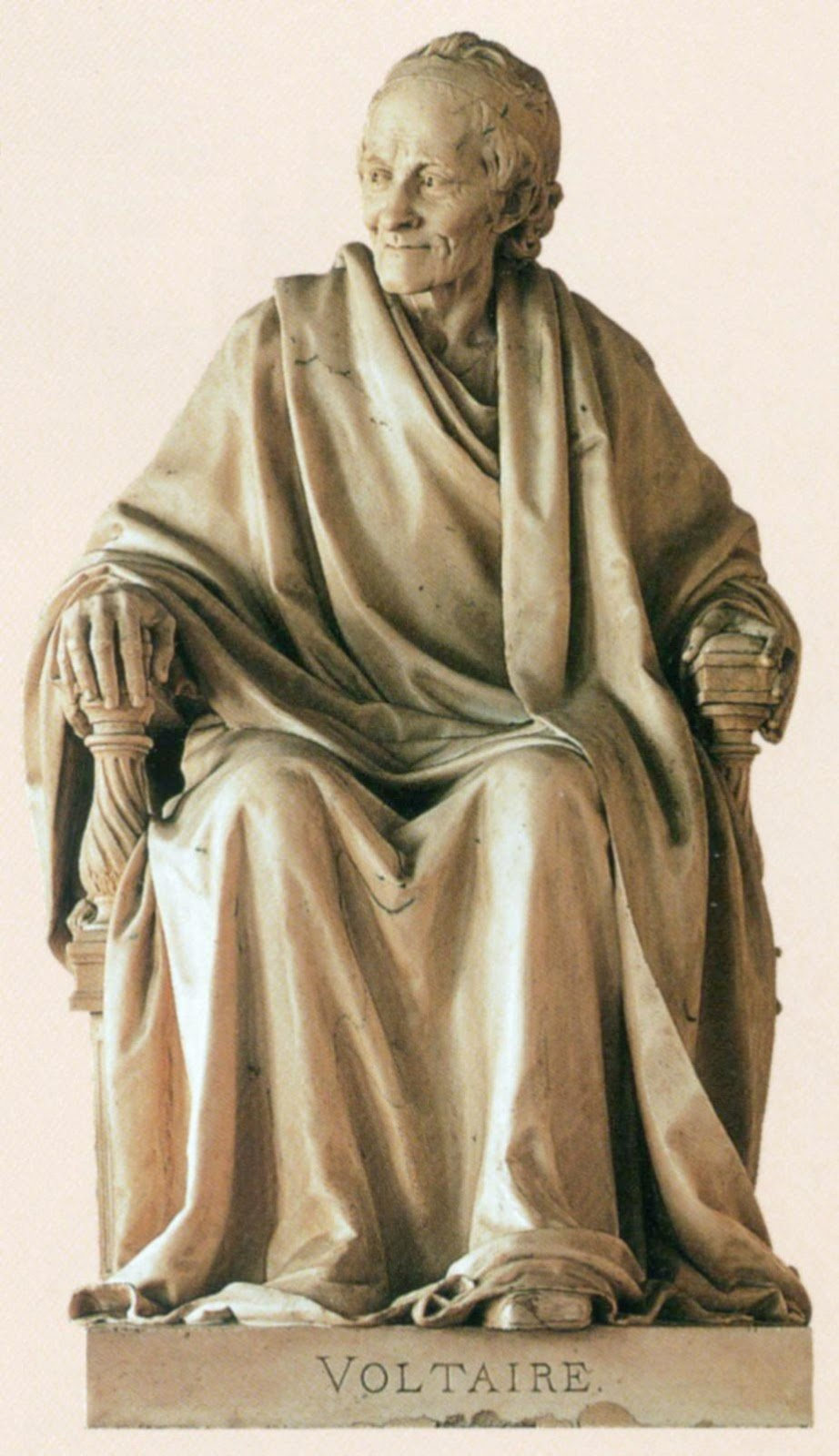
In 1770 his friends arranged a subscription to have a bust made of him. The rich had to be forbidden to give more than a mite, for thousands asked the honor of contributing. Frederick inquired how much he should give; he was told, “A crown piece, sire, and your name.” Voltaire congratulated him on adding to his cultivation of the other sciences this encouragement of anatomy by subscribing for the statue of a skeleton. He demurred to the whole undertaking on the ground that he had no face left to be modeled. “You would hardly guess where it ought to be. My eyes have sunk in three inches; my cheeks are like old parchment; … the few teeth I had are gone.” To which d’Alembert replied: “Genius … has always a countenance which genius, its brother, will easily find.” When his pet, Bellet-Bonne, kissed him, he said it was “Life kissing Death.” 

In 1770 his friends arranged a subscription to have a bust made of him. The rich had to be forbidden to give more than a mite, for thousands asked the honor of contributing. 

He was now eighty-three; and a longing came over him to see Paris before he died. The doctors advised him not to undertake so arduous a trip; but “if I want to commit a folly,” he answered, “nothing will prevent me”; he had lived so long, and worked so hard, that perhaps he felt he had a right to die in his own way, and in that electric Paris from which he had been so long exiled. And so he went, weary mile after weary mile, across France; and when his coach entered the capital his bones hardly held together. He went at once to the friend of his youth, d’Argental: “I have left off dying to come and see you,” he said. The next day his room was stormed by three hundred visitors, who welcomed him as a king; Louis XVI fretted with jealousy. Benjamin Franklin was among the callers, arid brought his grandson for Voltaire’s blessing; the old man put his thin hands upon the youth’s head and bade him dedicate himself to “God and Liberty.” 

He was now eighty-three; and a longing came over him to see Paris before he died. And so he went, weary mile after weary mile, across France. After he arrived his room was stormed by three hundred visitors, who welcomed him as a king.

He was so ill now that a priest came to shrive him. “From whom do you come, M. l’Abbé?’, asked Voltaire. “From God Himself,” was the answer. “Well, well, sir,” said Voltaire; “your credentials?” The priest went away without his prey. Later Voltaire sent for another abbé, Gautier, to come and hear his confession; Gautier came, but refused Voltaire absolution until he should sign a profession of full faith in Catholic doctrine. Voltaire rebelled; instead, he drew up a statement which he gave to his secretary, Wagner: “I die adoring God, loving my friends, not hating my enemies, and detesting superstition. (Signed) Voltaire. February 28, 1778.”

Voltaire was so ill now that a priest came to shrive him. But when asked to sign a profession of full faith in Catholic doctrine, Voltaire refused. Instead, he drew up a statement, “I die adoring God, loving my friends, not hating my enemies, and detesting superstition.”

Though sick and tottering, he was driven to the Academy, through tumultuous crowds that clambered on his carriage and tore into souvenirs the precious pelisse which Catherine of Russia had given him. “It was one of the historic events of the century. No great captain returning from a prolonged campaign of difficulty and hazard crowned by the most glorious victory, ever received a more splendid and far-resounding greeting.” At the Academy he proposed a revision of the French dictionary; he spoke with youthful fire, and offered to undertake all such part of the work as would come under the letter A. At the close of the sitting he said, “Gentlemen, I thank you in the name of the alphabet.” To which the chairman, Chastellux, replied: “And we thank you in the name of letters.” 

Voltaire went to the Academy in Paris, where he proposed a revision of the French dictionary, and spoke with youthful fire.

Meanwhile his play, Irene, was being performed at the theatre; against the advice of the physicians again, he insisted on attending. The play was poor; but people marveled not so much that a man of eighty-three should write a poor play, but that he should write any play at all; and they drowned the speech of the players with repeated demonstrations in honor 

of the author. A stranger, entering, supposed himself to be in a madhouse, and rushed back frightened into the street.

Voltaire attended his play, Irene, which was being performed at the theatre; against the advice of the physicians again.

When the old patriarch of letters went home that evening he was almost reconciled to death. He knew that he was exhausted now; that he had used to the full that wild and marvelous energy which nature had given to him perhaps more than to any man before him. He struggled as he felt life being torn from him; but death could defeat even Voltaire. The end came on May 30, 1778. 

Voltaire’s end finally came on May 30, 1778. 

He was refused Christian burial in Paris; but his friends set him up grimly in a carriage, and got him out of the city by pretending that he was alive. At Scellières they found a priest who understood that rules were not made for geniuses; and the body was buried in holy ground. In 1791 the National Assembly of the triumphant Revolution forced Louis XVI to recall Voltaire’s remains to the Pantheon. The dead ashes of the great flame that had been were escorted through Paris by a procession of 100,000 men and women, while 600,000 flanked the streets. On the funeral car were the words: “He gave the human mind a great impetus; he prepared us for freedom.” On his tombstone only three words were necessary:

HERE LIES VOLTAIRE 

What a wonderful life and end Voltaire had!

.