
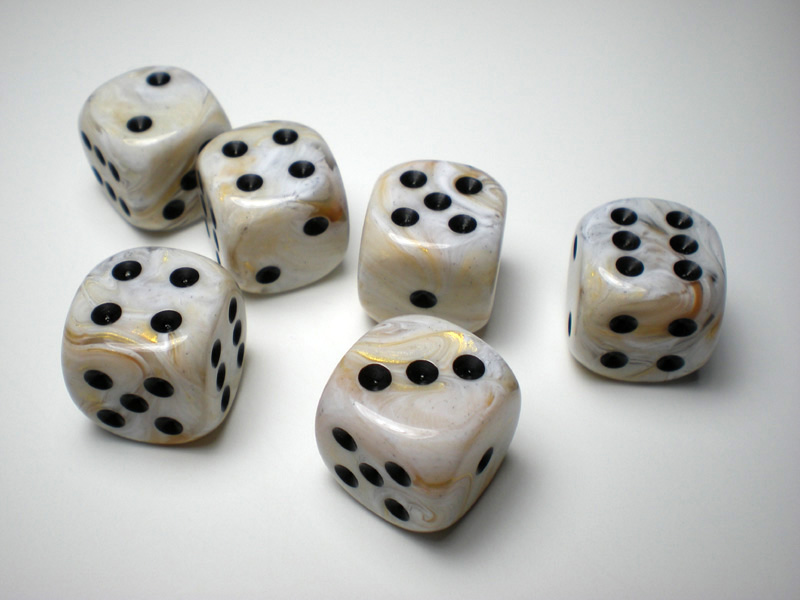
ARITHMETIC = Arithmos (number) + Techne (Skill) = Number skill
.
(1) Arithmetic starts with COUNTING.
Counting starts with one. The next count is one more.
.
(2) What is counted is called a UNIT.
UNIT = what is counted one at a time.
If one is counting houses, then each house is a unit.
If one is counting inches in a length, then each inch is a unit.
.
(3) Each count is represented by symbols called NUMBERS.
The numbers are 1, 2, 3, etc. They are read as ONE, TWO, THREE, and so on.
.
(4) The counting numbers start from ‘1’. The next number is always one more.
ONE = 1
TWO = 1 + 1 = 2
THREE = 2 + 1 = 3
FOUR = 3 + 1 = 4, and so on.
These numbers go on forever.
.
(5) Numbers are patterns (see the picture of the dice above).
Numbers are visualized as ‘patterns’, such as, a pattern of five dots for five.
If we visualize five as the symbol ‘5’, then it is like visualizing a cat as the symbol “CAT’.
.
(6) The concept of ‘no unit’ is represented by 0 (zero).
0 (zero) means “nothing”, and, therefore, it is not used in counting.
.
(7) The set of counting numbers is called NATURAL NUMBERS.
The smallest natural number is 1 (one) and not 0 (zero).
.
(8) When zero is included, the number set is called WHOLE NUMBERS.
0 (zero) is a whole number, but not a natural number.
1 (one) is a whole number as well as a natural number .
.
(9) Numbers are written with DIGITS.
This is similar to writing words with letters.
The word CAT is written with three letters: C – A – T.
The number 105 is written with three digits: 1 – 0 – 5.
.
(10) There are ten different digits: 0, 1, 2, 3, 4, 5, 6, 7, 8, 9.
This is just like having 26 different letters in English, which are used to write all the words in English.
The word ‘I’ is written with a single letter; ‘ME’with two letters; and ‘YOU’ with three letters.
The number ‘7’ is written with a single digit; ‘15’ with two digits; and ‘164’ with three digits.
.
(11) Numbers are grouped as ONES, TENS and HUNDREDS.
There are 1 to 9 ONES.
There are 1 to 9 TENS.
There are 1 to 9 HUNDREDS, and so on.
Thus, ONES, TENS and HUNDREDS, may be used as “units.” See (2) above.
For example: 369 = 3 HUNDREDS + 6 TENS + 9 ONES
.
(12) The 1 to 9 ONES are single-digit numbers.
(1, 2, 3, 4, 5, 6, 7, 8, 9)
The 1 to 9 TENS are double-digit numbers.
(10, 20, 30, 40, 50, 60, 70, 80, 90)
The 1 to 9 HUNDREDS are three-digit numbers.
(100, 200, 300, 400, 500, 600, 700, 800, 900)
.
(13) 10 ONES become 1 TEN, like 10 pennies become 1 dime.
10 TENS become 1 HUNDRED, like 10 dimes become 1 dollar.
.
(14) The ONES may be counted between two consecutive TENS, such as.
Between 10 and 20: 11, 12, 13, 14, 15, 16, 17, 18, and 19 (1 more gives 20)
Between 20 and 30: 21, 22, 23, 24, 25, 26, 27, 28, and 29 (1 more gives 30)
And so on…
.
(15) The TENS may be counted between two consecutive HUNDREDS, such as,
Between 100 and 200: 110, 120, 130, 140, 150, 160, 170, 180, and 190 (10 more gives 200)
And, the ONES may be counted between two consecutive TENS within HUNDREDS.
And so on…
.
(16) The single-digit numbers are from: 1 to 9
Note: There are nine single-digit numbers.
Zero (0) is a whole number but not a counting number.
The double-digit numbers are from: 10 to 99
Note: There are ninety double-digit numbers.
The three-digit numbers are from: 100 to 999
Note: There are nine hundred three-digit numbers.
And so on…
.
(17) The “units” of ONES, TENS HUNDREDS make a BASIC group.
The next group of ONES, TENS HUNDREDS is called the THOUSANDS.
The next group of ONES, TENS HUNDREDS is called the MILLIONS.
The next group of ONES, TENS HUNDREDS is called the BILLIONS.
The next group of ONES, TENS HUNDREDS is called the TRILLIONS, and so on.

.
For further details, please refer to: MATH MILESTONE #1: NUMBERS & PLACE VALUES
.
.


