Author Archives: vinaire

I am originally from India. I am settled in United States since 1969. I love mathematics, philosophy and clarity in thinking.

Physics II: Chapter 3

Reference: Beginning Physics II

Chapter 3: COULOMB’S LAW AND ELECTRIC FIELDS

.

KEY WORD LIST

Electric Charge, Electric Force, Law Of Conservation Of Charge, Conductors, Ground, Coulomb’s Law, Electric Field, Electric Field Lines, Flux Density, Flux, Flux Density, Gauss’ Law (for Electric Field), Gaussian Surface

.

GLOSSARY

For details on the following concepts, please consult Chapter 3.

ELECTRIC CHARGE
Electric charge is created when amber rod is rubbed with fur. By convention, the charge on amber rod is considered positive and that on the fur is considered negative. In ordinary matter, negative charge is carried by electrons, and positive charge is carried by the protons in the nuclei of atoms. Atoms are neutral because the number of electrons surrounding the nucleus equals the number of protons in the nucleus.  A point charge that is static requires a material base to exist on, which is usually an atom or a molecule. The negative charge is the material base with an additional electron. The positive charge is a material base lacking an electron. Charge is measured in units of Coulomb (C). The magnitude of the charge of an electron (e) is 1.602 x 10⁻¹⁹ C.

ELECTRIC FORCE
All charged particles exert a force on each other called the electric force. When one separates the charges one can explore the force between them. It is found that the force is one of attraction between charges of opposite polarity and of repulsion between charges of like polarity. Furthermore, the magnitude of the force decreases as the charges move further apart.

LAW OF CONSERVATION OF CHARGE
This law requires that the total amount of charge remains unchanged. If one starts with uncharged materials the initial charge present is zero. Then the total charge after it has been separated must still add to zero, requiring that there be equal amounts of positive and negative charge present.

CONDUCTORS
In many materials, called conductors, there are some charges, usually electrons in the outer reaches of the atoms, which are free to move in the material. If the conducting material is uncharged, then the electrons are uniformly distributed in the material, with each electron being attracted to a fixed, positively charged nucleus. If other charges are inserted in the conductor, then the free charges move in response to the electrical forces that occur. Since it is the electrons that move, a piece of conductor can be given a negative charge by adding some electrons from elsewhere, or a positive charge by removing some electrons to another location. This charge is found distributed on the surface of the conductor because similar charges repels each and they end up on the surface where the area is maximum to spread out on. The interior of the conductor remains neutral. when a charged conductor is brought close to a neutral conductor, it creates an opposite charge on the surface of the second conductor.

GROUND
The ground is a large uncharged reservoir.

COULOMB’S LAW
Coulomb’s law is the quantitative law which gives the force between two charged particles. It states that the magnitude of the electrostatic force of attraction or repulsion between two point charges is directly proportional to the product of the magnitudes of charges and inversely proportional to the square of the distance between them.

Here, ke is the Coulomb constant (ke ≈ 8.988 × 10⁹ N⋅m2⋅C−2), q1 and q2 are the assigned magnitudes of the charges, and the scalar r is the distance between the charges.

The direction of the force is along the line joining the charges. If the charges are of the same sign, then the force is one of repulsion, i.e. it is directed away from q1, while if the charges are of opposite sign then the force is one of attraction, i.e. it is directed toward q1. Of course, there will also be a force exerted by q2 on q1, which will have the same magnitude as the force on q2 but will be in the opposite direction.

NOTE: Like the gravitational force, the electric force is also looked upon as “action at a distance.” The formula for the magnitude of the force is identical in form to that for the gravitational force between two masses. On an atomic and molecular scale, gravitational forces are negligible compared to electrical forces and can almost invariably be neglected.

ELECTRIC FIELD
An electric field is the physical field that surrounds electrically charged particles and exerts force on all other charged particles in the field, either attracting or repelling them. It also refers to the physical field for a system of charged particles. The electric field is defined as a vector field that associates to each point in space the electrostatic (Coulomb) force per unit of charge exerted on an infinitesimal positive test charge at rest at that point. The derived SI unit for the electric field is the newton per coulomb (N/C).

Suppose one has an electric field E at a certain position in space. If we now place a charge Q at that point the electric field will exert a force on the charge, given by:

F = QE

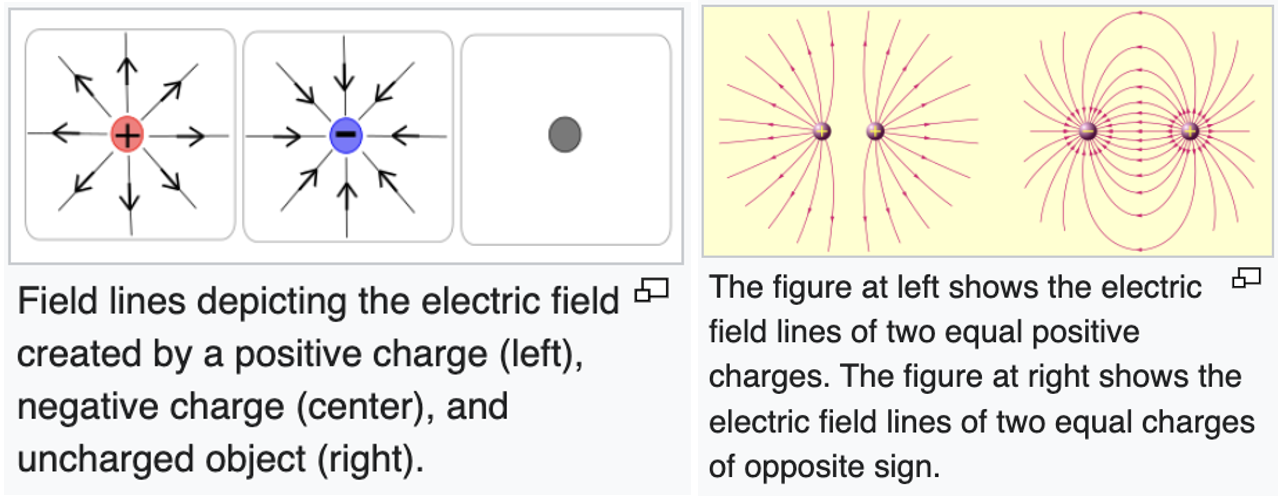
ELECTRIC FIELD LINES
A field line is a graphical visual aid for visualizing vector fields. These are lines traced through space in such a way that as the line passes through a point it always aims in the direction of the electric field at that point. One can always determine the direction of the electric field at a point in space by drawing the tangent to the electric field line going through that point. All the lines begin on positive charges and end on negative charges. It cannot happen that lines cross each other since at the point of crossing there would then be two directions for the electric field, which cannot happen.

FLUX (F)
Flux is the number of field lines passing through any given area. The field produced by the charge q has a magnitude of (1/4πε0) q/r2. Equating this to the number of field lines per unit area, we get N/4πr2 = q/4 πε0 r2, or N = q/ε0.

Choosing N, the representative number of field lines drawn from the charge q, to equal q/ε0 is particularly useful because we can now deduce the magnitude of the electric field at any point P at any distance R from the charge in terms of the lines/area at that point. The lines/area at a point P is defined as the number of lines passing through a small “window” centered on the point P and facing perpendicular to the field lines, divided by the small area of the window.

The lines/area (as defined above) when chosen to equal |E|, is called the flux density, and the number of lines passing through any given area is called the flux through that area. Flux is positive when its direction is the same as the area vector.

Note: Thinking in terms of lines/area is a very useful pictorial device for understanding the behavior of the electric field, but ultimately all the results we obtain are expressible directly in terms of the electric field E and do not depend on the artifact of lines that are drawn through space.

Noting that E cos θ is just the component of E parallel to A (area vector), we see that the flux through A is just the component of E along A times the magnitude of A:

Flux = E (cos θ) A

This is an equivalent definition of flux that needs no reference to “field lines per unit area” or other intuitive constructs.

GAUSS’ LAW (ELECTRIC FIELD)
For a closed surface, if the flux is positive then net flux leaves the surface, i.e. more lines leave the surface than enter the surface. If the sum is negative, then on net more lines have entered the surface from outside than leave. The net electric flux through any hypothetical closed surface is equal to 1/ε0 times the net electric charge enclosed within that closed surface.

where E is the total electric field due to all charges in the universe and Qin is the total charge enclosed in the surface. The closed surface is also referred to as Gaussian surface.

.

Mathematical Results

See the chapter for problems and their solutions.

(1) The electric field produced by the charge on the ring:

The field at the center of the ring (P1) will be zero. The field at point P2 will be:

.

(2) The electric field produced by the charge distributed uniformly on a sphere:

The magnitude of the field outside the sphere is given by E = kQ/r2, where Q is the total charge on the sphere. This is the same field that would be produced by a point charge Q located at the center of the sphere.

.

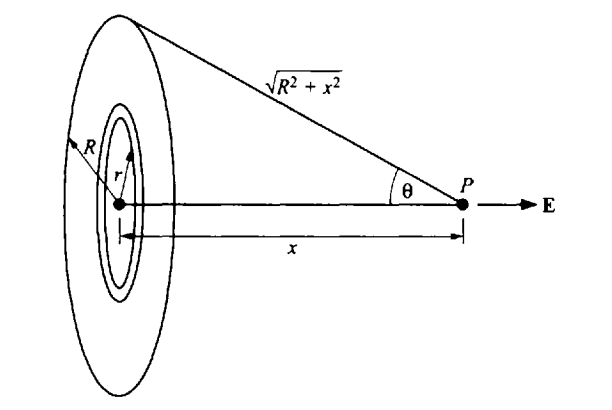
(2) The electric field produced by the charge distributed uniformly on a disk:

The field at point P will be:

When one is close to the disk or “far” from the edge from planar planar charge distribution of any shape (i.e. x << R):

.

(3) The electric field produced by the charge distributed uniformly on a rod:

The field at point P will be:

where Q = 2Lλ is the total charge on the rod.

.

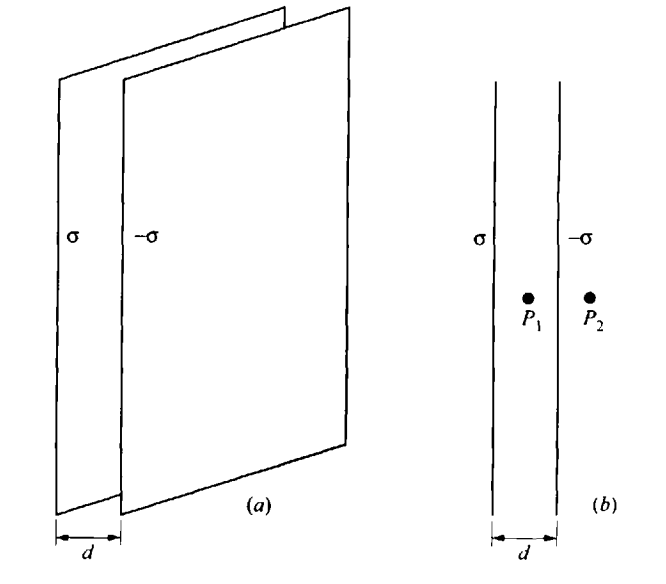
(4) The electric field produced by two oppositely charged parallel plates, where the distance between them is much smaller than the linear dimension of the charged area:

At point P1, both fields point toward the right, and the total field is therefore,

At point P2, the fields point in opposite directions, and the total field is therefore zero.

.

Religion: A Final Examination

Reference: The World’s Religions

[NOTE: In color are Vinaire’s comments.]

Things are more integrated than they seem, they are better than they seem, and they are more mysterious than they seem; something like this emerges as the highest common denominator of the wisdom traditions’ reports. The world at large, however, particularly the modern world, is not persuaded by this view of things; it cannot rise to the daringness of the claim.

The most obvious question that suggests itself at the close of this inquiry is: What have we gotten out of it? Has it done any good? 

What have we gotten out of it? Has it done any good? 

It would be surprising if we had not picked up some facts along the way: what the yogas are, Buddha’s analysis of the cause of life’s dislocation, Confucius’ ideal of the true gentleman, what the yin/yang symbol signifies, the literal meaning of “Islam,” what the Exodus means to the Jews, what was the “good news” that excited the early Christians, and so on. Such facts are not to be belittled; a well-stocked mind adds interest to the world that comes its way. But is this all? 

It would be surprising if we had not picked up some facts along the way. But is this all? 

New questions may have emerged from the reading, or old ones assumed new urgency. Three such questions suggest themselves, and their consideration will round off this study. First, how are we to gestalt or pattern the religions we have considered? Having listened to them individually, what do we now take to be their relationships to one another? Second, have they anything to say collectively to the world at large? Granted their variety, do they speak with a concerted voice on any important matters? Third, how should we comport ourselves in a world that is religiously pluralistic where it is religious at all? 

New questions may have emerged from the reading, or old ones assumed new urgency.

.

The Relation between Religions 

To the question of how to pattern these religions, three answers suggest themselves. The first holds that one of the world’s religions is superior to the others. Now that the peoples of the world are getting to know one another better, we hear this answer less often than weused to; but even so it should not be dismissed out of hand. The opening chapter of this book quoted Arnold Toynbee as saying that no one alive knows enough to say with confidence whether or not one religion is superior to the others—the question remains an open one. True, this book has found nothing that privileges one tradition above the others, but that could be due to the kind of book it is: It eschews comparisons in principle. Nothing in the comparative study of religions requires that they cross the finishing line of the reader’s regard in a dead heat. 

A religion may be superior to others in the reader’s regard.

A second position lies at the opposite end of the spectrum: It holds that the religions are all basically alike. Differences are acknowledged but, according to this second view, they are incidental in comparison to the great enduring truths on which the religions unite. 

This appeals to our longing for human togetherness, but on inspection it proves to be the trickiest position of the three. For as soon as it moves beyond vague generalities—“every religion has some version of the Golden Rule”; or, “Surely we all believe in some sort of something,” as a Member of Parliament once ventured following a bitter debate in the House of Commons over the Book of Common Prayer—it flounders on the fact that the religions differ in what they consider essential and what negotiable. Hinduism and Buddhism split over this issue, as did Judaism, Christianity, and Islam. In the nineteenth century Alexander Campbell tried to unite Protestants on grounds of their common acceptance of the Bible as the model for faith and organization. To his surprise he discovered that denominational leaders were not prepared to concede that the uniting principle he proposed was more important than their distinctive tenets; his movement ended by adding another denomination—the Disciples of Christ (Christian Church)—to the Protestant roster. On a world scale Baha’u’llah’s mission came to the same end. Baha’i, which originated in the hope of rallying the major religions around the beliefs they held in common, has settled into being another religion among many. 

We may consider that the religions are all basically alike; but, this view flounders on the fact that the religions differ in what they consider essential and what negotiable. 

Because this second position is powered by the hope that there may someday be a single world religion, it is well to remind ourselves again of the human element in the religious equation. There are people who want to have their own followers. They would prefer to head their own flock, however small, than be second-in-command in the largest congregation. This suggests that if we were to find ourselves with a single religion tomorrow, it is likely that there would be two the day after. 

There are people who want to have their own followers.

A third conception of the way the religions are related likens them to a stained glass window whose sections divide the light of the sun into different colors. This analogy allows for significant differences between the religions without pronouncing on their relative worth. If the peoples of the world differ from one another temperamentally, these differences could well affect the way Spirit appears to them; it could be seen from different angles, so to speak. Stated in the language of revelation, for God to be heard and understood divine revelations would have had to be couched in the idioms of its respective hearers. The Koran comes close to saying just this in Surah 14:4: “We never sent a messenger except with the language of his people, so that he might make (the message) clear for them.” 

Stated in the language of revelation, for God to be heard and understood divine revelations would have had to be couched in the idioms of its respective hearers. 

Having mentioned three obvious ways in which the world’s religions might be configured, we turn to what they might have to say collectively to the world at large.

.

The Wisdom Traditions 

The opening chapter of this book mentioned T. S. Eliot’s rhetorical questions: “Where is the knowledge that is lost in information? Where is the wisdom that is lost in knowledge?” And even earlier, in one of the book’s epigraphs, we encountered E. F. Schumacher’s assertion that “we need the courage to consult and profit from the ‘wisdom traditions of mankind.’” Those traditions have been the subject of this book. What wisdom do they offer the world?

What wisdom do these traditions offer the world?

In traditional times it was assumed that they disclosed the ultimate nature of reality. In the sixteenth and seventeenth centuries science began to cast doubt on that assumption; for Scriptures only assert their truths, whereas controlled experiments can prove scientific hypotheses. After three centuries of confusion on this point, however, we now see that such proofs hold only for the empirical world. The worthful aspects of reality—its values, meaning, and purpose—slip through the devices of science in the way that the sea slips through the nets of fishermen. 

The worthful aspects of reality—its values, meaning, and purpose—slip through the devices of science in the way that the sea slips through the nets of fishermen. 

Where then can we turn for counsel concerning things that matter most? Our realization that science cannot help us reopens the door to looking seriously again at what the wisdom traditions propose. Not all of their contents are enduringly wise. Modern science has superseded their cosmologies, and the social mores of their day, which they reflect—gender relations, class structures, and the like—must be reassessed in the light of changing times and the continuing struggle for justice. But if we pass a strainer through the world’s religions to lift out their conclusions about reality and how life should be lived, those conclusions begin to look like the winnowed wisdom of the human race. 

But if we pass a strainer through the world’s religions to lift out their conclusions about reality and how life should be lived, those conclusions begin to look like the winnowed wisdom of the human race. 

What are the specifics of that wisdom? In the realm of ethics the Decalogue pretty much tells the cross-cultural story. We should avoid murder, thieving, lying, and adultery. These are minimum guidelines (the chapter on Judaism expands them slightly) but they are not nothing, as we realize if we reflect on how much better the world would be if they were universally honored. 

The minimum guidelines are: we should avoid murder, thieving, lying, and adultery. 

Proceeding from this ethical base to the kind of people we should strive to become, we encounter the virtues, which the wisdom traditions identify as basically three: humility, charity, and veracity. Humility is not self-abasement. It is the capacity to regard oneself in the company of others as one, but not more than one. Charity shifts that shoe to the other foot; it is to regard one’s neighbor as likewise one, as fully one as oneself. As for veracity, it extends beyond the minimum of truth-telling to sublime objectivity, the capacity to see things exactly as they are. To conform one’s life to the way things are is to live authentically. 

The wisdom traditions identify the virtues as basically three: humility, charity, and veracity. 

The Asian religions extol these same three virtues, while emphasizing the obstacles that must be overcome in acquiring them. The Buddha identified these obstacles as greed, hatred, and delusion, and called them the “three poisons.” To the degree that they are eliminated, selflessness (humility), compassion (charity), and seeing things in their Suchness (veracity) replace them. Though the word virtue now carries a heavy moralistic ring, the wisdom traditions emphasize the root meaning of the word, which inclines toward power; philosophical Taoism has remained particularly alert to this original meaning. We catch echoes of the power component of “virtue” when people speak, as they still occasionally do, of “the virtue of a drug.” 

The obstacles that must be overcome in acquiring these virtues are: greed, hatred, and delusion.

When we turn to vision, the wisdom traditions’ rendering of the ultimate character of things, three points must here suffice.

The religions begin by assuring us that if we could see the full picture we would find it more integrated than we normally suppose. Life gives us no view of the whole. We see only snatches here and there, and self-interest skews our perspective grotesquely. Things that are close to us assume exaggerated importance, while the rest we view with cold dispassion. It is as if life were a great tapestry, which we face from its wrong side. This gives it the appearance of a maze of knots and threads, which for the most part appear chaotic. 

If we could see the full picture we would find it more integrated than we normally suppose.

From a purely human standpoint the wisdom traditions are the species’ most prolonged and serious attempts to infer from the maze on this side of the tapestry the pattern which, on its right side, gives meaning to the whole. As the beauty and harmony of the design derive from the way its parts are related, the design confers on those parts a significance that we, seeing only scraps of the design, do not normally perceive. We could almost say that this belonging to the whole, in something of the way the parts of a painting suggest, is what religion (religio, rebinding) is all about; the theme of at-one-ment laces its every expression. Buddhists bring their palms together to symbolize the overcoming of duality, and Advaitic Vedantins deny duality altogether. 

As the beauty and harmony of the design derive from the way its parts are related, the design confers on those parts a significance that we, seeing only scraps of the design, do not normally perceive. 

The second claim the wisdom traditions make about reality is implied by the first. If things are pervaded by a grand design, they are not only more integrated than they seem; they are also better than they seem. Having used art (via a tapestry) to symbolize the world’s unity, we shall invoke astrophysics to allegorize this second point, reality’s worth; for if the upshot of astronomy is its verdict that the universe is bigger than human senses disclose, the conclusion of the wisdom traditions is that it is better than our sensibilities discern. And better to comparable degree, which means that we are talking about the value equivalent of lightyears here. T’ien and the Tao, Brahman and nirvana, God and Allah all carry the signature of ens perfectissium—perfect being. This causes the wisdom traditions to flame with an ontological exuberance that is nowhere else to be found. This exuberance is reflected in their estimates of the human self, for in the way that the world’s unity implies that selves belong to the world, its worth implies that they share in the world’s exalted stature. The sheer immensity of the human self as envisioned by the world’s religions is awesome. Atman and the Buddha-nature come immediately to mind, and we remember the rabbis’ angels who precede human beings crying, “Make way for the image of God.” Saint Paul reports that “beholding the glory of the Lord [changes us] from one degree of glory to another” (2 Corinthians 3:18). 

If things are pervaded by a grand design, they are not only more integrated than they seem; they are also better than they seem. 

Beyond the unity of things and their inestimable worth is the wisdom traditions’ third report. Reality is steeped in ineluctable mystery; we are born in mystery, we live in mystery, and we die in mystery. Here again we must rescue our world from time’s debasement, for “mystery” has come to be associated with murder mysteries, which because they are solvable are not mysteries at all. A mystery is that special kind of problem which for the human mind has no solution; the more we understand it, the more we become aware of additional factors relating to it that we do not understand. In mysteries what we know, and our realization of what we do not know, proceed together; the larger the island of knowledge, the longer the shoreline of wonder. It is like the quantum world, where the more we understand its formalism, the stranger that world becomes. 

A mystery is that special kind of problem which for the human mind has no solution; the more we understand it, the more we become aware of additional factors relating to it that we do not understand.

Things are more integrated than they seem, they are better than they seem, and they are more mysterious than they seem; something like this emerges as the highest common denominator of the wisdom traditions’ reports. When we add to this the baseline they establish for ethical behavior and their account of the human virtues, one wonders if a wiser platform for life has been conceived. At the center of the religious life is a particular kind of joy, the prospect of a happy ending that blossoms from necessarily painful beginnings, the promise of human difficulties embraced and overcome. We have only hints of this joy in our daily life. When it arrives we do not know whether our happiness is the rarest or the commonest thing on earth; for in all earthly things we find it, give it, and receive it, but cannot hold onto it. When those intimations are ours it seems in no way strange to be so happy, but in retrospect we wonder how such gold of Eden could have been ours. The human opportunity, the religions tell us, is to transform our flashes of insight into abiding light. 

Things are more integrated than they seem, they are better than they seem, and they are more mysterious than they seem; something like this emerges as the highest common denominator of the wisdom traditions’ reports. 

The world at large, however, particularly the modern world, is not persuaded by this view of things; it cannot rise to the daringness of the claim. So what do we do? This is our final question. Whether religion is, for us, a good word or bad; whether (if on balance it is a good word) we side with a single religious tradition or to some degree open our arms to all: How do we comport ourselves in a pluralistic world that is riven by ideologies, some sacred, some profane? 

The world at large, however, particularly the modern world, is not persuaded by this view of things; it cannot rise to the daringness of the claim. 

We listen.

.

Listening 

If one of the wisdom traditions claims us, we begin by listening to it. Not uncritically, for new occasions teach new duties and everything finite is flawed in some respects. Still, we listen to it expectantly, knowing that it houses more truth than can be encompassed in a single lifetime. 

If one of the wisdom traditions claims us, we begin by listening to it expectantly.

But we also listen to the faith of others, including the secularists. We listen first because, as this book opened by noting, our times require it. The community today can be no single tradition; it is the planet. Daily the world grows smaller, leaving understanding the only place where peace can a find a home. We are not prepared for the annihilation of distance that science has effected. Who today stands ready to accept the solemn equality of peoples? Who does not have to fight an unconscious tendency to equate foreign with inferior? Some of us have survived this bloodiest of centuries; but if its ordeals are to be birth pangs rather than death throes, the century’s scientific advances must be matched by comparable advances in human relations. Those who listen work for peace, a peace built not on ecclesiastical or political hegemonies but on understanding and mutual concern. For understanding, at least in realms as inherently noble as the great faiths of humankind, brings respect; and respect prepares the way for a higher power, love—the only power that can quench the flames of fear, suspicion, and prejudice, and provide the means by which the people of this small but precious Earth can become one to one another. 

But we also listen to the faith of others, including the secularists because our times require it. The community today can be no single tradition; it is the planet.

Understanding, then, can lead to love. But the reverse is also true. Love brings understanding; the two are reciprocal. So we must listen to understand, but we must also listen to put into play the compassion that the wisdom traditions all enjoin, for it is impossible to love another without hearing that other. If we are to be true to these religions, we must attend to others as deeply and as alertly as we hope that they will attend to us; Thomas Merton made this point by saying that God speaks to us in three places: in scripture, in our deepest selves, and in the voice of the stranger. We must have the graciousness to receive as well as to give, for there is no greater way to depersonalize another than to speak without also listening. 

So we must listen to understand, but we must also listen to put into play the compassion that the wisdom traditions all enjoin, for it is impossible to love another without hearing that other.

Said Jesus, blessed be his name, “Do unto others as you would they should do unto you.” Said Buddha, blessed be his name as well, “He who would, may reach the utmost height—but he must be eager to learn.” If we do not quote the other religions on these points, it is because their words would be redundant.

Said Jesus, blessed be his name, “Do unto others as you would they should do unto you.” Said Buddha, blessed be his name as well, “He who would, may reach the utmost height—but he must be eager to learn.”

.

Religion: Point of Departure

Reference: The World’s Religions

Note: The original Text is provided below.

If we lay aside our preconceptions about these religions, seeing each as forged by people who were struggling to see something that would give help and meaning to their lives; and if we then try without prejudice to see ourselves what they saw—if we do these things, the veil that separates us from them can turn to gauze. 

.

Summary

.

Comments

.

Original Text

Although the individuals that I name are now only memories for me, I begin this second edition of this book with the four paragraphs that launched its first edition. 

I write these opening lines on a day widely celebrated throughout Christendom as World-Wide Communion Sunday. The sermon in the service I attended this morning dwelt on Christianity as a world phenomenon. From mud huts in Africa to the Canadian tundra, Christians are kneeling today to receive the elements of the Holy Eucharist. It is an impressive picture. 

Still, as I listened with half my mind, the other half wandered to the wider company of God-seekers. I thought of the Yemenite Jews I watched six months ago in their synagogue in Jerusalem: dark-skinned men sitting shoeless and cross-legged on the floor, wrapped in the prayer shawls their ancestors wore in the desert. They are there today, at least a quorum of ten, morning and evening, swaying backwards and forwards like camel riders as they recite their Torah, following a form they inherit unconsciously from the centuries when their fathers were forbidden to ride the desert horse and developed this pretense in compensation. Yalcin, the Muslim architect who guided me through the Blue Mosque in Istanbul, has completed his month’s Ramadan fast, which was beginning while we were together; but he too is praying today, five times as he prostrates himself toward Mecca. Swami Ramakrishna, in his tiny house by the Ganges at the foot of the Himalayas, will not speak today. He will continue the devotional silence that, with the exception of three days each year, he has kept for five years. By this hour U Nu is probably facing the delegations, crises, and cabinet meetings that are the lot of a prime minister, but from four to six this morning, before the world broke over him, he too was alone with the eternal in the privacy of the Buddhist shrine that adjoins his home in Rangoon. Dai Jo and Lai San, Zen monks in Kyoto, were ahead of him by an hour. They have been up since three this morning, and until eleven tonight will spend most of the day sitting immovable in the lotus position as they seek with intense absorption to plumb the Buddha-nature that lies at the center of their being. 

What a strange fellowship this is, the God-seekers in every land, lifting their voices in the most disparate ways imaginable to the God of all life. How does it sound from above? Like bedlam, or do the strains blend in strange, ethereal harmony? Does one faith carry the lead, or do the parts share in counterpoint and antiphony where not in full-throated chorus? 

We cannot know. All we can do is try to listen carefully and with full attention to each voice in turn as it addresses the divine. 

Such listening defines the purpose of this book. It may be wondered if the purpose is not too broad. The religions we propose to consider belt the world. Their histories stretch back thousands of years, and they are motivating more people today than ever before. Is it possible to listen seriously to them within the compass of a single book? 

The answer is that it is, because we shall be listening for well-defined themes. These must be listed at the outset or the pictures that emerge from these pages will be distorted. 

1. This is not a textbook in the history of religions. This explains the scarcity of names, dates, and social influences in what follows. There are useful books that focus on such material. This one too could have been swollen with their facts and figures, but it is not its intent to do their job in addition to its own. Historical facts are limited here to the minimum that is needed to locate in space and time the ideas the book focuses on. Every attempt has been made to keep scholarship out of sight—in foundations that must be sturdy, but not as scaffolding that would obscure the structures being examined. 

2. Even in the realm of meanings the book does not attempt to give a rounded view of the religions considered, for each hosts differences that are too numerous to be delineated in a single chapter. One need only think of Christendom. Eastern Orthodox Christians worship in ornate cathedrals, while Quakers consider even steeples desecrations. There are Christian mystics and Christians who reject mysticism. There are Christian Jehovah’s Witnesses and Christian Unitarians. How is it possible to say in a manageable chapter what Christianity means to all Christians? 

The answer, of course, is that it is not possible—selection is unavoidable. The question facing an author is not whether to select among points of view; the questions are how many to present, and which ones. In this book the first question is answered economically; I try to do reasonable justice to several perspectives instead of attempting to catalogue them all. In the case of Islam, this has meant ignoring Sunni/Shi’ite and traditional/modernist divisions, while noting different attitudes toward Sufism. In Buddhism I distinguish its Hinayana, Mahayana, and Vajrayana traditions, but the major schools within Mahayana are bypassed. The subdivisions never exceed three lest trees obscure the woods. Put the matter this way: If you were trying to describe Christianity to an intelligent and interested but busy Thailander, how many denominations would you include? It would be difficult to ignore the differences between Roman Catholic, Greek Orthodox, and Protestant, but you would probably not get into what separates Baptists from Presbyterians. 

When we turn to which views to present, the guideline has been relevance to the interests of the intended reader. Three considerations have figured in determining this relevance. First, there is the simple matter of numbers. There are some faiths that every citizen should be acquainted with, simply because hundreds of millions of people live by them. The second consideration has been relevance to the modern mind. Because the ultimate benefit that may accrue from a book such as this is help in the ordering of the reader’s own life, I have given priority to what (with caution yet a certain confidence) we may regard as these religions’ contemporary expressions. The third consideration is universality. Every religion mixes universal principles with local peculiarities. The former, when lifted out and made clear, speak to what is generically human in us all. The latter, rich compounds of rites and legends, are not easy for outsiders to comprehend. It is one of the illusions of rationalism that the universal principles of religion are more important than the rites and rituals that feed them; to make that claim is like contending that the branches and leaves of a tree are more important than the roots from which they grow. But for this book, principles are more important than contexts, if for no other reason than that they are what the author has spent his years working with. 

I have read books that have brought contexts themselves to life: Heather Wood’s Third Class Ticket for India, Lin Yu-tang’s My Country and My People for China, and Shalom Rabinowitz’s The Old Country for Eastern European Jews. Perhaps someday someone will write a book about the great religions that roots them to their social settings. This, though, is a book I shall read, not write. I know my limitations and attend to areas from which ideas can be extracted. 

3. This book is not a balanced account of its subject. The warning is important. I wince to think of the shock if the reader were to close the chapter on Hinduism and step directly into the Hinduism described by Nehru as “a religion that enslaves you”: its Kali Temple in Calcutta, the curse of her caste system, her two million cows revered to the point of nuisance, her fakirs offering their bodies as sacrifice to bedbugs. Or what if the reader were transported to Bali, with its theaters named the Vishnu-Hollywood and its bookstores that do brisk business in Klasik Comics, in which Hindu gods and goddesses mow down hosts of unsightly demons with cosmic ray guns? I know the contrast. I sense it sharply between what I have written of Taoism and the Taoism that surrounded me as a boy in China: its almost complete submergence in augury, necromancy, and superstition. It is like the contrast between the Silent Christ and the Grand Inquisitor, or between the stillness of Bethlehem and department stores blaring “Silent Night” to promote Christmas shopping. The full story of religion is not rose-colored; often it is crude. Wisdom and charity are intermittent, and the net result is profoundly ambiguous. A balanced view of religion would include human sacrifice and scapegoating, fanaticism and persecution, the Christian Crusades and the holy wars of Islam. It would include witch hunts in Massachusetts, monkey trials in Tennessee, and snake worship in the Ozarks. The list would have no end. 

Why then are these things not included in the pages that follow? My answer is so simple that it may sound ingenuous. This is a book about values. Probably as much bad music as good has been composed in the course of human history, but we do not expect courses in music appreciation to give it equal attention. Time being at a premium, we assume that they will attend to the best. I have adopted a similar strategy with respect to religion. A recent book on legal science carries the author’s confession that he has written lovingly of the law. If something as impersonal as the law can enamor one author, it should come as no surprise that religion—again at its best—has enamored another. Others will be interested in trying to determine if religion in its entirety has been a blessing or a curse. That has not been my concern. 

Having said what my concern is—the world’s religions at their best—let me say what I take that best to be, beginning with what it is not. Lincoln Steffens has a fable of a man who climbed to the top of a mountain and, standing on tiptoe, seized hold of the Truth. Satan, suspecting mischief from this upstart, had directed one of his underlings to tail him; but when the demon reported with alarm the man’s success—that he had seized hold of the Truth—Satan was unperturbed. “Don’t worry,” he yawned. “I’ll tempt him to institutionalize it.” 

That story helps to separate the best from the ambiguous in religion. The empowering theological and metaphysical truths of the world’s religions are, this book is prepared to argue, inspired. Institutions—religious institutions emphatically included—are another story. Constituted as they are of people with their inbuilt frailties, institutions are built of vices as well as virtues. When the vices—in-group versus out-group loyalties, for example—get compounded by numbers, the results can be horrifying to the point of suggesting (as some wag has) that the biggest mistake religion ever made was to get mixed up with people. Actually, this is not true, however, for to hold aloof from people would have resulted in leaving no mark on history. Given the choice—to remain aloof as disembodied insights or to establish traction in history by institutionalizing those insights—religion chose the wiser course. 

This book honors that choice without following its story—I have already said that it is not a book about religious history. It adopts what in ways is the easier course of skimming off the cream of that history: the truths that religious institutions preserve, and which in turn empower those institutions. When religions are sifted for those truths, a different, cleaner side appears. They become the world’s wisdom traditions. (“Where is the knowledge that is lost in information? Where is the wisdom that is lost in knowledge?”—T. S. Eliot.) They begin to look like data banks that house the winnowed wisdom of the human race. As this book concentrates on those wisdom deposits, it could have been titled alternatively “The World’s Great Wisdom Traditions.” 

4. Finally, this is not a book on comparative religions in the sense of seeking to compare their worth. Comparisons always tend to be odious, those among religions the most odious of all. So there is no assumption here that one religion is, or for that matter is not, superior to others. “There is no one alive today,” Arnold Toynbee observed, “who knows enough to say with confidence whether one religion has been greater than all others.” I have tried to let the best in each faith shine through by presenting it in the way I have found its most impressive adherents envisioning it. Readers may press on with comparisons if they wish to do so. 

In saying what this book is not, I have already started to say what it is, but let me be explicit. 

1. It is a book that seeks to embrace the world. In one sense, of course, that wish must fail. Even when stretched to the maximum, a single pair of arms falls short, and feet must be planted somewhere. To begin with the obvious, the book is written in English, which to some extent anchors it from the start. Next come cross-references, introduced to ease entry onto foreign turf. There are proverbs from China, tales from India, paradoxes from Japan, but most of the illustrations are Western: a line from Shakespeare, a verse from the Bible, a suggestion from psychoanalysis—Eliot and Toynbee have already been quoted. Beyond idiom, however, the book is incorrigibly Western in being targeted for the contemporary Western mind. That being the author’s mind, he had no choice in the matter; but it must be accepted with the recognition that the book would have been different had it been written by a Zen Buddhist, a Muslim Sufi, or a Polish Jew. 

This book, then, has a home—a home whose doors swing freely in and out, a base from which to journey forth and return, only to hit the road again in study and imaginings when not in actual travel. If it is possible to be homesick for the world, even places one has never been and suspects one will never go, this book is born of such homesickness. 

We live in a fantastic century. I brush aside the incredible discoveries of science, and the razor’s edge between doom and fulfillment onto which they have pushed us, to speak of the new situation among peoples. Lands across the planet have become our neighbors, China across the street, the Middle East at our back door. Young people with backpacks are everywhere, and those who remain at home are treated to an endless parade of books, documentaries, and visitors from abroad. We hear that East and West are meeting, but it is an understatement. They are being flung at one another, hurled with the force of atoms, the speed of jets, the restlessness of minds impatient to learn the ways of others. When historians look back on our century, they may remember it most, not for space travel or the release of nuclear energy, but as the time when the peoples of the world first came to take one another seriously. 

The change that this new situation requires of us all—we who have been suddenly catapulted from town and country onto a world stage—is staggering. Twenty-five hundred years ago it took an exceptional man like Diogenes to exclaim, “I am not an Athenian or a Greek but a citizen of the world.” Today we must all be struggling to make those words our own. We have come to the point in history when anyone who is only Japanese or American, only Oriental or Occidental, is only half human. The other half that beats with the pulse of all humanity has yet to be born. 

To borrow an image from Nietzsche, we have all been summoned to become Cosmic Dancers who do not rest heavily on a single spot but lightly turn and leap from one position to another. As World Citizen, the Cosmic Dancer will be an authentic child of its parent culture, while closely related to all. The dancer’s roots in family and community will be deep, but in those depths they will strike the water table of a common humanity. For is the dancer not also human? If only she might see what has interested others, might it not interest her as well? It is an exciting prospect. The softening of divisions will induce borrowings that sometimes produce hybrids, but for the most part simply enrich species and sustain their vigor. 

The motives that impel us toward world understanding are varied. I was once taxied by bomber to an air force base to lecture to officers on other peoples’ faiths. Why? Obviously, because those officers might some day have to deal with those peoples as allies or antagonists. This is one reason for coming to know them. It may be a necessary reason, but one hopes that there are others. Even the goal of avoiding military engagement through diplomacy is provisional because instrumental. The final reason for understanding another is intrinsic—to enjoy the wider angle the vision affords. 

I am, of course, speaking metaphorically of vision and view, but an analogue from ocular sight fits perfectly. Without two eyes—binocular vision—there is no awareness of space’s third dimension. Until sight converges from more than one angle, the world looks as flat as a postcard. The rewards of having two eyes are practical; they keep us from bumping into chairs and enable us to judge the speed of approaching cars. But the final reward is the deepened view of the world itself—the panoramas that unroll before us, the vistas that extend from our feet. It is the same with “the eye of the soul,” as Plato called it. “What do they know of England, who only England know?” 

I have acknowledged that the practical gains that come from being able to look at the world through others’ eyes are major. They enable corporations to do business with China, and diplomats to stumble less often. But the greatest gains need no tally. To glimpse what belonging means to the Japanese; to sense with a Burmese grandmother what passes in life and what endures; to understand how Hindus can regard their personalities as masks that overlay the Infinite within; to crack the paradox of a Zen monk who assures you that everything is holy but scrupulously refrains from certain acts—to swing such things into view is to add dimensions to the glance of spirit. It is to have another world to live in. The only thing that is good without qualification is not (as Kant argued) the good will, for a will can mean well in cramped quarters. The only thing that is unqualifiedly good is extended vision, the enlargement of one’s understanding of the ultimate nature of things. 

These thoughts about world understanding lead directly to the world’s religions, for the surest way to the heart of a people is through its faith, if that faith has not fossilized. Which distinction—between religion alive and dead—brings us to the second constructive intent of this book. 

2. It is a book that takes religion seriously. It is not a tourist guide. There will be no pandering to curiosity seekers, no riffling through peoples’ faiths to light on what has shock value; no ascetics on beds of nails, no crucifixions among Penitentes in Mexico, no Parsi Towers of Silence that expose the dead for vultures’ consumption, no erotic sculpture or excursions into Tantric sex. The great religions house such material, but to focus on it is the crudest kind of vulgarization. 

There are subtler ways to belittle religion. One of these is to acknowledge its importance, but for other people—people of the past, people of other cultures, people whose ego strength needs bolstering. This, too, will not be our approach. Our parts of speech will be in the third person. We shall be talking about Hindus, Buddhists, Confucianists, Muslims—it will be “they” and “them” all the way. But behind these fronts our deepest concern is for ourselves. The chief reason I find myself returning to the world’s great wisdom traditions is for help on issues I have not myself been able to circumvent. Given the essential similarity in human nature—we are all more human than otherwise—I assume that the issues engage the readers of this book as well. 

Even the subtlest way to patronize religion will be avoided, the way that honors it not for itself but for its yields—its contributions to art, or to peace of mind, or to group cohesion. This is a book about religion that exists, in William James’s contrast, not as a dull habit but as an acute fever. It is about religion alive. And when religion jumps to life it displays a startling quality. It takes over. All else, while not silenced, becomes subdued and thrown into a supporting role. 

Religion alive confronts the individual with the most momentous option life can present. It calls the soul to the highest adventure it can undertake, a proposed journey across the jungles, peaks, and deserts of the human spirit. The call is to confront reality, to master the self. Those who dare to hear and follow that secret call soon learn the dangers and difficulties of its lonely journey.

A sharpened edge of a razor, hard to traverse,
A difficult path is this—the poets declare!

Science makes major contributions to minor needs, Justice Holmes was fond of saying, adding that religion, however small its successes, is at least at work on the things that matter most. When, then, a lone spirit succeeds in breaking through to major conquests here, it becomes more than a king or queen. It becomes a world redeemer. Its impact stretches for millennia, blessing the tangled course of history for centuries. “Who are…the greatest benefactors of the living generation of mankind?” Toynbee asked. “I should say: ‘Confucius and Laotze, the Buddha, the Prophets of Israel and Judah, Zoroaster, Jesus, Mohammed and Socrates.’”

His answer should not surprise, for authentic religion is the clearest opening through which the inexhaustible energies of the cosmos enter human life. What then can rival its power to inspire life’s deepest creative centers? Moving outward from there through myth and rite, it provides the symbols that carry history forward, until at length its power is spent and life awaits a new redemption. This recurrent pattern leads even the impish, like George Bernard Shaw, to conclude that religion is the only real motive force in the world. (Alfred North Whitehead added science, which raises the number to two.) It is religion as empowering that will be our object in the chapters ahead. 

3. Finally, this book makes a real effort to communicate. I think of it as a work of translation, one that tries not only to penetrate the worlds of the Hindus, Buddhists, and Muslims, but to throw bridges from those worlds to the reader’s world. The study of religion can be as technical and academic as any, but I have tried not to lose sight of the relevance this material has for the problems that human beings face today. “If you cannot—in the long run—tell everyone what you have been doing,” wrote a great scientist who was also a superb communicator, “your doing has been worthless.”

This interest in communication leads back to the book’s stance toward historical scholarship that was touched on earlier. 

As far as I am aware there is nothing in these pages contrary to the facts of historical evidence, but beyond the avoidance of outright inaccuracy, the issue is less simple. I have deleted enormously, simplifying where historical details seemed to be slowing the pace and obscuring the essential. Occasionally, I have supplied corollaries that seemed to be implied, and I have introduced examples that appear to be in keeping with the theme but are not in the texts themselves. These liberties may lead some to feel that the book “sits loose to the facts,” but historical accuracy is not the basic issue. Religion is not primarily a matter of facts; it is a matter of meanings. An analogy from biochemistry is helpful here. “Despite a knowledge of the structure of protein molecules down to the very placement of their atoms in exact three-dimensional space, we do not have the faintest idea of what the rules are for folding them up into their natural form.” The religious analogue to the biochemist’s atoms are the facts that history, sociology, anthropology, and textual studies marshal about religion. These could be as complete as the biochemists’ knowledge of the atomic structure of protein molecules; by themselves they are as lifeless. Implicitly, not explicitly, I have tried in these chapters to apply the “rules” that “fold” religious facts “into their natural form.” I have tried to make them live religiously. 

We are about to begin a voyage in space and time and eternity. The places will often be distant, the times remote, the themes beyond space and time altogether. We shall have to use words that are foreign—Sanskrit, Chinese, and Arabic. We shall try to describe states of consciousness that words can only hint at. We shall use logic to try to corner insights that laugh at our attempt. And ultimately, we shall fail; being ourselves of a different cast of mind, we shall never quite understand the religions that are not our own. But if we take those religions seriously, we need not fail miserably. And to take them seriously we need do only two things. First, we need to see their adherents as men and women who faced problems much like our own. And second, we must rid our minds of all preconceptions that could dull our sensitivity or alertness to fresh insights. If we lay aside our preconceptions about these religions, seeing each as forged by people who were struggling to see something that would give help and meaning to their lives; and if we then try without prejudice to see ourselves what they saw—if we do these things, the veil that separates us from them can turn to gauze. 

A great anatomist used to close his opening lecture to beginning medical students with words that apply equally to our own undertaking. “In this course,” he would say, “we shall be dealing with flesh and bones and cells and sinews, and there are going to be times when it’s all going to seem terribly cold-blooded. But never forget. It’s alive!”

.

PRIMAL RELIGIONS: Conclusion

Reference:The Primal Religions

[NOTE: In color are Vinaire’s comments.]

Primal peoples are not primitive and uncivilized, much less savage. They are not backward; they are different. They are not impaired; they are apart.

As between the primal and the historical religions, time seems to be on the side of the latter, for though millions would now like to see the primal way of life continue, it seems unlikely that it will do so. “Civilization” is seductive where not imperious, and we cannot quarantine the primal peoples who remain, preserving them for anthropologists to study and the rest of us to romanticize as symbols of our lost paradise. How industrial peoples will comport themselves toward the primal in what seems to be the short time they have left on this planet will be the final topic of this chapter. 

The primal culture has only a short time left on this planet.

The historical religions have largely abandoned their earlier missionary designs on “the heathen,” as they were once disparagingly referred to. If anything, the pendulum has swung in the opposite direction, toward romanticizing the primal. Dismayed by the relentless utilitarianism of technological society and its seeming inability to contain its power to destroy both people and planet, citifiedpeoples have come to hope that a fundamentally different way of life is possible, and they latch onto primal peoples to support that hope. Guilt enters the picture too, as the descendants of those who had power face up to the ways their forbears looked down on, despoiled, and destroyed those who lacked it. Whether things could have gone differently, given what the conquerors then understood and the seemingly irresistible disposition of those who possess power to abuse it, we shall never know. What we do know, and it is at least to our credit that we now confess it, is that there was holocaust on a global scale. 

It is to our credit that we now confess that there was holocaust on a global scale

On the positive side we can note that we now recognize that we were mistaken in our assessment of these people. Primal peoples are not primitive and uncivilized, much less savage. They are not backward; they are different. They are not impaired; they are apart. With this realization in place and disparagement of the primal behind us, we return for a moment to our current propensity to romanticize these people, for there is an aspect of that impulse that is not widely understood. 

Primal peoples are not primitive and uncivilized, much less savage. They are not backward; they are different. They are not impaired; they are apart.

Disenchantment with the complexities and mistakes of industrial life, the scission between human beings and nature it has effected, and the bitter fruits that that scission has borne, have (as we were saying) produced by way of reaction the image of tribal peoples as wholly natural. We regard them as sons and daughters of the earth and sky, brothers and sisters of animals and plants, who live by nature’s ways and do not upset the delicate balances of their ecological zones; gentle hunting folk who are still in touch with the magic and myth that we ourselves so badly need. Seeing them thus, we assume that our ancestors resembled them in these respects and we celebrate them as our heroes. There is a deep, unconscious reason for this bent of thought. Every people, ourselves not excepted, needs to think well of its origins; it is part of having a healthy self-image. So modern peoples, who are no longer confident that God created them, transfer some of God’s nobility to the source from which they assume that they did derive, namely early humankind. This is the deepest impulse behind “the myth of the noble savage” that the eighteenth century invented. 

Seeing them thus, we assume that our ancestors resembled them in these respects and we celebrate them as our heroes.

What may be hoped is that we are now ready to put both prejudice and idealization behind us. If we are, perhaps we can live out our numbered years of planetary partnership in mutual respect, guided by the dream of one primal spokesman that “we may be brothers after all.” If we succeed in doing this, there is still time for us to learn some things from them. For, tabling shortcomings that are not the issue here, it is not romantic to affirm what John Collier, one time United States Commissioner of Indian Affairs, said of his charges:

They had what the world has lost: the ancient, lost reverence and passion for human personality joined with the ancient, lost reverence and passion for the earth and its web of life. Since before the Stone Age they have tended that passion as a central, sacred fire. It should be our long hope to renew it in us all.

What may be hoped is that we are now ready to put both prejudice and idealization behind us.

.

PRIMAL RELIGIONS: The Symbolic Mind

Reference:The Primal Religions

[NOTE: In color are Vinaire’s comments.]

Tribal wisdom: The circles in spider webs are sticky, whereas its radii are not. This means, “If you wander from side to side in life you get stuck, but if you move toward its center you don’t.” 

A summary of the primal world as thus far sketched shows its internal divisions to be provisional and there to be no transcendent reality that relativizes it. All of this, however, would amount to a string of zeros without a digit to confer value on them were we not to introduce the divine source from which the world is believed to issue, or in other versions, divine arrangers who bring order out of chaos. The presence of these divinities raises the question of theism in the primal traditions, and it must be considered carefully, for the issue is a subtle one. 

Is theism present in any form in primary traditions?

A common stereotype pegs primal religions as polytheistic, and this is not altogether wrong if the word tokens that the divine can congeal in hallowed places and alight on specific objects. But this has nothing to do with the flat, Olympian, and Mediterranean polytheism generally that the Bible had to contend with; nor does it militate against a single Ultimate of which the many gods are instantiations or expressions. Wilhelm Schmidt’s twelve-volume Ursprung der Gottesidee, concluded that every then-known tribe—the work was published between 1912 and 1955—had its High God who lives and works through its deputies. The Yoruba of West Africa, for example, never rank their Supreme Being, Olodimave, with lesser divinities (orisa), nor do the Edo confuse Osanobuwa with the ebo. Even if Schmidt overstates the case, however, this scarcely matters; for the issue is not whether tribal peoples explicitly identify a Supreme Being who coordinates the gods but instead, whether they sense such a being whether they name and personify it or not. The evidence suggests that they do. As the Navajo artist Carl Gorman points out: “Some researchers into Navajo religion say that we have no supreme God because he is not named. This is not so. The Supreme Being is not named because he is unknowable. He is simply the Unknown Power. We worship him through his creation for he is everything in his creation. The various forms of creation have some of his spirit within them.” One can call this pan-or poly-monotheism if one wishes. The fact remains that though primal religions affirm the divine Unity less exclusively, and in some cases seem even to veil it, they contain nothing that is strictly comparable to the anthropomorphic polytheism of the early Europeans. It is just that the holy, the sacred, the wakan as the Sioux call it, need not be exclusively attached, or consciously attached at all, to a distinguishable Supreme Being. 

The evidence suggests that the tribal people do sense a Supreme Being. The Supreme Being is not named because it is simply the Unknown Power.

Something may even be lost by so attaching it, that loss being the removal of holiness from things that are other than the God that is factored out. This brings us to what is probably the most important single feature of living primal spirituality; namely, what has been called its symbolist mentality. The symbolist vision sees the things of the world as transparent to their divine source. Whether that source is specified or not, the world’s objects are open to its light. Physical sight presents the water in a lake in existential isolation, for as far as the eye reports, the body of water exists as a reality in its own right. From there modern thought may go on to reason that the water is composed of oxygen and hydrogen, and if a spiritual gloss is desired it may attribute to the water allegorical significance. Normally, however, modernity recognizes no ontological connection between material things and their metaphysical, spiritual roots. In this respect primal peoples are better metaphysicians, though their metaphysics, where articulated—we have seen that it need not be—is naturally of mythic cast. When ethnologists declared that for the Algonquins “there is no manitu [spirit] outside the world of appearances,” this simply meant that they were unaware that for the primal mind appearances never exist entirely on their own. As the friend of Black Elk whom we have already mentioned puts the point:

It is often difficult for those who look on the tradition of the Red Man from the outside or through the “educated” mind to understand that no object is what it appears to be, but it is simply the pale shadow of a Reality. It is for this reason that every created object is wakan, holy, and has a power according to the loftiness of the spiritual reality that it reflects. The Indian humbles himself before the whole of creation because all visible things were created before him and, being older than he, deserve respect.

Every object is holy, and has a power according to the loftiness of the spiritual reality that it reflects. The Indian humbles himself before the whole of creation because all visible things were created before him and, being older than he, deserve respect.

A student of the Musicas in the high Andes of Columbia confirms this point: “All primordial men saw the ‘more’ in the ‘less,’ in the sense that the landscape was for them a reflection of a superior reality which ‘contained’ the physical reality; they added, may one say, to the latter, a ‘spiritual dimension’ which escapes modern man.” 

There is a superior reality which contains the physical reality.

Paul Radin, who was mentioned earlier, was as impatient as any anthropologist with the “erroneous impression” that primal people are mystics across the board. He insisted that we find among them, as among us, “two general types of temperament: the man of action and the thinker, the type which lives fairly exclusively on what might be called a motor level and the type that demands explanations and derives pleasure from some form of speculative thinking.” Yet he would “not for a moment,” he said, “deny that mysticism and symbolism are more frequently utilized among them than among Western Europeans today…. Only when we have fully grasped the mystic and symbolic meanings inherent in most of the activities of primitive man can we hope to understand him.” As an example of what he was referring to, we can cite the tribesman who pointed out that the circles in spider webs are sticky, whereas its radii are not. This means, he said, that if you wander from side to side in life you get stuck, but if you move toward its center you don’t. 

Tribal wisdom: The circles in spider webs are sticky, whereas its radii are not. This means, “If you wander from side to side in life you get stuck, but if you move toward its center you don’t.” 

This section should not end without mentioning a distinctive personality type, the shaman—widespread but not universal in tribal societies—who can bypass symbolism and perceive spiritual realities directly. We can think of shamans as spiritual savants, savant being defined as a person whose talents, be they in music (Mozart), drama (Shakespeare), mathematics, or whatever domain, are exceptional to the point of belonging to a different order of magnitude. Subject to severe physical and emotional traumas in their early years, shamans are able to heal themselves and reintegrate their lives in ways that place psychic if not cosmic powers at their disposal. These powers enable them to engage with spirits, both good and evil, drawing power from the former and battling the latter where need be. They are heavily engaged in healing, and appear to have preternatural powers to foretell the future and discern lost objects.

Some tribal societies have shamans, who can bypass symbolism and perceive spiritual realities directly. They are heavily engaged in healing, and appear to have preternatural powers to foretell the future and discern lost objects.

.