I am originally from India. I am settled in United States since 1969. I love mathematics, philosophy and clarity in thinking.
Reference: Postulate Mechanics
The Time
When we sense some substance, that substance must be persisting or enduring to some degree. This duration is a dimension of substance that is called TIME. When there is no substance, nothing is enduring and there is no time.
Objects that are enduring forever appear to be fixed, such as, the configurations of stars in the sky. Objects that are enduring to a lesser degree appear to change. For example, we have planets wandering among the fixed stars. These planets are changing in their location in space. They are not as enduring as the stars are. Time and motion are intimately related. The faster is the motion the lesser is endurance in terms of time.
Awareness of time is essentially the awareness of change. We are aware of changes in the external universe. We measure such changes by a physical clock. This gives us an appreciation of the physical time. When we shut out the external universe by closing our eyes, we continue to be aware of our internal universe of thought. We promptly become aware of changes in thoughts. This gives us an appreciation of the mental time. We find the experience of mental time to be different from physical time.
When substance condenses its endurance increases. This is reflected in motion slowing down. For example, matter is a highly condensed substance compared to light because its consistency is higher by many orders of magnitude. This is reflected in the free motion of matter being much slower than the free motion of light. Compared to light, the free motion of thought is expected to be higher by many orders of magnitude.
From thought to radiation to matter, we see time becoming more solid (enduring). It amounts to the increasing of the frequency of substance. Matter has the highest frequency. The frequency of radiation is lower by many orders of magnitude. The frequency of thought is still lower by many orders of magnitude. Black holes at the center of galaxies may constitute the most persistent substance of near infinite frequency. Science views time mathematically without associating any substance with it.
The planets, stars and galaxies are enduring. The environment of radiation and thought around them is changing much more rapidly.
.
Reference: Postulate Mechanics
The Space
When we sense some substance, that substance must have some extension. This extension is called SPACE. We may say that the substance is occupying this space; but that space denotes the dimension of the substance.
In short, space is a characteristic of the substance that we sense. In the absence of substance there is no space. When we observe “empty space” around us, it is empty of matter only; It is not empty of radiation and thought. It is an error to think that there can be a void in which nothing exists. What comes closest to being a void is non-awareness.
When a substance condenses it becomes smaller. This we see as space contracting. It amounts to a shortening of the wavelength of the substance. It is assumed that that the wavelength of the universe is infinite.
Matter has the smallest wavelength. The wavelength of radiation is larger by many orders of magnitude. The wavelength of thought is still larger by many orders of magnitude. Thought may approximate the infinite wavelength of the universe’s space. Science views this space mathematically without associating any substance with it.
The planets, stars and galaxies are floating in a sea of radiation. And that sea of radiation is most likely floating in a much larger sea of thought.
.
Reference: Postulate Mechanics
The Radiation
Radiation is the short expression for electromagnetic radiation. The foremost example of radiation as substance is the light from the sun. We can sense it on our skin. It helps us see things. It has a visible spectrum of colors. It has a much larger spectrum from radio waves to the gamma rays. Radiation is seen to have an extremely high speed but no mass.
We differentiate radiation from energy, where energy is a capacity for action or, more exactly, for interaction. Energy is the measure of that which passes from one quantum to another in the course of their transformations. Thus, all substance, whether it is thought, radiation or matter, displays energy as kinetic or potential.
For a long time radiation has been visualized as a wavelike disturbance in a material medium (ether), similar to the ripples in water; but radiation is now found to be substantial, being made of quanta that occupies space.
The concepts of wavelength and frequency are still used; but they mean something very different in the context of radiation. For example, radiation is viewed as a field; and higher frequency may denote higher concentration of this field, while larger wavelength may denote much larger spread of the field.
.
Reference: Postulate Mechanics
The Matter
Most of us recognize matter as substance. The classical understanding of matter is as follows:
Matter has the characteristics of volume, density, weight, shape, color, etc. Matter can exist in the states of solid, liquid, and gas depending on factors like temperature and pressure. In solid state, matter holds its shape. In liquid state, matter takes the shape of its container. In gaseous state, matter fills the entire container. Matter has mass, which is very compact and rigid. It allows matter to be divided into very small particles. The motion of a material object, regardless of its size, can be treated mathematically as if it belongs to a point where all the mass of the object is concentrated. We call this point the center-of-mass.
The smallest particle of matter is an atom. The atom is actually configured of substances of different masses, such as, nucleons and electrons. This makes matter a composite substance.
.
Reference: Postulate Mechanics
The Substance
Substance is what we sense. It is anything substantial enough to be sensed. We may refer to the degree of substantiality as the consistency of substance.
A postulate is a substance of very low consistency. The postulate and the reasoning following from it, may be referred to as thought. Thought is a substance.
As thought manifests and becomes more persistent and automatic, its consistency assumes a higher range. It may now be referred to as electromagnetic radiation. Radiation is a substance.
As radiation becomes more condensed into patterns and starts to assume a structure, its consistency becomes extremely high. It may now be referred to as matter. Matter is the substance we are most familiar with.
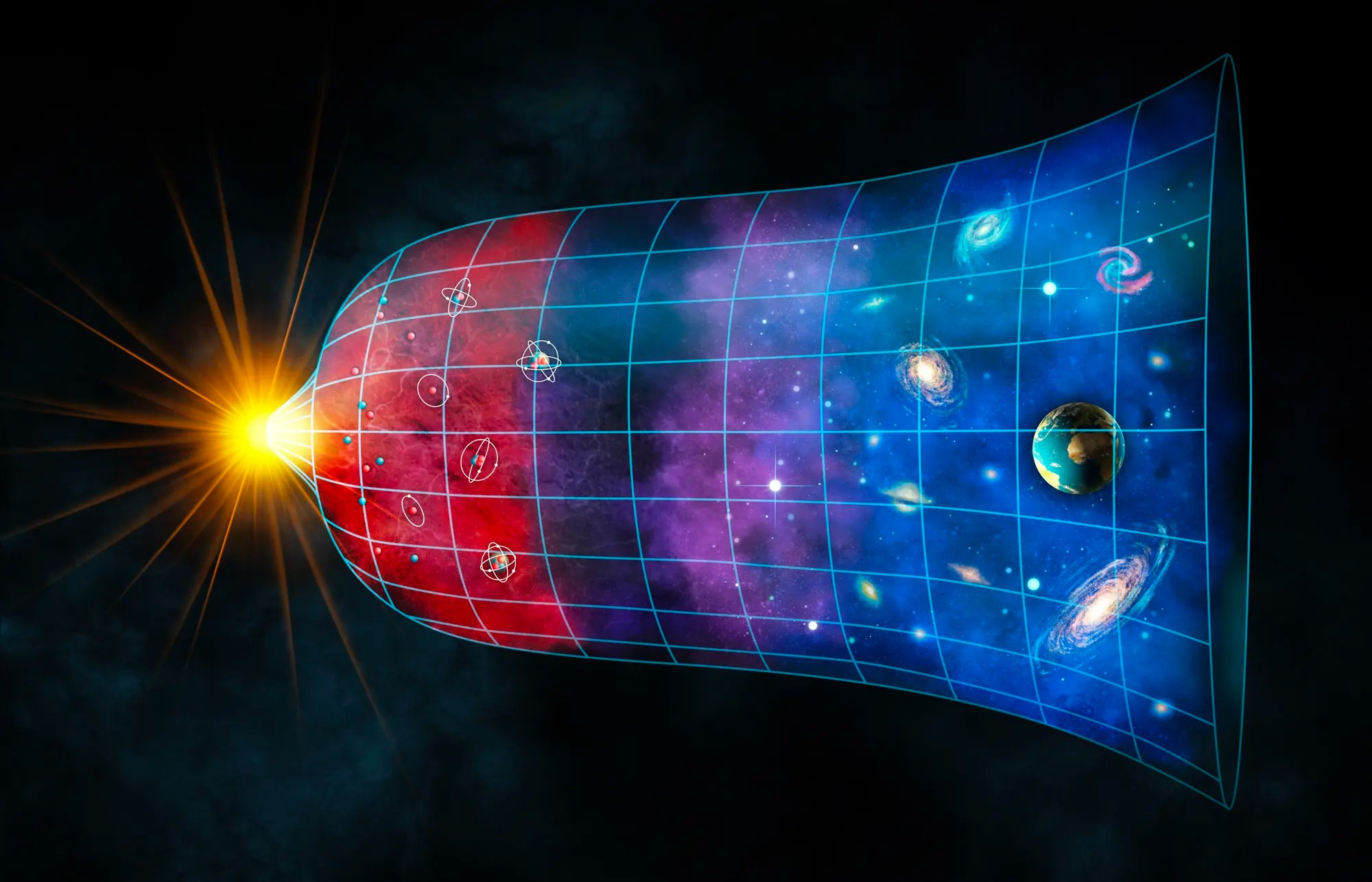
Thus, we have a spectrum of substance of increasing consistency from thought to radiation to matter. As the consistency increases, the substance becomes more condensed and acquires greater endurance.
The condensation manifests as the contracting dimensions of the substance. This is measured by wavelength, and it is the characteristic of SPACE of the substance.
The greater endurance manifests as the increasing durability of the substance. This is measured by frequency, and it is the characteristic of TIME of the substance.
.