
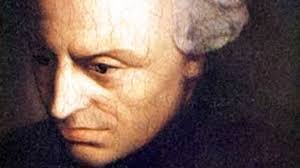
The Story of Philosophy by Will Durant presents a fascinating summary of Kant’s philosophy, which, otherwise, is quite difficult to understand. Here is the whole summary: Immanuel Kant and German Idealism
.
Durant introduces Kant as follows:
NEVER has a system of thought so dominated an epoch as the philosophy of Immanuel Kant dominated the thought of the nineteenth century. After almost three-score years of quiet and secluded development, the uncanny Scot of Konigsberg roused the world from its “dogmatic slumber,” in 1781, with his famous Critique of Pure Reason; and from that year to our own the “critical philosophy” has ruled the speculative roost of Europe. The philosophy of Schopenhauer rose to brief power on the romantic wave that broke in 1848; the theory of evolution swept everything before it after 1859; and the exhilarating iconoclasm of Nietzsche won the center of the philosophic stage as the century came to a close. But these were secondary and surface developments; underneath them the strong and steady current of the Kantian movement flowed on, always wider and deeper; until today its essential theorems are the axioms of all mature philosophy. Nietzsche takes Kant for granted, and passes on; Schopenhauer calls the Critique “the most important work in German literature,” and considers any man a child until he has understood Kant; Spencer could not understand Kant, and for precisely that reason, perhaps, fell a little short of the fullest philosophic stature. To adapt Hegel’s phrase about Spinoza: to be a philosopher, one must first have been a Kantian…
Here is how Durant starts out with his summary of Kant’s Critique of Pure Reason:
The Critique comes to the point at once. “Experience is by no means the only field to which our understanding can be confined. Experience tells us what is, but not that it must be necessarily what it is and not otherwise. It therefore never gives us any really general truths; and our reason, which is particularly anxious for that class of knowledge, is roused by it rather than satisfied. General truths, which at the same time bear the character of an inward necessity, must be independent of experience,—clear and certain in themselves.” That is to say, they must be true no matter what our later experience may be; true even before experience; true a priori. “How far we can advance independently of all experience, in a priori knowledge, is shown by the brilliant example of mathematics.” Mathematical knowledge is necessary and certain; we cannot conceive of future experience violating it. We may believe that the sun will “rise” in the west to-morrow, or that someday, in some conceivable asbestos world, fire will not burn stick; but we cannot for the life of us believe that two times two will ever make anything else than four. Such truths are true before experience; they do not depend on experience past, present, or to come. Therefore they are absolute and necessary truths; it is inconceivable that they should ever become untrue. But whence do we get this character of absoluteness and necessity? Not from experience; for experience gives us nothing but separate sensations and events, which may alter their sequence in the future. These truths derive their necessary character from the inherent structure of our minds, from the natural and inevitable manner in which our minds must operate. For the mind of man (and here at last is the great thesis of Kant) is not passive wax upon which experience and sensation write their absolute and yet whimsical will; nor is it a mere abstract name for the series or group of mental states; it is an active organ which molds and coordinates sensations into ideas, an organ which transforms the chaotic multiplicity of experience into the ordered unity of thought…
Kant’s thoughts are the ultimate in philosophy at the moment. I shall be posting my comments based on this summary of Kant’s philosophy.
COMMENTS:
Mindfulness looks at mind as a sense organ that perceives mental objects. All knowledge is derived from physical and mental sense-experience. It is an arbitrary assumption that “pure” reason is to mean knowledge that does not come through our senses, but is independent of all sense experience.
Knowledge seems to exist as associations among data. This data may be perceived as being arranged in a matrix form. Each node of the matrix may be perceived as a matrix in its own right. This may keep on going to any number of levels. This is the inherent nature and structure of the mind.
Pure knowledge is characterized by continuity, harmony and consistency in this matrix at all levels. Knowledge does not become impure just by being sensed. Knowledge becomes impure to the degree it is discontinuous, disharmonious and inconsistent in its matrix.
.


