Author Archives: vinaire

I am originally from India. I am settled in United States since 1969. I love mathematics, philosophy and clarity in thinking.

Inertia, Space and Location

 GabrielHorn


A state of motion is defined by INERTIA. The main confusion seems to be between physical and mental aspects of MOTION. So, there is physical inertia as well as mental inertia.

PHYSICAL INERTIA = FREQUENCY & MASS

MENTAL INERTIA = FIXEDNESS & EGO

Physical inertia is made up of the FREQUENCY of electromagnetic waves, and the MASS of material particles. On the spectrum of physical inertia, frequency appears in the lower half, and mass appears on the upper half.

Mental inertia is made up of the FIXEDNESS of attention, and the EGO of individuality. On the spectrum of mental inertia, fixedness appears in the lower half, and ego appears on the upper half.

Based on the concept of inertia we may define SPACE and LOCATION as follows.

PHYSICAL SPACE = A STATE DEVOID OF PHYSICAL INERTIA

MENTAL SPACE = A STATE DEVOID OF MENTAL INERTIA

Space may be defined as the lower end on the spectrum of inertia. Thus, physical space would be an electromagnetic wave of zero frequency and infinite wavelength.

Mental space would be a state of attention that is totally free.

PHYSICAL LOCATION = THE CENTER OF MASS

MENTAL LOCATION = THE CENTER OF EGO

A location may be defined as the upper end on the spectrum of inertia. Thus, physical location would be an infinite mass that is centered at a point. We visualize geometrical point to be dimensionless but discrete. On this concept of point we base the whole subject of geometry. But geometry is only as useful as it is consistent with physical observations.

Mental location would be an immense ego that is centered at a “point”. The “point” is visualized as the spiritual “I”. On this concept of “I” we base the whole subject of spirituality, where God is the ultimate “I”. But spirituality is only as useful as it is consistent with what is experienced.

The concept of SPIRIT is derived from the mental aspect of motion, just like the concept of MATTER is derived from the physical aspect of motion. Both spiritual and material aspects are present at every point on the spectrum of motion or inertia.

When we talk about SPIRIT, we are talking about mental aspects and not the physical aspect. So, SPIRIT has to do with mental space and time, whereas, MATTER has to do with physical space and time. We cannot talk about SPIRIT in terms of physical space and time as it has been done in many religions.

.

Calculus and Quantum Mechanics

hqdefault
Reference: Mathematics of Space and Location

The usefulness of calculus is limited to Classical Mechanics.  Classical mechanics deals with mass that is “centered” and with waves that are “spread out.” In both cases, physical locations may be assumed to be uniform in their characteristics and to be distributed uniformly as points in space.

This assumption no longer holds in the subatomic region, which is the concern of quantum mechanics. In this region, the inertia (state of motion) starts to transition from “mass of particles” to “frequency of waves.” With this transition the nature of locations starts to change from “centered” to being “spread out.”

Thus the locations in the atomic region cannot be considered to be uniform, and they cannot be treated by the infinitesimals of calculus with any certainty.

Calculus cannot be applied with any certainty to the problems of Quantum Mechanics in the subatomic region.

.

The Big Bang

Universe_expansion2

From Wikipedia:

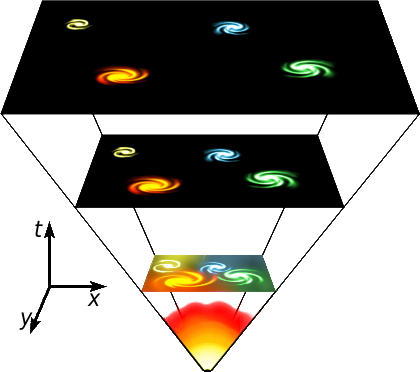
“The Big Bang theory is the prevailing cosmological model for the birth of the universe. It states that at some moment all of space was contained in a single point from which the Universe has been expanding ever since. Modern measurements place this moment at approximately 13.8 billion years ago, which is thus considered the age of the universe. After the initial expansion, the Universe cooled sufficiently to allow the formation of subatomic particles, and later simple atoms. Giant clouds of these primordial elements later coalesced through gravity to form stars and galaxies. The Big Bang theory does not provide any explanation for the initial conditions of the Universe; rather, it describes and explains the general evolution of the Universe going forward from that point on.”

.

Big Bang is the best theory put forth  at present but it does not seem to be the last word.

Did the universe start at the beginning of time, t = 0? Assuming that time could be zero, amounts to thinking of time in absolute terms. The Theory of relativity challenges that notion. From relativistic point of view there is no absolute zero of time.

The universe could be an alternation between expansion and contraction phases.

The universe is essentially motion. The state of motion is called inertia. There is a scale of inertia. As we move toward the high end of the scale, inertia appears as the mass of particles. Inertia increases as mass increases. An example of mass approaching infinity shall be the black hole.

As we move toward the low end of the scale, inertia appears as the frequency of electromagnetic radiation. Inertia decreases as frequency decreases. An example of frequency approaching zero shall be the motion of infinite wavelength. This may be identified as pure space.

At the point of maximum contraction, the universe may appear as having infinite inertia. This condition may appear as a mass particle with a point location. This would be a physical particle that is completely immovable. On the other hand, at the point of maximum expansion, the universe may appear as having zero inertia. This condition may appear as the infinite spread of pure space.

The universe could be oscillating between a point mass of infinite inertia and pure space of infinitesimal inertia.

Therefore “Big Bang” shall occur at the point when the universe transitions from the contracting phase into the expanding phase.

The universe has to be referenced from itself because there is nothing beside the universe. This is where physics transitions into metaphysics.

The conditions of “infinite spread” and “point location” may only be referenced from each other.

.

Solving Real-Life Problems

images

Reference: Scientific method from Wikipedia
Reference: The 12 Aspects of Mindfulness

Here is a step-by-step method for using thought experiments to solve real life problems.

(1) Use your experience

  • Consider the problem.
  • Look for previous explanations.
  • Try to eliminate all inconsistencies using the 12 aspects of mindfulness.
  1. Observe without getting influenced by your expectations and desire for answers.
  2. Observe things as they are, without assuming anything.
  3. If something is missing do not imagine something else in its place.
  4. If something does not make sense then do not explain it away.
  5. Use physical senses as well as mental sense to observe.
  6. Let the mind un-stack itself.
  7. Experience fully what is there.
  8. Do not suppress anything.
  9. Associate data freely.
  10. Do not get hung up on name and form.
  11. Contemplate thoughtfully.
  12. Let it all be effortless.

(2) Form a conjecture

  • State a simple hypothesis or conjecture no matter how unconventional it may appear.

(3) Deduce a prediction from that explanation

  • Predict consequences that may follow from that explanation.

(4) Test (Experiment)

  • Check for the opposite of each consequence to disprove the conjecture.

(5) Verify

  • Note that this can never absolutely verify (prove the truth of) the conjecture. It can only falsify the conjecture.
  • If the conjecture cannot be disproven then continue with step (1) until the complexity of the problem is adequately addressed.
  • If the conjecture is disproven then go back to step (2).

.

Mathematics of Space and Location

SL5

References:

What is Awareness, Scientifically?

A Proposed Measure of Motion

A New Explanation of Inertia

.

When it comes to space and location it seems that the understanding of these concepts is based on idealized mathematical objects. The following is a description of Space from Wikipedia:

“Space is the boundless three-dimensional extent in which objects and events have relative position and direction. Physical space is often conceived in three linear dimensions, although modern physicists usually consider it, with time, to be part of a boundless four-dimensional continuum known as spacetime. In mathematics, “spaces” are examined with different numbers of dimensions and with different underlying structures. The concept of space is considered to be of fundamental importance to an understanding of the physical universe. However, disagreement continues between philosophers over whether it is itself an entity, a relationship between entities, or part of a conceptual framework.”

The concept of space is not well understood. The location of a physical object in space is approximated by a mathematical point. The following is a description of Point from Wikipedia:

“In modern mathematics, a point refers usually to an element of some set called a space. More specifically, in Euclidean geometry, a point is a primitive notion upon which the geometry is built. Being a primitive notion means that a point cannot be defined in terms of previously defined objects. That is, a point is defined only by some properties, called axioms that it must satisfy. In particular, the geometric points do not have any length, area, volume, or any other dimensional attribute. A common interpretation is that the concept of a point is meant to capture the notion of a unique location in Euclidean space.”

The mathematical point is a primitive notion that is idealized per Euclidean space. The following is a description of Primitive Notion from Wikipedia:

“In mathematics, logic, and formal systems, a primitive notion is an undefined concept. In particular, a primitive notion is not defined in terms of previously defined concepts, but is only motivated informally, usually by an appeal to intuition and everyday experience. In an axiomatic theory or other formal system, the role of a primitive notion is analogous to that of axiom. In axiomatic theories, the primitive notions are sometimes said to be “defined” by one or more axioms, but this can be misleading. Formal theories cannot dispense with primitive notions, under pain of infinite regress.”

The mathematical point is a primitive notion, and its definition should be derived from the observed property of location in physical space.

The following is an analysis of physical space and the locations within it.

.

The physical space is visualized as a “background,” which is populated by matter and energy. Einstein related these two elements with his famous equation: E = mc2. The key characteristic common to matter and energy is Inertia. The property of inertia is defined in Wikipedia as follows:

Inertia is the resistance of any physical object to any change in its state of motion, including changes to its speed and direction… Isaac Newton defined inertia as his first law in his Philosophiæ Naturalis Principia Mathematica, which states: The vis insita, or innate force of matter, is a power of resisting by which every body, as much as in it lies, endeavours to preserve its present state, whether it be of rest or of moving uniformly forward in a straight line.

According to Newton, inertia is an innate state of motion that resists change. This may be visualized by thinking of a spinning top, which maintains the speed and direction of its motion. For a matter particle, inertia is expressed by its mass.

Let’s look at how inertia may be expressed for an energy photon. From Einstein’s equations,  E = hf = mc2, the frequency is proportional to mass. A certain equivalence between frequency and mass exists in the region where wave-particle duality is observed. Since mass expresses inertia in matter particles, we may assume that frequency shall expresses inertia in energy photons.

Inertia is the innate state of motion that resists change. It is expressed through mass in matter particles, and frequency in energy photons.

.

We visualize mass particles to be compact like golf balls. As the mass of a particle increases, the inertia gets increasingly centered at the “center of mass,” and the particle becomes harder to move. The ultimate in mass then provides a completely centered inertia.

Going in the opposite direction, as the mass of a particle decreases, the inertia becomes less centered, until inertia transitions into the frequency of a photon. In the region where particle-wave duality is observed, inertia is expressed through both mass and frequency.

We visualize photons as wave packets that do not have mass but they carry a frequency. The inertia of a photon cannot be expressed as being located at a “center.” That means that the innate state of motion of a photon oscillates over an appreciable range. It no longer resists change, except in its frequency of oscillation. As the frequency of a photon decreases, the oscillations spread out over a  larger range, and the photon becomes less discrete. The ultimate disappearance of frequency then provides a completely spread out non-discrete inertia.

Thus, we observe a scale of inertia (innate state of motion). At the upper end of this scale, inertia is totally discrete, unvarying and centered. This state of motion may be identified with a physical location. At the lower end of the scale, inertia is non-discrete, non-resisting and spread out. This state of motion may be identified with physical space.

We may define this universe as gradients of inertia (innate states of motion), at one end of which is physical space, and at the other end of which is a physical location.

.

The primitive notion of a mathematical point should then approximate the properties of a physical location as a discrete, unvarying and centered state of motion.

.