Author Archives: vinaire

I am originally from India. I am settled in United States since 1969. I love mathematics, philosophy and clarity in thinking.

Continuity of Substance and Space

Reference: Essays on Substance

Continuity of Substance and Space

According to the criterion used by The Scientific Method, reality is continuous, consistent and harmonious. Therefore, in The Theory of Substance, the substance is postulated to be continuous, consistent and harmonious. This means that the substance is continuous even when it is divided into the categories of matter, energy and aether. To prove this one may show the movement of substance across these categories in either direction.

Space describes the dimensions of substance; and if substance is continuous then space must also be continuous. This continuity must exist regardless of the scale. If we can establish this continuity then a major disagreement between GR and QM can then be resolved.

The substance takes on different forms and configurations that can have sharply distinct boundaries. But if continuity exists, the substance should be able to move across these boundaries in either direction. The following boundaries may be examined:

  1. Between atom and the surrounding electromagnetic region.
  2. Between the nuclear region and the surrounding electronic region.
  3. Among the electrons in the electronic region.
  4. Among the nucleons within the nuclear region.

Point 3 and 4 above shall prove that nucleons and electrons are not mathematical “point particles” that can have exact locations within the atom. They are more like homogenous “fluid drops” with no definite locations. See The Atom.

The above reasoning is theoretically consistent. It may be verified by examining currently existing experimental data. Otherwise, new experiments can easily be designed.

.

General Relativity & Quantum Mechanics

Reference: Essays on Substance

General Relativity & Quantum Mechanics

General Relativity (GR) and Quantum Mechanics (QM) are two fundamental theories in physics that describe the universe, but they have key disagreements. These disagreements come from the mathematical models used to support either theory and its focus. For example, GR views the space-time structure on a cosmic scale as continuous; whereas, QM looks at the same space-time structure on an atomic scale as discrete.

The space-time structure is a dimensional structure, and the dimensions, in reality, must belong to something. That something is substance, which is matter, energy or aether. There is no empty space. When GR talks about the curvature of space-time, it is the curvature of actual substance. It is the curvature of matter, energy and aether. We can see the curvature of matter in moons, planets and stars; but the curvature of energy and aether is not visible to us.

QM supposes that this space-time or substance is of a discrete nature ad infinitum, but the substance is not discrete even at the cosmic level. There is a continuation from matter to energy to aether. There appears to be a boundary between a planet and surrounding space; but, factually, there is a continuity across that boundary. As we examine that boundary closely, it comes down to the boundary between the atom and its surrounding energy, or between the nuclear region and the surrounding electronic region, or among nucleons and electrons. There is no clear-cut break or discontinuity in reality. Any discontinuity is only mathematical.

So, the disagreements between GR and QM come down to mathematics only. The mathematical models that are being used for GR and QM are inconsistent with each other. According to The Scientific Method, these inconsistencies send us back to the drawing board. According to Mathematics and Physics, we need to resolve the inconsistencies in mathematical logic with live logic.

This next step is to look more closely at the mathematical models being used for GR and QM.

.

The Theory of Substance

Reference: Essays on Substance

The Theory of Substance

At the end of the twentieth century, it was noticed that light, which was considered to have no mass, had momentum that could be sensed and measured. This defined light to be a substance just like matter. The equivalence of matter and energy (radiation) was then postulated by several scientists, and was made famous by Einstein through the equation E = mc2.

NOTE: In the context of substance, energy is interpreted as radiation. It is not the same as the potential or kinetic energy that were concepts coined for matter only.

The theory of Substance is inspired by this equivalence of matter and energy (radiation). It defines substance as follows:

Substance is that which is substantial enough to be sensed. The degree of substantiality is its consistency. Consistency means “a degree of density, firmness, viscosity, etc.” The consistency of matter is called mass.

We can sense matter, radiation and thought. However, we place thought in the “black box” of aether because we do not know about it as a substance. This gives us three categories of substance as follows:

MATTER (MASS)
In classical mechanics mass is used for matter only. Mass is not used for light even when light has momentum. The classical concept of mass is, therefore, generalized as CONSISTENCY to cover all three categories of substance. For example, radiation is considered to have “no mass” but it has consistency.

Substance of very high consistency in the nucleus of an atom may still be called mass, because it appears as “solid mass particle.” In contrast, the substance filling the rest of the atom (electrons) is of lower consistency, and it appears as “liquid mass.” The substance beyond the boundary of the atom (electromagnetic radiation) is of very low consistency, and it appears as “gaseous mass.”

RADIATION (CONSISTENCY)
Radiation is the electromagnetic radiation (EMR), which is generalized as light. It is called “energy” because it has no mass; but it is not the same concept as the energy of matter. Here we address it as radiation that has consistency instead of mass, and has a very high inherent motion compared to matter. The consistency of radiation is many degrees of magnitudes lower than that of matter. In a manner, the consistency of radiation is represented by its frequency.

THOUGHT (AETHER)
“Aether” has been postulated since ancient times, and has been given different meanings at different times. It has been used as a “black box” for trying out different ideas. Aether was used as a medium in the wave theory of light. Maxwell used it as certain properties in developing his theory of electromagnetism. Einstein rejected the idea of aether as used in the wave theory of light, but did not outright deny its existence. Mathematically derived ideas of black matter and black energy are now part of this “black box.” Mathematics, basically, has a thought structure; and mathematically described aether shall essentially be a thought construct. The consistency of aether is predicted to be many orders of magnitude lower than even that of light. However, aether, or thought, occupies most of the volume of the universe.

Today this aether is described mathematically as a “field” through a complexity of mathematical symbols and relationships. However, it was described by Faraday very simply as lines of force that could thin out to an infinite degree.

According to the Theory of Substance, aether can be sensed, but in a manner very different from matter and energy. The sensing of aether as “thought” is real, as you can sense it when somebody is looking at you in a crowd, such as, from behind.

.

Speed of Light

The theory of Relativity postulates that light has a unique velocity because it corresponds to zero mass, and its ratio with speed of matter is so large that it doesn’t change with change in speed of matter.

The theory of Substance postulates the following:

  1. The velocity of substance, such as light, in free space is constant because its motion is balanced by the inertia of its consistency (mass).
  2. The velocity of substance has an inverse relationship with its consistency. The motion increases as the consistency decreases.
  3. From matter to radiation to thought, as the consistency decreases, the velocity increases.

The very fact that the speed of light is finite and constant, means that speed is in balance with a little bit of mass (consistency). If that consistency is reduced the velocity would increase. Einstein’s postulate works only because the speed of light is too large compared to the speed of matter to be affected by changes in the speed of matter.

.

Gravity

Einstein’s General Relativity uses mathematical symbols and equations to express how gravity is governed by four-dimensional spacetime The theory of Substance describes the same relationships in more realistic terms as follows.

Not only motion, but consistency is also relative. All bodies arrange themselves dynamically in space such that their consistencies and motions are in equilibrium at all times. This describes gravity.

This is nature.

.

The Problem of Relativity

Reference: Essays on Substance

The Problem of Relativity

The problem of relativity arises from the fact that, when it comes to a body moving in free space, we can measure its relative velocity only. We have no way of knowing its absolute velocity. For example, the earth moves at a velocity of 29.78 km/s around the sun, but the sun itself is moving. So, we do not know the absolute velocity of either earth or the sun in space.

Knowledge of the absolute velocities is necessary to test and refine our fundamental theories of physics. For example, accurate velocity data allows us to verify and refine the theory of gravity. The theory of gravity then helps accurately determine the masses and motion of celestial bodies.

Newton suggested that his concept of absolute space could be called ‘Aether,’ implying a connection between aether and a fixed reference frame. This idea was central to the Michelson-Morley experiment of 1887, which aimed to detect Earth’s motion through this supposedly stationary aether. The experiment aimed to measure the speed of light in perpendicular directions to observe any differences that would indicate the Earth’s movement relative to this aether. Michelson and Morley used an interferometer, which utilized light wave interference to perform incredibly precise measurements. They expected to observe interference fringes that would indicate different light speeds depending on the orientation of the apparatus relative to the Earth’s motion. But no such fringes were observed.

Einstein then developed his Special relativity that essentially replaced the “absolute rest frame” by an “absolute velocity frame” using the velocity of light. In addition, Einstein noticed that light, which had no mass, had momentum as did the material objects with mass. This led to Einstein establishing an equivalence between electromagnetic radiation and matter, with his famous equation: E = mc2.

But the absolute motion among celestial bodies was not independent of their mutual gravity, and this required accounting for acceleration in addition to simple velocities. To do so, Einstein developed General relativity using a four-dimensional framework, which included both space and time coordinates and their interdependence.

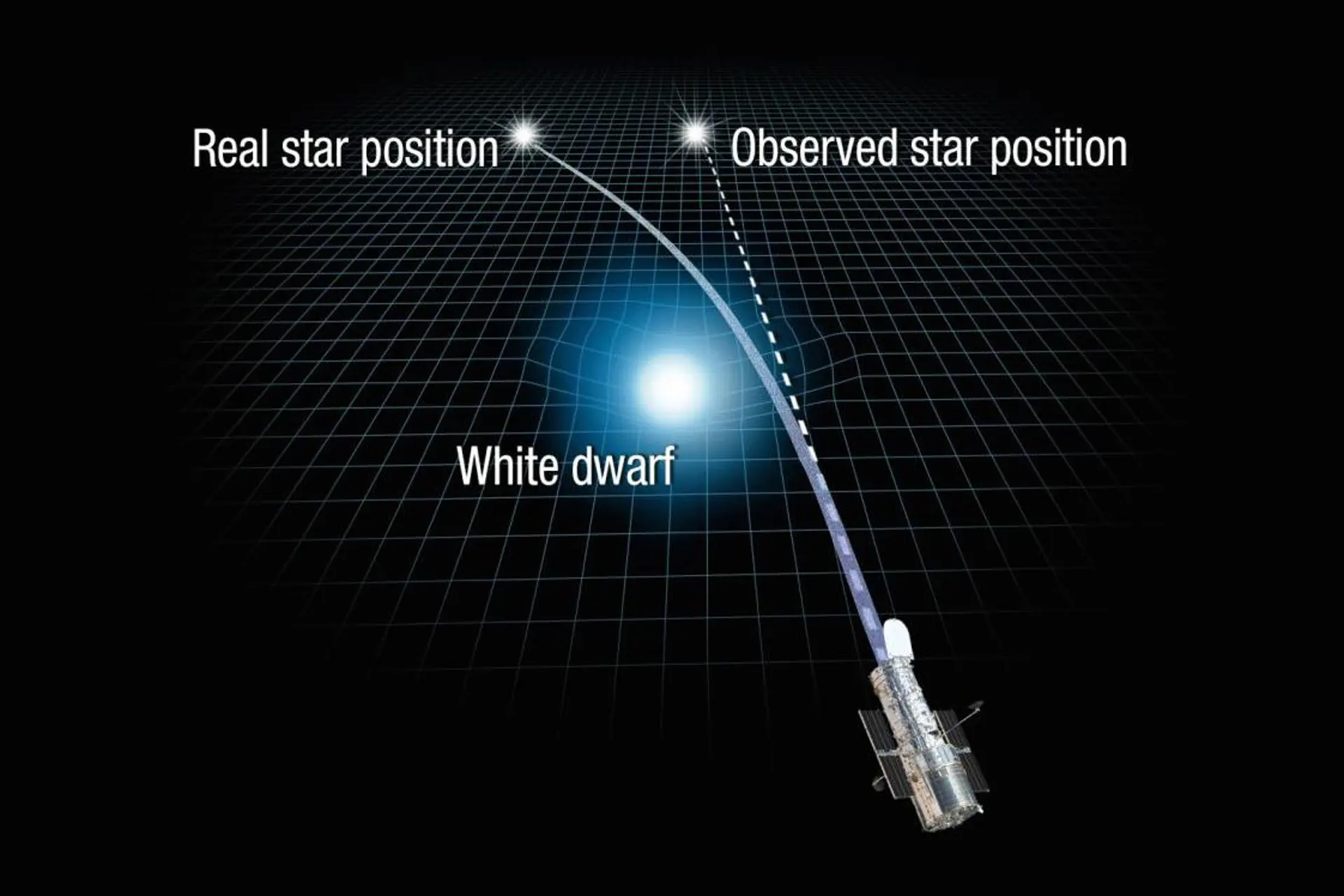
General relativity describes gravity not as a force, but as a consequence of the curvature of spacetime caused by mass and energy. It predicts phenomena such as gravitational time dilation, light deflection by massive bodies, and gravitational waves.

General relativity has been remarkably successful. It has found practical applications in everyday technology such as the Global Positioning System (GPS).

But, despite its remarkable success in explaining many gravitational phenomena, General relativity has several known limitations and weaknesses. For example, it does not integrate well with quantum mechanics, leading to inconsistencies when describing gravity at very small scales or high energies. It also requires the existence of dark matter and dark energy to explain observed cosmic phenomena, but these have not been directly detected.

These limitations suggest that General Relativity, while highly successful in many contexts, may be an approximation of a more fundamental theory of gravity that resolves these issues.

In order to understand the approximations in GR (General Relativity) one must understand the assumptions made in developing this theory. The key assumption appears to be the speed of light. The theoretical basis for the speed of light is Maxwell’s theory, which assumed light to be a disturbance in aether, which it is not.

.

Proton, Electron and Photon

Reference: Essays on Substance

Proton, Electron and Photon

A particle implies a point-like center and a fixed identity that is moving. But the quantum “particles” inside the atom are not like material particles. They are like drops that could be dissolving and forming within a fluid-like field.

According to the Theory of Substance there are no material-like particles inside the atom. There are only fluid-like fields of different consistencies. These fields are continuous with each other despite sharply varying consistencies.

In a hydrogen atom, the only proton of very high consistency is the very small nucleus at the center, but the only electron of 1836 times lesser consistency fills the rest of the atom. This electron is like a huge field of very diluted mass. It is not like a point-like condensed particle orbiting the nucleus. This makes the electron tens of thousands of times larger than the proton.

There seems to be a relationship between consistency and size of substance: The lower is the consistency, the greater is the size.

Even when the atoms are packed tightly within matter, they have very large spaces among them. These spaces are filled with photons of negligible consistency. From the relationship between consistency and size, we may estimate the size of a photon to be tens of thousands of times larger than the electron.

We may not have the exact sizes of Proton, Electron and Photon, but we can say with certainty that the size of the electron is humongous compared to the size of the proton; and the size of the photon is humongous compared to the size of the electron.

The mathematical interpretation of quantum mechanics may disagree with the above conclusion but the mathematics of quantum mechanics assumes quantum entities to be point-like particles that have probabilistic locations.

.