Author Archives: vinaire

I am originally from India. I am settled in United States since 1969. I love mathematics, philosophy and clarity in thinking.

Locality and Non-locality

Reference: Essays on Substance

Locality and Non-locality

The following definitions provided by AI are influenced by Quantum Mechanics, which believes that SPACE is a void. According to the Theory of Substance, there is no such thing as a void. Space is always denotes dimensions of some substance. If there is space, there must be substance filling it. If there is no substance, there is no space either.

.

In physics, locality and non-locality refer to fundamental principles that describe how objects or particles interact with each other and their surroundings.

Locality
The principle of locality states that an object is influenced directly only by its immediate surroundings. This means that for one object to affect another, there must be some mediating force or particle that travels through the space between them. In the context of special relativity, locality implies that no influence can propagate faster than the speed of light.

Key aspects of locality include:

  • Causes and effects are limited by the speed of light
  • Interactions occur through fields or particles in the intervening space
  • It aligns with our intuitive understanding of classical physics

Non-locality
Non-locality, particularly in quantum mechanics, refers to phenomena that appear to violate the principle of locality. The most notable example is quantum entanglement, where measuring the properties of one particle can instantaneously affect the properties of another particle, regardless of the distance between them.

Characteristics of non-locality in quantum physics:

  • Entangled particles can exhibit correlations that seem to defy classical locality
  • These correlations appear to occur instantaneously, regardless of spatial separation
  • Non-local effects do not allow for faster-than-light communication of information

Implications
The tension between locality and non-locality has profound implications for our understanding of reality:

  • It challenges our classical intuitions about cause and effect
  • It has led to debates about the completeness of quantum mechanics, as highlighted by the EPR paradox
  • Non-locality is crucial for quantum technologies like quantum computing and quantum cryptography

While non-locality in quantum mechanics seems to violate the principle of locality, it’s important to note that it does not actually allow for faster-than-light communication or violate the principles of special relativity. The apparent contradiction between these concepts continues to be a subject of research and philosophical debate in modern physics.

.
Einstein and Spinoza’s God

Reference: Essays on Substance

Einstein and Spinoza’s God

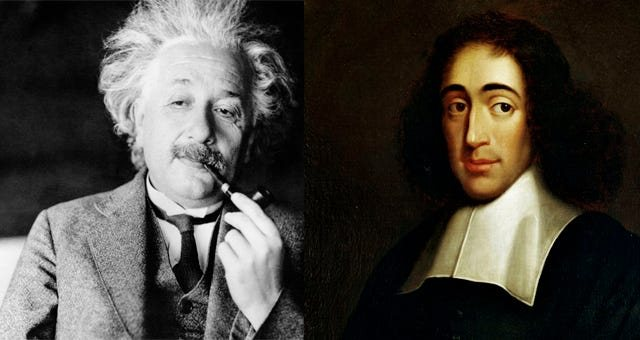
I am totally with Einstein and Spinoza here. To me Oneness = continuity + consistency + harmony. There is oneness in all reality. Any departure from this oneness is an anomaly to be resolved.

Einstein was drawn to Spinoza’s conception of God, which differed significantly from traditional theistic views. The key characteristics of Spinoza’s God that appealed to Einstein were:

Orderly Harmony of Nature
Einstein appreciated Spinoza’s view of God as revealed in the “orderly harmony of what exists”. This concept aligns with Einstein’s scientific perspective, seeing the universe as governed by rational, comprehensible laws.

Non-Interventionist Deity
Spinoza’s God does not intervene in human affairs or concern itself with “fates and actions of human beings”. This non-personal deity appealed to Einstein, who rejected the idea of a God who answers prayers or involves itself in human matters.

Unity of God and Nature
Spinoza’s famous phrase “Deus sive natura” (“God, or nature”) expresses the idea that God and nature are inseparable. Einstein found this concept compelling, seeing God as embedded in the natural world rather than separate from it.

Rationality and Logical Simplicity
Einstein admired Spinoza’s emphasis on rationality and the “logical simplicity of the order” in the universe. This aligned with Einstein’s scientific approach and his search for elegant, unified explanations of natural phenomena.

Transcendence Through Immanence
Spinoza’s God is both immanent (present throughout nature) and transcendent (beyond human comprehension). This concept creates a “profound metaphysical intimacy with God without denying His transcendence”, which Einstein found intellectually satisfying.

Ethical Implications
While Einstein was primarily drawn to the philosophical and scientific aspects of Spinoza’s God, he also appreciated the ethical dimension. Spinoza’s philosophy emphasizes understanding and virtue, which resonated with Einstein’s humanistic values.

In essence, Einstein saw in Spinoza’s God a concept that harmonized with his scientific worldview while maintaining a sense of awe and wonder at the universe’s underlying order and beauty.

.

Misconceptions about Quanta

Reference: Essays on Substance

Misconceptions about Quanta

Misconceptions about quanta arise from its mathematical origins. A quantum could not be perceived directly, so it had to be visualized. Only thing known was that a quantum was a discrete entity. It could be counted. These were also the properties associated with material particle. So, an association was made between a quantum and a material particle.

However, matter, ultimately, breaks down into atoms that do not coalesce with each other. They form bonds and remain discrete. With energy it is different. Energy of the same frequency may thin out and reduce to individual quantum; but, when many quanta come together, they coalesce back into the continuum of energy.

Planck assumed that energy comes in distinct particles or packets, rather than being continuous; and that has been the fundamental error. Energy may only be emitted in integral multiples of hν, but nothing prevents it from coalescing back and forming a continuous media.

Planck found that the energy radiated from a heated body is exactly proportional to the frequency of its radiation. This doesn’t require radiation of the same frequency to be discontinuous within itself. It is true that radiation of different frequencies shall maintain that difference down to the level of individual quantum. That is how radiation maintains its spectrum.

So, energy can only be absorbed or emitted in discrete amounts, not continuously as previously thought. But, in space, energy of a particular frequency or wavelength forms a continuous medium, until it thins out into quanta.

In 1905, Einstein proposed that light behaves as if it is composed of discrete particles, which we now call photons. This revolutionary idea explained the photoelectric effect and earned him the Nobel Prize in 1921. In 1909, Einstein introduced the concept of wave-particle duality, suggesting that light exhibits both wave-like and particle-like properties. This dual nature of light became a fundamental principle in quantum mechanics.

Einstein carried forward the misconception of the equivalency of a photon with a material particle, which could not split and coalesce back like a fluid particle. Einstein explored the quantum structure of mechanical energies of particles embedded in matter. This work contributed to the view of how energy is quantized at the atomic level.

Later when Einstein believed quantum mechanics should provide a deterministic description of nature, rather than relying on probabilities, he was arguing against himself. Niels Bohr used Albert Einstein’s own theories to defend quantum mechanics during their debates. Einstein accepted the mathematical framework of quantum mechanics, and its explanatory power but questioned whether it provided a complete description of reality.

What was missed by both Einstein and Bohr was that energy of the same frequency formed a continuous medium. A boundary existed only between energy quanta of different frequencies, but not between energy quanta of the same frequency. Energy is quantized at atomic levels because of phenomena such as resonance, etc., but that does not refute the continuity of energy of same frequency and wavelength.

.

The History of Quanta

Reference: Essays on Substance

The History of Quanta

The concept of quantum emerged in the late 19th and early 20th centuries, revolutionizing our understanding of physics at the atomic and subatomic levels.

The idea of energy quanta was introduced by Planck in 1900 to explain blackbody radiation. Planck had been working on black-body radiation for years, trying to derive a law based on thermodynamics and electromagnetic theory. In October 1900, new experimental results showed that the existing Wien’s law was invalid for certain wavelengths. Planck presented a new radiation law that fit the experimental data well. This formula was initially derived through mathematical curve fitting rather than from first principles. Within two months, Planck worked to provide a theoretical explanation for why his formula worked. This led him to introduce the revolutionary concept of energy quanta.

Planck proposed that energy could only be emitted or absorbed in discrete “packets” or quanta. The energy of these quanta was directly proportional to the frequency of the radiation, expressed as E = hf, where h is Planck’s constant. Planck himself viewed this as a “act of desperation” and did not fully understand the implications of his own theory at first. The presentation of Planck’s quantum hypothesis on December 14, 1900, is often considered the birth of quantum theory. Albert Einstein’s work on the photoelectric effect in 1905 further corroborated and expanded on Planck’s findings.

As light moves out from its source in all directions in space, it spreads over an ever increasing volume. Following the inverse square law. The light thins out but it maintains its frequency. Ultimately, it reduces to photons that have the minimum energy possible for that frequency. This minimum energy is determined by E = hf.

These photons are like drops of a fluid and not point particles. When photons of the same frequency come together they coalesce into a larger body of light. Photons of different frequencies do not coalesce together. 

The quantized states within the atom introduced by Niels Bohr is a very different phenomenon. These energy states are closely related to the resonance phenomenon. Atoms exhibit resonant behavior in their interactions with electromagnetic radiation, which is fundamental to their energy structure. The idea of “quantization” should not be confused with the concept of quanta.

.

The Quantum Particle

Reference: Essays on Substance

The Quantum Particle

This is a video of the first lecture of an introductory course on QM at Yale university. Here are the lecture notes from this video.

This lecture discusses the wave-particle duality. The results of the famous double slit experiment cannot be explained with either the wave or the classical particle model of light. The math shows a photon to be massless.

The photon does not follow the classical wave model because it has its own substance, and it does not require a medium. The photon does not follow the classical particle model either because it can split between the slits, and it does not always leave a point impression. Yet it does appear to have a discrete existence.

The Theory of Substance sees light to be a fluid substance that flows. It has a continuous medium, that can be reduced to discrete “drops” similar to water. These “drops” or “fluid-particles” have dimensions and they have the ability to split and coalesce back. The classical point-particles do not have such properties.

The analogy of light and water ends when we notice that, when divided, water ends up with hard core molecules that cannot coalesce with each other. However, light has no such limitations.

The photon being, a fluid-particle, can appear as a point on the photographic plate in the experiment. But it extends in spacetime, such that it can coalesce with the next photon when it comes along. So there is a fluid-like aspect to light that seems to make all the difference. This has not been examined in physics so far.

A quantum particle is, therefore, a fluid-particle that can split and coalesce and remain a continuous fluid medium.

.