
Reference: Essays on Substance
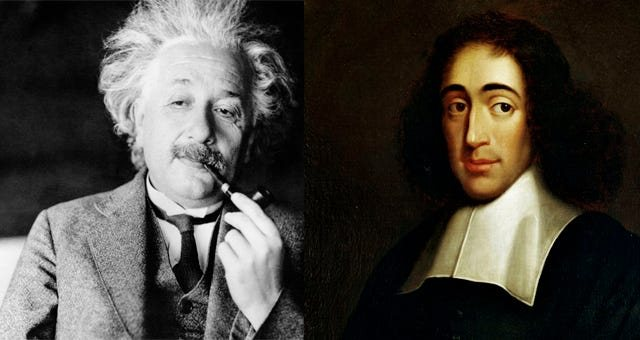
Einstein and Spinoza’s God
I am totally with Einstein and Spinoza here. To me Oneness = continuity + consistency + harmony. There is oneness in all reality. Any departure from this oneness is an anomaly to be resolved.
Einstein was drawn to Spinoza’s conception of God, which differed significantly from traditional theistic views. The key characteristics of Spinoza’s God that appealed to Einstein were:
Orderly Harmony of Nature
Einstein appreciated Spinoza’s view of God as revealed in the “orderly harmony of what exists”. This concept aligns with Einstein’s scientific perspective, seeing the universe as governed by rational, comprehensible laws.
Non-Interventionist Deity
Spinoza’s God does not intervene in human affairs or concern itself with “fates and actions of human beings”. This non-personal deity appealed to Einstein, who rejected the idea of a God who answers prayers or involves itself in human matters.
Unity of God and Nature
Spinoza’s famous phrase “Deus sive natura” (“God, or nature”) expresses the idea that God and nature are inseparable. Einstein found this concept compelling, seeing God as embedded in the natural world rather than separate from it.
Rationality and Logical Simplicity
Einstein admired Spinoza’s emphasis on rationality and the “logical simplicity of the order” in the universe. This aligned with Einstein’s scientific approach and his search for elegant, unified explanations of natural phenomena.
Transcendence Through Immanence
Spinoza’s God is both immanent (present throughout nature) and transcendent (beyond human comprehension). This concept creates a “profound metaphysical intimacy with God without denying His transcendence”, which Einstein found intellectually satisfying.
Ethical Implications
While Einstein was primarily drawn to the philosophical and scientific aspects of Spinoza’s God, he also appreciated the ethical dimension. Spinoza’s philosophy emphasizes understanding and virtue, which resonated with Einstein’s humanistic values.
In essence, Einstein saw in Spinoza’s God a concept that harmonized with his scientific worldview while maintaining a sense of awe and wonder at the universe’s underlying order and beauty.
.
