
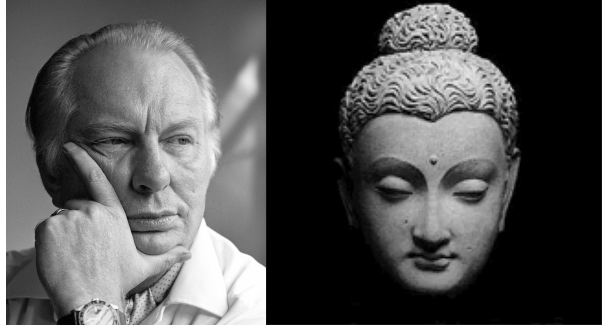
Reference: The Book of Scientology
The fundamentals of Scientology may be understood better by comparing them to the fundamentals of Buddhism.
Scientology believes in the narrative of Creator-creation, and considers Theta (thought) to have produced MEST (the physical universe). Buddhism, on the other hand, believes in the duality of Unknowable-knowable, and considers the universe to be the knowable part of this dichotomy. From the perspective of Buddhism, both Theta and MEST are constituents of this knowable universe, and the concept of Unknowable does not exist in Scientology. Thus, from Scientology perspective, everything will become known at some point in future. From Buddhist perspective, there will always be something more to know.
Scientology believes in the immortality of individuality (the thetan). From Buddhist perspective,
“The Absolute Truth is that there is nothing absolute in the world, that everything is relative, conditioned and impermanent, and that there is no unchanging, everlasting, absolute substance like Self, Soul, or Ātman within or without.”
The Buddhist concept of reincarnation is very different from Scientology concept of past lives. What continues from one life to the next is karma and not the individual.
Karma is essentially the influence on us from past lives. It is also the consequence of our actions in this life. Structurally, Karma is made up of unassimilated impressions in our mind. In Dianetics, we have mental impressions in the form of locks, secondaries and engrams. In Scientology, we have identification of thoughts (A=A=A) that messes up our thinking. At OT Levels, we have misconceptions that go deep into our postulates. These misconceptions lie at the root of all our aberrations. All these are included in the definition of Karma.
Scientology seems to be fixated on the survival of the individuality; and, therefore, it believes in the eventual immortality of the thetan. According to Buddhism:
“Two ideas are psychologically deep-rooted in man: self-protection and self-preservation. For self-protection man has created God, on whom he depends for his own protection, safety and security, just as a child depends on its parent. For self-preservation man has conceived the idea of an immortal Soul or Atman, which will live eternally. In his ignorance, weakness, fear, and desire, man needs these two things to console himself. Hence he clings to them deeply and fanatically.”
In Scientology, the very idea of immortality of thetan means that the uniqueness that makes one thetan different from another is very precious and it must be maintained at all costs. A thetan is basically a point of awareness without any fixation. Any uniqueness of a thetan considered immortal would be a fixation. This fixation on individuality makes Scientology limited in its ability to handle all human aberrations.
Scientology has many workable techniques but they can be improved upon.The removal of misconceptions pointed out above, will certainly bring about this improvement.
.

Comments
In Theta-MEST theory Hubbard is talking about a scale of Motion. Theta is the static end and MEST is kinetic end of this scale. In between there are different degrees of motion. But, according to Hubbard’s own definition, Theta has no substance. That means Theta is completely off the scale of motion. And, since motion has to do with substance, MEST would represent the whole scale of motion.
The scale of motion is also the scale of substance. By definition, substance is anything substantial enough to be sensed. Thought, energy and matter are different categories of substance. Thought condenses into energy, and energy condenses into matter. The scale of motion/substance, therefore, shows the continuity of thought, energy, and matter.
So, theta is something more than thought. It creates thought by postulating it. Thought allows reasoning to occur. From reasoning comes data. As data condenses, we get energy and matter. Thought, energy, and matter, together describe the substance. The substance has the characteristics of extents (space) and duration (time). This describes MEST.
According to Hubbard Theta can be individualistic, and it can create individual universes. Each universe has the characteristics of MEST.
.
The above summary shows where Hubbard is going with his Theta-MEST theory. This theory is based on the Creator-creation paradigm. It introduces the idea of there being many creators, who are individuals. These individual creators have their individual universe. The biggest arbitrary in this theory is that it postulates individual creators and does not define the relationship among them.
In contrast, Buddhism favors the principle of oneness, which translates into everything being inherently continuous, consistent and harmonious. The violation of this principle gives us anomalies, such as, discontinuity (missing data), inconsistency (contradictory data), and disharmony (arbitrary data).
From Buddhist perspective, the Theta-MEST theory has the anomaly of “arbitrary data” right at the top.
About: “The biggest arbitrary in this theory is that it postulates individual creators and does not define the relationship among them.”
Please read “The Factors” in a new unit of time. It very much accounts for the relationship. It gives us the agreed upon universe you are reading this in.
Nelson
The physical universe exists. There is no doubt about it. It has certain natural laws, and if we don’t agree with those laws, then we are punished, no matter what we postulate.
Hubbard says that the universe is a product of agreement among thetans, but he doesn’t say anything about the origins of the thetan, so that is an anomaly of missing data. This anomaly needs to be resolved before “The Factors” can make complete sense.
I have studied those factors thoroughly, and have proposed an update here, which makes them compatible with Buddhism.
The KHTK Factors
I hope you will appreciate this effort.
I have no doubt in my mind that you have had wonderful gains from Scientology. So have I.
LRH has his theories and explanations for these gains. His theories are a great advance over the knowledge that existed in the Western world previously. But LRH himself admitted that his theories are workable enough for the purpose he had in mind.
I believe that the workability of LRH’s theories can be improved by aligning them with Buddhism. Then we can get results in much greater abundance.
I have recently come to realize that LRH does admit the idea of Unknowable in the form of the Eighth Dynamic. All other dynamics are knowable. Both Theta and MEST are knowable.
I just finished summarizing the following section from Scientology 8-8008 that may augment the data of the above post.
CAUSE-FULL EFFECT