

Reference: DEATH: An Inside Story
“Most people in the world believe that if they die in their sleep, it is wonderful. What a horrible way to go!” ~ Sadhguru
6.1 Does Death Need Preparation
Death is moving from the physical to the non-physical. It is the greatest moment in your life. So it is very important that you make it happen most gracefully and wonderfully.
OPPORTUNITY
If you want to make use of the opportunity that death presents, you cannot approach it with fear. This is not something that you can handle all of a sudden at that moment. So it is important that on many levels we prepare for death beforehand. If you can manage this last conscious moment of your life gracefully, you will at least go through the disembodied phase well. You will not make it hellish.
SPIRITUAL PERSPECTIVE
From a spiritual perspective, what did not perhaps happen in life can be accomplished at the moment of death, if it is handled sensibly. This is because it is very easy to untie the knots of everything that you have accumulated at that final moment. But if you are unprepared or become fearful of it or are ignorant of the ways of life, you will create resistance towards it and miss that possibility completely.
REQUIREMENTS
You must be able to sit quietly and die. People on the spiritual path often choose the time, date and place of their death. They have created the necessary awareness within themselves so that, when the time comes, they can bundle the life energies and leave the body consciously without damaging it, just like taking off their clothes. They know where they are connected to the physical body, so they can disentangle themselves whenever the moment is right for them.
THE PROCESS
Death is never sudden. Life dribbles out, over some time. Once your senses are disconnected, you have no experience of the world or the body, but the experience of presence is still there. One can die peacefully even when the body is violently broken up in a car crash. Or one can die a violent death in bed surrounded by family having become terrified in that moment. The violence of the death is not determined by what happened to the body; it depends on what happened within that person.
LAST MOMENTS
You die peacefully when you are aware of your last moments and you are not just reacting. If you have lived a life of awareness, then it is very much possible that even at the last moment you remain aware. If this has to come, you have to build a life of awareness. Only then you can be aware in your death.
6.2 Sleep, Ojas and Death
Sadhguru says, “Fundamentally, the dynamism of the physical has to touch the inertia of the non-physical. This is the Shiva–Shakti principle. Shiva is inertia, Shakti is dynamism.” I think that choice of words here is very confusing. I like the following description.
SHIVA-SHAKTI PRINCIPLE
Shiva is the stable data, the fundamental postulate. Shakti describes the reasoning, the myriads of considerations, which can now come about because of that postulate. The whole theory of relativity depends on the postulate of a universal constant ‘c’ that is associated with the speed of light. The fundamental principle underlying any duality is that of a dimension extending to infinity in either direction. All dualities represent the two ends of a dimension. Here SHIVA is the fundamental principle of the dimension. SHAKTI is like all the dualities which can now be manifested based on the principle of dimension.
OJAS
According to Sadhguru: Ojas is “A non-physical force generated by spiritual practices.” This is based on the Shiva-Shakti principle, where spiritual practices are becoming aware of the stable data of all nature. Ojas then follows. Ojas is a Sanskrit term that can be translated as “vigor” or “essence of vitality.” In a nutshell, ojas is the vital energy that rules our immunity, strength, and happiness—three things we want to have in abundance. The more you are aware of deeper stable data, the more ojas is generated automatically. Ojas is a function of deep awareness.
SLEEP & DEATH
Sleep and death are similar in the sense that a person is transitioning from an active, wakeful state (Shakti) to a completely different state in which one is deeply engrossed (Shiva). Here you need to become aware of the state of being deeply engrossed. You can get an idea of that from deep contemplation, or meditation.
MOMENT OF DEATH
The state of mind at the moment of death determines what you will be engrossed in from then on. That state would not change until any rebirth.
6.3 Why Do People Fear Death
The fear of death is simply because we are not in touch with reality. Our identification with this body has become so strong because we have not explored other dimensions. Therefore, body has become a big issue. But if you had known something in your life that is more than the body, then shedding the body will not be a big deal for you.
6.4 How to Deal with the Fear of Death
CAUSE OF INSECURITY
Death is the universe recycling itself. During this process you have an opportunity to transcend this whole cycle. You identify yourself as a body, and only because of that, there is all this insecurity.
CONFRONTING FEAR
If you truly experienced yourself beyond the limitations of the physical and the mental, there would be no fear. That is why you must do sadhana. Confronting your fear of death can bring tremendous clarity and transformation in your life.
CONTROLLING IMAGINATION
There are two significant faculties that human beings have—a vivid sense of memory and a vivid sense of imagination. Fear means your imagination is out of control. So it is a question of taking your faculties into your control rather than fighting fear.
TAKING CHARGE OF PHYSIOLOGY
What is needed is taking charge of your physiological and psychological process, paying attention to the process of how we generate thoughts, how we generate emotions, how we conduct our body and how we manage our chemistry.
REMINDING YOURSELF
One thing you can do is remind yourself about death—your death. Every day, just spend five minutes reminding yourself that you are mortal and today you may die. Just remind yourself this much and this will take away your fear of death.
EXPERIENCE THE NON-DUAL
In experiencing the non-dual, the duality of life and death will become one. It is the illusion of duality and the attachment to one of them that makes death a fearful expectation—of being wrenched away from that which you know.
6.5 How to Live One’s Old Age
When you are approaching death, it is an opportunity, because when energies have become feeble and they are progressing towards dropping the body, it is much easier to become aware of the nature of your existence. You can see the distinction between what is you and what is your body with greater clarity. When the time comes, the best place to die is always under the open sky, not the hospital.
6.6 The Wisdom of Vanaprastha Ashrama
In ancient India, when couples took up Vanaprastha Ashrama, they often withdrew together and lived a very simple ‘back-to-basics’ kind of life, until their death. This was to ensure that they died well or had a good death.
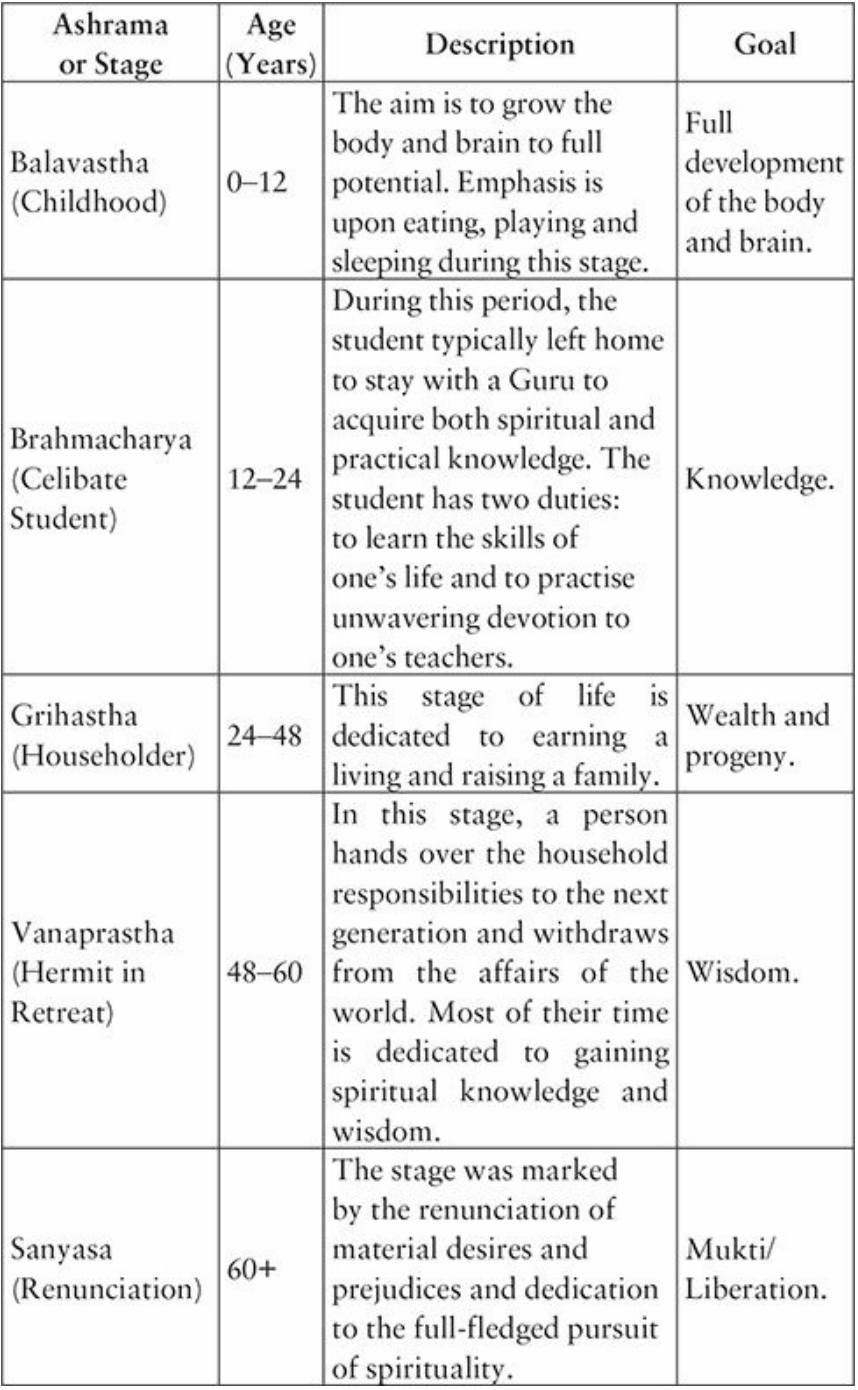
Essentially, the idea of Vanaprastha Ashrama was to withdraw from a place that has four walls. Even if you don’t understand this, your body will understand this very clearly when you sleep outdoors as to how vulnerable it is. Vanaprastha Ashrama meant being in communion with the vana, or forest. The fundamental idea is that after living in a home all your life, now, as the end nears, you move closer to Nature and be aware of this vulnerability. Vanaprastha Ashrama brings a deep sense of mortality home to this body. Once this body is completely conscious it is mortal, it will arrange itself properly.
It is not good for people to die at home in the midst of their family and relatives. It is better not to remain connected to the same reality you are now departing from. if you die among the family, you will die with a huge sense of attachment, which is not good for what happens after. It is best to withdraw into a protected outdoor space, such as, an ashram.
Vanaprastha Ashrama is not about going to die; it is to live your life with a certain kind of awareness and preparation, so that death can happen in the best possible manner. This is not an invitation to death but a profound acceptance of the human condition.
6.7 The Practice of Sallekhana
SALLEKHANA
Sallekhana is a supplementary vow to the ethical code of conduct of Jainism. It is the religious practice of voluntarily fasting to death by gradually reducing the intake of food and liquids. It is viewed in Jainism as the thinning of human passions and the body, and another means of destroying rebirth-influencing karma by withdrawing all physical and mental activities. It is not considered a suicide by Jain scholars because it is not an act of passion, nor does it employ poisons or weapons.After the sallekhana vow, the ritual preparation and practice can extend into years.
BHOGI
A bhogi is one who is lost in material or sensual pleasure
ROGI
A rogi is one whose life is contained by the disease he is suffering from. NOTE: This makes bhogi a mental rogi.
YOGI
A yogi is someone who has achieved union or harmony with the Existence.
HEALTHCARE INTERVENTION
Today, a large number of people are choosing to die as rogis. There is a whole industry that has come up for this—maybe they feel that they have to support it. Currently, in the US, a disproportionately large number of healthcare interventions are being done in the last thirty days of human life. Why do you need so much intervention at that stage? This effort is not for well-being, as this results mostly in torturing people to the extreme, knowing fully well that they anyway have to die soon.
WALKING OUT OF LIFE
Sallekhana is about being so aware that you know when life has completed its cycle and you walk out of it. This is about developing sufficient awareness to separate yourself from the physicality that you have gathered. In that level of awareness, one can leave. If you do not attain such a level of awareness, then the least you should do is make the last moment very graceful, pleasant, joyful and blissful for yourself. This can be done if you manage certain things beforehand. If none of this is possible, then at least one can take the decision not to choose excessive medical intervention. This will be good for you, and good for the planet.
6.8 The Significance of Dying in Kashi
KASHI
No other city in the world is as deeply associated with death as Kashi is. It is also one of the oldest, continuously inhabited cities in the world. There is evidence of it being at least 12,000 years old. But surely it is much older than that. Not only was Kashi continuously inhabited for thousands of years, it was also the most powerful spiritual magnet that drew people from far and wide. It would not be an overstatement to say that it would have been impossible to find someone in the subcontinent who did not want to go to Kashi for whatever reason.
KALA
Kala means both time and space.
KALABHAIRAVA
Kalabhairava means the dark one, one who represents limitless time and space.
YATANA
Ultimate suffering
YATANA SHARIRA
Once a person loses their physical body, Kalabhairava gives them a yatana sharira, a special subtle energy body, for them to work out their karma. They say the suffering in this yatana sharira is forty-two times more intense than normal suffering. Because it is so intense, it is over almost instantaneously.
BHAIRAVI YATNA
It is something that can happen to you beyond the body, but Kalabhairava will make it happen to you here. So at the moment of death, your many, many lifetimes play out in a few moments with great intensity. Whatever pleasures, sufferings and pains that need to happen to you—spread over many lifetimes—will now happen to you in a microsecond.
FAST FORWARD
Essentially, spirituality means putting your life on fast forward. You may suffer much more because everything happens at a fast pace. What you would have stretched for ten years happens, let us say, in one month. So the intensity of the suffering that you go through is extremely acute. There may be moments of ecstasy and joy, but there is so much suffering also happening rapidly within you.
CONSECRATED SPACE
A consecrated space means just this—it is concentrated life. By saying the suffering is forty-two times more intense means that life there is forty-two times more intense than the way you know it. So that means you burn fuel forty-two times faster. That means everything is faster. After some time, once you get used to it, there is no more yatana, it just burns. You are at a higher rev. That is the purpose of every consecrated space. This whole longing to die in Kashi is to empty out your karma bucket entirely at least towards the end of your life and not make Kashi another item on your bucket list. Emptying one’s karma leads to all experiences happening at a tremendous pace.
.
