
As shown in the chapter on Mass Density and Field, the range of mass density was extended greatly with the discovery of the nuclear and electronic regions in the atom.
The density of ordinary matter is the average of the nuclear and electronic mass densities. This is so for solids and liquids. For gases the atoms and molecules are separated by space filled with electromagnetic and gravitational fields.
The mass density of electronic and other fields is beyond the range of material densities. In fact the mass density of field, in general, is so low that it is replaced by an equivalent “energy” value.
.
Equivalency of Mass and Energy
Einstein’s famous equation, E = mc2 shows that the energy to mass ratio is c2 to 1. Therefore, it is practical to represent infinitesimal measures of mass by an equivalent energy value that can be measured.
The mass density of the electronic region is so small that we represent it by an equivalent energy value. But that does not mean that the electronic field is not a substance.
The electronic field does not stop being a substance, just because its mass is represented by equivalent energy value.
.
Motion of Electrons
Motion exists because substance changes its location in space. The greater is the duration of substance the longer it stays at a location and the lesser is its motion. That means the more enduring a substance is the smaller is its inherent motion.
We notice that ephemeral substances do not have as much endurance as solid objects. Therefore, mass density is a direct measure of the endurance and inherent motion of a substance. The lesser is the mass density, the greater is its inherent motion. We see this in the inherent motion of the electronic substance relative to the nucleus.
In the atom, the electronic region is in rapid motion relative to the nucleus because of the large mass density differential.
.
Motion: Matter versus Field
The mass density of electromagnetic (EM) radiation is much less than the mass density of the electronic region in the atom. In general, the mass densities in the field region are many orders of magnitude less than the mass densities in the material region. This is reflected in the velocity of light being many orders of magnitude greater than the velocity of a material body, such as, the earth.
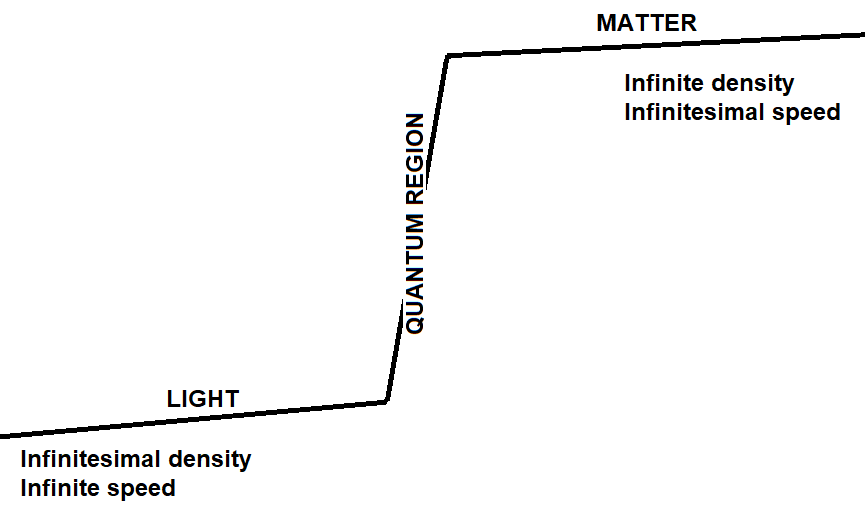
It appears that the lesser is the mass density of a substance, the greater is its velocity. This velocity is indicative of an intrinsic motion, and not of relative motions. There are many examples of intrinsic motion in the macroscopic material world in the form of the brownian motion and in the agitation of gas molecules.
There exists instrinsic motion in substances due to differences in their mass densities.
.
Motion of Matter
The mass density in the material region may be called inertia. This is so with solid and liquids where atoms are concentrated. Gases shall be excluded from this consideration unless they are liquefied or frozen.
We may, therefore, expect a material object to be fixed in its natural velocity. If the material object is forced to accelerate by the application of external force, it will return to its natural velocity when that force is removed. This conclusion modifies what Newton proposed.
If a material object is continually accelerated by the application of a constant force (as in a gravitational field), then its inertia might decrease. This change, however, may be imperceptible because of energy to mass ratio is c2 to 1.
The following conclusions of the theory of special relativity become questionable.
- Does mass increases with increasing velocity? The opposite appears to be true.
- Can a material object be accelerated to the velocity of light without reducing its inertia? This doesn’t seem to be so.
Many scientific beliefs have been inspired by incorrect interpretations of mathematics, as in the case of the special theory of relativity.
.
Motion of Field
The mass density of the EM radiation may be approximated by its frequency. The higher is the frequency the greater seems to be the mass density of the field. We may, therefore, expect the velocity of the field substance to decrease with increasing frequency.
The velocity of light that has been measured is essentially the velocity of visible light. We assume this velocity to be the same throughout the EM spectrum, but that may not be so. This assumption is the outcome of Maxwell’s theory, which, by default, assumes constant mass density for aether, the medium of whole EM spectrum.
The gravitational field is expected to have much lesser mass density and frequency than those in the EM spectrum. Therefore, its velocity is expected to be much higher than the velocity of light
On the basis of mass density the speed of gravitational field is expected to be much greater than the velocity of light.
.
Absolute Motion
Absolute motion is the motion that does not depend on anything external to the moving object for its existence or specific nature. Thus, the motion, which depends only on the mass density of the substance, may be deemed absolute.
A substance of infinite inertia is expected to be at absolute rest. In other words, any substance at absolute rest shall have infinite inertia. If there is stationary aether, its inertia would be infinite. The empty space has zero inertia. Therefore, empty space shall have infinie velocity.
Einstein was right to discard the notion of stationary aether.
Acceleration is the change in velocity relative to the velocity of the object. Therefore, acceleration shall also fall under the category of absolute motion. Acceleration may also be seen as change in relative velocity. Relative velocity however, cannot be determined without an external reference. But acceleration can be sensed in one’s bones without an external reference.
Absolute motion exists.
.
