
Reference: Einstein’s 1920 Book
Appendix III
The Experimental Confirmation of the General Theory of Relativity
Please see Appendix 3 at the link above.
The development of a science a purely empirical enterprise. The theory correlates a large number of single observations. Although there are different theories, but they may agree completely in terms of deductions from them, which are capable of being tested.
General theory of relativity differs fundamentally from Newtonian mechanics, but the deductions from them are very much in agreement except in few testable cases.
(a) Motion of the Perihelion of Mercury
According to the general theory of relativity, the major axis of the elliptical orbit rotates round the sun in the same sense as the orbital motion of the planet. Theory requires that this rotation should amount to 43 seconds of arc per century for the planet Mercury. This is conformed by actual observations. The theory of Newton does not suffice to calculate the observed motion of Mercury with an
exactness as observed.
(b) Deflection of Light by a Gravitational Field
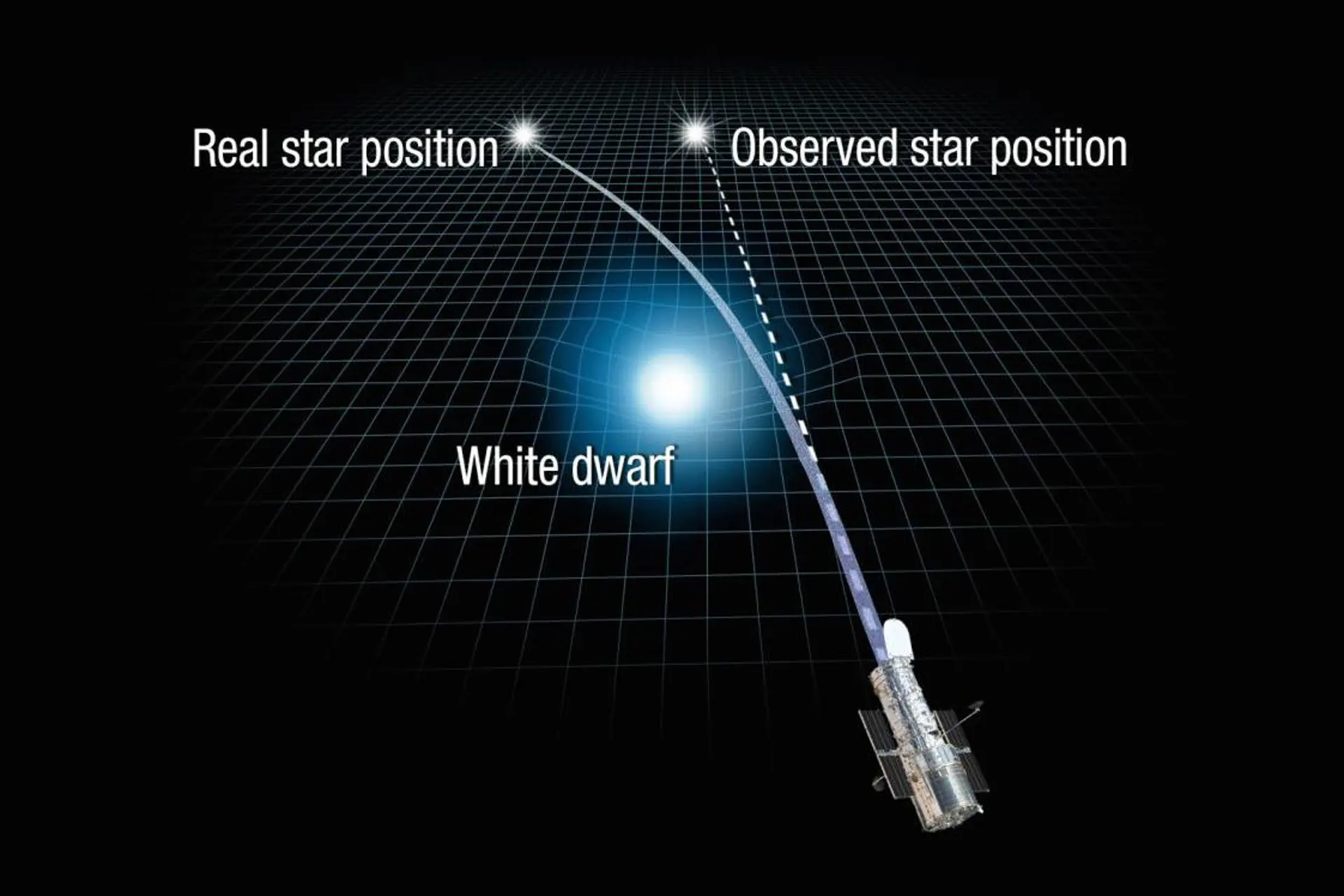
As a result of this theory, it was expected that a ray of light which is passing close to a heavenly body would be deviated towards the latter. This was tested during the total solar eclipse of 29th May, 1919. The stars in the neighborhood of the sun were photographed during the solar eclipse. The photograph was then compared for the position of the stars when sun was not present. The positions of the stars on the eclipse-photograph appeared displaced radially outwards (away from the centre of the sun) as predicted. The results of the measurements confirmed the theory in a thoroughly satisfactory manner.
(c) Displacement of Spectral Lines towards the Red.
An atom absorbs or emits light of a frequency which is dependent on the potential of the gravitational field in which it is situated. The frequency of an atom situated on the surface of a heavenly body will be somewhat less than the frequency of an atom of the same element which is situated in free space (or on the surface of a smaller celestial body). Thus a displacement towards the red ought to take place for spectral lines produced at the surface of stars as compared with the spectral lines of the same element produced at the surface of the earth. For the sun, the displacement towards the red predicted by theory amounts to about two millionths of the wave-length. A trustworthy calculation is not possible in the case of the stars, because in general neither the mass M nor the radius r is known. Up to the present the examination of the available data does not allow of any definite decision being arrived at, as to whether or not these displacements are to be referred in reality to the effect of gravitation.
.
