Monthly Archives: April 2019

OT 1948: Glossary

Reference: DIANETICS: The Original Thesis

This paper presents Chapter 18 from the book DIANETICS: THE ORIGINAL THESIS by L. RON HUBBARD. The contents are from the original publication of this book by The Hubbard Dianetic Foundation, Inc. (1948).

The paragraphs of the original material (in black) are accompanied by brief comments (in color) based on the present understanding.  Feedback on these comments is appreciated.

The heading below is linked to the original materials.

.

Glossary

A.A.—An attempted abortion case.

ABERREE — An aberrated individual, sane or insane, containing unrelieved engrams.

ANALYTICAL MIND — The residence of consciousness in the individual and the seat of his basic personality. This is an analogical term. The analytical mind can be sub-divided.

Alternatively, the analytical mind is the assimilated part of the mental matrix.

ASSOCIATIVE RESTIMULATOR— A perceptic in the environment which is confused with an actual restimulator.

BREAK ENGRAM — The secondary engram after the receipt of which the individual experienced a lowering of general tone to 2.5 or below and became therefore unable to cope with his environment.

CLEAR—(1) Dianetic Clear: An individual who has been cleared of all engrams and chains and who has achieved a general tone four; a Dianetic Case Completion; one who through Dianetic processing has become free of those things which make a person susceptible to, and “hold in place,” psychosomatic ills, and is a healthy, happy human being. In this book Clear means Dianetic Clear. (2) Scientology Clear: A person who, having received all the processing gains from Dianetics to Grade VI (highest Scientology Release Grade), has then completed the Clearing Course at an Advanced Organization. A Scientology Clear has by definition the ability to be cause over mental matter, energy, space and time as regards the First Dynamic (ref. chapter The Dynamics, in this book).

Alternatively, when the mental matrix is cleared of all aberrated and engramic nodes, it is fully assimilated. Such is the matrix of a person designated Clear.

CONFUSION — The condition of an area of an engram or the condition of a chain. Instants of existence which are not properly aligned on the time track.

CROSS ENGRAM — The severe engramic experience wherein two chains have met causing a marked change in the life of the individual. This is an engram which is on the time track of each of two or more chains.

DIANETICIST— A skilled user of dianetic therapy.

DIANETICS — Means “through the soul” (from Greek dia. through, and noes, soul). It is the first fully precise science of the mind. The world before Dianetics had never known a precision mental science.

DISPERSAL— The action of a dynamic or purpose meeting an engram. It is describable by an analogy of an electron stream striking impedance and showering around it, much weakened.

DYNAMIC — The dynamic thrust into time and space of an individual, a species, or a unit of matter or energy. Especially defined for the purpose of Dianetics as “Survive.”

DYNAMIC DIANETICS—The science of the basic drives of the individual and his basic personality. At this writing the branch of Dianetics most intensely under observation and research is this one. (See Science of Survival by L. Ron Hubbard.)

ENGRAM — A period of physical pain including unconsciousness and antagonism experienced by an individual, group or society and residing thereafter as irrational and restimulatable dramatizations.

Alternatively, this is a traumatic experience, which could not be assimilated in the mental matrix, and which remains connected as an unassimilated node.

ENGRAM CHAIN— A series of similar engrams on one or more dynamics which impede the dynamics of the individual.

Alternatively, this is a network of engrams, secondaries and locks.

LOCK— A period of mental anguish depending for its force upon an engram. It may or may not be available to the analytical mind but it does not contain actual unconsciousness.

Alternatively, these are tentacles of the engram reaching into the mental matrix.

PRECLEAR — Any individual receiving dianetic auditing for the purpose of being cleared; anyone not yet Clear.

Alternatively, this is the auditee, the person who is being audited.

PURPOSE—The survival route chosen by an individual, a species, or a unit of matter or energy in the accomplishment of its goal. (NOTE: The purpose is specific and may be closely defined being a subdivision of one of the sub-dynamics. It has been tentatively established by investigation that an individual human being has established his purpose for life at the age of two years and that the actual purpose is not derived in any degree from engrams but is only warped by them.)

REACTIVE MIND — That portion of the nervous system which contains reflexive or reactive data which does not clear through the analytical mind but is subject to dramatization or aberrations. It uses as a thought process the conception of identities. A equals A equals A. This is essentially the animal thinking mechanism.

This is simply the unassimilated portion of the mental matrix. In animals, the mental matrix is very coarse and not necessarily unassimilated.

RELEASE — ( 1 ) Dianetic Release: A preclear in whom the majority of emotional stress has been deleted from the reactive mind. Has had large gains from Dianetics, is not yet a Dianetic Case Completion. (2) Scientology Release: A series of major levels of gain wherein Scientology processing frees the person from the principal life difficulties or personal “blocks” stemming from the mind. Called Release Grades, each of these levels must be completed for one to be ready to undertake Scientology Clearing. Note: Release, in this book, refers to Dianetic Release.

RESTIMULATOR — The environmental perceptic which approximates a precise part of the engramic perceptics in the reactive mind.

SCIENTOLOGY — The study of knowledge in its fullest sense, and applied religious philosophy that covers man’s relationship to the universe. Dianetics is the forerunner of Scientology. Dianetics was the ultimate development of the mind of human beings. Scientology is the road from there to total freedom.

SOMATIC—The physiological counterpart of mental aberration. A somatic attends every aberration. This term is used in lieu of “physical pain” in auditing due to the high engramic value of the word pain and its failure to include in its meaning all painful perceptics.

TIME TRACK—The memory record of an individual, motor or sensory, precisely aligned in moments of time. In a Clear all such moments are available to the analytical mind. In an aberree areas of the time track are obscured, but the time track is considered to be in perfect condition, if partially and temporarily obscured. The existence of two time tracks is suspected— one sensory and one motor, the latter being more available to the dianeticist in the form of somatics. The time track is precise but as the analytical mind addresses it in the aberree, it is apparently obliterated in part, or tangled.

Alternatively, there are networked relationships, which, in a broader form, may appear to be sequentially connected. If there is a linear chain it exists within the facsimile only. It is not a property of the mind.

TONE—The emotional condition of an engram or the general condition of an individual.

TRAUMA — A term from a school of psychology implying an experience which would create a psychic scar. It is unused in Dianetics as being liable to misunderstanding of the nature of severe experiences. Scars cannot be removed; psychosomatic experiences can be.

UNCONSCIOUSNESS — A condition wherein the organism is discoordinated only in its analytical process and motor control direction. In the physio-animal section of the brain, a complete time track and a complete memory record of all perceptions for all moments of the organism’s existence is available.

Alternatively, this is a circuit, when activated, bypasses the assimilated matrix, which represents the consciousness of the individual.

.

OT 1948: Case Histories

Reference: DIANETICS: The Original Thesis

This paper presents Chapter 17 from the book DIANETICS: THE ORIGINAL THESIS by L. RON HUBBARD. The contents are from the original publication of this book by The Hubbard Dianetic Foundation, Inc. (1948).

The paragraphs of the original material (in black) are accompanied by brief comments (in color) based on the present understanding.  Feedback on these comments is appreciated.

The heading below is linked to the original materials.

.

Case Histories

The following case histories have been selected at random. Due to lack of time, these case histories are Releases, not Clears. The Releases have been fully diagnosed and researched.

.

CASE NO. 1

HYPERTENSION, COMBAT FATIGUE
TUBERCULOSIS, ARRESTED
MYOPIC ASTIGMATISM

A forty-three year old ex-Army officer and author; inclined to petty tyrannies; twice divorced; no children. Processed by army as psycho-neurotic.

Birth was discovered immediately but would not satisfactorily release. The preclear experienced great difficulty in visualizing and his aberrations intensified during auditing.

By use of dreams and restimulation of somatics the preclear was able to reach the beginning of the engramic chain as counted backwards from birth. Fifteen prenatal experiences were unstacked. They were found lying in two loops. The loops were corrected and the basic engram of the basic chain was reached. (A loop is a redoubling of the time track back on itself. In this case incidents are not in their correct place on the time track. )

The basic consisted of a severe quarrel between his mother and father with several abdominal blows being received by the mother. The mother was protesting that it would make her sick all of her life. At the same time the mother was coughing from a throat blow. The father was insisting that he was master in his own home and that people had to do what he told them. This quarrel occurred at about four and a half months after conception and resulted in the temporary paralysis of the preclear’s right side. The remainder of the chain consisted of similar incidents, evidently dramatizations on the part of the father of his own engrams, as the words used were almost identical, one engram to the next. This chain accounted for and relieved the subject’s fear that he would be ill and his desire to tyrannize others.

Birth was then found to consist of near suffocation and considerable antagonism between the doctor and the nurse. This was registered as commands to himself to the effect that he was blind and could not see. Birth was in the home and dust, camphor, the smell of clean sheets and greased metal were the restimulators for this severe lung irritation. This birth was not restimulated until the age of five and the prenatals were not restimulated until entrance into the service when the need for authority manifested itself.

No locks were found to need attention and only one half hour of his war experience failed to release, that being a new basic.

Number of hours on case: fifty-five.

.

CASE NO. 2

APATHY, PRECLEAR HAD BEEN UNDER PSYCHIATRIC TREATMENT FOR TWO YEARS PRIOR TO DIANETIC AUDITING. SHE HAD EXPERIENCED NO RELIEF. MALNUTRITION.

An eighteen-year-old girl in a condition of apathy bordering upon a break and worsening. She had been recently married. Afraid of her husband. She had done very badly in school, sporadically engaged in sexual escapades, relapsing afterwards into an illness which was variously diagnosed.

Case was entered with ease. Birth was reached and would not exhaust. A search for prenatals was for ten hours fruitless, until certain somatics were artificially restimulated and intensified to the point that the preclear had to recall the incident to find relief. Eight prenatals were then unstacked and only two incidents were discovered in confusion with each other, held together with a head somatic.

The basic proved to be a mutual abortion attempt by the mother and father. The mother said she would die if anyone found out but that she would probably die anyway. The father said that the baby was probably like her and that he didn’t want it. Eighteen penetrations of the head, throat and shoulders with a long orange-wood stick—probably in the third month. Several similar incidents completed this chain. Coitus followed each attempt at abortion. Another incident proved to be a basic without a chain and with innumerable locks: an attempted abortion by a professional abortionist who used some form of needle and scraper. Birth was found to be a mild experience. Three infant engrams with their own basic were discovered. They consisted of the mother’s fear over the injury and the fear that the baby would die.

Contagion of attempted abortion engrams was particularly manifest in the mother’s neurotic dwelling on fear of death, which was obviously a dramatization.

All neurotic and psychotic symptoms were relieved with a marked improvement in the health of the preclear and an increase of twenty-seven points on the Army Alpha test. Time of work: 65 hours.

.

CASE NO. 3

PSYCHOTIC MURDEROUS RAGES.
CHRONIC SKIN RASH.

A thirty-year-old male negro, six feet four inches in height, about two hundred and fifty pounds—swamp worker. He was in continual trouble with police and had a considerable jail record. He continually dramatized a hatred of women. He also dramatized a continuous suspicion that he was about to be murdered. His I.Q. was about eighty-five.

Uniquely enough this case offered no difficulties in entrance. The subject was extremely cooperative with the dianeticist. Birth was found and exhausted without improvement in the case. A number of infant and childhood engrams were discovered and tested. Continual address of the preclear’s attention to prenatal life finally brought about a convulsion in which terror and rage alternated. The dianeticist was able to induce the preclear to listen to the voices he was hearing and to go through with the experience.

The convulsion proved to be twenty engrams nearer birth than the basic, which lay on another chain and which was discovered by dream technique. The convulsion was caused by the dramatization of an engram involving the injection of turpentine into the uterus by the mother in an attempted abortion. The main engramic chain consisted of the mother’s efforts to abort herself. From engramic content it was gathered that the mother was a prostitute, for as many as twenty experiences of coitus succeeded two of these abortion attempts. They were too numerous to be evaluated.

The basic chain contained many quarrels about money between the mother and her customers. The somatics of this chain were largely bruises and concussions caused by the mother ramming herself into pointed objects, or beating her stomach and abdomen. There were many loops in the basic chain caused by the similarity of incident and the confusion of coitus with abortion attempts. The basic incident was at last discovered and exhausted. It was found to lie about twenty days after conception, when the mother first discovered her pregnancy.

All engrams were exhausted in the basic chain. The convulsion was fully cleared and birth was suddenly found to have been a very painful experience, particularly because the child was taken by others immediately after birth. Only one engram chain (unconsciousness resulting from fist fights) was found in childhood.

.

Final Comments

These hypnotism-oriented techniques of Dianetics require skill that is beyond the reach of general populace. There should be an easier alternative.

It is important to reach the engramic node and assimilate it into the mental matrix. After that the aberrated circuits can be straightened out quite easily. But the effort to reach the engramic node may require unburdening of some other aberrated nodes as a gradient.

.

Einstein 1938: Physics and Reality

Reference: Evolution of Physics

This paper presents Chapter IV section 7 from the book THE EVOLUTION OF PHYSICS by A. EINSTEIN and L. INFELD. The contents are from the original publication of this book by Simon and Schuster, New York (1942).

The paragraphs of the original material (in black) are accompanied by brief comments (in color) based on the present understanding.  Feedback on these comments is appreciated.

The heading below is linked to the original materials.

.

Physics and Reality

What are the general conclusions which can be drawn from the development of physics indicated here in a broad outline representing only the most fundamental ideas?

Science is not just a collection of laws, a catalogue of unrelated facts. It is a creation of the human mind, with its freely invented ideas and concepts. Physical theories try to form a picture of reality and to establish its connection with the wide world of sense impressions. Thus the only justification for our mental structures is whether and in what way our theories form such a link.

The theories of Physics try to describe the consistency between the physical reality and our mental structures.

We have seen new realities created by the advance of physics. But this chain of creation can be traced back far beyond the starting point of physics. One of the most primitive concepts is that of an object. The concepts of a tree, a horse, any material body, are creations gained on the basis of experience, though the impressions from which they arise are primitive in comparison with the world of physical phenomena. A cat teasing a mouse also creates, by thought, its own primitive reality. The fact that the cat reacts in a similar way toward any mouse it meets shows that it forms concepts and theories which are its guide through its own world of sense impressions.

“Three trees” is something different from “two trees”. Again “two trees” is different from “two stones”. The concepts of the pure numbers 2, 3, 4…, freed from the objects from which they arose, are creations of the thinking mind which describe the reality of our world.

An object is a primitive concept. From objects to numbers is a movement from concrete toward abstraction.

The psychological subjective feeling of time enables us to order our impressions, to state that one event precedes another. But to connect every instant of time with a number, by the use of a clock, to regard time as a one-dimensional continuum, is already an invention. So also are the concepts of Euclidean and non-Euclidean geometry, and our space understood as a three-dimensional continuum.

Our impressions are related to each other more as a matrix of “elements of knowledge”. They are not just a linear arrangement in terms of time.

Physics really began with the invention of mass, force, and an inertial system. These concepts are all free inventions. They led to the formulation of the mechanical point of view. For the physicist of the early nineteenth century, the reality of our outer world consisted of particles with simple forces acting between them and depending only on the distance. He tried to retain as long as possible his belief that he would succeed in explaining all events in nature by these fundamental concepts of reality. The difficulties connected with the deflection of the magnetic needle, the difficulties connected with the structure of the ether, induced us to create a more subtle reality. The important invention of the electromagnetic field appears. A courageous scientific imagination was needed to realize fully that not the behaviour of bodies, but the behaviour of something between them, that is, the field, may be essential for ordering and understanding events.

Particles are condensed inertia. The space between them is diffused inertia. The force between them probably represents inertial wave. This was Faraday’s view. This view can probably explain a lot of electromagnetic and quantum phenomena.

Later developments both destroyed old concepts and created new ones. Absolute time and the inertial co-ordinate system were abandoned by the relativity theory. The background for all events was no longer the one-dimensional time and the three-dimensional space continuum, but the four-dimensional time-space continuum, another free invention, with new transformation properties. The inertial co-ordinate system was no longer needed. Every co-ordinate system is equally suited for the description of events in nature.

The relativity theory delves indirectly into the diffusion of inertia through diffusion of space and time.

The quantum theory again created new and essential features of our reality. Discontinuity replaced continuity. Instead of laws governing individuals, probability laws appeared.

The reality created by modern physics is, indeed, far removed from the reality of the early days. But the aim of every physical theory still remains the same.

Quantum theory is dealing directly with the diffusion of inertia.

With the help of physical theories we try to find our way through the maze of observed facts, to order and understand the world of our sense impressions. We want the observed facts to follow logically from our concept of reality. Without the belief that it is possible to grasp the reality with our theoretical constructions, without the belief in the inner harmony of our world, there could be no science. This belief is and always will remain the fundamental motive for all scientific creation. Throughout all our efforts, in every dramatic struggle between old and new views, we recognize the eternal longing for understanding, the ever-firm belief in the harmony of our world, continually strengthened by the increasing obstacles to comprehension.

There is inherent harmony in physical reality. We are trying to comprehend that harmony through physical theories.

WE SUMMARIZE:

Again the rich variety of facts in the realm of atomic phenomena forces us to invent new physical concepts. Matter has a granular structure; it is composed of elementary particles, the elementary quanta of matter. Thus, the electric charge has a granular structure and most important from the point of view of the quantum theory so has energy. Photons are the energy quanta of which light is composed.

Is light a wave or a shower of photons? Is a beam of electrons a shower of elementary particles or a wave? These fundamental questions are forced upon physics by experiment. In seeking to answer them we have to abandon the description of atomic events as happenings in space and time, we have to retreat still further from the old mechanical view. Quantum physics formulates laws governing crowds and not individuals. Not properties but probabilities are described, not laws disclosing the future of systems are formulated, but laws governing the changes in time of the probabilities and relating to great congregations of individuals.

.

The dimension being discovered through the theory of relativity and quantum theory is the dimension of inertia. We live on a plateau of inertia, where we have been oblivious of small changes in inertia. The theory of relativity considered the “diffusion” of space and time. The light quanta considered the diffusion of mass. Underlying this is the relationship between inertia, space and time. With diffusion of inertia there is a diffusion of space and time.

.

Einstein 1938: Probability Waves

Reference: Evolution of Physics

This paper presents Chapter IV section 6 from the book THE EVOLUTION OF PHYSICS by A. EINSTEIN and L. INFELD. The contents are from the original publication of this book by Simon and Schuster, New York (1942).

The paragraphs of the original material (in black) are accompanied by brief comments (in color) based on the present understanding.  Feedback on these comments is appreciated.

The heading below is linked to the original materials.

.

Probability Waves

If, according to classical mechanics, we know the position and velocity of a given material point and also what external forces are acting, we can predict, from the mechanical laws, the whole of its future path. The sentence: “The material point has such-and-such position and velocity at such-and-such an instant,” has a definite meaning in classical mechanics. If this statement were to lose its sense, our argument (p. 32) about foretelling the future path would fail.

When no forces are acting on a given material point it has a velocity corresponding to its inertia, and it also has a curvature to its path.

In the early nineteenth century, scientists wanted to reduce all physics to simple forces acting on material particles that have definite positions and velocities at any instant. Let us recall how we described motion when discussing mechanics at the beginning of our journey through the realm of physical problems. We drew points along a definite path showing the exact positions of the body at certain instants and then tangent vectors showing the direction and magnitude of the velocities. This was both simple and convincing. But it cannot be repeated for our elementary quanta of matter, that is electrons, or for quanta of energy, that is photons. We cannot picture the journey of a photon or electron in the way we imagined motion in classical mechanics. The example of the two pinholes shows this clearly. Electron and photon seem to pass through the two holes. It is thus impossible to explain the effect by picturing the path of an electron or a photon in the old classical way.

It should be so for electrons and photons also; but they do not act as point particles as shown by the two pin holes example. They are relatively “diffused” as particles, and we cannot predict their precise path.

We must, of course, assume the presence of elementary actions, such as the passing of electrons or photons through the holes. The existence of elementary quanta of matter and energy cannot be doubted. But the elementary laws certainly cannot be formulated by specifying positions and velocities at any instant in the simple manner of classical mechanics.

But their paths can be predicted for larger holes relative to which they may act as “point particles”.

Let us, therefore, try something different. Let us continually repeat the same elementary processes. One after the other, the electrons are sent in the direction of the pinholes. The word “electron” is used here for the sake of definiteness; our argument is also valid for photons.

The same experiment is repeated over and over again in exactly the same way; the electrons all have the same velocity and move in the direction of the two pinholes. It need hardly be mentioned that this is an idealized experiment which cannot be carried out in reality but may well be imagined. We cannot shoot out single photons or electrons at given instants, like bullets from a gun.

The outcome of repeated experiments must again be dark and light rings for one hole and dark and light stripes for two. But there is one essential difference. In the case of one individual electron, the experimental result was incomprehensible. It is more easily understood when the experiment is repeated many times. We can now say: light stripes appear where many electrons fall. The stripes become darker at the place where fewer electrons are falling. A completely dark spot means that there are no electrons. We are not, of course, allowed to assume that all the electrons pass through one of the holes. If this were so, it could not make the slightest difference whether or not the other is covered. But we already know that covering the second hole does make a difference. Since one particle is indivisible, we cannot imagine that it passes through both the holes. The fact that the experiment was repeated many times points to another way out. Some of the electrons may pass through the first hole and others through the second. We do not know why individual electrons choose particular holes, but the net result of repeated experiments must be that both pinholes participate in transmitting the electrons from the source to the screen. If we state only what happens to the crowd of electrons when the experiment is repeated, not bothering about the behaviour of individual particles, the difference between the ringed and the striped pictures becomes comprehensible. By the discussion of a sequence of experiments a new idea was born, that of a crowd with the individuals behaving in an unpredictable way. We cannot foretell the course of one single electron, but we can predict that, in the net result, the light and dark stripes will appear on the screen.

We are assuming that electrons and photons are indivisible. These particles are too diffused to act as point particles relative to the pinholes. Both pinholes participate in transmitting the electrons. We cannot foretell the course of one single electron, but we can predict that, in the net result, the light and dark stripes will appear on the screen.

Let us leave quantum physics for the moment.

We have seen in classical physics that if we know the position and velocity of a material point at a certain instant and the forces acting upon it, we can predict its future path. We also saw how the mechanical point of view was applied to the kinetic theory of matter. But in this theory a new idea arose from our reasoning. It will be helpful in understanding later arguments to grasp this idea thoroughly.

There is a vessel containing gas. In attempting to trace the motion of every particle one would have to commence by finding the initial states, that is, the initial positions and velocities of all the particles. Even if this were possible, it would take more than a human lifetime to set down the result on paper, owing to the enormous number of particles which would have to be considered. If one then tried to employ the known methods of classical mechanics for calculating the final positions of the particles, the difficulties would be insurmountable. In principle, it is possible to use the method applied for the motion of planets, but in practice this is useless and must give way to the method of statistics. This method dispenses with any exact knowledge of initial states. We know less about the system at any given moment and are thus less able to say anything about its past or future. We become indifferent to the fate of the individual gas particles. Our problem is of a different nature. For example: we do not ask, “What is the speed of every particle at this moment?” But we may ask: “How many particles have a speed between 1000 and 1100 feet per second?We care nothing for individuals. What we seek to determine are average values typifying the whole aggregation. It is clear that there can be some point in a statistical method of reasoning only when the system consists of a large number of individuals.

In kinetic theory of gases, It may be possible to foretell the course of each gas particle, but in practice this is useless and must give way to the method of statistics. What we seek to determine are average values, typifying the whole aggregation. It is clear that there can be some point in a statistical method of reasoning only when the system consists of a large number of individuals.

By applying the statistical method we cannot foretell the behaviour of an individual in a crowd. We can only foretell the chance, the probability, that it will behave in some particular manner. If our statistical laws tell us that one-third of the particles have a speed between 1000 and 1100 feet per second, it means that by repeating our observations for many particles, we shall really obtain this average, or in other words, that the probability of finding a particle within this limit is equal to one-third.

Similarly, to know the birth rate of a great community does not mean knowing whether any particular family is blessed with a child. It means a knowledge of statistical results in which the contributing personalities play no role.

By observing the registration plates of a great many cars we can soon discover that one-third of their numbers are divisible by three. But we cannot foretell whether the car which will pass in the next moment will have this property. Statistical laws can be applied only to big aggregations, but not to their individual members.

We can now return to our quantum problem.

The laws of quantum physics are of a statistical character. This means: they concern not one single system but an aggregation of identical systems; they cannot be verified by measurement of one individual, but only by a series of repeated measurements.

It means a knowledge of statistical results in which the contributing personalities play no role. Statistical laws can be applied only to big aggregations, but not to their individual members. The laws of quantum physics are of a statistical character.

Radioactive disintegration is one of the many events for which quantum physics tries to formulate laws governing the spontaneous transmutation from one element to another. We know, for example, that in 1600 years half of one gram of radium will disintegrate, and half will remain. We can foretell approximately how many atoms will disintegrate during the next half-hour, but we cannot say, even in our theoretical descriptions, why just these particular atoms are doomed. According to our present knowledge, we have no power to designate the individual atoms condemned to disintegration. The fate of an atom does not depend on its age. There is not the slightest trace of a law governing their individual behaviour. Only statistical laws can be formulated, laws governing large aggregations of atoms.

But we can make certain conclusions about the nature of our basic concepts and assumptions.

Take another example. The luminous gas of some element placed before a spectroscope shows lines of definite wave-length. The appearance of a discontinuous set of definite wave-lengths is characteristic of the atomic phenomena in which the existence of elementary quanta is revealed. But there is still another aspect of this problem. Some of the spectrum lines are very distinct, others are fainter. A distinct line means that a comparatively large number of photons belonging to this particular wave-length are emitted; a faint line means that a comparatively small number of photons belonging to this wave-length are emitted. Theory again gives us statements of a statistical nature only. Every line corresponds to a transition from higher to lower energy level. Theory tells us only about the probability of each of these possible transitions, but nothing about the actual transition of an individual atom. The theory works splendidly because all these phenomena involve large aggregations and not single individuals.

The appearance of a discontinuous set of definite wave-lengths is characteristic of the atomic phenomena in which the existence of elementary quanta is revealed. The theory works splendidly because all these phenomena involve large aggregations and not single individuals.

It seems that the new quantum physics resembles somewhat the kinetic theory of matter, since both are of a statistical nature and both refer to great aggregations. But this is not so! In this analogy an understanding not only of the similarities but also of the differences is most important. The similarity between the kinetic theory of matter and quantum physics lies chiefly in their statistical character. But what are the differences?

If we wish to know how many men and women over the age of twenty live in a city, we must get every citizen to fill up a form under the headings “male”, “female”, and “age”. Provided every answer is correct, we can obtain, by counting and segregating them, a result of a statistical nature. The individual names and addresses on the forms are of no account. Our statistical view is gained by the knowledge of individual cases. Similarly, in the kinetic theory of matter, we have statistical laws governing the aggregation, gained on the basis of individual laws.

But in quantum physics the state of affairs is entirely different. Here the statistical laws are given immediately. The individual laws are discarded. In the example of a photon or an electron and two pinholes we have seen that we cannot describe the possible motion of elementary particles in space and time as we did in classical physics. Quantum physics abandons individual laws of elementary particles and states directly the statistical laws governing aggregations. It is impossible, on the basis of quantum physics, to describe positions and velocities of an elementary particle or to predict its future path as in classical physics. Quantum physics deals only with aggregations, and its laws are for crowds and not for individuals.

In kinetic theory of matter the statistical view is gained by the knowledge of individual cases. But in quantum physics the statistical laws are given immediately. In the example of two pinholes we cannot describe the possible motion in space and time for individual electrons, but for aggregation only.

It is hard necessity and not speculation or a desire for novelty which forces us to change the old classical view. The difficulties of applying the old view have been outlined for one instance only, that of diffraction phenomena. But many others, equally convincing, could be quoted. Changes of view are continually forced upon us by our attempts to understand reality. But it always remains for the future to decide whether we chose the only possible way out and whether or not a better solution of our difficulties could have been found.

We have had to forsake the description of individual cases as objective happenings in space and time; we have had to introduce laws of a statistical nature. These are the chief characteristics of modern quantum physics.

The classical view of stark contrast between particle and void can no longer be maintained in the quantum theory. The quanta may be identified as a chain of particles, which are not completely disconnected from each other.

Previously, when introducing new physical realities, such as the electromagnetic and gravitational field, we tried to indicate in general terms the characteristic features of the equations through which the ideas have been mathematically formulated. We shall now do the same with quantum physics, referring only very briefly to the work of Bohr, de Broglie, Schrodinger, Heisenberg, Dirac and Born.

Let us consider the case of one electron. The electron may be under the influence of an arbitrary foreign electromagnetic field, or free from all external influences. It may move, for instance, in the field of an atomic nucleus or it may diffract on a crystal. Quantum physics teaches us how to formulate the mathematical equations for any of these problems.

We have already recognized the similarity between an oscillating cord, the membrane of a drum, a wind instrument, or any other acoustical instrument on the one hand, and a radiating atom on the other. There is also some similarity between the mathematical equations governing the acoustical problem and those governing the problem of quantum physics. But again the physical interpretation of the quantities determined in these two cases is quite different. The physical quantities describing the oscillating cord and the radiating atom have quite a different meaning, despite some formal likeness in the equations. In the case of the cord, we ask about the deviation of an arbitrary point from its normal position at an arbitrary moment. Knowing the form of the oscillating cord at a given instant, we know everything we wish. The deviation from the normal can thus be calculated for any other moment from the mathematical equations for the oscillating cord. The fact that some definite deviation from the normal position corresponds to every point of the cord is expressed more rigorously as follows: for any instant, the deviation from the normal value is a function of the co-ordinates of the cord. All points of the cord form a one-dimensional continuum, and the deviation is a function defined in this one-dimensional continuum, to be calculated from the equations of the oscillating cord.

In the problem of the oscillating cord, we deal with the cord, mathematically, as a one-dimensional continuum of deviations from normal position.

Analogously, in the case of an electron a certain function is determined for any point in space and for any moment. We shall call this function the probability wave. In our analogy the probability wave corresponds to the deviation from the normal position in the acoustical problem. The probability wave is, at a given instant, a function of a three-dimensional continuum, whereas, in the case of the cord the deviation was, at a given moment, a function of the one-dimensional continuum. The probability wave forms the catalogue of our knowledge of the quantum system under consideration and will enable us to answer all sensible statistical questions concerning this system. It does not tell us the position and velocity of the electron at any moment because such a question has no sense in quantum physics. But it will tell us the probability of meeting the electron on a particular spot, or where we have the greatest chance of meeting an electron. The result does not refer to one, but to many repeated measurements. Thus the equations of quantum physics determine the probability wave just as Maxwell’s equations determine the electromagnetic field and the gravitational equations determine the gravitational field. The laws of quantum physics are again structure laws. But the meaning of physical concepts determined by these equations of quantum physics is much more abstract than in the case of electromagnetic and gravitational fields; they provide only the mathematical means of answering questions of a statistical nature.

A three-dimensional continuum of deviation from normal position may be called a probability wave. This may provide the structure of a diffused electron. It is interesting to note that Quantum physics is still looking at electron as a point particle instead of a diffused particle.

So far we have considered the electron in some external field. If it were not the electron, the smallest possible charge, but some respectable charge containing billions of electrons, we could disregard the whole quantum theory and treat the problem according to our old pre-quantum physics. Speaking of currents in a wire, of charged conductors, of electromagnetic waves, we can apply our old simple physics contained in Maxwell’s equations. But we cannot do this when speaking of the photoelectric effect, intensity of spectral lines, radioactivity, diffraction of electric waves and many other phenomena in which the quantum character of matter and energy is revealed. We must then, so to speak, go one floor higher. Whereas in classical physics we spoke of positions and velocities of one particle, we must now consider probability waves, in a three-dimensional continuum corresponding to this one-particle problem.

In quantum physics, the term “energy” refers more properly to the “diffused mass” of an electron or a quantum particle. It is no longer a point mass; there is a structure to it.

Quantum physics gives its own prescription for treating a problem if we have previously been taught how to treat an analogous problem from the point of view of classical physics.

For one elementary particle, electron or photon, we have probability waves in a three-dimensional continuum, characterizing the statistical behaviour of the system if the experiments are often repeated. But what about the case of not one but two interacting particles, for instance, two electrons, electron and photon, or electron and nucleus? We cannot treat them separately and describe each of them through a probability wave in three dimensions, just because of their mutual interaction. Indeed, it is not very difficult to guess how to describe in quantum physics a system composed of two interacting particles. We have to descend one floor, to return for a moment to classical physics. The position of two material points in space, at any moment, is characterized by six numbers, three for each of the points. All possible positions of the two material points form a six-dimensional continuum and not a three-dimensional one as in the case of one point. If we now again ascend one floor, to quantum physics, we shall have probability waves in a six-dimensional continuum and not in a three-dimensional continuum as in the case of one particle. Similarly, for three, four, and more particles the probability waves will be functions in a continuum of nine, twelve, and more dimensions.

In quantum physics, the statistical behavior described in terms of a “point mass” could be the actual structure of the diffused mass.

This shows clearly that the probability waves are more abstract than the electromagnetic and gravitational field existing and spreading in our three-dimensional space. The continuum of many dimensions forms the background for the probability waves, and only for one particle does the number of dimensions equal that of physical space. The only physical significance of the probability wave is that it enables us to answer sensible statistical questions in the case of many particles as well as of one. Thus, for instance, for one electron we could ask about the probability of meeting an electron in some particular spot. For two particles our question could be: what is the probability of meeting the two particles at two definite spots at a given instant?

The actual three-dimension space may be looked upon as a reality of zero inertia. In this background of space we have three-dimensional diffused mass waves of positive inertia.

Our first step away from classical physics was abandoning the description of individual cases as objective events in space and time. We were forced to apply the statistical method provided by the probability waves. Once having chosen this way, we are obliged to go further toward abstraction. Probability waves in many dimensions corresponding to the many-particle problem must be introduced.

The idea of “individual cases” is like considering point masses.  The idea of statistical “probability waves” is like considering diffused mass or inertial waves.

Let us, for the sake of briefness, call everything except quantum physics, classical physics. Classical and quantum physics differ radically. Classical physics aims at a description of objects existing in space, and the formulation of laws governing their changes in time. But the phenomena revealing the particle and wave nature of matter and radiation, the apparently statistical character of elementary events such as radioactive disintegration, diffraction, emission of spectral lines, and many others, forced us to give up this view. Quantum physics does not aim at the description of individual objects in space and their changes in time. There is no place in quantum physics for statements such as: “This object is so-and-so, has this-and-this property.” Instead we have statements of this kind: “There is such-and-such a probability that the individual object is so-and-so and has this-and-this property.” There is no place in quantum physics for laws governing the changes in time of the individual object. Instead, we have laws governing the changes in time of the probability. Only this fundamental change, brought into physics by the quantum theory, made possible an adequate explanation of the apparently discontinuous and statistical character of events in the realm of phenomena in which the elementary quanta of matter and radiation reveal their existence.

The wave nature of particle seems to originate from its diffused mass structure. Classical and quantum physics differ in the nature of mass or inertia. In classical physics, inertia is concentrated as mass that forms objects. In quantum physics, inertia is diffused as waves that form radiation. The space and time have a different character with diffusion of inertia.

Yet new, still more difficult problems arise which have not been definitely settled as yet. We shall mention only some of these unsolved problems. Science is not and will never be a closed book. Every important advance brings new questions. Every development reveals, in the long run, new and deeper difficulties.

We already know that in the simple case of one or many particles we can rise from the classical to the quantum description, from the objective description of events in space and time to probability waves. But we remember the all-important field concept in classical physics. How can we describe interaction between elementary quanta of matter and field? If a probability wave in thirty dimensions is needed for the quantum description of ten particles, then a probability wave with an infinite number of dimensions would be needed for the quantum description of a field. The transition from the classical field concept to the corresponding problem of probability waves in quantum physics is a very difficult step. Ascending one floor is here no easy task and all attempts so far made to solve the problem must be regarded as unsatisfactory. There is also one other fundamental problem. In all our arguments about the transition from classical physics to quantum physics we used the old pre-relativistic description in which space and time are treated differently. If, however, we try to begin from the classical description as proposed by the relativity theory, then our ascent to the quantum problem seems much more complicated. This is another problem tackled by modern physics, but still far from a complete and satisfactory solution. There is still a further difficulty in forming a consistent physics for heavy particles, constituting the nuclei. In spite of the many experimental data and the many attempts to throw light on the nuclear problem, we are still in the dark about some of the most fundamental questions in this domain.

We can imagine the extremely diffused inertia of photons gradually getting less diffused and more condensed and thus forming into electron. The diffused mass of electron can be imagined to condense into forming the heavier particles of the atom. This could occur in a standing wave type pattern toward a three-dimensional center.

There is no doubt that quantum physics explained a very rich variety of facts, achieving, for the most part, splendid agreement between theory and observation. The new quantum physics removes us still further from the old mechanical view, and a retreat to the former position seems, more than ever, unlikely. But there is also no doubt that quantum physics must still be based on the two concepts: matter and field. It is, in this sense, a dualistic theory and does not bring our old problem of reducing everything to the field concept even one step nearer realization.

The concepts of matter and field in quantum physics may be combined into a single concept of a field of inertia.

Will the further development be along the line chosen in quantum physics, or is it more likely that new revolutionary ideas will be introduced into physics? Will the road of advance again make a sharp turn, as it has so often done in the past?

During the last few years all the difficulties of quantum physics have been concentrated around a few principal points. Physics awaits their solution impatiently. But there is no way of foreseeing when and where the clarification of these difficulties will be brought about.

.

When mass is completely diffused in space it could be said to have infinite velocity. As it condenses the velocity lessens from the infinite value but it still is very large as that of visible light. When mass condenses from photon to an electron and finally to an atom the velocity reduces considerably. As point particles combine into an aggregate, the velocity reduces at a much slower rate. The following graphics may convey this meaning.

However, if such an aggregate suddenly condenses into a denser particle, such as, a neutron star or a black hole, the velocity shall reduce considerably again.

.

Einstein 1938: The Waves of Matter

Reference: Evolution of Physics

This paper presents Chapter IV section 5 from the book THE EVOLUTION OF PHYSICS by A. EINSTEIN and L. INFELD. The contents are from the original publication of this book by Simon and Schuster, New York (1942).

The paragraphs of the original material (in black) are accompanied by brief comments (in color) based on the present understanding.  Feedback on these comments is appreciated.

The heading below is linked to the original materials.

.

The Waves of Matter

How can we understand the fact that only certain characteristic wave-lengths appear in the spectra of the elements?

It has often happened in physics that an essential advance was achieved by carrying out a consistent analogy between apparently unrelated phenomena. In these pages we have often seen how ideas created and developed in one branch of science were afterwards successfully applied to another. The development of the mechanical and field views gives many examples of this kind. The association of solved problems with those unsolved may throw new light on our difficulties by suggesting new ideas. It is easy to find a superficial analogy which really expresses nothing. But to discover some essential common features, hidden beneath a surface of external differences, to form, on this basis, a new successful theory, is important creative work. The development of the so-called wave mechanics, begun by de Broglie and Schrodinger, less than fifteen years ago, is a typical example of the achievement of a successful theory by means of a deep and fortunate analogy.

Our starting-point is a classical example having nothing to do with modern physics. We take in our hand the end of a very long flexible rubber tube, or a very long spring, and try to move it rhythmically up and down, so that the end oscillates. Then, as we have seen in many other examples, a wave is created by the oscillation which spreads through the tube with a certain velocity. If we imagine an infinitely long tube, then the portions of waves, once started, will pursue their endless journey without interference.

Now another case. The two ends of the same tube are fastened. If preferred, a violin string may be used. What happens now if a wave is created at one end of the rubber tube or cord? The wave begins its journey as in the previous example, but it is soon reflected by the other end of the tube. We now have two waves: one creation by oscillation, the other by reflection; they travel in opposite directions and interfere with each other. It would not be difficult to trace the interference of the two waves and discover the one wave resulting from their superposition; it is called the standing wave. The two words “standing” and “wave” seem to contradict each other; their combination is, nevertheless, justified by the result of the superposition of the two waves.

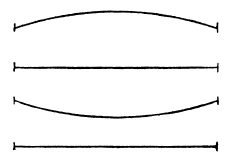
The simplest example of a standing wave is the motion of a cord with the two ends fixed, an up-and down motion, as shown in our drawing. This motion is the result of one wave lying on the other when the two are travelling in opposite directions. The characteristic feature of this motion is: only the two end-points are at rest. They are called nodes. The wave stands, so to speak, between the two nodes, all points of the cord reaching simultaneously the maxima and minima of their deviation.

But this is only the simplest kind of a standing wave. There are others. For example, a standing wave can have three nodes, one at each end and one in the centre. In this case three points are always at rest. A glance at the drawings shows that here the wave-length is half as great as the one with two nodes. Similarly, standing waves can have four, five, and more nodes. The wavelength in each case will depend on the number of nodes. This number can only be an integer and can change only by jumps. The sentence “the number of nodes in a standing wave is 3.576″—is pure nonsense. Thus the wave-length can only change discontinuously. Here, in this most classical problem, we recognize the familiar features of the quantum theory. The standing wave produced by a violin player is, in fact, still more complicated, being a mixture of very many waves with two, three, four, five, and more nodes and, therefore, a mixture of several wave-lengths. Physics can analyse such a mixture into the simple standing waves from which it is composed. Or, using our previous terminology, we could say that the oscillating string has its spectrum, just as an element emitting radiation. And, in the same way as for the spectrum of an element, only certain wave-lengths are allowed, all others being prohibited.

We have thus discovered some similarity between the oscillating cord and the atom emitting radiation. Strange as this analogy may seem, let us draw further conclusions from it and try to proceed with the comparison, once having chosen it. The atoms of every element are composed of elementary particles, the heavier constituting the nucleus, and the lighter the electrons. Such a system of particles behaves like a small acoustical instrument in which standing waves are produced.

Yet the standing wave is the result of interference between two or, generally, even more moving waves. If there is some truth in our analogy, a still simpler arrangement than that of the atom should correspond to a spreading wave. What is the simplest arrangement? In our material world, nothing can be simpler than an electron, an elementary particle, on which no forces are acting, that is, an electron at rest or in uniform motion. We could guess a further link in the chain of our analogy: electron moving uniformly → waves of a definite length. This was de Broglie’s new and courageous idea.

It was previously shown that there are phenomena in which light reveals its wave-like character and others in which light reveals its corpuscular character. After becoming used to the idea that light is a wave, we found, to our astonishment, that in some cases, for instance in the photoelectric effect, it behaves like a shower of photons. Now we have just the opposite state of affairs for electrons. We accustomed ourselves to the idea that electrons are particles, elementary quanta of electricity and matter. Their charge and mass were investigated. If there is any truth in de Broglie’s idea, then there must be some phenomena in which matter reveals its wave-like character. At first, this conclusion, reached by following the acoustical analogy, seems strange and incomprehensible. How can a moving corpuscle have anything to do with a wave? But this is not the first time we have faced a difficulty of this kind in physics. We met the same problem in the domain of light phenomena.

Fundamental ideas play the most essential role in forming a physical theory. Books on physics are full of complicated mathematical formulae. But thought and ideas, not formulae, are the beginning of every physical theory. The ideas must later take the mathematical form of a quantitative theory, to make possible the comparison with experiment. This can be explained by the example of the problem with which we are now dealing. The principal guess is that the uniformly moving electron will behave, in some phenomena, like a wave. Assume that an electron or a shower of electrons, provided they all have the same velocity, is moving uniformly. The mass, charge, and velocity of each individual electron are known. If we wish to associate in some way a wave concept with a uniformly moving electron or electrons, our next question must be: what is the wave-length? This is a quantitative question and a more or less quantitative theory must be built up to answer it. This is indeed a simple matter. The mathematical simplicity of de Broglie’s work, providing an answer to this question, is most astonishing. At the time his work was done, the mathematical technique of other physical theories was very subtle and complicated, comparatively speaking. The mathematics dealing with the problem of waves of matter is extremely simple and elementary but the fundamental ideas are deep and far-reaching.

Previously, in the case of light waves and photons, it was shown that every statement formulated in the wave language can be translated into the language of photons or light corpuscles. The same is true for electronic waves. For uniformly moving electrons, the corpuscular language is already known. But every statement expressed in the corpuscular language can be translated into the wave language, just as in the case of photons. Two clues laid down the rules of translation. The analogy between light waves and electronic waves or photons and electrons is one clue. We try to use the same method of translation for matter as for light. The special relativity theory furnished the other clue. The laws of nature must be invariant with respect to the Lorentz and not to the classical transformation. These two clues together determine the wave-length corresponding to a moving electron. It follows from the theory that an electron moving with a velocity of, say, 10,000 miles per second, has a wave-length which can be easily calculated, and which turns out to lie in the same region as the X-ray wave-lengths. Thus we conclude further that if the wave character of matter can be detected, it should be done experimentally in an analogous way to that of X-rays.

Imagine an electron beam moving uniformly with a given velocity, or, to use the wave terminology, a homogeneous electronic wave, and assume that it falls on a very thin crystal, playing the part of a diffraction grating. The distances between the diffracting obstacles in the crystal are so small that diffraction for X-rays can be produced. One might expect a similar effect for electronic waves with the same order of wave-length. A photographic plate would register this diffraction of electronic waves passing through the thin layer of crystal. Indeed, the experiment produces what is undoubtedly one of the great achievements of the theory: the phenomenon of diffraction for electronic waves. The similarity between the diffraction of an electronic wave and that of an X-ray is particularly marked as seen from a comparison of the patterns in Plate III. We know that such pictures enable us to determine the wave-lengths of X-rays. The same holds good for electronic waves. The diffraction pattern gives the length of a wave of matter and the perfect quantitative agreement between theory and experiment confirms the chain of our argument splendidly.

Our previous difficulties are broadened and deepened by this result. This can be made clear by an example similar to the one given for a light wave. An electron shot at a very small hole will bend like a light wave. Light and dark rings appear on the photographic plate. There may be some hope of explaining this phenomenon by the interaction between the electron and the rim, though such an explanation does not seem to be very promising. But what about the two pinholes? Stripes appear instead of rings. How is it possible that the presence of the other hole completely changes the effect? The electron is indivisible and can, it would seem, pass through only one of the two holes. How could an electron passing through a hole possibly know that another hole has been made some distance away?

We asked before: what is light? Is it a shower of corpuscles or a wave? We now ask: what is matter, what is an electron? Is it a particle or a wave? The electron behaves like a particle when moving in an external electric or magnetic field. It behaves like a wave when diffracted by a crystal. With the elementary quanta of matter we came across the same difficulty that we met with in the light quanta. One of the most fundamental questions raised by recent advance in science is how to reconcile the two contradictory views of matter and wave. It is one of those fundamental difficulties which, once formulated, must lead, in the long run, to scientific progress. Physics has tried to solve this problem. The future must decide whether the solution suggested by modern physics is enduring or temporary.

.

As described in Chapter II-8, light has both wave and particle like properties. It is only when very small obstacles and apertures are used that light reveals its wave-like nature. Later, Einstein showed more directly the particle-like nature of light through the photoelectric phenomenon.

The radiation emitted by atoms has discrete and orderly wavelengths, much like those of a standing wave, where it depends on the number of nodes. Thus, atom as a system of particles behaves like a small acoustical instrument in which standing waves are produced. This observation provided de Broglie with the new and courageous idea that electrons moving uniformly may also represent waves of definite wavelength.

If there is any truth in de Broglie’s idea, then there must be some phenomena, in which electron reveals its wave-like character. It was calculated mathematically that electron may have a wavelength in the same region as the X-ray wave-lengths. This was experimentally confirmed when an electronic beam was sent through a very thin crystal, and the resulting diffraction was registered on a photographic plate.

The only way we can reconcile the two contradictory views of matter and wave is that a moving particle is not like a “moving ball” but more like a vibrating string.

.