
Reference: The Book of Physics
Note: The original text is provided below.
Previous / Next
.
Summary
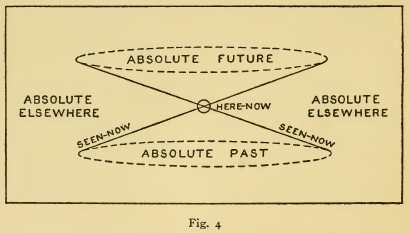
Since the speed of matter is negligible compared to the speed of light, the “seen-now” lines will get agreement from anywhere in the universe. The “seen-now” lines will actually make a cone when all spatial dimensions are taken into account. Eddington limits it to Here-Now but that is not necessary.
Eddington also extends the “seen-now” lines into future, and postulates a “neutral wedge”. But none of this is necessary because anything above the “seen-now” lines is based on calculations, whether it is about instantaneous now or actual future.
Eddington states, “As the speed of matter approaches the speed of light its mass increases to infinity, and therefore it is impossible to make matter travel faster than light.” This statements erroneously considers the external force required to increase the velocity of a particle as its “additional mass.”
In fact, a matter particle, as an isolated system, will decrease in its mass and inertia to increase in velocity. If external force is involved, then more force will be required to push a particle that offers less inertia. For example, a photon has no mass or inertia; therefore, it becomes impossible to accelerate it even with an infinite amount of push. Matter is very limited in its velocity before it looses its identity as matter and converts into a quanta of energy.
.
Comments
As the sense of intuition is better understood, the limitations due to the finite speed of light may be lifted.
.
Original Text
Let us now try to attain this absolute view. We rub out all the Now lines. We rub out Yourself and Myself, since we are no longer essential to the world. But the Seen-Now lines are left. They are absolute, since all observers from Here-Now agree about them. The flat picture is a section; you must imagine it rotated (twice rotated in fact, since there are two more dimensions outside the picture). The Seen-Now locus is thus really a cone; or by taking account of the prolongation of the lines into the future a double cone or hour-glass figure (Fig. 4). These hour-glasses (drawn through each point of the world considered in turn as a Here-Now) embody what we know of the absolute structure of the world so far as space and time are concerned. They show how the “grain” of the world runs.
Father Time has been pictured as an old man with a scythe and an hour-glass. We no longer permit him to mow instants through the world with his scythe; but we leave him his hour-glass.
Since the hour-glass is absolute its two cones provide respectively an Absolute Future and an Absolute Past for the event Here-Now. They are separated by a wedge-shaped neutral zone which (absolutely) is neither past nor future. The common impression that relativity turns past and future altogether topsy-turvy is quite false. But, unlike the relative past and future, the absolute past and future are not separated by an infinitely narrow present. It suggests itself that the neutral wedge might be called the Absolute Present; but I do not think that is a good nomenclature. It is much better described as Absolute Elsewhere. We have abolished the Now lines, and in the absolute world the present (Now) is restricted to Here-Now.
Perhaps I may illustrate the peculiar conditions arising from the wedge-shaped neutral zone by a rather hypothetical example. Suppose that you are in love with a lady on Neptune and that she returns the sentiment. It will be some consolation for the melancholy separation if you can say to yourself at some—possibly prearranged —moment, “She is thinking of me now”. Unfortunately a difficulty has arisen because we have had to abolish Now. There is no absolute Now, but only the various relative Nows differing according to the reckoning of different observers and covering the whole neutral wedge which at the distance of Neptune is about eight hours thick. She will have to think of you continuously for eight hours on end in order to circumvent the ambiguity of “Now”.
At the greatest possible separation on the earth the thickness of the neutral wedge is no more than a tenth of a second; so that terrestrial synchronism is not seriously interfered with. This suggests a qualification of our previous conclusion that the absolute present is confined to HereNow. It is true as regards instantaneous events (point-events). But in practice the events we notice are of more than infinitesimal duration. If the duration is sufficient to cover the width of the neutral zone, then the event taken as a whole may fairly be considered to be Now absolutely. From this point of view the “nowness” of an event is like a shadow cast by it into space, and the longer the event the farther will the umbra of the shadow extend.
As the speed of matter approaches the speed of light its mass increases to infinity, and therefore it is impossible to make matter travel faster than light. This conclusion is deduced from the classical laws of physics, and the increase of mass has been verified by experiment up to very high velocities. In the absolute world this means that a particle of matter can only proceed from Here-Now into the absolute future—which, you will agree, is a reasonable and proper restriction. It cannot travel into the neutral zone; the limiting cone is the track of light or of anything moving with the speed of light. We ourselves are attached to material bodies, and therefore we can only go on into the absolute future.
Events in the absolute future are not absolutely Elsewhere. It would be possible for an observer to travel from Here-Now to the event in question in time to experience it, since the required velocity is less than that of light; relative to the frame of such an observer the event would be Here. No observer can reach an event in the neutral zone, since the required speed is too great. The event is not Here for any observer (from Here-Now); therefore, it is absolutely Elsewhere.
.
