
Reference: The Book of Physics
Note: The original text is provided below.
Previous / Next
Summary
The FitzGerald Contraction was inferred from the Michelson-Morley experiment as an attempt to explain its unexpected null result. The experiment, designed to detect the motion of Earth through the hypothetical luminiferous aether, failed to observe the expected interference pattern shifts.
To reconcile this null result with the prevailing aether theory, George FitzGerald and Hendrik Lorentz independently proposed that objects moving through the aether might experience a physical contraction in the direction of motion. This contraction would precisely compensate for the expected path difference in the interferometer, explaining why no fringe shifts were observed. This ad hoc hypothesis, known as the Lorentz-FitzGerald contraction, attempted to preserve the concept of a stationary aether while explaining the experimental results.
FitzGerald’s approach was more intuitive and based on the idea that intermolecular forces might behave similarly to electromagnetic fields, which were known to be affected by motion through the ether. Lorentz provided a more detailed mathematical and physical justification, attempting to derive the effect from electromagnetic theory.
.
Comments
The inference of Fitzgerald contraction was an effort to explore the relationship between motion and inertia of a body. The contraction will occur only when the body is accelerated by an external force. When the external force is removed, the body will decelerate back due to inertia, until both motion and inertia are in balance.
.
Original Text
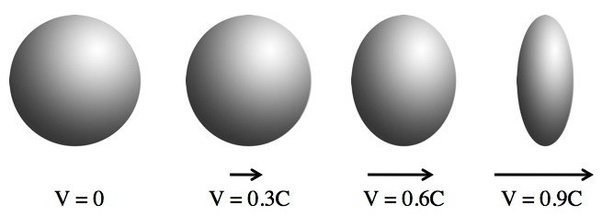
We can best start from the following fact. Suppose that you have a rod moving at very high speed. Let it first be pointing transverse to its line of motion. Now turn it through a right angle so that it is along the line of motion. The rod contracts. It is shorter when it is along the line of motion than when it is across the line of motion.
This contraction, known as the FitzGerald contraction, is exceedingly small in all ordinary circumstances. It does not depend at all on the material of the rod but only on the speed. For example, if the speed is 19 miles a second—the speed of the earth round the sun—the contraction of length is 1 part in 200,000,000, or 2 ½ inches in the diameter of the earth.
This is demonstrated by a number of experiments of different kinds of which the earliest and best known is the Michelson-Morley experiment first performed in 1887, repeated more accurately by Morley and Miller in 1905, and again by several observers within the last year or two. I am not going to describe these experiments except to mention that the convenient way of giving your rod a large velocity is to carry it on the earth which moves at high speed round the sun. Nor shall I discuss here how complete is the proof afforded by these experiments. It is much more important that you should realise that the contraction is just what would be expected from our current knowledge of a material rod.
You are surprised that the dimensions of a moving, rod can be altered merely by pointing it different ways. You expect them to remain unchanged. But which rod are you thinking of? (You remember my two tables.) If you are thinking of continuous substance, extending in space because it is the nature of substance to occupy space, then there seems to be no valid cause for a change of dimensions. But the scientific rod is a swarm of electrical particles rushing about and widely separated from one another. The marvel is that such a swarm should tend to preserve any definite extension. The particles, however, keep a certain average spacing so that the whole volume remains practically steady; they exert electrical forces on one another, and the volume which they fill corresponds to a balance between the forces drawing them together and the diverse motions tending to spread them apart. When the rod is set in motion these electrical forces change. Electricity in motion constitutes an electric current. But electric currents give rise to forces of a different type from those due to electricity at rest, viz. magnetic forces. Moreover these forces arising from the motion of electric charges will naturally be of different intensity in the directions along and across the line of motion.
By setting in motion the rod with all the little electric charges contained in it we introduce new magnetic forces between the particles. Clearly the original balance is upset, and the average spacing between the particles must alter until a new balance is found. And so the extension of the swarm of particles—the length of the rod—alters.
There is really nothing mysterious about the FitzGerald contraction. It would be an unnatural property of a rod pictured in the old way as continuous substance occupying space in virtue of its substantiality; but it is an entirely natural property of a swarm of particles held in delicate balance by electromagnetic forces, and occupying space by buffeting away anything that tries to enter. Or you may look at it this way: your expectation that the rod will keep its original length presupposes, of course, that it receives fair treatment and is not subjected to any new stresses. But a rod in motion is subjected to a new magnetic stress, arising not from unfair outside tampering but as a necessary consequence of its own electrical constitution; and under this stress the contraction occurs. Perhaps you will think that if the rod were rigid enough it might be able to resist the compressing force. That is not so; the FitzGerald contraction is the same for a rod of steel and for a rod of india-rubber; the rigidity and the compressing stress are bound up with the constitution in such a way that if one is large so also is the other. It is necessary to rid our minds of the idea that this failure to keep a constant length is an imperfection of the rod; it is only imperfect as compared with an imaginary “something” which has not this electrical constitution—and therefore is not material at all. The FitzGerald contraction is not an imperfection but a fixed and characteristic property of matter, like inertia.
We have here drawn a qualitative inference from the electrical structure of matter; we must leave it to the mathematician to calculate the quantitative effect. The problem was worked out by Lorentz and Larmor about 1900. They calculated the change in the average spacing of the particles required to restore the balance after it had been upset by the new forces due to the change of motion of the charges. This calculation was found to give precisely the FitzGerald contraction, i.e. the amount already inferred from the experiments above mentioned. Thus we have two legs to stand on. Some will prefer to trust the results because they seem to be well established by experiment; others will be more easily persuaded by the knowledge that the FitzGerald contraction is a necessary consequence of the scheme of electromagnetic laws universally accepted since the time of Maxwell. Both experiments and theories sometimes go wrong; so it is just as well to have both alternatives.
.

Comments
“Essentially, we are dealing with the constitution of substance. Even motion is a part of that constitution”
Time substance seems to be primarily motion and secondly duration.
Or possibly my priorities are mute, and there is a single, inseparable joining of the two into motion-duration, in the same way that there is unseparable spacetime.
Then the very next problematic concept arises, and it is that inseparable spacetime is apparently separated by entanglement.
So, apparently I know nuthin’ about nuthin’, and I am right back at the bottom of my hill, in my Tautological Universe.
As I said elsewhere, “Time is the duration of some substance. Time has no relevance in the absence of substance. Time is also the awareness of that duration.“
So I don’t look at time as some substance as you are doing. I look at time as a characteristic of substance. I look at motion also as a characteristic of substance. To me, space is also a characteristic of substance.
So, the starting point is substance, which is made up of all these characteristics, such as, space, time, consistency, motion, inertia, speed, etc.
Once you get the concept of substance, you realize that these various physical and even spiritual characteristics belong to it.
Substance, to me, denotes the oneness of all these physical and spiritual characteristics.