Buddhist psychology, systematized in the Abhidhamma (Abhidharma), developed a radically different yet equally sophisticated understanding of mind and mental illness. Rather than locating mind in a physical organ, Buddhism conceived citta (consciousness/mind) as an “ever-flowing stream” continuously changing from conception to death and continuing into subsequent lives.
Accompanying each moment of citta were cetasikas (mental factors)—52 distinct psychological qualities that determine the ethical character and phenomenological texture of consciousness. These include:
Seven universal cetasikas present in every moment of consciousness: contact, feeling, perception, volition, one-pointedness, life faculty, and attention
Thirteen particulars that can be wholesome, unwholesome, or neutral depending on context
Twenty-five beautiful (wholesome) cetasikas including compassion, loving-kindness, mindfulness, and wisdom
Fourteen unwholesome cetasikas that constitute the essence of mental illness
Buddhism looks at the mind as software, and locates it in the whole body and around it. This mind has both wholesome and unwholesome aspects. The unwholesome aspects constitute the essence of mental illness.
.
The Nature of Mental Illness
In perhaps the most radical conception in ancient psychology, Buddhism equated all mental defilement with mental illness. The Buddha taught: “Those beings who admit to being freed from mental illness even for a moment are difficult to find in the world, except those who have destroyed the contaminants”. From this perspective, only fully enlightened beings (arahants) are truly mentally healthy; everyone else suffers from varying degrees of mental illness.
Mental illness manifests through unwholesome states (akusala dhamma)—mental factors that are (1) mentally unhealthy, (2) morally blameworthy, (3) unskillful, and (4) productive of painful results. These states arise conditionally and are impermanent, making them treatable.
The fourteen unwholesome cetasikas divide into two categories:
Four universals appearing in all unwholesome consciousness:
Moha (delusion/ignorance)
Ahirika (shamelessness)
Anottapa (fearlessness of wrongdoing)
Uddhacca (restlessness/agitation)
Ten occasionals appearing in specific unwholesome states:
Lobha (greed), dosa (hatred)—the two primary unwholesome roots
Ditthi (wrong view), mana (conceit)
Issa (envy), macchariya (miserliness/pretense)
Kukkucca (worry), vicikiccha (doubt arising from temptation)
Thina (sloth), middha (torpor)—together constituting one of the Five Hindrances
Buddhism equates all mental defilements, which are listed in detail, with mental illness. From this perspective, only fully enlightened beings (arahants) are truly mentally healthy; everyone else suffers from varying degrees of mental illness.
.
Madness and Possession
Beyond this universal “metaphorical-evaluative” sense of mental illness, Buddhist texts also recognized literal pathological madness. The Pali Jataka commentary provides an eightfold classification of madness types, acknowledging both naturally-caused conditions and possession—not just by demons but by Mara, understood simultaneously as a deity and a phenomenological reality.
Possession traditions existed across Buddhist cultures. Tibetan Buddhism recognized dön zhugs pa (possession by grahas)—spirits that could enter practitioners during intense meditation, especially in states of deep samadhi. The Shurangama Sutra describes fifty types of mental demons that can attack practitioners who cling to unusual experiences or visions during meditation, potentially causing insanity with extreme emotional swings between joy, sadness, and mania.
Buddhism also recognizes literal pathological madness. These include “possessions,” as if by external entities; but they are looked upon more as phenomena of the mind.
.
Treatment and Practice
Buddhist treatment focused on cultivating wholesome cetasikas while eliminating unwholesome ones through the Noble Eightfold Path:
Right View as the foundation, correcting the fundamental delusion that fuels all mental defilement
Meditation practice—but with significant caveats about the risks of improper practice leading to possession or psychotic breaks
Moral conduct to eliminate shamelessness and fearlessness of wrong
Mindfulness to observe mental states without attachment
Mantra recitation—considered safer than visualization practices that can invite possession
Taking refuge in the Three Jewels (Buddha, Dharma, Sangha) as protection against negative entities
The tradition emphasized that those with “firm conviction” in the Dharma and who practice daily merit dedication cannot be harmed by demons. Nevertheless, practitioners were warned against clinging to visions or unusual experiences, as “if one claims to see Buddhas and bodhisattvas, these are demons”—meaning either literal entities or subjective delusions.
Buddhist treatment and practice includes mindfulness to spot anomalies and mediation to resolve them. This, assisted by taking refuge in the Three Jewels and mantra recitation, brings about right view, and moral conduct.
Chinese medicine, systematized in the Huangdi Neijing (Yellow Emperor’s Inner Canon, 4th-2nd century BCE), developed a sophisticated psychology centered on Shen (spirit/mind). Unlike the Greek emphasis on the brain, Chinese medicine located Shen in the Heart, conceived as the “emperor of organs” and the seat of consciousness, thinking, emotions, memory, and awareness.
Shen formed one of the “Three Treasures” alongside Jing (essence) and Qi (vital energy). The Heart-Shen governed not just individual consciousness but coordinated the Five Spirits—distinct aspects of psychic life associated with different organs:
Mental health depended on the harmonious cooperation of these five spirits under Shen’s governance. When the Heart-Shen “loses its governance,” disorder spreads throughout the psyche, just as chaos arises in a state when the sovereign fails.
The five spirits in Chinese conception show that there exists a gradient of awareness.
.
Mental Illness Categories
The Huangdi Neijing described two major categories of mental illness:
Dian: marked by unhappiness, headache, red eyes, and a troubled mind—resembling what we might call depression or melancholic states
Kuang: characterized by manic forgetfulness, flying into rages, and wild activity—corresponding to manic or psychotic presentations
The Atharva Veda’s Chinese parallel distinguished between mild conditions (neurosis-like deviations from normal mental functioning) and severe disruptions (psychosis-like states).
The same categories of mental illnesses in different cultures show that man is the same in all cultures.
.
The Five Emotions and Organ Pathology
Perhaps the most distinctive feature of Chinese medical psychology was its systematic theory linking specific emotions to particular organs through the Five Phases (Wu Xing) cosmological framework:
Anger (nu) → Liver/Wood: causes Qi to rise excessively, leading to headaches, red face and eyes, irritability, and eventual Liver damage
Joy (xi) → Heart/Fire: excessive elation makes Qi “loose” and scattered, impairing concentration and Heart function
Worry/Pensiveness (si) → Spleen/Earth: causes Qi to “bind” or knot, creating digestive problems, obsessive thinking, and exhaustion
Sadness/Grief (bei) → Lungs/Metal: makes Qi “disappear” or descend excessively, depleting vitality and weakening the Lungs
Fear (kong) → Kidneys/Water: causes Qi to descend or withdraw, potentially leading to involuntary urination, weak knees, and Kidney depletion
The Huangdi Neijing taught: “When anger abounds and does not end, then it will harm the mind”. Emotions weren’t merely psychological phenomena but “movements of Qi” with direct physiological consequences. Each emotion in moderation represented a healthy response, but excess transformed natural propensities into pathological states—vigor becoming rage, ecstasy becoming hysteria, contemplation becoming worry.
The Chinese medical psychology links specific emotions to particular organs, indicating that mind and body influence each other.
.
Treatment Philosophy
Chinese medicine emphasized prevention over cure, regulation over correction. The therapeutic goal was restoring the smooth, balanced flow of Qi and harmonizing the Five Spirits. Methods included:
Acupuncture at points like HT-7 (Shenmen, “Spirit Gate”) to calm the mind and nourish Heart Blood
Herbal formulas to nourish organs and regulate Qi flow
Dietary therapy following seasonal principles
Emotional interventions using the principle of “winning with emotions”—using one emotion to counterbalance another (e.g., joy to overcome sadness)
Lifestyle modifications including meditation, proper sleep, and seasonal regimens
Calming the Heart and settling Shen, while soothing the Liver and relieving constraint
The approach was fundamentally holistic, recognizing that “human mental activity is not merely the electrochemical activity of the cerebral cortex, but an outward projection of the flourishing or decline of the essential qi of the five zang and six fu organs”.
The Chinese treatment philosophy is prevention over cure, regulation over correction. This is very wise.
In Vedic times, understanding of the mind emerged from texts spanning roughly 1500-500 BCE, particularly the Atharva Veda and later Ayurvedic medical texts like the Charaka Samhita and Sushruta Samhita. The Vedic conception distinguished the manas (mind) as separate from but intimately connected to the physical body, governed by three fundamental qualities or gunas: sattva (purity, balance), rajas (passion, activity), and tamas (darkness, inertia).
Ayurveda recognized two mental doshas—rajas and tamas—as the contaminants or distorting forces of the mind, while sattva represented the mind’s pure, ideal state. These interacted with the three physical doshas (vata, pitta, kapha)—biological humors governing physiological and psychological processes. Mental illness thus arose from imbalances in this integrated mind-body system.
Sattva (purity, balance) is the ideal state. Rajas and tamas depart from this ideal state. This ideal state may be defined as Oneness (continuity, consistency and harmony). Spirit, mind and body are one.
.
Causes: A Dual Framework
Vedic understanding operated on two parallel tracks that were never fully separated:
Supernatural causation remained prominent throughout the Vedic period. Mental illness could result from:
Demonic possession by various classes of malevolent spirits: bhutas (hostile spirits), pretas (ghosts), pisacas (flesh-eating demons), raksasas (sense-stealing demons), and apsaras (seductive spirits causing amorous madness)
Divine punishment from gods like Rudra, Varuna, or Soma for moral transgressions, insults to elders, or breaking taboos
Witchcraft and curses (sapatha), particularly the “evil eye”
Karma from past lives (purvakrta karma)—actions in previous incarnations manifesting as mental affliction
Natural causation developed alongside these supernatural explanations:
Dosha imbalances: excess or deficiency of vata, pitta, or kapha affecting mental functioning
Prajnaparadha (“intellectual blasphemy” or “offense against wisdom”)—the conscious commission of harmful acts through defective judgment, considered by some scholars the primary natural cause
Mental shock (mano abhighata) from unbearable losses—death of loved ones, loss of property or status
Extreme emotions: fear (bhaya), grief (shoka), anger (krodha)
“Supernatural” causation was something that was not properly understood, and, therefore, it was given a specious explanation. Today we have a better understanding of such causation.
.
Classification: The Six Types of Unmada (उन्माद)
Unmada (insanity, mental derangement) represented the comprehensive category for serious mental illness, defined as the perversion of intellect (buddhi), mind (manas), consciousness (sanjna), knowledge, memory (smriti), desire, behavior, and conduct. Ayurveda classified six distinct types:
Vatonmada (vata-caused): restlessness, rapid/incoherent speech, violent behavior, laughing/crying inappropriately, loss of appetite
Pittonmada (pitta-caused): anger, aggression, threatening others, attacking with fists or stones, desire for coolness, seeing flames and lights that aren’t present, yellow skin coloration
Kaphonmada (kapha-caused): loss of appetite, vomiting, minimal desires and speech, excessive sleep, copious saliva and nasal secretions, swelling of face, symptoms worse at night and after eating
Sannipatonmada: combined vitiation of all three doshas, most severe and difficult to treat
Citta Ghataja Unmada: mental shock from unbearable losses, characterized by pallor, fainting, weeping, praising lost objects/persons, inability to sleep, performing unusual acts
Visaja Unmada: poisoning-induced, with blue face, red eyes, loss of strength and sensory function, unstable mind
The Atharva Veda further distinguished between severe disruptions like unmada and milder impairments of mental function such as krodha (anger), moh (attachment), shok (depression), and dushswapna (bad dreams).
These are different symptoms that have the same general cause in traumatic and other mental impressions that get activated.
.
Treatment: The Threefold Approach
Ayurveda developed a remarkably comprehensive therapeutic system encompassing spiritual, rational, and psychological interventions:
Daivavyapashraya (divine/spiritual therapy) addressed supernatural causes through prayers, mantras, rituals, and offerings to specific deities. The Atharva Veda contains numerous exorcism mantras designed to expel possessing entities.
Yukti vyapashraya (rational therapy based on clinical reasoning) employed systematic treatments:
Herbal medicines: notably Sarpagandha (Rauwolfia serpentina), used for millennia to treat psychotic disorders and later providing reserpine to Western psychiatry
Dietary regimens to restore dosha balance
Physical therapies
Satwavajaya (psychotherapy—literally “conquering the mind”) aimed to bring intellect (dhi), fortitude (dhrti), and memory (smrti) into proper condition through:
Mind control and restraint
Replacement of harmful emotions with beneficial ones
Spiritual knowledge and philosophy
Concentration and remembrance practices
Environmental and behavioral modifications
This integrated approach recognized that treatment must address the whole person—body, mind, and spirit—with methods calibrated to the specific type and cause of illness.
The treatment must address the whole person—body, mind, and spirit.
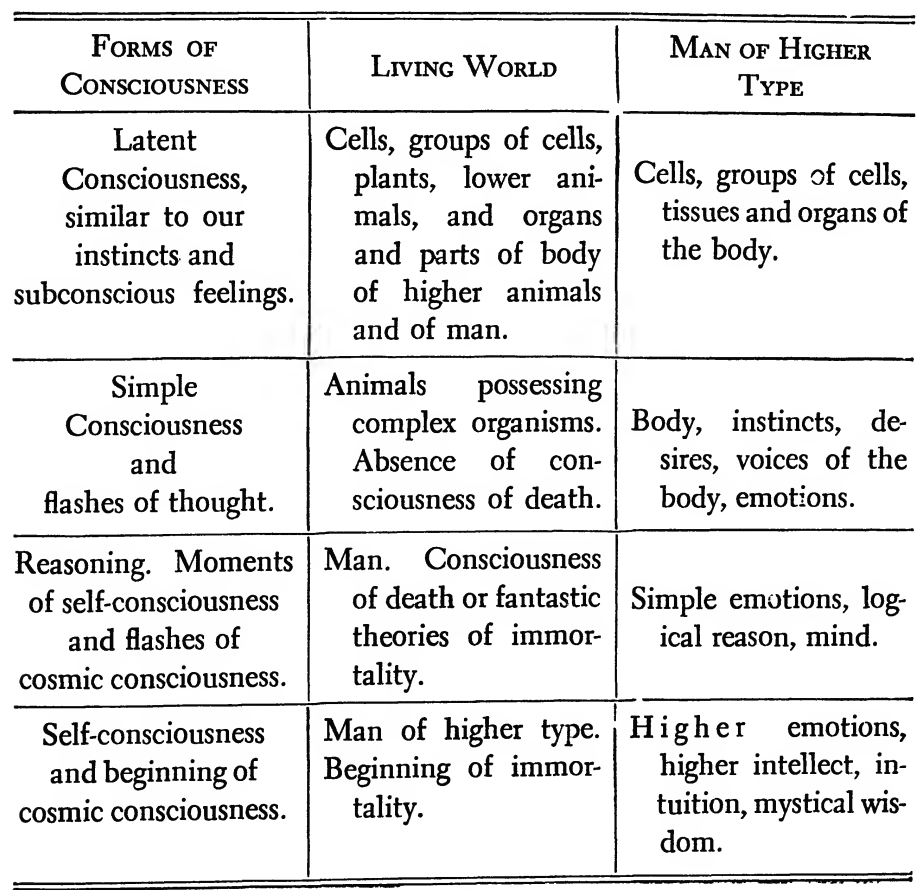
Cosmic Consciousness of Dr. Bucke. | The three forms of consciousness according to Dr. Bucke. | Simple consciousness, or the consciousness of animals. | Self-consciousness, or the consciousness of men. | Dr. Bucke’s fundamental error. | Cosmic consciousness. | In what is it expressed? | Sensation, perception, concept, higher moral concept — creative intuition. | Men of cosmic consciousness. | Adam’s fall into sin. | The knowledge of good and evil. | Christ and the salvation of man. | Commentary on Dr. Bucke’s book. | Birth of the new humanity. | Two races. | SUPERMAN. | Table of the four forms of the manifestation of consciousness.
.
Very many men believe that the fundamental problems of life are absolutely unsolvable, that humanity will never know why it is striving, or for what it is striving, for what it suffers, or whither it is bound. It is regarded as almost indecent even to raise these questions. It is decreed that we live “so” — that we “simply live” thinking of nothing or thinking only on that which yields a solution — on the surface at least. Men have despaired of finding answers to fundamental questions and so have left them alone.
Yet at the same time men are not in the least aware of what redly created in them such a sense of insolubility and despair. Whence comes this feeling that it is better not to think about many things?
In reality we feel this despair only when we begin to regard man as something “finite,” finished; when we see nothing beyond man, and think that we already know everything about him. In such form the problem is truly a desperate one. A cold wind blows on us from all those social theories promising incalculable welfare on earth, leaving a sense of dissatisfaction and chill even when we believe their promises.
Why? What is all this for? Well, everybody will be well fed and well taken care of — Splendid! But after that, what?
Let us suppose — although it is difficult, almost impossible to imagine — that materialistic culture, of itself, has led men to a fortunate state of existence. On earth, then, there exists an unadulterated civilization and culture. But after that, what?
After that, many resounding phrases of “incredible horizons” opening before science. “Communication with the planet Mars,” “The chemical synthesis of protoplasm,” “The utilization of the rotation of the earth around the sun,” ”Energy imprisoned in an atom,” “Vaccine for all diseases,” “Life to the length of a hundred years” — or even to one hundred and fifty! After that perhaps, “The artificial creation of men” — but beyond this imagination fails.
It is possible to dig through the earth, but that would be entirely useless.
Here indeed we encounter that feeling of the insolubility of the main questions concerning the aims of existence, and that feeling of despair on account of our lack of understanding.
Truly, suppose that we have dug completely through the earth — what then? Shall we dig in another direction? But it is all very wearisome after all. Nevertheless the various positivistic social theories, “historical materialism,” and so forth, promise nothing better, and can promise nothing. To get any answer at all to such tormenting questions we must turn in quite another direction: to the psychological method of study of man and of humanity. And here we see with amazement, that the psychological method gives an entirely satisfactory answer to those fundamental questions which seem to us quite insoluble, and around about which we fruitlessly wander equipped with the detective instrument of the positivistic method.
The psychological method gives a direct answer at least to the question of the immediate purpose of our existence. For some strange reason men do not care to accept this answer; and they desire at all costs to receive an answer in some form that they like, refusing to recognize anything that is different from that form. They require the solution of the destiny of man as they fancy him, and they do not want to recognize that man can and must become entirely different. In him there are not as yet manifest those faculties which will create his future. Man must not and cannot remain such as he is now. To think of the future of this man is just as absurd as to think of the future of a child as if it were always going to remain a child. The analogy is not quite complete, for the reason that probably only a small part of humanity is capable of growth, but nevertheless this comparison paints a true picture of our usual attitude toward this question. And the fate of that greater part of humanity which will prove incapable of growth, depends not upon itself, but upon that minority which will progress. Only inner growth, the unfoldment of new forces, will give to man a correct understanding of himself, his ways, his future, and give him power to organize life on earth. At the present time the general concept “man” is too undifferentiated and includes within himself entirely different categories, those capable of development and those incapable. In men capable of development, new faculties are stirring into life, though not as yet manifest, because for their manifestation they require a special culture, a special education. The new conception of humanity disposes of the idea of equality, which after all does not exist, and it tries to establish the signs and facts of the differences between men, because humanity will need soon to divide the “progressing” from the “incapable of progress” — the wheat from the tares, for the tares are growing too fast, and choke the growth of the wheat.
This is the key to the understanding of our life, and this key was found long ago!
The enigma was solved long ago. But different thinkers, living in different epochs, finding the solution, expressed it differently, and often, not knowing one another, trod the same path amid enormous difficulties, unaware of their predecessors and contemporaries who had gone and were going along the selfsame path.
In the world’s literature there exist books, usually little known, which accidentally or by design may happen to be assembled on one shelf in one library. These, taken together, will yield so clear and complete a picture of human existence, its path and its goal, that there will be no further doubts about the destiny of humanity (though only its minor part), but a destiny of quite a different sort from those hard labors of digging through the globe, which positive philosophy, “historical materialism” and “socialism” have in store for humankind.
And if it seems to us that we do not as yet know our destiny, if we still doubt, and do not dare to part with the hopeless “positivistic” view of life, it is primarily because men of different categories, having quite different futures, are commingled into one in our perception; and secondarily because the necessary ideas by means of which we might understand the true relation of forces have not won for themselves their rightful place in official science — do not represent any recognized division or branch of science; it is rarely possible to find them all in one book and it is even rarely possible to find books expressing these ideas assembled together.
We do not understand many things because we too easily and too arbitrarily specialize. Philosophy, religion, psychology, mathematics, the natural sciences, sociology, the history of culture, art — each has its own separate literature. There is no complete whole at all. Even the little bridges between these separate literatures are built very badly and unsuccessfully, while they are often altogether absent. And this formation of special literatures is the chief evil and the chief obstacle to a correct understanding of things. Each “literature” elaborates its own terminology, its own language, which is incomprehensible to the students of other literatures, and does not coincide with other languages; by this it defines its own limits the more sharply, divides itself from others, and makes these limits impassable.
But there are movements of thought which strive not in words, but in action, to fight this specialization.
Books are appearing which it is impossible to refer to any accepted library classification, which it is impossible to “enroll” in any faculty. These books are the forerunners of a new literature which will break down all fences built in the region of thought, and will clearly show to those who desire to know, where they are going and where they can go.
The names of the authors of these books yield the most unexpected combinations. I shall not now mention the names of these authors, or the titles of these books, but shall dwell only upon the writings of Edward Carpenter and Dr. R. M. Bucke.
Edward Carpenter, directly and without any allegories and symbols, formulated the thought that the existing consciousness by which contemporary man lives, is merely the transitory form of another higher consciousness, which even now is manifesting in certain men, after appropriate preparation and training.
This higher consciousness Edward Carpenter names cosmic consciousness.
Carpenter traveled in the Orient, visited India and Ceylon, and there he found men, yogis and ascetics, striving to achieve cosmic consciousness, and he holds the opinion that the path to cosmic consciousness is already found in the Orient.
In the book, From Adam’s Peak to Elephanta, he says:
The West seeks the individual consciousness — the enriched mind, ready perceptions and memories, individual hopes and fears, ambitions, loves, conquests — the self, the local self, in all its phases and forms — and sorely doubts whether such a thing as an universal consciousness exists. The East seeks the universal consciousness, and in these cases where its quest succeeds individual self and life thin away to a mere film, and are only the shadows cast by the glory revealed beyond.
The individual consciousness takes the form of Thought, which is fluid and mobile like quicksilver, perpetually in a state of change and unrest, fraught with pain and effort; the other consciousness is not in the form of thought. It touches, sees, hears, and is those things which it perceives, without motion, without change, without effort, without distinction of subject and object, but with a vast and incredible joy.
The individual consciousness is specially related to the body. The organs of the body are in some degree its organs. But the whole body is only as one organ of the cosmic consciousness. To attain this latter one must have the power of knowing one’s self separate from the body — of passing into a state of ecstasy, in fact. Without this the cosmic consciousness cannot be experienced.
All the subsequent writings of Carpenter, and especially his book of free verse, Towards Democracy, deal with the psychology of ecstatic experiences and portray the path whereby man goes toward this principal aim of his existence, i.e., to a new consciousness.
Only the attainment of this principal aim will illumine for man the past and the future; it will be a seership, an awakening — without this, with only the ordinary sleepy, “individual” consciousness, man is blind, and cannot hope to know anything that he cannot feel with his stick.
It appears that we need to understand why we exist in the first place. Different thinkers have answered this question differently. Apparently, there is individual consciousness that seeks universal consciousness. The individual consciousness takes the form of Thought; but the universal consciousness is pure awareness with a vast and incredible joy. The individual consciousness is specially related to the body; but the universal consciousness is related to all things.
Dr. Bucke, in his book, Cosmic Consciousness, gives the psychological view of this awakening of the new consciousness.
I shall give, in abbreviated form, several quotations from his book.
I
What is Cosmic Consciousness?
Cosmic Consciousness is a higher form of consciousness than that possessed by the ordinary man. This last is called Self Consciousness and is that faculty upon which rests all of our life (both subjective and objective) which is not common to us and the higher animals, except that small part of it which is derived from the few individuals who have had the higher consciousness above named. To make the matter clear it must be understood that there are three forms or grades of consciousness. (1) Simple Consciousness, which is possessed by, say, the upper half of the animal kingdom. (2) Self-Consciousness possessed by man in addition to the simple consciousness, which is similar in man and in animals.[*This division constitutes Dr. Bucke’s principal error. Human consciousness, i.e., the consciousness of the enormous majority of men, is “simple consciousness”; “self-consciousness,” like “cosmic consciousness,” exists only in a flash.] (3) Cosmic Consciousness. By means of simple consciousness a dog or a horse is just as conscious of the things about him as a man is; he is also conscious of his own limbs and body and knows that these are a part of himself. By virtue of self-consciousness man is not only conscious of trees, rocks, water, his own limbs and body, but he becomes conscious of himself as a distinct entity apart from all the rest of the universe.
It is as good as certain that no animal can realize himself in that way. Further, by means of self-consciousness, man becomes capable of treating his own mental states as objects of consciousness. The animal is, as it were, immersed in his consciousness as a fish in the sea; he cannot, even in imagination, get outside of it for one moment so as to realize it. But man by virtue of self-consciousness can step aside, as it were, from himself and think: “ Yes, that thought that I had about that matter is true; I know it is true and I know that I know it is true.” There is no evidence that any animal can think, but if they could we should soon know it. Between two creatures living together, as dogs or horses and men, and each self-conscious, it would be the simplest matter in the world to open up communication. We do, by watching the dog’s acts, enter into his mind pretty freely. If he were self-conscious, we must have learned it long ago. We have not learned it and it is as good as certain that no dog, horse, elephant or ape ever was self-conscious. Another thing: on man’s self-consciousness is built everything in and about us distinctly human. Language is the objective of which self-consciousness is the subjective. Self-consciousness and language (two in one for they are two halves of the same thing) are the sine qua non of human social life, of manners, of institutions, of industries of all kinds, of all arts useful and fine. If any animal possessed self-consciousness it would build a superstructure of language. . . . But no animal has done this, therefore, we infer that no animal has self-consciousness. The possession of self-consciousness and language (its other self) by man creates an enormous gap between him and the highest creature possessing simple consciousness merely.
Cosmic Consciousness is a third form, which is as far above Self Consciousness as is that above Simple Consciousness. The prime characteristic of Cosmic Consciousness is, as its name implies, a consciousness of the cosmos, that is, of the life and order of the universe. Along with the consciousness of the cosmos there occurs an intellectual enlightenment or illumination which alone would place the individual on a new plane of existence — would make him almost a member of a new species. To this is added a state of moral exaltation, an indescribable feeling of elevation, elation and joyousness, and a quickening of the moral sense, which is fully as striking and more important both to the individual and to the race than is the enhanced intellectual power. With these come what may be called a sense of immortality, a consciousness of eternal life, not a conviction that he shall have this, but the consciousness that he has it already.
Only a personal experience of it, or a prolonged study of men who have passed into the new life, will enable us to realize what this actually is. The writer expects his work to be useful in two ways: first, in broadening the general view of human life by comprehending in our mental vision this important phase of it, then by enabling us to realize, in some measure, the true status of certain men who, down to the present, are either exalted to the ranks of gods or are adjudged insane. The writer takes the view that our descendants will sooner or later reach, as a race, the condition of cosmic consciousness, just as long ago, our ancestors passed from simple to self-consciousness. He believes that this step in evolution is even now being made, since it is clear to him both that men with the faculty in question are becoming more and more common and also that as a race we are approaching nearer and nearer to that stage of the self-conscious mind from which the transition to the cosmic conscious is effected. He knows that intelligent contact with cosmic conscious minds assists self-conscious individuals in the ascent to the higher plane.
Simple consciousness starts to develop in higher animals, which is shared by humans. This is the consciousness of the body and immediate environment. In humans, it develops further into self-consciousness. It makes man conscious of being a distinct entity apart from all the rest of the universe. The language and communication arising from self-consciousness lead to art, science and industries. A higher consciousness of life and order of the universe then occurs as an intellectual enlightenment or illumination. It is accompanied by a state of moral exaltation, an indescribable feeling of elevation, elation and joyousness. This may be called universal or cosmic consciousness.
II
The immediate future of our race [the writer thinks] is indescribably hopeful. There are at the present moment impending over us three revolutions, the least of which would dwarf the ordinary historic upheaval called by that name into absolute insignificance. They are: (1) the material, economic and social revolution which will depend upon and result from the establishment of aerial navigation. (2) The economic and social revolution which will abolish individual ownership and rid the earth at once of two immense evils — riches and poverty. And (3) the psychical revolution of which there is here question.
Either of the first two would (and will) radically change the conditions of, and greatly uplift, human life, but the third will do more for humanity than both of the former, were their importance multiplied by hundreds or even thousands.
The three operating (as they will) together will literally create a new heaven and a new earth. Old things will be done away and all will become new.
Before aerial navigation national boundaries, tariffs and perhaps distinctions of language will fade out. Great cities will no longer have reason for being and will melt away. The men who now dwell in cities will inhabit in summer the mountains and the seashores; building often in airy and beautiful spots, now almost or quite inaccessible, commanding the most extensive and magnificent views. In the winter they will probably dwell in communities of moderate size. As herding together, as now, in great cities, so the isolation of the worker of the soil will become a thing of the past. Space will be practically annihilated, there will be no crowding together and no enforced solitude.
Before socialism crushing toil, cruel anxiety, insulting and demoralizing riches, poverty and its ills will become subjects for historical novels.
In contact with the flux of cosmic consciousness all religions known and named today will be melted down. The human soul will be revolutionized. Religion will absolutely dominate the race. It will not depend on traditions. It will not be believed and disbelieved. It will be part of life, not belonging to certain hours, times, occasions. It will not be in sacred books, nor in the mouths of priests. It will not dwell in churches and meetings and forms and days. Its life will not be in prayers, hymns nor discourses. It will not depend on special revelations, on the words of gods who came down to teach, nor on any bible or bibles. It will have no mission to save men from their sins or to secure their entrance to heaven. It will not teach a future immortality nor future glories, for immortality and all glory will exist in the here and now. The evidence of immortality will live in every heart as sight in every eye. Doubt of God and of eternal life will be as impossible as is now doubt of existence; the evidence of each will be the same. Religion will govern every minute of every day of all life. Churches, priests, forms, creeds, prayers, all agents, all intermediaries between the individual man and God will be permanently replaced by direct unmistakable intercourse. Sin will no longer exist nor will salvation be desired. Men will not worry about death or a future, about the kingdom of heaven, about what may come with and after the cessation of the life of the present body. Each soul will feel and know itself to be immortal, will feel and know that the entire universe with all its good and with all its beauty is for it and belongs to it forever. The world peopled by men possessing cosmic consciousness will be as far removed from the world of today as this is from the world as it was before the advent of self-consciousness.
There are impending economic, social and psychical revolutions, which may radically change the conditions of human life for the better.
Ill
There is a tradition, probably very old, to the effect that the first man was innocent and happy until he ate of the fruit of the tree of the knowledge of good and evil. That having eaten thereof he became aware that he was naked and was ashamed. Further, that there sin was born into the world, the miserable sense whereof replaced man’s former feeling of innocency; that then and not till then man began to labor and to cover his body. Stranger than all, the story runs, that along with this change or immediately following upon it there came into man’s mind the remarkable conviction which has never since left it, but which has been kept alive by its own inherent vitality and by the teaching of all true seers, prophets and poets that man will be saved by the rising up within him of a Savior — the Christ.
Man’s progenitor was a creature with simple consciousness merely. He was (as are today the animals) incapable of sin and equally incapable of shame (at least in the human sense). He had no feeling or knowledge of good and evil. He as yet knew nothing of what we call work and had never labored. From this state he fell (or rose) into self-consciousness, his eyes were opened, he knew he was naked, he felt shame, acquired the sense of sin (became in fact what is called a sinner) and learned to do certain things in order to encompass certain ends — that is, he learned to labor.
For weary aeons this condition has lasted — the sense of sin still haunts his pathway — by the sweat of his brow he still eats bread — he is still ashamed. Where is the deliverer, the Saviour? Who or what?
The Savior of man is Cosmic Consciousness — in Paul’s language, the Christ. The cosmic sense (in whatever mind it appears) crushes the serpent’s head — destroys sin, shame, the sense of good and evil, as contrasted one with the other, and will annihilate labor, though not human activity.
Man is becoming aware of his ignorance. He can now see that because of that ignorance he is committing wrong actions. Since he cannot seem to overcome his failings, he thinks that he must be born with them. Therefore, he looks for a savior to appear. That savior is actually the universal or cosmic consciousness.
IV
A personal exposition of the writer’s own experience of cosmic consciousness may help the reader to understand the meaning of the following facts:
In childhood he was subject at times to a sort of ecstasy of curiosity and hope. As on one special occasion when about ten years old he earnestly longed to die that the secrets of the beyond, if there were any beyond, might be revealed to him. . . .
At the age of thirty he fell in with “Leaves of Grass,” and at once saw that it contained, in greater measure than any book so far found, what he had so long been looking for. He read the “Leaves” eagerly, even passionately, but for several years derived little from them. At last light broke and there was revealed to him (as far perhaps as such things can be revealed) at least some of the meanings. Then occurred that to which the foregoing is the preface.
It was in the early spring, at the beginning of his thirty-sixth year. He and two friends had spent the evening reading Wordsworth, Shelley, Keats, Browning, and especially Whitman. They parted at midnight and he had a long drive in a hansom (it was in an English city). His mind, deeply under the influence of the ideas, images and emotions called up by the reading and talk of the evening, was calm and peaceful. He was in a state of quiet, almost passive enjoyment. All at once, without warning of any kind, he found himself wrapped around as it were by a flame-colored cloud. For an instant he thought of fire, some sudden conflagration in the great city; the next he knew the light was within himself. Directly afterwards came upon him a sense of exultation, of immense joyousness accompanied or immediately followed by an intellectual illumination quite impossible to describe. Into his brain streamed one momentary lightning-flash of the Brahmic splendor which has ever since lightened his life; upon his heart fell one drop of Brahmic Bliss, leaving thenceforward for always an after taste of heaven. Among other things he did not come to believe, he saw and knew that the cosmos is not dead matter but a living Presence, that the soul of man is immortal, that the universe is so built and ordered that without peradventure all things work together for the good of each and all, that the foundation principle of the world is what we call love and that the happiness of everyone in the long run is absolutely certain. He claims he learned more within the few seconds during which the illumination lasted than in previous months or even years of study and that he learned much that no study could ever have taught.
The illumination itself continued not more than a few moments, but its effects proved ineffaceable; it was impossible for him ever to forget what he at that time saw and knew; neither did he, nor could he, ever doubt the truth of what was then presented to his mind. There was no return that night or at any other time of the experience.
The supreme occurrence of that night was his real and sole initiation to the new and higher order of ideas. But it was only an initiation. He saw the light but had no more idea whence it came and what it meant than had the first creature that saw the light of the sun. Years afterwards he met a man who had had a large experience in the higher life. His conversations with this man threw a flood of light upon the meaning of what he had himself experienced.
Looking round then upon the world of man, he saw the significance of the subjective light in the case of Paul and in that of Mohammed. The secret of Whitman’s transcendent greatness was revealed to him. Personal intercourse and conversations with men, [* Among whom was Edward Carpenter.] who had similar experiences assisted greatly in the broadening and clearing up of his speculations.
After spending much time and labor in thinking he came to the conclusion that there exists a family sprung from, living among, but scarcely forming a part of ordinary humanity, whose members are spread abroad throughout the advanced races of mankind and throughout the last forty centuries of the world’s history.
The trait that distinguishes these people from other men is this: Their spiritual eyes have been opened and they have seen. The better known members of this group who, if they were collected together, could be accommodated all at one time in a modern drawing-room, have created all the great modern religions, beginning with Taoism and Buddhism, and speaking generally, have created, through religion and literature, modern civilization. Not that they have contributed any large numerical proportion of the books which have been written, but that they have produced the few books which have inspired the larger number of all that have been written in modern times. These men dominate the last twenty-five, especially the last five centuries as stars of the first magnitude dominate the midnight sky.
Cosmic consciousness comes in flashes that last only a few seconds, but they provide a reality that changes the outlook of the person that lasts for the rest of his life. It may be preceded by a sort of ecstasy of curiosity and hope and a deep longing to know. The flash occurs suddenly when the person is in deep contemplation. There is an intellectual illumination quite impossible to describe. It is a real initiation to the new and higher order of ideas.
V
It remains to say a few words upon the psychological origin of what is called in this book Cosmic Consciousness.
Although in the birth of Cosmic Consciousness the moral nature plays an important part, it will be better for many reasons to confine our attention at present to the evolution of the intellect. In this evolution there are four distinct steps. The first of them was taken when upon the primary quality of excitability sensation was established. At this point began the acquisition and more or less perfect registration of sense impressions — that is, of percepts. A percept is of course a sense impression. If we could go back far enough we should find among our ancestors a creature whose whole intellect was made up simply of these percepts. But this creature had in it what may be called an eligibility of growth, and what happened with it was something like this: Individually and from generation to generation it accumulated these percepts, the constant repetition of which, calling for further and further registration, led, in the struggle for existence and under the law of natural selection, to an accumulation of cells in the central sense ganglia; at last a condition was reached in which it became possible for our ancestor to combine groups of these percepts into what we today call a recept. This process is very similar to that of composite photography. Similar percepts (as of a tree) are registered one over the other until they are generalized into the percept of a tree.
Now the work of accumulation begins again on a higher plane: the sensory organs keep steadily at work manufacturing percepts; the receptual centers keep steadily at work manufacturing more and yet more recepts from the old and the new percepts; the capacity of the central ganglia is constantly taxed to do necessary registration of percepts, the necessary elaboration of these into recepts; then as the ganglia by use and selection are improved they constantly manufacture from percepts and from the initial simple recepts, more and more complex, that is, higher and higher recepts.
At last, after many thousands of generations have lived and died, comes a time when the mind has reached the highest possible point of purely receptual intelligence; the accumulation of percepts and of recepts has gone on until no greater stores of impressions can be laid up and no further elaboration of these can be accomplished on the plane of receptual intelligence. Then another break is made and the higher recepts are replaced by concepts. The relation of a concept to a recept is somewhat similar to the relation of algebra to arithmetic. A recept is a composite image of hundreds, perhaps thousands of percepts; it is itself an image abstracted from many images; but a concept is that same composite image — that same recept — named, ticketed, and, as it were, dismissed. A concept is in fact neither more nor less than a named recept — the name that is, the sign (as in algebra), standing henceforth for the thing itself, that is, for the recept.
Now it is clear as day to any one who will give the least thought to the subject, that the revolution by which concepts are substituted for recepts increases the efficiency of the brain for thought as much as the introduction of machinery increases the capacity of the race for work — as much as the use of algebra increases the power of the mind in mathematical calculations. To replace a great cumbersome recept by a simple sign was almost like replacing actual goods — as wheat, fabrics and hardware — by entries in the ledger.
But, as hinted above, in order that a recept may be replaced by a concept it must be named, or, in other words, marked with a sign which stands for it — just as a check stands for a piece of goods; in other words, the race that is in possession of concepts is also, and necessarily, in possession of language. Further, it should be noted, as the possession of concepts implies the possession of language, so the possession of concepts and language (which are in reality two aspects of the same thing) implies the possession of self-consciousness. All this means that there is a moment in the evolution of mind when the receptual intellect, capable of simple consciousness only, becomes almost or quite instantaneously a conceptual intellect in possession of language and self-consciousness.
Our intellect, then, today is made up of a very complex mixture of percepts, recepts and concepts.
The intellect started with precepts that assimilated into recepts, which then assimilated into concepts. Our intellect, then, today is made up of a very complex mixture of percepts, recepts and concepts.
The next chapter in the story is the accumulation of concepts. This is a double process, each individual accumulates a larger and larger number while the individual concepts are becoming constantly more and more complex.
Is there to be any limit to this growth of concepts in number and complexity? Whoever will seriously consider that question will see that there must be a limit. No such process could go on to infinity.
We have seen that the expansion of the perceptual mind had a necessary limit: that its continued life led inevitably up to and into the receptual mind; that the receptual mind by its own growth was inevitably led up to and into the conceptual mind. A priori considerations make it certain that a corresponding outlet will be found for the conceptual mind.
But we do not need to depend upon abstract reasoning to demonstrate the necessary existence of the supra-conceptual mind, since it exists and can be studied with no more difficulty than other natural phenomena. The supra-conceptual intellect, the elements of which instead of being concepts are intuitions, is already (in small numbers it is true) an established fact, and the form of consciousness that belongs to that intellect may be called and has been called — Cosmic Consciousness.
The basic fact in cosmic consciousness is implied in its name — that fact is consciousness of the cosmos — this is what is called in the East the “Brahmic Splendor,” which is in Dante’s phrase capable of trans-humanizing a man into a god. Whitman, who has an immense deal to say about it, speaks of it in one place as “ineffable light — light rare, untellable, lighting the very light — beyond all signs, description, languages.” This consciousness shows the cosmos to consist not of dead matter governed by unconscious, rigid, and unintending law; it shows it on the contrary as entirely immaterial, entirely spiritual and entirely alive; it shows that death is an absurdity, that everyone and everything has eternal life; it shows that the universe is God and that God is the Universe. . . . A great deal of this is of course, from the point of view of self-consciousness, absurd; it is nevertheless undoubtedly true. Now all this does not mean that when a man has cosmic consciousness he knows everything about the universe. We all know that when at three years of age we acquired self-consciousness, we did not at once know all about ourselves. . . . So neither does a man know all about the cosmos merely because he becomes conscious of it. . . .
If it has taken the race several thousand years to learn a smattering of the science of humanity since its acquisition of self-consciousness, so it may take it millions of years to acquire cosmic consciousness.
As on self-consciousness is based the human world as we see it with all its works and ways, so on cosmic consciousness is based the higher religions and the higher philosophies and what comes from them, and on it will be based, when it becomes more general, a new world of which it would be idle to try to speak today.
The philosophy of the birth of cosmic consciousness in the individual is very similar to that of the birth of self-consciousness. The mind becomes overcrowded (as it were) with concepts and these are constantly becoming larger, more numerous and more and more complex; some day (the conditions being all favorable) the fusion, or what might be called the chemical union, of several of them and of certain moral elements takes place; the result is an intuition and the establishment of the intuitional mind, or, in other words, cosmic consciousness.
The scheme by which the mind is built up is uniform from beginning to end: a recept is made of many percepts; a concept of many or several recepts and percepts, and an intuition is made of many concepts, recepts and percepts together with other elements belonging to and drawn from the moral nature. The cosmic vision or the cosmic intuition, from which what may be called the new mind takes its name, is thus seen to be simply the complex and union of all prior thought and experience — just as self-consciousness is the complex and union of all thought and experience prior to it.
Concepts also grow in number and complexity. They assimilate into intuitions. This is the level of consciousness of the cosmos, or cosmic consciousness. It is simply the assimilation of all prior sensations, perceptions, memory, experience, and knowledge into wisdom.
Cosmic consciousness, like other forms of consciousness, is capable of growth, it may have different forms, different degrees.
It must not be supposed that because a man has cosmic consciousness he is therefore omniscient or infallible. Men of cosmic consciousness have reached a higher level; but on that level there can be different degrees of consciousness. And it must be still more evident that, however godlike the faculty may be, those who first acquire it, living in diverse ages and countries, passing their life in different surroundings, brought up to view life from totally different points of view, must necessarily interpret somewhat differently those things which they see in the new world which they enter.
Language corresponds to the intellect and is therefore capable of expressing it perfectly and directly; on the other hand, the functions of the moral nature are not connected with language and are only capable of indirect and imperfect expression by its agency. Perhaps music, which certainly has its roots in the moral nature, is, as at present existing, the beginning of a language which will tally and express emotions as words tally and express ideas. . . .
Language is the exact tally of the intellect; for every concept there is a word or words and for every word there is a concept. . . . No word can come into being except as the expression of a concept, neither can a new concept be formed without the formation (at the same time) of the new word which is its expression. But as a matter of fact ninety-nine out of every hundred of our sense impressions and emotions have never been represented in the intellect by concepts and therefore remain unexpressed and inexpressible except by roundabout description and suggestion.
As the correspondence of words and concepts is not casual or temporary but resides in the nature of these and continues during all time and under all circumstances absolutely constant, so changes in one of the factors must correspond with changes in the other. So evolution of intellect must be accompanied by evolution of language. An evolution of language will be evidence of evolution of intellect.
It seems that in every, or nearly every man who enters into cosmic consciousness apprehension is at first more or less excited, the person doubting whether the new sense may not be a symptom or form of insanity. Mohammed was greatly alarmed. The Apostle Paul was alarmed in the same manner.
The first thing each person asks himself upon experiencing the new sense is: Does what I see and feel represent reality or am I suffering from a delusion? The fact that the new experience seems even more real than the old teachings of consciousness does not at first fully reassure him, because he knows the force of delusions.
Simultaneously or instantly following the above sense and emotional experiences there comes to the person an intellectual illumination quite impossible to describe. Like a flash there is presented to his consciousness a clear conception (a vision) in outline of the meaning and drift of the universe. He does not come to believe merely; but he sees and knows that the cosmos, which to the self-conscious mind seems made up of dead matter, is in fact far otherwise -is in very truth a living presence. He sees that instead of men being, as it were, patches of life scattered through an infinite sea of non-living substance, they are in reality specks of relative death in an infinite ocean of life. He sees that the life which is in man is eternal, as all life is eternal, that the soul of man is as immortal as God is. . . .
A man learns infinitely much of the new. Especially does he obtain such a conception of THE WHOLE — or at least of an immense WHOLE — as dwarfs all conception, imagination or speculation, such a conception as makes the old attempts to mentally grasp the universe and its meaning petty and even ridiculous.
This expansion of the intellect enormously increases the capacity both for learning and initiating.
Cosmic consciousness then continues to grow. Simultaneously with it the intellect and language also grow. It is something totally new and it takes some getting used to. There comes to the person an intellectual illumination quite impossible to describe. A man learns infinitely much of the new and obtains a conception of the WHOLE.
The history of the development and appearance of cosmic consciousness in humanity is the same as that of the development of all the various psychic faculties. These faculties appear first in certain exceptional individuals, then become more frequent, thereafter become susceptible of development in all, and at last begin to belong to all men from their birth. Rare, exceptional, unique abilities appear in man in mature age, sometimes even in senility. Becoming more common they manifest as “talents” in younger men. And then they appear as “abilities” even in children. At last they become the common property of all from their birth, and their absence is regarded as a monstrosity.
Such is the faculty of speech (i.e., the faculty of making concepts). Probably in a distant past, at the beginning of the appearance of self-consciousness, this faculty was the gift of a few exceptional individuals and it began then to appear perhaps in senility. After that it began to appear more frequently and to manifest itself earlier. Probably there was a period when speech was not a gift of all men just as are not now artistic talents, the musical sense, the sense of color and form. Gradually it became possible for all and then inevitable and necessary, if some physical defect did not prevent its manifestation.
Today we see cosmic consciousness being manifested in a few exceptional individuals. We can expect this consciousness to be manifested in the future in more individuals and from an earlier age.
COMMENTS ON THE QUOTATIONS FROM DR. BUCKE’S BOOK
1. Though I am quoting Dr. Bucke’s opinion regarding three coming revolutions, let me note that I do not at all share his optimism regarding social life, which, as follows from what he says, can and must change by reason of material causes (the conquest of the air and social revolution). The only possible ground for favorable changes in the outer life (provided such changes are generally possible) can only be changes in the inner life — i.e., those changes which Dr. Bucke calls the psychical revolution. This is the only thing that can create a better future for men. All cultural conquests in the realm of the material are double-edged, may equally serve for good or for evil. A change of consciousness can alone be a guarantee of the surcease of willful misuses of the powers given by culture, and only thus will culture cease to be a “growth of barbarity.” Democratic organization and the nominal rule of the majority guarantee nothing: on the contrary, even now, where they are realized — though only in name — they create without delay, and promise in future to create on a larger scale, violence toward the minority, the limitation of the individual, and the curtailment of freedom.
Psychical revolution is the only thing that can create a better future for men.
2. Dr. Bucke says that once human consciousness is attained., then further evolution is inevitable. In this affirmation Dr. Bucke makes a mistake common to all men who dogmatize about evolution. Having painted a very true picture of the consecutive gradations of the forms of consciousness observed by us — of animal-vegetable, of animal, and of man — Dr. Bucke considers this gradation exclusively in the light of the evolution of one form from another, not at all admitting the possibility of other points of view: for example, the fact that each of the existing forms is a link of separate evolutionary chains, i.e., that the evolutions of animal-vegetables, of animals and of men are different, go by different routes, and do not impinge upon one another. And this standpoint is entirely justifiable when we take into consideration the fact that we never know transitional forms. Moreover Dr. Bucke makes an entirely arbitrary conclusion concerning the inevitability of the further evolution of man, because unconscious evolution (i.e., unconscious for the individual directed by the consciousness of the species) in the vegetable and animal kingdoms is impossible with the appearance of reasoning in man. It is necessary to recognize that the mind of a man depends upon itself to a considerably greater degree than the mind of an animal. The mind of a man has far more power over itself; it can assist in its own evolution, and can also impede it. We are confronted with the general question: can unconscious evolution proceed with the appearance of reasoning? It is far more correct to suppose that the appearance of reasoning annihilates the possibility of unconscious evolution. Power over evolution passes from the group-soul (or from nature) to the individual itself. Further evolution, if it take place, cannot be an elemental and unconscious affair, but will result solely from conscious efforts toward growth. This is the most interesting point in the whole process, but Dr. Bucke fails to bring it out. Man, not striving toward evolution, not conscious of its possibility, not helping it, will not evolve. And the individual who is not evolving does not remain in a static condition, but goes down, degenerates (i.e, some of his elements begin their own evolution, inimical to the whole). This is the general law. And if we take into consideration what an infinitesimal percentage of men think and are capable of thinking of their evolution (or their striving toward higher things) then we shall see that to talk about the inevitability of this evolution is at least naive.
The evolution up until now has been unconscious for the individual directed by the consciousness of the species. Such unconscious evolution is now impossible with the appearance of reasoning in man. Power over evolution passes from the group-soul (or from nature) to the individual itself.
3. Speaking of the formation of a higher faculty of knowledge and reason. Dr. Bucke fails to take into consideration one very important circumstance. He himself previously remarks that the blending of concepts with emotional elements proceeds in the mind, and as a result of this a new understanding appears, and then cosmic consciousness. Thus it follows from his own words that cosmic consciousness is not simply a blending of concepts with emotional elements, or ideas with feelings, but is the result of this blending. Dr. Bucke however does not dwell on this with sufficient attention. Moreover he further regards the fundamental element of cosmic consciousness as the blending of sensations, perceptions and concepts with elements properly belonging to the emotional nature. This is a mistake, because one element of cosmic consciousness is not simply the blending of thought and feeling, but the result of this blending, or in other words: thought and feeling plus something else, plus something else that is absent either in the intellect or in the emotional nature.
But Dr. Bucke regards this new faculty of understanding and reasoning as a product of the evolution of existing faculties and this vitiates all his deductions. Let us imagine that some scientist from another planet, not suspecting the existence of man, studies the horse, and its “evolution” from colt to saddle-horse, and regards as its highest evolution the horse with the horseman in the saddle. From our standpoint it is clearly impossible to regard a man sitting in the horse’s saddle as a fact of horse evolution, but from the point of view of the scientist who knows nothing about man, this will be only logical. Dr. Bucke finds himself in exactly this position when he regards that which transcends the region of humanity altogether as a fact of human evolution. Man possessing cosmic consciousness, or approaching cosmic consciousness is not merely man, but man with something higher added. Dr. Bucke, like Edward Carpenter in many cases also, is handicapped by the desire not to go too strongly counter to accepted views (although that is inevitable); by the desire to reconcile those views with the “new thought,” to flatten out contradictions, to reduce everything to one thing, which is of course impossible — as is the reconciliation of correct and incorrect, true and false views upon one and the same thing.
The blending of concepts with emotional elements proceeds in the mind, and as a result of this a new understanding appears, and then cosmic consciousness. We have here the universe evolving from man to a new form.
.
The greater part of Dr. Bucke’s book consists of examples and quotations from the teachings and writings of men of “cosmic consciousness” in the history of the world. He draws parallels between these teachings, and establishes the unity of the forms of transition into the new state of consciousness in men of different centuries and of different peoples, and the unity of their sensations of the world and of the self, testifying more than anything else to the genuineness and reality of their experiences.
The founders of world-religions, prophets, philosophers, poets — these are men of “cosmic consciousness” according to Dr. Bucke’s book. He does not pretend to present a full list of them, and it is of course possible to add many names to his list. [* Dr. Bucke makes a very important error concerning self-consciousness. In his opinion “simple consciousness” characterizes an animal and “self-consciousness” characterizes a man. But as a matter of fact a prolonged self-consciousness during sensation, feeling or thinking is a very rare phenomenon in man, usually that which is called self-consciousness is simply thought and it goes post factum. True self-consciousness exists in man only potentially, and, if it manifests itself, it does so only by moments. These moments of self-consciousness should not be identified with prolonged self-consciousness. Prolonged self-consciousness is already “a new consciousness,” and there is the possibility of moments of cosmic consciousness, which in the course of further development may, in turn, become prolonged.]
But after all, various little imperfections of Dr. Bucke’s book are not important, nor additions which might possibly be made. What is important is the general conclusion to which Dr. Bucke comes — the possibility and the immanence of the NEW CONSCIOUSNESS.
All this announces to us the nearness of the NEW HUMANITY. We are building without taking into consideration the fact that a NEW MASTER must come who may not at all like everything that we have built. Our “social sciences,” sociology, and so forth, have in view only man, while as I have several times shown before, the concept “man” is a complex one, and includes in itself different categories of men going along different paths. The future belongs not to man, but to superman, who is already born, and lives among us.
A higher race is rapidly emerging among humanity, and it is emerging by reason of its quite remarkable understanding of the world and life.
It will be truly a HIGHER RACE — and there will be no possibility of any falsification, any substitution, or any usurpation at all. It will be impossible for anything to be bought, or appropriated to oneself by deceit or by might. Not only will this race be, but it already is.
The men approaching the transition into a new race begin already to know one another: already are established pass-words and countersigns. And perhaps those social and political questions so sharply put forward in our time may be solved on quite another plane and by quite a different method than we think — may be solved by the entrance into the arena of a new race CONSCIOUS OF ITSELF which will judge the old races.
The experiences of men of “cosmic consciousness” have a unity regardless of when and where these men have came from. The immanence of the new consciousness is quite possible. A higher race is rapidly emerging among humanity, and it is emerging by reason of its quite remarkable understanding of the world and life.
In my remarks I called attention to certain imperfections in Dr. Bucke’s book arising chiefly from a strange indecisiveness of his, from his timidity in asserting the dominant significance of the new consciousness. This results from the desire of Dr. Bucke to establish the future of humanity from a positivistic standpoint upon social and political revolutions. But we may regard this view as having lost all validity. The bankruptcy of materialism, i.e., “logical” systems, when it comes to organizing life on earth is now evident in the bloody epoch which we are undergoing, even to those men who but yesterday were prating of “culture” and “civilization.” It became clearer and clearer that the changes in the outer life of the majority, when these changes come, will do so as a result of inner changes in a few.
We may say further with regard to Dr. Bucke’s entire book, that touching the idea of the natural growth of consciousness, he does not notice that these faculties do not unfold themselves perforce: conscious work on them is necessary. And he does not dwell at all on conscious efforts in this direction, on the idea of the culture of cosmic consciousness. Meanwhile there exists a whole series of psychological teachings (occultism, yoga, etc.) and a large literature having in view a systematic culture of the higher consciousness. Dr. Bucke does not remark this, and insists upon the idea of natural growth, although he himself several times touches upon the culture of consciousness. In one portion of his book he speaks very contemptuously regarding the use of narcotics for the creation of ecstatic states, not taking into consideration the fact that narcotics cannot give anything which man does not possess (this is the explanation of the different action of narcotics on different men), but can only in certain cases unfold that which is already in the soul of man. This entirely alters the point of view upon narcotics, as Prof. William James has shown in his book, The Varieties of Religious Experience.
In general, allured by the evolutionary point of view, and looking at the future, Dr. Bucke, like many others, does not pay sufficient attention to the present. That new consciousness which men may discover or unfold in themselves now is indeed far more important than that which may or may not appear in other men millenniums hence.
Evolution beyond man requires conscious work to unfold new faculties. There exists teachings, such as yoga, to bring about higher consciousness. Narcotics cannot give anything which man does not already possess. They can only unfold that which is already in the soul of man.
Regarding from different standpoints the complex forms of the manifestation of spirit, and analyzing the views and opinions of various authors, we are always confronted with what seem to be consecutive phases or consecutive stages of this unfoldment. And we find such phases or stages to be four in number. Further consideration of the living world known to us, from the lower animal organisms up to the highly developed body of man, reveals the simultaneous existence of all four forms of consciousness to which all other aspects of the inner life correspond: the sense of space and time, the form of activity, etc. Still further consideration of man of the higher type reveals the presence of all the four forms of consciousness which are in living nature, with forms corresponding to them.
The simultaneous coexistence of all four forms of consciousness at once, both in nature and in the higher type of man, makes the exclusively evolutionary standpoint seem forced and artificial. The evolutionary standpoint is often made the means of escape from difficult problems, and from hard thinking.
Some people apply the evolutionary theory where there is no necessity for it whatever. In many cases this is a compromise of thought. Not understanding the existing variety of forms, and not possessing the skill to think of all this as a unity, men have recourse to the evolutionary idea, and regard this great variety of forms as an ascending ladder — not because this conforms to facts, but from a desire to systematize the observed facts at all costs, though on entirely artificial foundations. It appears to men that having built a system they already know something, whereas in reality the absence of a system is often much nearer to real knowledge than an artificial system.
“Evolutionists,” being incapable of understanding the whole, without representing it to themselves as a chain, one link of which is connected with another, are like the blind men in the Oriental fable, who feel of an elephant in different places, and one affirms that the elephant is like pillars, another that it is like a thick rope, and so forth. The evolutionists, however, add to this that the trunk of the elephant must evolve from the feet, the ears from the trunk, and so on. But we after all know that this is an elephant, i.e., a single being, unknown to men who are blind. Such a being is the living world. And with regard to the forms of consciousness, it is far more correct to consider them not as consecutive phases or steps of evolution which are separate from one another, but as different sides or parts of one whole which we do not know.
In “man” this unity is apparent. All forms of consciousness in him can exist simultaneously; the life of cells and organs, with their consciousness; the life of the entire body, taken as a whole; the life of the emotions and of the logical reason, and the life of the higher understanding and feeling.
The higher form of consciousness is not necessary for life; it is possible to live without it. But without it the organization and orderliness of life is impossible. Long under the domination of materialism and positive thinking, forgetting and perverting religious ideas, men thought that it was possible to live by the merely logical mind alone. But now, little by little, it is becoming quite evident to those who have eyes, that merely by the exercise of logical reason men will not be able to organize their life on earth, and if they do not finally exterminate themselves, as some tribes and peoples are doing, in any case they will create (and have already created) impossible conditions of life in which everything gained will be lost — i.e., everything that was given them in the past by men of self-consciousness and cosmic consciousness.
Reality is one. All of reality is in the present. The evolutionists, however, are incapable of understanding the whole, so they see it as a chain. It is not possible to live by the merely logical mind alone. Without higher, or cosmic, consciousness the organization and orderliness of life is impossible.
The living world of nature (including man) is analogous to man; and it is more correct and more convenient to regard the different forms of consciousness in different divisions and strata of living nature as belonging to one organism and performing different, but related functions, than as separate, and evolving from one another. Then the necessity disappears for all this naive theorizing on the subject of evolution. We do not regard the organs and members of the body of man as evolved one from another in a given individual and we should not be guilty of the same error with relation to the organs and members of the body of living nature.
I do not deny the law of evolution, but the application of it to the explanation of many phenomena of life is in great need of correction.
Firstly, if we accept the idea of one common evolution, after all it is necessary to remember that the types which develop slower, the remnants of evolution, may not continue to follow after, and at a slow pace, the same evolution, but may begin an evolution of their own, developing in many cases exactly those properties on account of which they were thrown out from basic evolution.
Secondly, though we accept the law of evolution, there is no necessity to regard all existing forms as having been developed one from another (like man from the ape, for example). In such cases it is more correct to regard them all as the highest types in their own evolution. The absence of intermediate forms makes this view much more probable than that which is usually accepted, and which gives such rich material for discussions about the obligatory and inevitable perfection of all — “perfection” from our standpoint.
The views propounded here are indeed more difficult than the usual evolutionary point of view, just as the conception of the living world as an entire organism is more difficult; but this difficulty must be surmounted. I have said already that the real world must be illogical from the usual points of view, and by no means can it be made simple and comprehensible to one and all. The theory of evolution is in need of many corrections, additions, and much development. If we consider the existing forms on any given plane, it will be quite impossible to declare that all these forms evolved from the simplest forms on this plane. Some undoubtedly evolved from the lowest ones; others resulted from the process of degeneration of the higher ones; a third class developed from the remnants of some evolved form — while a fourth class resulted as a consequence of the incursion into the given plane of the properties and characteristics of some higher plane. It is certainly impossible to regard these complex forms as developed by an evolutionary process upon the given plane.
The below classification will show more clearly this correlation of forms of manifestation of consciousness, or of different states of consciousness.
First form. A sense of one-dimensional space in relation to the outer world. Everything transpires on a line, as it were. Sensations are not differentiated. Consciousness is immersed in itself, in its work of nutrition, digestion and assimilation of food, etc. This is the state of the cell, the group of cells, of tissues and organs of the body of an animal, of plants and lower organisms. In a man this is the “instinctive mind.”
Second form. A sense of two-dimensional space. This is the state of the animal. That which is for us the third dimension, for it is motion. It already senses, feels, but does not think. Everything that it sees appears to it as genuinely real. Emotional life and flashes of thought in a man.
Third form. A sense of three-dimensional space. Logical thinking. Philosophical division into I and Not-I. Dogmatic religions or dualistic spiritism. Codified morality. Division into spirit and matter. Positivistic science. The idea of evolution. A mechanical universe. The understanding of cosmic ideas as metaphors. Imperialism, “historical materialism,” socialism, etc. Subjection of the personality to society and law. Automatism. Death as the extinction of the personality. Intellect and flashes of self-consciousness.
Fourth form. Beginning of the understanding of four-dimensional space. A new concept of time. The possibility of more prolonged self-consciousness. Flashes of cosmic consciousness. The idea and sometimes the sensation of a living universe. A striving toward the wondrous. Sensation of infinity. Beginning of self-conscious will and moments of cosmic consciousness. Possibility of personal immortality.
Thus the third form includes that “man” whom science studies. But the fourth form is characteristic of the man who is beginning to pass out of the field of observation of positivism and logical understanding.
The table at the end of the book is a summing up of the contents of the entire book, and shows more in detail the correlation of the observed forms of consciousness in the living world and in “man.”
Different forms of consciousness that perform different but related functions, belong to one organism. They have evolved as part of the organism and not necessarily from one another. It is difficult to view the whole universe as a living organism; but this difficulty must be surmounted.
EVOLUTION OR CULTURE?
The most interesting and important questions arising with regard to cosmic consciousness may be summed up as follows: 1. — Is the manifestation of cosmic consciousness a problem of the distant future, and of other generations — i.e., must cosmic consciousness appear as the result of an evolutionary process, after centuries and millenniums, and will it then become a common property or a property of the majority? And 2. — Can cosmic consciousness make its appearance now in contemporary man, i.e., at least as the result of a certain education and self-development which will aid the unfolding in him of dominant forces and capabilities, i.e., as the result of a certain culture?
It seems to me that with regard to this, the following ideas are tenable:
The possibility of the appearance or development of cosmic consciousness belongs to the few.
But even in the case of those men in whom cosmic consciousness may appear, certain quite definite inner and outer conditions are requisite for its manifestation — a certain culture, the education of those elements congenial to cosmic consciousness, and the elimination of those hostile to it.
The distinguishing signs of those men in whom cosmic consciousness is likely to manifest are not studied at all.
The first of these signs is the constant or frequent sensation that the world is not at all as it appears; that what is most important in it is not at all what is considered most important. The quest of the wondrous, sensed as the only real and true, results from this impression of the unreality of the world and everything related thereto.
High mental culture, high intellectual attainments, are not necessary conditions at all. The example of many saints, who were not intellectual, but who undoubtedly attained cosmic consciousness, shows that cosmic consciousness may develop in purely emotional soil, i.e., in the given case as a result of religious emotion. Cosmic consciousness is also possible of attainment through the emotion attendant upon creation — in painters, musicians and poets. Art in its highest manifestations is a path to cosmic consciousness.
But equally in all cases the unfoldment of cosmic consciousness demands a certain culture, a correspondent life. From all the examples cited by Dr. Bucke, and all others that one might add, it would not be possible to select a single case in which cosmic consciousness unfolded in conditions of inner life adverse to it, i.e., in moments of absorption by the outer life, with its struggles, its emotions and interests.
For the manifestation of cosmic consciousness it is necessary that the center of gravity of everything shall lie for man in the inner world, in self-consciousness, and not in the outer world at all.
If we assume that Dr. Bucke himself had been surrounded by entirely different conditions than those in which he found himself at the moment of experiencing cosmic consciousness, then in all probability his illumination would not have come at all.
He spent the evening reading poetry in the company of men of high intellectual and emotional development, and was returning home full of the thoughts and emotions of the evening.
But if instead of this he had spent the evening playing cards in the society of men whose interests were common and whose conversation was vulgar, or at a political meeting, or had he worked a night shift in a factory at a turning-lathe or written a newspaper editorial in which he himself did not believe and nobody else would believe — then we may declare with certainty that no cosmic consciousness would have appeared in him at all. For it undoubtedly demands a great freedom, and concentration on the inner world.
This conclusion in regard to the necessity for special culture and definitely favorable inner and outer conditions does not necessarily mean that cosmic consciousness is likely to manifest in every man who is put in these conditions. There are men, probably an enormous majority of contemporary humanity, in whom exists no such possibility at all. And in those who do not possess it in some sort already, it cannot be created by any culture whatever, in the same way that no kind or amount of culture will make an animal speak the language of man. The possibility of the manifestation of cosmic consciousness cannot be inoculated artificially. A man is either born with or without it. This possibility can be throttled or developed, but it cannot be created.
Not all can learn to discern the real from the false; but he who can will not receive this gift of discernment free. This is a thing of great labor, a thing of great work, which demands boldness of thought and boldness of feeling.
The possibility of the manifestation of cosmic consciousness cannot be inoculated artificially; but a certain culture may aid the unfolding of cosmic consciousness in contemporary man. It undoubtedly demands a great freedom, and concentration on the inner world. There is the constant or frequent sensation that the world is not at all as it appears. From this unreality is then sensed something wondrous as the only real and true.
CONCLUSION
In conclusion I wish to speak of those wonderful words, full of profound mystery from the Apocalypse and the apostle Paul’s Epistle to the Ephesians, which are placed as the epigraph of this book.
The Apocalyptic angel swears that THERE SHALL BE TIME NO LONGER.
We know not what the author of the Apocalypse wanted to convey, but we do know those STATES OF SPIRIT when time disappears. We know that in this very thing, in the change of the time-sense, the beginning of the fourth form of consciousness is expressed, the beginning of the transition to COSMIC CONSCIOUSNESS.
In this and in phrases similar to it, the profound philosophical content of the evangelical teaching sometimes flashes forth. And the understanding of the fact that the MYSTERY OF TIME is the first mystery to be revealed is the first step toward the development of cosmic consciousness along the intellectual path.
But what did the Apocalyptic sentence mean? Did it mean precisely what we are now able to construe in it — or was it simply a bit of verbal art, a rhetorical figure of speech, the accidental harping of a string which has continued to sound up to our own time, through centuries and millenniums, with such a wonderfully powerful, true and beautiful tone of thought? We know not now, nor shall we ever, but the words are full of splendor, and we may accept them as a symbol of remote and inaccessible truth.
The apostle Paul’s words are even more strange, even more startling by reason of their mathematical exactness. (A friend showed me these words in A. Dobroluboff’s From the Book Invisible, who saw in them a direct reference to “the fourth measure of space.”
Truly, what does this mean? . . .
That ye, being rooted and grounded in love, may be able to comprehend with all saints what is the BREADTH and LENGTH and DEPTH and HEIGHT.
First of all, what does the comprehension of breadth and length and depth and height mean? What is it but the comprehension of space? And we now know that the comprehension of the mysteries of space is the beginning of the higher comprehension.
The apostle says that “being rooted and grounded in love, with all saints” they may comprehend what space is.
Here arises the question: why must love give comprehension? That love leads to sanctity — this is easily understood. Love in the sense that the apostle Paul understands it (Chapter XIII of the First Epistle to the Corinthians) is the highest of all emotions, the synthesis, the blending of all highest emotions. Incontestably, this leads to sanctity. Sanctity: that is the state of the spirit liberated from the duality of man, from his eternal disharmony of soul and body. In the language of the apostle Paul sanctity meant even a little less than in our contemporary language. He called all members of his church saints; sanctity meant to him righteousness, morality, religiosity. We say that all this is merely the path to sanctity. Sanctity is something more — something attained. But it is after all immaterial how we shall understand his words — in his meaning or in , ours — sanctity is a superhuman quality. In the region of morality it corresponds to genius in the region of mind. Love is the path to sainthood.
But with sanctity the apostle Paul unites KNOWLEDGE. Saints comprehend what is the breadth and length and depth and height; and he says that all — through love — may comprehend this with them. But may comprehend what, exactly? COMPREHEND SPACE. Because ‘‘breadth and length and depth and height” translated into our language of shorter definitions actually means space.
This last is the most strange.
How could the apostle Paul possibly KNOW that sanctity gives a new understanding of space? We know that it must give it, but FROM WHAT could he know that?
None of his contemporaries ever united sanctity with the idea of the comprehension of space; and in general there was no discussion at all about “space” at that time, at least among the Greeks and Romans. Only now, after Kant, and after we have had access to the treasures of thought of the Orient, do we understand that the transition into a new phase of consciousness is impossible without the expansion of the space-sense.
But we wonder if this is what the apostle Paul wanted to say — that strange man: Roman official, persecutor of the first Christianity who became its preacher, philosopher, mystic; the man who “saw God,” the bold reformer and moralist of his time, who fought for “the spirit” against “the letter” and was of course not responsible for the fact that he himself was understood by others not in “the spirit,” but in “the letter.” Is it this that he wanted to say? We do not know.
But let us look at these words of the Apocalypse and the Epistles from the standpoint of our usual “positivistic thinking,” which sometimes condescendingly agrees to admit the “metaphorical meaning” of mysticism. What shall we see?
WE SHALL SEE NOTHING!
The flash of mystery, which appeared just for an instant, will immediately disappear. The words will be without any content, nothing in them will attract our wearied attention, which will merely glide over them as it glides over everything. We will indifferently turn the page and indifferently close the book.
An interesting metaphor, yes: But nothing else!
And we fail to observe that we rob ourselves, deprive life of all beauty, all mystery, all content; and wonder afterwards why everything is so uninteresting and detestable to us, why we do not desire to live, and why we do not understand anything around us; we wonder why brute force wins, or deceit and falsification, though to these things we have nothing to oppose.
THE METHOD IS NO GOOD.
In its time “positivism” appeared as something refreshing, sober, healthful and progressive, which explored new avenues of thought.
After the sentimental speculations of naive dualism “positivism” was indeed a great step forward. Positivism became a symbol of the progress of thought.
But we see now that it inevitably leads to materialism. And in this form it arrests thought. From revolutionary, persecuted, anarchistic, freethinking, positivism became the basis of official science. It is decked-out in full dress. It is given medals. There are academies and universities dedicated to its service. It is recognized; it teaches; it tyrannizes over thought.
But having attained to well-being and prosperity, positivism immediately opposed obstacles to the forward march of thought.
A Chinese wall of “positivistic” sciences and methods is built up around free investigation. Everything rising above this wall is condemned as unscientific.
And seen in this way positivism, which before was a symbol of progress, now appears as conservative, reactionary.
The existing order is already established in the world of thought, and to fight against it is declared to be a crime.
With astonishing rapidity those principles which only yesterday expressed the highest radicalism in the region of thought have become the basis of opportunism in the region of ideas and serve as blind alleys, stopping the progress of thought. In our eyes this occurred with the idea of evolution, on which it is now possible to build up anything, and with the help of which it is possible to tear down anything.
But thought, which is free, cannot be bound by any limits.
The true motion which lies at the foundation of everything, is the motion of thought. True energy is the energy of consciousness. And truth itself is motion, and can never lead to arrestment, to the cessation of search.
ALL THAT ARRESTS THE MOTION OF THOUGHT — IS FALSE.
Therefore the true and real progress of thought is only in the broadest striving toward knowledge, that does not recognize the possibility of arrestment in any found forms of knowledge at all. The meaning of life is in eternal search. And only in that search can we find something truly new.
As a person transitions to Cosmic consciousness, his time-sense changes. The higher comprehension starts with the comprehension of the mysteries of space. That comprehension comes from being grounded in love; because love allows you to look from the perspective of another person or object, which is its space. We rob ourselves, deprive life of all beauty, all mystery, all content when we fail to see that space. The meaning of life is in eternal search. That requires looking at things more closely, until you see them as they are.
This is a write-up sent to me by my old friend Ivan Doskocil. Its full title is:
Presenting / Zpřítomnění: Being in the Present Moment Without Judgment
In recent years, the term mindfulness has become widely popular, yet its meaning often remains vague and, at times, misleading. Historically, the concept derives from the Buddhist notion of sati, commonly translated as “memory” or “recollection.” In contemporary usage, however, mindfulness is frequently reduced to the simple act of observing the present moment. In many languages—including Czech—its translations emphasize noticing or paying attention, which only partially captures what is actually at stake. The essence of the practice is not merely noticing, but being present without judgment.
For this reason, it is useful to introduce a clearer and more precise term: Presenting in English and zpřítomnění in Czech. Both refer to a process of consciously entering into direct contact with the present moment. This is not meditation, concentration training, or a relaxation technique. Rather, it is a stance of openness and neutrality toward one’s immediate experience. It is the capacity to be present in the body, in emotions, and in thoughts without the reflexive impulse to evaluate, analyze, or modify what is happening.
At its core, presenting is based on three interconnected principles: a non-judgmental attitude toward experience, direct contact with what is occurring here and now, and grounding in reality. One learns to relate to sensations, emotions, thoughts, and the surrounding environment as they are, without immediately interpreting or labeling them. This stance not only deepens self-contact but also supports clearer decision- making, greater emotional stability, and a more nuanced sensitivity to the world.
Presenting—or zpřítomnění—is relevant for anyone seeking a more grounded relationship with their life: for people under stress, for professionals working under pressure, for therapists and coaches who aim to help others regain contact with themselves, and for anyone interested in meeting reality as it unfolds. Unlike mindfulness, presenting is linguistically and conceptually clean, secular, and practically applicable, free from historical or cultural baggage that can obscure its meaning.
Put simply, presenting is the ability to enter the present moment as it is, without judgment or preconception. It offers a way of inhabiting one’s life more fully— meeting reality directly and, in doing so, cultivating inner stability, openness, and a deeper alignment with the world around us.