Proton, Electron and Photon

Reference: Essays on Substance

Proton, Electron and Photon

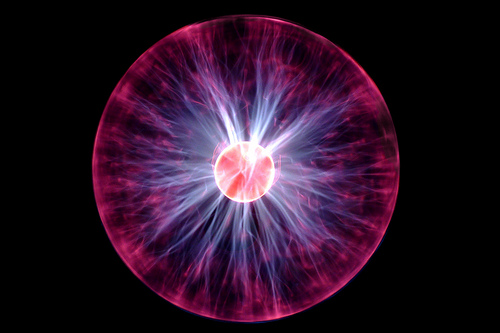
A particle implies a point-like center and a fixed identity that is moving. But the quantum “particles” inside the atom are not like material particles. They are like drops that could be dissolving and forming within a fluid-like field.

According to the Theory of Substance there are no material-like particles inside the atom. There are only fluid-like fields of different consistencies. These fields are continuous with each other despite sharply varying consistencies.

In a hydrogen atom, the only proton of very high consistency is the very small nucleus at the center, but the only electron of 1836 times lesser consistency fills the rest of the atom. This electron is like a huge field of very diluted mass. It is not like a point-like condensed particle orbiting the nucleus. This makes the electron tens of thousands of times larger than the proton.

There seems to be a relationship between consistency and size of substance: The lower is the consistency, the greater is the size.

Even when the atoms are packed tightly within matter, they have very large spaces among them. These spaces are filled with photons of negligible consistency. From the relationship between consistency and size, we may estimate the size of a photon to be tens of thousands of times larger than the electron.

We may not have the exact sizes of Proton, Electron and Photon, but we can say with certainty that the size of the electron is humongous compared to the size of the proton; and the size of the photon is humongous compared to the size of the electron.

The mathematical interpretation of quantum mechanics may disagree with the above conclusion but the mathematics of quantum mechanics assumes quantum entities to be point-like particles that have probabilistic locations.

.
The Book of Physics

Reference: Beginning Physics I
Reference: Beginning Physics II

The Theory of Substance

This is currently a developing theory.

  1. The Theory of Substance
  2. Substance and Consistency
  3. The Foundation
  4. The Spectrum of Substance
  5. Substance & Matter
  6. Substance & Space
  7. Substance and Time
  8. Inertia and Absolute Motion

Under Review

PHILOSOPHY

  1. The Scientific Method
  2. The Basis of Scientific Method
  3. Mathematics and Physics
  4. The Matter-Centric Fixation
  5. Physics and Brainwashing
  6. Einstein and Spinoza’s God
  7. Non-Locality & Oneness of Reality
  8. Testing a Theory
  9. New Theory and Skeptics
  10. Falsifiability
  11. Providing Proof
  12. Critical Thinking
  13. Thought as Substance

RELATIVITY

  1. An Analysis of Special Relativity (SR)
  2. Michelson-Morley’s Null Result
  3. The Universal Constant ‘c’
  4. The Gravitational Waves
  5. The Einstein’s Observer
  6. Objections to Einstein’s Relativity
  7. Relativistic Mass
  8. Space Contraction
  9. The Gravity
  10. The Principle of Gravity
  11. Motion and Gravity
  12. Motion-Inertia Relationship
  13. The Problem of Relativity
  14. The Speed of Light
  15. Theory of Substance and GR
  16. First postulate of Relativity
  17. Second Postulate of Relativity
  18. Special Relativity & Time
  19. Inertia versus Motion

GR & QM

  1. The Particle of Particle Physics
  2. Fields and Particles
  3. Spin in Quantum Physics
  4. General Relativity & Quantum Mechanics
  5. GR, QM and Theory of Substance
  6. Einstein & Quantum Mechanics
  7. Einstein-Bohr Debate

QUANTUM MECHANICS

  1. The Quantum
  2. The Quantum Particle
  3. The History of Quanta
  4. Misconceptions about Quanta
  5. The Atom
  6. Concepts in Quantum Mechanics
  7. The Particle-Wave Contradiction
  8. The Uncertainty Principle
  9. Quantum Superposition
  10. Quantum Entanglement
  11. Locality and Non-locality
  12. Quantum Mechanics and Reality

.

Old Versions

  1. Logic, Reality and Oneness
  2. The Space
  3. Motion and Relativity
  4. Proton, Electron and Photon
  5. The Nature of Space
  6. Continuity of Substance and Space
  7. Space and Medium of Light
  8. Is Energy Substance?
  9. Is Aether still there?

.

Mathematics and Physics

Reference: Essays on Substance

Mathematics and Physics

The postulates of Mathematics do arise from real experience, but they are then extended into abstract concepts that become distant from reality. For example, numbers, and their relationships arise from our experience with counting and accounting of distances and directions, but they are then extended to ideas, such as, zero and infinity that are abstract concepts only, and can be interpreted in many ways.

Mathematics has developed along the lines of establishing consistency among its postulates. The abstract postulates have become part of its woof and warp. When mathematics is applied to physics, its abstractions have to tested against real observations. Establishing consistency between the mathematical abstractions and real observations benefits both mathematics and physics.

A scientific hypothesis starts from real observations that are not quite consistent with established theories. The scientist generates a hypothesis to resolve that inconsistency. He may create a mathematical model to flush out as many inconsistencies as possible from his hypothesis.

The hypothesis may make new postulates. These postulates need to be properly justified. When we talk about subjectivity, we are talking about unjustified, arbitrary postulates.

So the scientist develops experiments to test the postulates of his hypothesis. These experiments can be conducted using physical equipment in a lab. The resulting measurements are then compared against the predictions from the hypothesis. A consistency between the two helps the hypothesis to be accepted as a theory.

When mathematical interpretations of the hypotheses and theories start to become complex, unreal, or simply pointless then it is time to develop thought experiments to further test the hypotheses and theories for inconsistencies. The theory of relativity and quantum mechanics are very mathematically oriented. They have espoused ideas about space and time that conflict with reality. Such ideas need to be carefully examined with well designed thought experiments that use live logic.

The thought experiments shall examine the postulates of the hypothesis for consistency with established principles. It will also examine the logical continuity among the ideas and observations leading to those postulates. Finally it will examine the harmony, which these new postulates bring to the broad scene of scientific principles.

The resolution of inconsistencies arising between a hypothesis and the reality of scientific principles may also bring into view basic concepts that are missing both in mathematics as well as in physics. This is what Faraday was insisting in his essay quoted below:

Faraday 1857: On the Conservation of Force

.

Motion and Relativity

Reference: Essays on Substance

Motion and Relativity

When you look at motion on a large scale you see what is missing from the Special Theory of Relativity of Einstein. You can say that light move at the speed of 3 x 10⁸ relative to the Earth; but you cannot say that Earth moves at the same speed relative to light. 

Einstein’s theory is tied to the inertial frame of reference of matter. But even then it doesn’t differentiate between the nature of the speed of the train from the nature of the speed of the platform in the opposite direction. The platform having much higher inertia has a much smaller absolute motion than the train. But the theory of relativity treats both motions the same way.

Newton’s relativity worked  as simple addition of speeds when the two bodies involved had comparable masses. But that mathematical relationship failed when the two bodies involved had a large difference in their masses, as is the case between the masses of Mercury and the Sun. Einstein solved that problem by figuring out a way to take into account the effect of the difference in inertia of Mercury and Sun on the relative speed.

Einstein did it by indirectly “extrapolating” between the inertia/consistency of matter and light, and applying that gradient to the differential of inertia between Mercury and the Sun. This was a genius move. The value of ‘c’ is that gradient. 

But ‘c’ is an approximation that works for heavenly bodies. It does not work at the atomic level because there are no “material particles” within the atom. Now that we know this, a more accurate value for ‘c’ can be determined for atoms.

.

Motion-Inertia Relationship

Reference: Essays on Substance

Motion-Inertia Relationship

According to Motion and Gravity, motion increases as inertia decreases. This is visible on a cosmic scale. The reason Newton did not point to this relationship is because for changes in speeds of objects, the corresponding change in inertia is so small that it cannot be measured.

This observation adds to the Newton’s laws of motion. We may say,

When a particle of matter is accelerated, its mass decreases. The decrease in mass is proportional to the increase in its speed.

A little math for it is provided in the graphics below.

The configuration of a system of bodies in free space is determined strictly by the equilibrium among their consistency and motion, where consistency and motion are tightly related in an inverse relationship. This equilibrium is confused with the gravitational force of attraction. There is no one-way gravitational force of attraction. 

A constant velocity in free space means that the acceleration of the body is exactly balanced by its inertia. Thus, it becomes possible to control motion by controlling the inertia of a body, or vice versa. This is likely to be one of the areas of future technology.

.