Fields and Particles

Reference: Essays on Substance

Fields and Particles

According to the AI:

In quantum field theory, a particle being an excitation of a field means that it is a temporary disturbance or oscillation in an underlying quantum field. These quantum fields are continuous and permeate all of spacetime. When a quantum field receives energy, it can create a ripple or excitation that behaves like a particle.

Particles are not individual entities existing on their own, but rather manifestations of these field excitations. For example, an electron is an excitation of the electron field, while a photon is an excitation of the electromagnetic field. These excitations can be thought of as wave packets propagating through their respective fields.

The strength and duration of these excitations determine the nature of the particles:

  1. Virtual particles: Tiny, fleeting ripples that exist for extremely short periods.
  2. Real particles: Stronger excitations with definite properties like location and momentum, which can be measured in experiments.

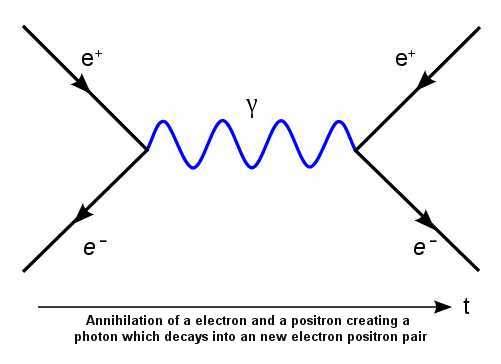
When particles interact or are detected, it involves an exchange of energy between different quantum fields. This exchange can cause the fields to “bunch up” or concentrate at specific locations, which is what we observe as particle behavior.

Understanding particles as field excitations helps explain phenomena like particle creation and annihilation, which occur through the interactions and energy exchanges between these fundamental quantum fields.

.

According to Substance Theory:

Spacetime and Field

  1. Space and time represent dimensions of substance.
  2. Therefore, any space and time has substance in it.
  3. A mathematical field could be modeling an actual substance.

Field and particles

  1. As substance gets concentrated it becomes a particle that is smaller in size and more sluggish.
  2. A particle exists as a more concentrated substance in a less concentrated background. For example, the electronic region exists within an electromagnetic background.
  3. This pattern may repeat with the particle becoming the background of a more concentrated particle. For example, the nuclear region exists within the electronic background.
  4. This pattern may repeat with the background becoming a particle within a still broader and less concentrated background. For example, the electromagnetic region may exist as a particle within aether as its background.
  5. The particle moves within its background like a “pulse.” It is continuous with its background.
  6. There is spectrum of particles according to their degree of concentration. This is same as the spectrum of substance.
  7. There is relative motion among pulses at the same level of concentration.
  8. As the concentration increases with successive particle-background iterations, the absolute motion decreases.
  9. With each iteration of “background-particle,” there is creation of mass.
  10. The least concentrated background may be compared with the mathematical Higgs Field.
  11. All particles and backgrounds shall be related to each other through the continuity of substance.
  12. When the backgrounds (fields) interact with each other, the energy generated gets converted into particles.
  13. Energy is conserved but not the number of particles.

.

The Universal Constant ‘c’

Reference: Essays on Substance

The Universal Constant ‘c’

According to the AI:

The velocity of light, commonly denoted as c, holds profound significance in physics and beyond due to its unique properties and implications:

1. Universal Constant
The speed of light in a vacuum is a universal constant with a value of exactly 299,792,458 meters per second. It is independent of the motion of the source or the observer, as postulated by Einstein’s Special Theory of Relativity. This invariance underpins modern physics and has been confirmed by numerous experiments.

2. Foundation of Relativity
The constancy of the speed of light is a cornerstone of Einstein’s Special Theory of Relativity. It leads to revolutionary concepts such as time dilation, length contraction, and the equivalence of mass and energy (E=mc^2). These phenomena become significant at speeds approaching c, fundamentally altering our understanding of space and time.

3. Upper Limit for Speed
The speed of light represents the ultimate speed limit in the universe. No information, energy, or matter can travel faster than c. This restriction arises because an object’s mass would approach infinity as it nears c, requiring infinite energy for further acceleration.

4. Measurement and Standards
The speed of light is critical for precise measurements:

  • It defines the meter: since 1983, the meter has been defined as the distance light travels in 1/299,792,458 seconds.
  • It is used in time-of-flight measurements to calculate vast distances with high accuracy, such as between celestial bodies.

5. Implications for Astronomy and Cosmology
Light’s finite speed allows us to observe distant astronomical objects as they were in the past, providing insights into the history and evolution of the universe. For example, starlight seen today might have traveled millions or billions of years to reach Earth.

6. Role in Electromagnetism
The speed of light emerges naturally from Maxwell’s equations as a property of electromagnetic waves. It unifies electric and magnetic fields into a single framework, linking electromagnetism with relativity.

In summary, the velocity of light is not just a physical constant but a fundamental property that shapes our understanding of reality, from microscopic particles to the vast cosmos.

.

According to Substance Theory:

  1. The velocity of a particle in free space is constant because its motion is balanced by the inertia of its mass (consistency).
  2. The velocity of light is constant because it is balanced by the inertia of the photon.
  3. The constant ‘c’ represents an average value of the mass/consistency ratio of atom to photon.
  4. Because ‘c’ is so large it is practically constant with respect to change in inertial motion of matter. That is why the relativity theory provides accurate results, but only under certain conditions.

Theoretical considerations:

  1. The theoretical value of ‘c’ in Electromagnetism depends on the assumption of a “uniform aether,” which lacks full substantiation.
  2. The velocity of EMR, across the spectrum, is expected to vary, because the consistency of EMR, as determined by its frequency, varies.
  3. The velocity of light is an average value associated with the narrow band of the spectrum of visible light.

Claims of Relativity Theory:

  1. The object’s mass does not approach infinity as it nears c. All it means is that even an infinite force won’t accelerate a particle like photon that has no mass or inertia.
  2. The claim, “The speed of light represents the ultimate speed limit in the universe” lacks full substantiation because of the variability pointed above.
  3. The explanation of relativity theory in terms of length contraction and time dilation raises questions.

.

The Gravitational Waves

Reference: Essays on Substance

The Gravitational Waves

According to the AI:

Gravitational waves are ripples in the fabric of space-time, caused by massive objects undergoing acceleration, such as colliding black holes, merging neutron stars, or supernovae. These waves propagate outward from their source at the speed of light, carrying information about their origins and the nature of gravity itself.

Key Characteristics

  • Nature: Gravitational waves are distortions in space-time, predicted by Albert Einstein in 1916 as part of his general theory of relativity.
  • Speed: They travel at the speed of light (approximately 186,000 miles per second).
  • Effects: As they pass through space, gravitational waves stretch and compress space-time along their path.

Sources of Gravitational Waves
Gravitational waves are generated by some of the most energetic events in the universe:

  • Collisions and mergers of black holes or neutron stars.
  • Supernovae (explosions of massive stars).
  • Rotating neutron stars with irregular shapes.
  • Potential remnants from the Big Bang.

Detection
Gravitational waves were first directly detected in 2015 by the Laser Interferometer Gravitational-Wave Observatory (LIGO). This landmark observation came from the merger of two black holes 1.3 billion light-years away. LIGO and similar observatories use highly sensitive instruments to measure the minute distortions in space-time caused by passing gravitational waves.

Importance
The discovery and study of gravitational waves have opened a new window into understanding the universe. Unlike electromagnetic waves (light), gravitational waves provide insights into phenomena that are otherwise invisible, such as black hole collisions. They also offer a new way to test Einstein’s theory of relativity and explore cosmic events in unprecedented detail.

.

According to Substance Theory:

  1. Not only motion, but mass (consistency) is also relative.
  2. The velocity of a particle in free space is constant because its motion is balanced by the inertia of its mass (consistency).
  3. All bodies arrange themselves dynamically in space such that their mass (consistency) and motions are in equilibrium at all times. This describes gravity.
  4. It is natural that when gravitational relationships change, their effect will propagate very quickly to other bodies near and far.
  5. What propagates is the readjustment of the configurations of masses and motions, and not some wave in abstract space-time dimension.
  6. How fast these readjustments propagate is not necessarily the speed of light, which is a postulate underlying General Relativity.
  7. The speed at which gravitational readjustments propagate is an open question.

.

The Particle of Particle Physics

Reference: Essays on Substance

The Particle of Particle Physics

According to AI:

In particle physics, a particle is defined as the smallest possible vibration of a quantum field. It is a fundamental unit of matter and energy that cannot be broken down further. Particles in this context are not physical objects in the classical sense, but rather mathematical constructs used to describe quantum phenomena.

Specifically, particles in particle physics exhibit the following characteristics:

  1. They are point-like objects with no internal structure.
  2. They possess specific properties such as mass, charge, and spin.
  3. They can behave both as particles and waves, a phenomenon known as wave-particle duality.
  4. They are described by wave-functions in quantum mechanics.
  5. They interact with each other through fundamental forces, as explained by the Standard Model of particle physics.

Examples of particles in this field include quarks, leptons (such as electrons), and bosons (such as photons). These fundamental particles form the building blocks of all matter and are the subject of study in high-energy physics.

.

According to Substance Theory:

The Substance Theory is trying to bring reality to the mathematical model of Particle Physics.

  1. There are no point particles. Particles have dimensions.
  2. Not all particles have the same shape, volume and other physical characteristics.
  3. The size of a particle is determined by its wavelength.
  4. The substantiality of a particle is determined by its mass or consistency.
  5. A particle is as longer-lasting as its mass or consistency.
  6. A particle has a homogenous structure. It can said to be solid, liquid or gaseous in nature depending on its mass or consistency.

.

Critical Thinking

Reference: Essays on Substance

Critical Thinking

Critical thinking means that you can see both similarities and differences and do not just think in identities. The bug in human mind is the identity thinking.

The ultimate identity thinking would by when one assigns God to be the cause of everything and thinks no further.

When one starts to move away from identity thinking, he first thinks in black and white and does not recognize any shade of gray. To him, everything that Newton said is right; and everything that Einstein said is wrong. Christianity is good; all other religions are bad. God is good; Man is evil. This kind of thinking is very close to identity thinking.

A more flexible thinking starts to recognize some shades of gray. He starts to think in terms of categories, but such categories are few and strictly defined. They are limited in their scope. Here we have an abundance of fixed ideas, and an unwillingness to look beyond those fixed ideas. They cannot think creatively. They cannot accept a new idea because their ability to evaluate is quite primitive.

The above is the “identity thinking” end of the scale of logic. At the other end is thinking that recognizes differences and similarities appropriately. This is the thinking of scientists. They think in terms of infinite categories. These categories can subdivide and their numbers can grow indefinitely. They balance the information belonging to these infinite categories using the first Law of Thought.

FIRST LAW OF THOUGHT: All thought related to a subject must be continuous, consistent and harmonious.

At this end of the logic scale resides Critical Thinking.

Understanding of subjects, such as, physics and Nuclear Physics cannot occur without critical thinking.

.