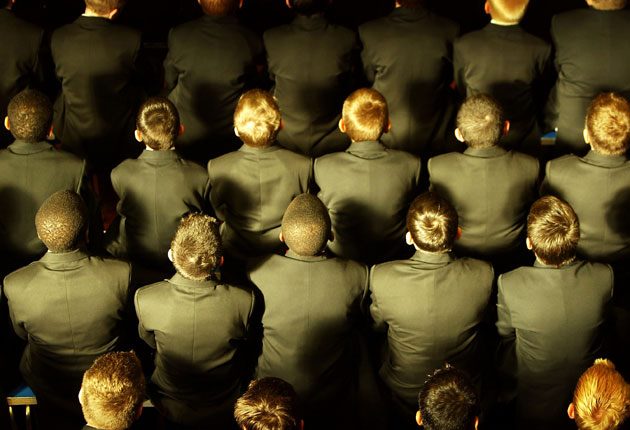
BRAINWASHING

I believe Scientology built itself up on some kind of existing cultural brainwashing in the western society. It has not been successful in the eastern culture. I spent 12 years in the Sea Org and came out relatively okay. I have neither hate nor love for Scientology. It is just an interesting subject.

The brainwashing, which is quite prevalent in the western culture is the idea of “eternal soul”. Scientology concept of THETAN forwards that brainwashing and makes an “immortal individuality” the cornerstone of its philosophy and therapy.

There is individuality–that is not in question. But it is the belief in the adjective “immortal” attached to it that constitutes brainwashing. This belief affects so much of man’s behavior that it is amazing.

Scientology does not talk about God. There is no mention of “Lord” in its philosophy. However, it preserves that concept of God in its concept of the THETAN. THETAN combines the anthropomorphic concept of “God” with the concept of “eternal soul” into one.

In the East, the concept of ATMAN is more like the idea of an “electric current”. ATMAN is something that energizes the BODY-MIND system. PARAMATMA (supreme ATMAN) is the concept in Hinduism that is used in place of God. It refers to the most subtle form of energy and not to some “being”. The Scientology concept of THETA (life force) is similar to it.

What could be considered immortal is ENERGY WITH INNATE IMPULSE. This idea is also supported by the Law of Conservation. This energy has been expressed as ATMAN, or THETA, or Life force.

THETAN is a concept that defines the individuality of the BODY-MIND system. It is, actually, a part of the BODY-MIND system. Upon death, the BODY-MIND system disintegrates and so does the THETAN along with it. A new THETAN is formed with the next iteration of the BODY-MIND system. This is how the mechanism of evolution works.

The concept of “eternal” (along with the concepts of heaven and hell) is not necessary to enforce responsibility on the individual. The concept of “karma” is enough to make the mortal individual understand the liability that his actions can bring. He knows that the liability of his actions extends to other aspects of life, such as, the family, society, mankind, etc. It is not limited to just “that one individual in next life”.

Scientology brainwashing, which uses the the belief in “immortal individuality,” is not something new. It is something that has been considered sacred and worshipped for ages in the western culture. This fixation on individuality is what we refer to as EGO.

.

DIANETICS: The Four Dynamics

Reference: Hubbard 1950: Dianetics TMSMH

These are some comments on Book One, Chapter 4, “The Four Dynamics” from DIANETICS: THE MODERN SCIENCE OF MENTAL HEALTH.

.

Comments on
The Four Dynamics

KEY WORDS: Dynamic, The dynamics

Man’s behavior can be explained fully only in terms of his brotherhood with the Universe. Man is the result of the evolution of the universe, and now he is acting as a catalyst to further evolution. Man’s behavior cannot be explained by focusing just on self, sex, group or even mankind. 

Hubbard asks, “Exactly for what is man surviving?” He then comes up with four dynamics.

“DYNAMIC ONE is the urge toward ultimate survival on the part of the individual and for himself. It includes his immediate symbiotes, the extension of culture for his own benefit, and name immortality.

“DYNAMIC TWO is the urge of the individual toward ultimate survival via the sex act, the creation of and the rearing of children. It includes their symbiotes, the extension of culture for them, and their future provision. 

“DYNAMIC THREE is the urge of the individual toward ultimate survival for the group. It includes the symbiotes of the group and the extension of its culture. 

“DYNAMIC FOUR includes the urge of the individual toward ultimate survival for all Mankind. It includes the symbiotes of Mankind and the extension of its culture.”

As explained in the previous chapter, this “ultimate survival” is not immortality but attainment of a STATIC viewpoint from which further evolution of the universe may be catalyzed.

Attainment of STATIC viewpoint requires Man to expand his viewpoint from self to families, to groups, to species, and to all mutually dependent entities.

As a person grows up, his viewpoint naturally expands from dynamic one to dynamic two, three and four. A higher dynamic is naturally inclusive of the lower dynamics. Any exception would only mean fixation on a dynamic to the exclusion of other dynamics. A fixation would simply amount to the aberration defined as a “narrow viewpoint.” A rational person shall be operating harmoniously on all dynamics.

Any competition among dynamics, if not harmonious, would constitute an anomaly that needs to be resolved. An anomaly, if considered to be something normal, shall be an aberration.

Any solution must resolve the anomaly completely, and that would bring about an optimum scene. The categorization into four dynamics is for the sake of dealing with the complexity of a situation only. 

Hubbard says, “The case of a sailor giving his own life to save his ship answers the group dynamic. Such an action is a valid solution to a problem. But it violates the optimum solution because it did not answer for Dynamic One: self.”

Of course, it would be optimum to save oneself while also saving the group, but the safety of the group comes first, and the group must be saved even at the expense of self, depending on its value to mankind.

.

DIANETICS: The Goal of Man

Reference: Hubbard 1950: Dianetics TMSMH

These are some comments on Book One, Chapter 3, “The Goal of Man” from  DIANETICS: THE MODERN SCIENCE OF MENTAL HEALTH.

.

Comments on
The Goal of Man

KEY WORDS: Survival, Immortality

Hubbard writes:
“TIME, SPACE, ENERGY and LIFE have a single denominator in common. As an analogy it could be considered that TIME, SPACE, ENERGY and LIFE began at some point of origin and were commanded to continue to some nearly infinite destination. They were told nothing but WHAT to do. They obey a single order and that order is “SURVIVE!”

Did the universe begin at some point? Was it commanded to SURVIVE? The ancient Vedas say that the universe has neither a beginning nor an end. Science says that energy forms the basic substance of the universe and it is conserved. Thus, from all evidence, energy has always been there, and it has no choice but to survive.

Hubbard writes:
“THE DYNAMIC PRINCIPLE OF EXISTENCE IS SURVIVAL The goal of life can be considered to be infinite survival. Man, as a life form, can be demonstrated to obey in all his actions and purposes the one command: SURVIVE!”

Although energy has no choice but to survive, the energy forms appear and disappear, and through this process, the forms change and evolve. Subtle energy evolves into solid atoms of matter (see the ELECTROMAGNETIC SPECTRUM). Atoms evolve into complex atoms (see the PERIODIC TABLE). Atoms combine into molecules and these molecules also evolve into complex molecules (see CHEMISTRY). Complex molecules acquire enough electronic circuits to develop self-animation. Thus come about basic life forms that evolve into complex life forms (see BIOLOGY). Life forms develop the ability to react. Such reactions gradually evolve into sophisticated analytical abilities. Thus life forms evolve from minerals to plants to animals to humans. Since Man is part of the universe, his goal is consistent with the overall goal of the universe, which is evidently, to EVOLVE. 

Like the energy it is made of, Mankind cannot help but survive. Although individual human forms take birth and ultimately die, they evolve from the experience of living. The goal of Man, therefore, is continual evolution, and not the immortality of some individual form.

Some may assume that the goal of Man is to be immortal. But the actual goal of Man, like the goal of the universe and life, has always been to EVOLVE.

Where evolution will ultimates take us, we don’t know; and that is the energizing aspect of it. This is the aspect of an advancing science compared to a moribund religion.

Hubbard writes:
“In order to establish nomenclature in dianetics which would not be too complex for the purpose, words normally considered as adjectives or verbs have occasionally been pressed into service as nouns.”

Some of the words coined by Hubbard as nouns are as follows.

DYNAMIC = innate impulse or urge
SOMATIC = physical sensation
PERCEPTIC = a sense message

Hubbard writes:
“… a spectrum of life has been conceived to span from the zero of death or extinction toward the infinity of potential immortality… The thrust of survival is away from death and toward immortality. The ultimate pain could be conceived as existing just before death and the ultimate pleasure could be conceived as immortality… The urge is away from death, which has a repelling force, and toward immortality, which has an attracting force; the attracting force is pleasure, the repelling force is pain… Pain is provided to repel the individual from death, pleasure is provided to call him toward optimum life.”

Hubbard postulates “thetan” as the ultimate in individuality and gives it the attribute of immortality. Thus “thetan” is similar to the concept of “eternal soul” in Christianity. However, individuality belongs to the body-mind system as its core property. The body-mind system is subject to the cycle of birth and death, and so is individuality. What is eternal is the life force (symbolized by Hubbard as THETA), which energizes the body-mind-individuality system. Like the idea of the “eternal soul,” the postulate of an “immortal thetan” is also in error. Neither soul nor thetan stands apart from the body-mind system. What stands apart is the STATIC viewpoint.

The actual spectrum is from MYSTERY to KNOWINGNESS as it applies to consciousness. The ultimate consciousness resides in the knowingness of the STATIC viewpoint.

By definition, the STATIC viewpoint stands beyond all MOTION. Motion is the key characteristic of the universe. Motion becomes “emotion” in life organisms. Therefore, the STATIC viewpoint stands beyond all emotion too. An individual, when cleared of all anomalies, attains the STATIC viewpoint. He then views all motion (the universe) and emotion (life experiences) objectively without alteration.

It may be said that attaining the STATIC viewpoint is the goal of Man. But this STATIC viewpoint simply helps man to evolve through the cycles of birth and death.

Immortality lies in the total objectivity of the STATIC viewpoint expressed as happiness in action. The thrust from this viewpoint is always toward evolution. Each step of evolution brings immense joy. The death of the body-mind system is inevitable. There may be pain associated with death; but a person with STATIC viewpoint views death simply as a phenomena to be experienced.

Hubbard seems to advance the idea that all actions of life are driven by pain and pleasure. This is not so. All actions of life are driven by the dynamic of the life organism. Pain and pleasure are just indicators that help one evaluate the experience at that moment. The state of mind may be graded on a tone scale—apathy, anger, bearable existence, happiness. This mental state may reflect how subjective or objective the viewpoint is. The freer is the viewpoint from fixations the more objective it is. 

Dianetics assumes that aberration enters through pain only. But aberration also enters through the fixation and narrowing of the viewpoint as one goes through various experiences in life. The narrower is the viewpoint the more selfish and immoral the person becomes.

A broad STATIC viewpoint is all inclusive. Life is a group effort. As the forms grow more complex, a tremendous interdependence exists. No one survives alone.

.

ARISTOTLE: The Foundation of Logic

Reference: The Story of Philosophy

This paper presents Chapter II, Section 3 from the book THE STORY OF PHILOSOPHY by WILL DURANT. The contents are from the 1933 reprint of this book by TIME INCORPORATED by arrangement with Simon and Schuster, Inc.

The paragraphs of the original material (in black) are accompanied by brief comments (in color) based on the present understanding.  Feedback on these comments is appreciated.

The heading below is linked to the original materials.

.

III. The Foundation of Logic 

The first great distinction of Aristotle is that almost without predecessors, almost entirely by his own hard thinking, he created a new science—Logic. Renan speaks of “the ill training of every mind that has not, directly or indirectly, come under Greek discipline”; but in truth the Greek intellect itself was undisciplined and chaotic till the ruthless formulas of Aristotle provided a ready method for the test and correction of thought. Even Plato (if a lover may so far presume) was an unruly and irregular soul, caught up too frequently in a cloud of myth, and letting beauty too richly veil the face of truth. Aristotle himself, as we shall see, violated his own canons plentifully; but then he was the product of his past, and not of that future which his thought would build. The political and economic decay of Greece brought a weakening of the Hellenic mind and character after Aristotle; but when a new race, after a millennium of barbaric darkness, found again the leisure and ability for speculation, it was Aristotle’s “Organon” of logic, translated by Boethius (470-525 A. D.), that became the very mould of medieval thought, the strict mother of that scholastic philosophy which, though rendered sterile by encircling dogmas, nevertheless trained the intellect of adolescent Europe to reasoning and subtlety, constructed the terminology of modern science, and laid the bases of that same maturity of mind which was to outgrow and overthrow the very system and methods which had given it birth and sustenance. 

The ruthless formulas of Aristotle provided a ready method for the test and correction of thought.

Logic means, simply, the art and method of correct thinking. It is the logy or method of every science, of every discipline and every art; and even music harbors it. It is a science, because to a considerable extent the processes of correct thinking can be reduced to rules like physics and geometry, and taught to any normal mind; it is an art because by practice it gives to thought, at last, that unconscious and immediate accuracy which guides the fingers of the pianist over his instrument to effortless harmonies. Nothing is so dull as logic, and nothing is so important. 

Logic is the art and method of correct thinking. 

There was a hint of this new science in Socrates’ maddening insistence on definitions, and in Plato’s constant refining of every concept. Aristotle’s little treatise on Definitions shows how his logic found nourishment at this source. “If you wish to converse with me,” said Voltaire, “define your terms.” How many a debate would have been deflated into a paragraph if the disputants had dared to define their terms! This is the alpha and omega of logic, the heart, and soul of it, that every important term in serious discourse shall be subjected to strictest scrutiny and definition. It is difficult, and ruthlessly tests the mind; but once done it is half of any task. 

The heart and soul of logic are the definitions that are consistent with the context.

How shall we proceed to define an object or a term? Aristotle answers that every good definition has two parts, stands on two solid feet: first, it assigns the object in question to a class or group whose general characteristics are also its own—so man is, first of all, an animal; and secondly, it indicates wherein the object differs from all the other members in its class—so man, in the Aristotelian system, is a rational animal, his “specific difference” is that unlike all other animals he is rational (here is the origin of a pretty legend). Aristotle drops an object into the ocean of its class, then takes it out all dripping with generic meaning, with the marks of its kind and group; while its individuality and difference shine out all the more clearly for this juxtaposition with other objects that resemble it so much and are so different. 

A definition must have a context. It is easy to differentiate a man from an animal. But to differentiate a man from another man requires closer inspection. So, a context may require simple “black and white definition” for an object, but another context may require a “definition with many shades” for the same object.

Passing out from this rear line of logic we come into the great battle-field on which Aristotle fought out with Plato the dread question of “universals”; it was the first conflict in a war which was to last till our own day, and make all medieval Europe ring with the clash of “realists” and “nominalists.”* A universal, to Aristotle, is any common noun, any name capable of universal application to the members of a class: so animal, man, book, tree, are universals. But these universals are subjective notions, not tangibly objective realities; they are nomina (names), not res (things); all that exists outside us is a world of individual and specific objects, not of generic and universal things; men exist, and trees, and animals; but man-in-general, or the universal man, does not exist, except in thought; he is a handy mental abstraction, not an external presence or re-ality. 

*[It was In reference to this debate that Friedrich Schlegel said, ”Every man is born either a Platonist or an Aristotelian” (in Benn, i, 291).] 

The “universals” can be treated as objective notions in proper context. Subjectivity enters the picture when the object and its context do not match.

Now Aristotle understands Plato to have held that universals have objective existence; and indeed Plato had said that the universal is incomparably more lasting and important and substantial than the individual,—the latter being but a little wavelet in a ceaseless surf; men come and go, but man goes on forever. Aristotle’s is a matter-of-fact mind; as William James would say, a tough, not a tender, mind; he sees the root of endless mysticism and scholarly nonsense in this Platonic “realism”; and he attacks it with all the vigor of a first polemic. As Brutus loved not Cresar less but Rome more, so Aristotle says, Amicus Plato, sed magis amica veritas—“Dear is Plato, but dearer still is truth.”

We sense the universe and try to assimilate all those sensations into a oneness to form a complete picture. Both realism and nominalism provide different viewpoints of that assimilation. The viewpoint is the frame of reference one is using. The broader is the viewpoint the more objective it is.

A hostile commentator might remark that Aristotle (like Nietzsche) criticizes Plato so keenly because he is conscious of having borrowed from him generously; no man is a hero to his debtors. But Aristotle has a healthy attitude, nevertheless; he is a realist almost in the modern sense; he is resolved to concern himself with the objective present, while Plato is absorbed in a subjective future. There was, in the Socratic-Platonic demand for definitions, a tendency away from things and facts to theories and ideas, from particulars to generalities, from science to scholasticism; at last Plato became so devoted to generalities that they began to determine his particulars, so devoted to ideas that they began to define or select his facts. Aristotle preaches a return to things, to the “unwithered face of nature” and reality; he had a lusty preference for the concrete particular, for the flesh and blood individual. But Plato so loved the general and universal that in the Republic he destroyed the individual to make a perfect state. 

The broadest viewpoint shall provide a consistency between all the general concepts and the particular observations. This consistency extends to continuity in dimensions, and harmony in relationships.

Yet, as is the usual humor of history, the young warrior takes over many of the qualities of the old master whom he assails. We have always goodly stock in us of that which we condemn: as only similars can be profitably contrasted, so only similar people quarrel, and the bitterest wars are over the slightest variations of purpose or belief. The knightly Crusaders found in Saladin a gentleman with whom they could quarrel amicably; but when the Christians of Europe broke into hostile camps there was no quarter for even the courtliest foe. Aristotle is so ruthless with Plato because there is so much of Plato in him; he too remains a lover of abstractions and generalities, repeatedly betraying the simple fact for some speciously bedizened theory, and compelled to a continuous struggle to conquer his philosophic passion for exploring the empyrean. 

Where a disharmony exists there also exists, out of view, some discontinuity or inconsistency, which is yet to be found.

There is a heavy trace of this in the most characteristic and original of Aristotle’s contributions to philosophy—the doctrine of the syllogism. A syllogism is a trio of propositions of which the third (the conclusion) follows from the conceded truth of the other two (the “major” and “minor” premisses). E. g., man is a rational animal; but Socrates is a man; therefore Socrates is a rational animal. The mathematical reader will see at once that the structure of the syllogism resembles the proposition that two things equal to the same thing are equal to each other; if A is B, and C is A, then C is B. As in the mathematical case the conclusion is reached by canceling from both premisses their common term, A; so. in our syllogism the conclusion is reached by canceling from both premisses their common term “man,” and combining what remains. The difficulty, as logicians have pointed out from the days of Pyrrho to those of Stuart Mill, lies in this, that the major premiss of the syllogism takes for granted precisely the point to be proved; for if Socrates is not rational (and no one questions that he is a man) it is not universally true that man is a rational animal. Aristotle would reply, no doubt, that where an individual is found to have a large number of qualities characteristic of a class (“Socrates is a man”), a strong presumption is established that the individual has the other qualities characteristic of the class (“rationality”). But apparently the syllogism is not a mechanism for the discovery of truth so much as for the clarification of exposition and thought. 

The truth of Aristotle’s syllogism depends on the broad preciseness of major premise, so as to include the minor premise.

All this, like the many other items of the Organon, has its value: “Aristotle has discovered and formulated every canon of theoretical consistency, and every artifice of dialectical debate, with an industry and acuteness which cannot be too highly extolled; and his labors in this direction have perhaps contributed more than any other single writer to the intellectual stimulation of after ages.” But no man ever lived who could lift logic to a lofty strain: a guide to correct reasoning is as elevating as a manual of etiquette; we may use it, but it hardly spurs us to nobility. Not even the bravest philosopher would sing to a book of logic underneath the bough. One always feels towards logic as Virgil bade Dante feel towards those who had been damned because of their colorless neutrality: Non agionam di lor, maguarda e passa—“Let us think no more about them, but look once and pass on.” 

Aristotle’s logic assumes but does not explicitly insist on maintaining the consistency of the viewpoint or context.

.

ARISTOTLE: The Work of Aristotle

Reference: The Story of Philosophy

This paper presents Chapter II, Section 2 from the book THE STORY OF PHILOSOPHY by WILL DURANT. The contents are from the 1933 reprint of this book by TIME INCORPORATED by arrangement with Simon and Schuster, Inc.

The paragraphs of the original material (in black) are accompanied by brief comments (in color) based on the present understanding.  Feedback on these comments is appreciated.

The heading below is linked to the original materials.

.

II. The Work of Aristotle

It was not hard for the instructor of the king of kings to find pupils even in so hostile a city as Athens. When, in the fifty-third year of his age, Aristotle established his school, the Lyceum, so many students flocked to him that it became necessary to make complicated regulations for the maintenance of order. The students themselves determined the rules, and elected, every ten days, one of their number to supervise the School. But we must not think of it as a place of rigid discipline; rather the picture which comes down to us is of scholars eating their meals in common with the master, and learning from him as he and they strolled up and down the Walk along the athletic field from which the Lyceum took its name.

[The Walk was called Peripatos; hence the later name, Peripatetic School. The athletic field was part of the grounds of the temple of Apollo Lyceus—the protector of the flock against the wolf (Iycos).]

In the fifty-third year of his age, Aristotle established his school to conduct research and teach.

The new School was no mere replica of that which Plato had left behind him. The Academy was devoted above all to mathematics and to speculative and political philosophy; the Lyceum had rather a tendency to biology and the natural sciences. If we may believe Pliny, Alexander instructed his hunters, gamekeepers, gardeners and fishermen to furnish Aristotle with all the zoological and botanical material he might desire; other ancient writers tell us that at one time he had at his disposal a thousand men scattered throughout Greece and Asia, collecting for him specimens of the fauna and flora of every land. With this wealth of material he was enabled to establish the first great zoological garden that the world had seen. We can hardly exaggerate the influence of this collection upon his science and his philosophy. 

The main areas of research were biology and the natural sciences.

Where did Aristotle derive the funds to finance these undertakings? He was himself, by this time, a man of spacious income; and he had married into the fortune of one of the most powerful public men in Greece. Athenaeus (no doubt with some exaggeration) relates that Alexander gave Aristotle, for physical and biological equipment and research, the sum of 800 talents (in modern purchasing power, some $4,000,000). It was at Aristotle’s suggestion, some think, that Alexander sent a costly expedition to explore the sources of the Nile and discover the causes of its periodical overflow. Such works as the digest of 158 political constitutions, drawn up for Aristotle, indicate a considerable corps of aides and secretaries. In short we have here the first example in European history of the large-scale financing of science by public wealth. What knowledge would we not win if modern states were to support research on a proportionately lavish scale!

[The expedition reported that the inundations were due to the melting of the snow on the mountains of Abyssinia.]

We have here the first example in European history of the large-scale financing of science by public wealth.

Yet we should do Aristotle injustice if we were to ignore the almost fatal limitations of equipment which accompanied these unprecedented resources and facilities. He was compelled “to fix time without a watch, to compare degrees of heat without a thermometer, to observe the heavens without a telescope, and the weather without a barometer. … Of all our mathematical, optical and physical instruments he possessed only the rule and compass, together with the most imperfect substitutes for some few others. Chemical analysis, correct measurements and weights, and a thorough application of mathematics to physics, were unknown. The attractive force of matter, the law of gravitation, electrical phenomena, the conditions of chemical combination, pressure of air and its effects, the nature of light, heat, combustion, etc., in short, all the facts on which the physical theories of modern science are based were wholly, or almost wholly, undiscovered.” 

However, a fatal limitations of equipment accompanied these unprecedented resources and facilities. 

See, here, how inventions make history: for lack of a telescope Aristotle’s astronomy is a tissue of childish romance; for lack of a microscope his biology wanders endlessly astray. Indeed, it was in industrial and technical invention that Greece fell farthest below the general standard of its unparalleled achievements. The Greek disdain of manual work kept everybody but the listless slave from direct acquaintance with the processes of production, from that stimulating contact with machinery which reveals defects and prefigures possibilities; technical invention was possible only to those who had no interest in it, and could not derive from it any material reward. Perhaps the very cheapness of the slaves made invention lag; muscle was still less costly than machines. And so, while Greek commerce conquered the Mediterranean Sea, and Greek philosophy conquered the Mediterranean mind, Greek science straggled, and Greek industry remained almost where Aegean industry had been when the invading Greeks had come down upon it, at Cnossus, at Tiryns and Mycene, a thousand years before. No doubt we have here the reason why Aristotle so seldom appeals to experiment; the mechanisms of experiment had not yet been made; and the best he could do was to achieve an almost universal and continuous observation. Nevertheless the vast body of data gathered by him and his assistants became the groundwork of the progress of science, the text-book of knowledge for two thousand years; one of the wonders of the work of man. 

Greek science straggled because the Greek disdain of manual work kept everybody from stimulating contact with machinery and from direct acquaintance with the processes of production.

Aristotle’s writings ran into the hundreds. Some ancient authors credit him with four hundred volumes, others with a thousand. What remains is but a part, and yet it is a library in itself—conceive the scope and grandeur of the whole. There are, first, the Logical works: “Categories,” “Topics,” “Prior” and “Posterior Analytics,” “Propositions,” and “Sophistical Refutation”; these works were collected and edited by the later Peripatetics under the general title of Aristotle’s “Organon,”—that is, the organ or instrument of correct thinking. Secondly, there are the Scientific works: “Physics,” “On the Heavens,” “Growth and Decay,” “Meteorology,” “Natural History,” “On the Soul,” “The Parts of Animals,” “The Movements of Animals,” and “The Generation of Animals.” There are, thirdly, the Esthetic works: “Rhetoric” and “Poetics.” And fourthly come the more strictly Philosophical works: “Ethics,” “Politics,” and “Metaphysics.”

Aristotle wrote voluminously on Logics, Science, Esthetics and Philosophy.

Here, evidently, is the Encyclopedia Britannica of Greece: every problem under the sun and about it finds a place; no wonder there are more errors and absurdities in Aristotle than in any other philosopher who ever wrote. Here is such a synthesis of knowledge and theory as no man would ever achieve again till Spencer’s day, and even then not half so magnificently; here, better than Alexander’s fitful and brutal victory, was a conquest of the world. If philosophy is the quest of unity Aristotle deserves the high name that twenty centuries gave him—IlIe Philosophus: The Philosopher. 

It was essentially the compilation of an Encyclopedia.

Naturally, in a mind of such scientific turn, poesy was lacking. We must not expect of Aristotle such literary brilliance as floods the pages of the dramatist-philosopher Plato. Instead of giving us great literature, in which philosophy is embodied (and obscured) in myth and imagery, Aristotle gives us science, technical, abstract, concentrated; if we go to him for entertainment we shall sue for the return of our money. Instead of giving terms to literature, as Plato did, he built the terminology of science and philosophy; we can hardly speak of any science today without employing terms which he invented; they lie like fossils in the strata of our speech: faculty, mean, maxim, (meaning, in Aristotle, the major premiss of a syllogism), category, energy, actuality, motive, end, principle, form—these indispensable coins of philosophic thought were minted in his mind. And perhaps this passage from delightful dialogue to precise scientific treatise was a necessary step in the development of philosophy; and science, which is the basis and backbone of philosophy, could not grow until it had evolved its own strict methods of procedure and expression. Aristotle, too, wrote literary dialogues, as highly reputed in their day as Plato’s; but they are lost, just as the scientific treatises of Plato have perished. Probably time has preserved of each man the better part. 

Instead of great literature, Aristotle gave us technical, abstract, concentrated science.

Finally, it is possible that the writings attributed to Aristotle were not his, but were largely the compilations of students and followers who had embalmed the unadorned substance of his lectures in their notes. It does not appear that Aristotle published in his life-time any technical writings except those on logic and rhetoric; and the present form of the logical treatises is due to later editing. In the case of the Metaphysics and the Politics the notes left by Aristotle seem to have been put together by his executors without revision or alteration. Even the unity of style which marks Aristotle’s writings, and offers an argument to those who defend his direct authorship, may be, after all, merely a unity given them through common editing by the Peripatetic School. About this matter there rages a sort of Homeric question, of almost epic scope, into which the busy reader will not care to go, and on which a modest student will not undertake to judge. We may at all events be sure that Aristotle is the spiritual author of all these books that bear his name: that the hand may be in some cases another’s hand, but that the head and the heart are his.

[The reader who wishes to go to the philosopher himself will find the Meteorology an interesting example of Aristotle’s scientific work; he will derive much practical instruction from the Rhetoric; and he will find Aristotle at his best in books i-ii of the Ethics, and books i-iv of the Politics. The best translation of the Ethics is Welldon’s; of the Politics, Jowett’s. Sir Alexander Grant’s Aristotle is a simple book; Zeller’s Aristotle (vols. iii-iv in his Greek Philosophy), is scholarly but dry; Gomperz’s Greek Thinker. (voL iv). Is masterly but difficult.]

Aristotle is the spiritual author of all these books that bear his name. The hand may be in some cases another’s hand, but that the head and the heart are his.

.