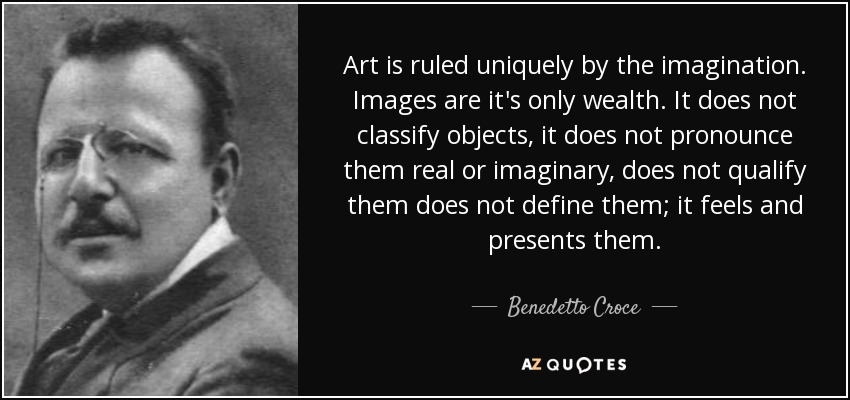
BENEDETTO CROCE: What is Beauty?

Reference: The Story of Philosophy

This paper presents Chapter X Section 2.3 from the book THE STORY OF PHILOSOPHY by WILL DURANT. The  contents are from the 1933 reprint of this book by TIME INCORPORATED by arrangement with Simon and Schuster, Inc.

The paragraphs of the original material (in black) are accompanied by brief comments (in color) based on the present understanding.

.

II. BENEDETTO CROCE

3. What is Beauty?

Croce came to philosophy from historical and literary studies; and it was natural that his philosophic interest should be deeply colored by the problems of criticism and esthetics. His greatest book is his Esthetic (1902). He prefers art to metaphysics and to science: the sciences give us utility but the arts give us beauty; the sciences take us away from the individual and the actual, into a world of increasingly mathematical abstractions, until (as in Einstein) they issue in momentous conclusions of no practical importance; but art takes us directly to the particular person and the unique fact, to the philosophical universal intuited in the form of the concrete individual. “Knowledge has two forms: it is either intuitive knowledge or logical knowledge; knowledge obtained through the imagination or knowledge obtained through the intellect; knowledge of the individual or knowledge of the universal; of individual things or of the relations between them; it is the production either of images or of concepts.” The origin of art, therefore, lies in the power of forming images. “Art is ruled uniquely by the imagination, Images are its only wealth. It does not classify objects, it does not pronounce them real or imaginary, does not qualify them, does not define them; it feels and presents them—nothing more.” Because imagination precedes thought, and is necessary to it, the artistic, or image-forming activity of the mind is prior to the logical, concept-forming, activity. Man is an artist as soon as he imagines, and long before he reasons.

Croce prefers art to metaphysics and to science: the sciences give us utility but the arts give us beauty. The origin of art lies in the power of forming images and not concepts. The image-forming activity of the mind is prior to the logical, concept-forming, activity.

The great artists understood the matter so. “One paints not with the hands but with the brain,” said Michelangelo; and Leonardo wrote: “The minds of men of lofty genius are most active in invention when they are doing the least external work.” Everybody knows the story told of da Vinci, that when he was painting the “Last Supper,” he sorely displeased the Abbot who had ordered the work, by sitting motionless for days before an untouched canvas; and revenged himself for the importunate Abbot’s persistent query—When would he begin to work?—by using the gentleman as an unconscious model for the figure of Judas.

One paints not with the hands but with the brain. The minds of men of lofty genius are most active in invention when they are doing the least external work.

The essence of the esthetic activity lies in this motionless effort of the artist to conceive the perfect image that shaIl express the subject he has in mind; it lies in a form of intuition that involves no mystic insight, but perfect sight, complete perception, and adequate imagination. The miracle of art lies not in the externalization but in the conception of the idea; externalization is a matter of mechanical technique and manual skill.

“When we have mastered the internal word, when we have vividly and clearly conceived a figure or a statue, when we have found a musical theme, expression is born and is complete, nothing more is needed. If, then, we open our mouth, and speak or sing, … what we do is to say aloud what we have already said within, to sing aloud what we have already sung within. If our hands strike the keyboard of the pianoforte, if we take up pencil or chisel, such actions are willed” (they belong to the practical, not to the esthetic, activity), “and what we are then doing is executing in great movements what we have already executed briefly and rapidly within.”

The miracle of art lies not in the externalization but in the conception of the idea; externalization is a matter of mechanical technique and manual skill.

Does this help us to answer that baffling question, What is beauty? Here certainly there are as many opinions as, there are heads; and every lover, in this matter, thinks himself an authority not to be gainsaid. Croce answers that beauty is the mental formation of an image (or a series of images ) that catches the essence of the thing perceived. The beauty belongs, again, rather to the inward image than to the outward form in which it is embodied. We like to think that the difference between ourselves and Shakespeare is largely a difference in technique of external expression; that we have thoughts that lie too deep for words. But this is a fond delusion: the difference lies not in the power of externalizing the image but in the power of inwardly forming an image that expresses the object.

Beauty is the mental formation of an image (or a series of images ) that catches the essence of the thing perceived. The difference lies not in the power of externalizing the image but in the power of inwardly forming an image that expresses the object.

Even that esthetic sense which is contemplation rather than creation is also inward expression; the degree in which we understand or appreciate a work of art depends upon our ability to see by direct intuition the reality portrayed,—our power to form for ourselves an expressive image. “It is always our own intuition we express when we are enjoying a beautiful work of art. … It can only be my own intuition when, reading Shakespeare, I form the image of Hamlet or Othello.” Both in the artist creating and in the spectator contemplating beauty, the esthetic secret is the expressive image. Beauty is adequate expression: and since there is no real expression if it be not adequate, we may answer very simply the ancient question, and say, Beauty is expression.

It is always our own intuition we express when we are enjoying a beautiful work of art. It can only be my own intuition when, reading Shakespeare, I form the image of Hamlet or Othello. The esthetic secret is the expressive image.

.

BENEDETTO CROCE: The Philosophy of the Spirit

Reference: The Story of Philosophy

This paper presents Chapter X Section 2.2 from the book THE STORY OF PHILOSOPHY by WILL DURANT. The  contents are from the 1933 reprint of this book by TIME INCORPORATED by arrangement with Simon and Schuster, Inc.

The paragraphs of the original material (in black) are accompanied by brief comments (in color) based on the present understanding.

.

II. BENEDETTO CROCE

2. The Philosophy of the Spirit

His first book, in its original form, was a leisurely series of articles (1895-1900) on Historical Materialism and the Economics of Karl Marx. He had been immensely stimulated by Antonio Labriola, his professor at the University of Rome; under his guidance Croce had plunged into the labyrinths of Marx’s Kapital. “This intercourse with the literature of Marxism, and the eagerness with which for some time I followed the socialistic press of Germany and Italy, stirred my whole being, and for the first time awakened in me a feeling of political enthusiasm, yielding a strange taste of newness to me; I was like a man who, having fallen in love for the first time when no longer young, should observe in himself the mysterious process of the new passion.” But the wine of social reform did not quite go to his head; he soon reconciled himself to the political absurdities of mankind, and, worshipped again at the altar of philosophy.

Croce was inspired by the literature of Marxism. But the wine of social reform did not quite go to his head; he soon reconciled himself to the political absurdities of mankind, and, worshipped again at the altar of philosophy.

One result of this adventure was his elevation of the concept Utility to a parity with Goodness, Beauty and Truth. Not that he conceded to economic affairs the supreme importance given to them in the system of Marx and Engels. He praised these men for a theory which, however incomplete, had drawn attention to a world of data before underrated and almost ignored; but he rejected the absolutism of the economic interpretation of history, as an unbalanced surrender to the suggestions of an industrial environment. He refused to admit materialism as a philosophy for adults or even as a method for science; mind was to him the primary and ultimate reality. And when he came to write his system of thought he called it, almost pugnaciously, “The Philosophy of the Spirit.”

One result of this adventure was his elevation of the concept Utility to a parity with Goodness, Beauty and Truth. But he refused to admit materialism as a philosophy for adults or even as a method for science; mind was to him the primary and ultimate reality.

For Croce is an idealist, and recognizes no philosophy since Hegel’s. All reality is idea; we know nothing except in the form it takes in our sensations and our thoughts. Hence all philosophy is reducible to logic; and truth is a perfect relationship in our ideas. Perhaps Croce likes this conclusion a bit too well; he is nothing if not logical; even in his book on Esthetics he cannot resist the temptation to intrude a chapter on logic. It is true that he calls philosophy the study of the concrete universal, and science the study of the abstract universal; but it is the reader’s misfortune that Croce’s concrete universal is universally abstract. He is, after all, a product of the scholastic tradition; he delights in abstruse distinctions and classifications that exhaust both the subject and the reader; he slides easily into logical casuistry, and refutes more readily than he can conclude. He is a Germanized Italian, as Nietzsche is an ltalianized German.

For Croce, all reality is idea; we know nothing except in the form it takes in our sensations and our thoughts. Hence all philosophy is reducible to logic; and truth is a perfect relationship in our ideas.

Nothing could be more German, or more Hegelian, than the title of the first of the trilogy that makes up the Filosofia dello Spirito—the Logic as the Science of the Pure Concept (1905). Croce wants every idea to be as pure as possible—which seems to mean as ideological as possible, as abstract and unpragmatic as possible; there is nothing here of that passion for clarity and practical content which made William James a beacon-light amid the mists of philosophy. Croce does not care to define an idea by reducing it to its practical consequences; he prefers to reduce practical affairs to ideas, relations, and categories. If all abstract or technical words were removed from his books they would not so suffer from obesity.

Croce wants every idea to be as pure as possible. There is no desire for clarity and practical content. He prefers to reduce practical affairs to ideas, relations, and categories.

By a “pure concept” Croce means a universal concept, like quantity, quality, evolution, or any thought which may conceivably be applied to all reality. He proceeds to juggle these concepts as if the spirit of Hegel had found in him another avatar, and as if he were resolved to rival the reputation of the master for obscurity. By calling all this “logic,” Croce convinces himself that he scorns metaphysics, and that he has kept himself immaculate from it; metaphysics, he thinks, is an echo of theology, and the modern university professor of philosophy is just the latest form of the medieval theologian. He mixes his idealism with a certain hardness of attitude towards tender beliefs: he rejects religion; he believes in the freedom of the will, but not in the immortality of the soul; the worship of beauty and the life of culture are to him a substitute for religion. “Their religion was the whole intellectual patrimony of primitive peoples; our intellectual patrimony is our religion. … We do not know what use could be made of religion by those who wish to preserve it side by side with the theoretic activity of man, with his art, his criticism, and his philosophy. … Philosophy removes from religion all reason for existing. … As the science of the spirit, it looks upon religion as a phenomenon, a transitory historical fact, a psychic condition that can be surpassed.” One wonders if La Gioconda’s smile did not hover over the face of Rome when it read these words.

By a “pure concept” Croce means a universal concept, like quantity, quality, evolution, or any thought which may conceivably be applied to all reality. He calls all this logic and he scorns metaphysics. He substitutes religion by the worship of beauty and the life of culture.

We have here the unusual occurrence of a philosophy that is at once naturalistic and spiritualistic, agnostic and indeterministic, practical and idealistic, economic and esthetic. It is true that Croce’s interest is caught more surely by the theoretical than by the pragmatic aspects of life; but the very subjects he has essayed bear witness to an honorable effort to overcome his scholastic inclinations. He has written an immense volume on The Philosophy of the Practical, which turns out to be in part another logic under another name, and in part a metaphysical discussion of the old problem of free will. And in a more modest tome On History he has achieved the fruitful conception of history as philosophy in motion, and of the historian as one who shows nature and man not in theory and abstraction but in the actual flow and operation of causes and events. Croce loves his Vico, and warmly seconds the earlier Italian’s plea that history should be written by philosophers. He believes that the fetish of a perfectly scientific history has led to a microscopic erudition in which the historian loses the truth because he knows too much. Just as Schliemann exhumed not only one Troy but seven after scientific historians had shown that there had been no Troy at all, so Croce thinks the hypercritical historian exaggerates our ignorance of the past.

I recollect the remark made to me when I was occupied with research work in my young days, by a friend of but slight literary knowledge, to whom I had lent a very critical, indeed hypercritical, history of ancient Rome. When he had finished reading it he returned the book to me, remarking that he had acquired the proud conviction of being ‘the most learned of philologists’: for the latter arrive at the conclusion that they know nothing, as the result of exhausting toil; while he knew nothing without any effort at all, simply as a generous gift of nature.

We have here the unusual occurrence of a philosophy that is at once naturalistic and spiritualistic, agnostic and indeterministic, practical and idealistic, economic and esthetic. Croce thinks the hypercritical historian exaggerates our ignorance of the past.

Croce recognizes the difficulty of finding out the actual past, and quotes Rousseau’s definition of history as “the art of choosing, from among many lies, that one which most resembles the truth.” He has no sympathy with the theorist who, like Hegel, or Marx, or Buckle, distorts the past into a syllogism that will conclude with his prejudice. There is no foreordained plan in history; and the philosopher who writes history must devote himself not to the tracing of cosmic designs, but to the revelation of causes and consequences and correlations. And he will also remember that only that part of the past is of value which is contemporary in its significance and its illumination. History might at last be what Napoleon called it,—“the only true philosophy and the only true psychology”—if historians would write it as the apocalypse of nature and the mirror of man.

Croce recognizes the difficulty of finding out the actual past. He has no sympathy with the theorist who distorts the past into a syllogism that will conclude with his prejudice. The philosopher who writes history must devote himself to the revelation of causes and consequences and correlations.

.

BENEDETTO CROCE: The Man

Reference: The Story of Philosophy

This paper presents Chapter X Section 2.1 from the book THE STORY OF PHILOSOPHY by WILL DURANT. The  contents are from the 1933 reprint of this book by TIME INCORPORATED by arrangement with Simon and Schuster, Inc.

The paragraphs of the original material (in black) are accompanied by brief comments (in color) based on the present understanding.

.

II. BENEDETTO CROCE

1. The Man

From Bergson to Croce is an impossible transition: there is hardly a parallel in all their lines. Bergson is a mystic who translates his visions into deceptive clarity; Croce is a sceptic with an almost German gift for obscurity. Bergson is religiously-minded” and yet talks like a thorough-going evolutionist; Croce is an anti-clerical who writes like an American Hegelian. Bergson is a French Jew who inherits the traditions of Spinoza and Lamarck; Croce is an Italian Catholic who has kept nothing of his religion except its scholasticism and its devotion to beauty.

Bergson and Croce are two very different philosophers.

Perhaps the comparative infertility of Italy in the philosophy of the last hundred years is due in some part to the retention of scholastic attitudes and methods even by thinkers who have abandoned the old theology. (More of it, doubtless, is due to the northward movement of industry and wealth.) Italy might be described as the land that had a Renaissance, but never a Reformation; it will destroy itself for beauty’s sake, but it is as skeptical as Pilate when it thinks of truth. Perhaps the Italians are Wiser than the rest of us, and have found that truth is a mirage, while beauty—however subjective—is a possession and a reality. The artists of the Renaissance (excepting the sombre and almost Protestant Michelangelo, whose brush was the echo of Savonarola’s voice) never worried their heads about morals or theology; it was enough for them that the Church recognized their genius, and paid their bills. It became an unwritten law in Italy that men of culture would make no trouble for the Church. How could an Italian be unkind to a Church that had brought all the world to Canossa, and had levied imperial tribute on every land to make Italy the art-gallery of the world?

Perhaps the comparative infertility of Italy in the philosophy of the last hundred years is due in some part to the retention of scholastic attitudes and methods even by thinkers who have abandoned the old theology.

So Italy remained loyal to the old faith, and contented itself with the Summa of Aquinas for philosophy. Giambattista Vico came, and stirred the Italian mind again; but Vico went, and philosophy seemed to die with him. Rosmini thought for a time that he would rebel; but he yielded. Throughout Italy men became more and more irreligious, and more and more loyal to the Church.

Italy remained loyal to the old faith, and contented itself with the Summa of Aquinas for philosophy. 

Benedetto Croce is an exception. Born in 1866 in a small town in the province of Aquila, and the only son of a well-to-do Catholic and conservative family, he was given so thorough a training in Catholic theology that at last, to restore the balance, he became an atheist. In countries that have had no Reformation there is no half-way house between orthodoxy and absolute unbelief. Benedetto was at first so pious that he insisted on studying every phase of religion, until at last he reached its philosophy and its anthropology; and insensibly his studies were substituted for his faith.

Benedetto Croce is an exception. Benedetto was at first so pious that he insisted on studying every phase of religion, and insensibly his studies were substituted for his faith.

In 1888 life dealt him one of those ruthless blows which usually turn men’s minds back to belief. An earthquake overwhelmed the little town of Casamicciola where the Croces were staying; Benedetto lost both his parents, and his only sister; he himself remained buried for hours under the ruins, with many broken bones. It took him several years to recover his health; but his later life and work showed no breaking of his spirit. The quiet routine of convalescence gave him, or strengthened in him, the taste for scholarship; he used the modest fortune which the catastrophe left him to collect one of the finest libraries in Italy; he became a philosopher without paying the usual penalty of poverty or a professorship; he realized Ecclesiastes’ cautious counsel, that “wisdom is good with an inheritance.”

Croce went through a catastrophe. He used the modest fortune which the catastrophe left him to collect one of the finest libraries in Italy.

He has remained throughout his life a student, a lover of letters and of leisure. It was against his protests that he was drawn into politics and made minister of Public Education, perhaps to lend an air of philosophic dignity to a cabinet of politicians. He was chosen to the Italian senate; and as the rule in Italy is, once a senator always a senator (the office being for life), Croce provides the spectacle, not unusual in ancient Rome, but rather unique in our day, of a man who can be a senator and a philosopher at the same time. He would have interested Iago. But he does not take his politics too seriously; his time goes chiefly to the editing of his internationally famous periodical, La Critica, in which he and Giovanni Gentile dissect the world of thought and belles lettres (beautiful letters).

It was against his protests that Croce was drawn into politics and made minister of Public Education. But he did not take his politics too seriously; his time went chiefly to the editing of his internationally famous periodical, La Critica,

When the war of 1914 came; Croce, angered at the thought that a mere matter of economic conflict should be permitted to interrupt the growth of the European mind, denounced the outbreak as suicidal mania; and even when Italy had, of necessity, thrown in her lot with the Allies, he remained aloof, and became as unpopular in Italy as Bertrand Russell in England or Romain Rolland in France. But Italy has forgiven him now; and all the youth of the land look up to him as their unbiased guide, philosopher, and friend; he has become for them an institution as important as the universities. It is nothing unusual now to hear judgments of him like Giuseppe Natoli’s: “The system of Benedetto Croce remains the highest conquest in contemporary thought.” Let us inquire into the secret of this influence.

Croce denounced the outbreak of the war of 1914, and remained aloof even when Italy had, of necessity, thrown in her lot with the Allies. Although this made him initially unpopular, his reputation was restored after the war. He became for the Italian youth an institution as important as the universities. 

.

BERGSON: Criticism

Reference: The Story of Philosophy

This paper presents Chapter X Section 1.4 from the book THE STORY OF PHILOSOPHY by WILL DURANT. The  contents are from the 1933 reprint of this book by TIME INCORPORATED by arrangement with Simon and Schuster, Inc.

The paragraphs of the original material (in black) are accompanied by brief comments (in color) based on the present understanding.

.

I. HENRI BERGSON

4. Criticism

“I believe,” says Bergson, “that the time given to refutation in philosophy is usually time lost. Of the many attacks directed by the many thinkers against each other, what now remains? Nothing, or assuredly very little. That which counts and endures is the modicum of positive truth which each contributes. The true statement is of itself able to displace the erroneous idea, and becomes, without our having taken the trouble of refuting anyone, the best of refutations.” This is the voice of Wisdom herself. When we ”prove” or disprove” a philosophy we are merely offering another one, which, like the first, is a fallible compound of experience and hope. As experience widens and hope changes, we find more “truth” in the “falsehoods” we denounced, and perhaps more falsehood in our youth’s eternal truths. When we are lifted upon the wings of rebellion we like determinism and mechanism, they are so cynical and devilish; but when death looms up suddenly at the foot of the hill we try to see beyond it into another hope. Philosophy is a function of age. Nevertheless…

The time given to refutation in philosophy is usually time lost. That which counts and endures is the modicum of positive truth. The true statement is of itself able to displace the erroneous idea. Philosophy is a function of age. 

What strikes one first in reading Bergson is the style: brilliant not with the paradox-fireworks of Nietzsche, but with a steady brightness, as of a man who is resolved to live up to the fine traditions of luminous French prose. It is harder to be wrong in French than in some other languages; for the French will not tolerate obscurity, and truth is clearer than fiction. If Bergson is occasionally obscure it is by the squandered wealth of his, imagery, his analogies, and his illustrations; he has an almost Semitic passion for metaphor, and is apt at times to substitute ingenious simile for patient proof. We have to be on our guard against this image-maker, as one bewares of a jeweler, or a real-estate poet—while recognizing gratefully, in Creative Evolution, our century’s first philosophic masterpiece.*

* As with Schopenhauer, so with, Bergson, the reader will do well to pass by all summaries and march resolutely through the philosopher’s chef-d’oeuvre itself. Wildon Carr’s exposition is unduly worshipful, Hugh Elliott’s unduly disparaging; they cancel each other into confusion. The Introduction to Metaphysics is as simple as one may expect of metaphysics; and the essay on Laughter, though one-sided, is enjoyable and fruitful.

Bergson is very clear in his language. If he is occasionally obscure it is because of his excessive use of metaphors.

Perhaps Bergson would have been wiser to base his criticism of the intellect on the grounds of a broader intelligence, rather than on the ukases of intuition. Introspective intuition is as fallible as external sense; each must be tested and corrected by matter-of-fact experience; and each can be trusted only so far as its findings illumine and advance our action. Bergson presumes too much in supposing that the intellect catches only the states, and not the flux, of reality and life; thought is a stream of transitive ideas, as James had shown before Bergson wrote; “ideas” are merely points that memory selects in the flow of thought; and the mental current adequately reflects the continuity of perception and the movement of life.

Bergson presumes too much in supposing that the intellect catches only the states, and not the flux, of reality and life. He puts intuition above the intellect. But intuition is just as fallible as the intellect, and must be tested and corrected by matter-of-fact experience.

It was a wholesome thing that this eloquent challenge should check the excesses of intellectualism; but it was as unwise to offer intuition in the place of thought as it would be to correct the fancies of youth, with the fairy-tales of childhood. Let us correct our errors forward, not backward. To say that the world suffers from too much intellect would require the courage of a madman. The romantic protest against thinking, from Rousseau and Chateaubriand to Bergson and Nietzsche and James, has done its work; we will agree to dethrone the Goddess of Reason if we are not asked to re-light the candles before the ikon of Intuition. Man exists by instinct, but he progresses by intelligence.

Man exists by instinct, but he progresses by intelligence. We need a balance of both intuition and intellect.

That which is best in Bergson is his attack upon materialist mechanism. Our pundits of the laboratory had become a little too confident of their categories, and thought to squeeze all the cosmos into a test-tube. Materialism is like a grammar that recognizes only nouns; but reality, like language, contains action as well as objects, verbs as well as substantives, life and motion as well as matter. One could understand, perhaps, a merely molecular memory, like the “fatigue” of overburdened steel; but molecular foresight, molecular planning, molecular idealism?—Had Bergson met these new dogmas with a cleansing skepticism he might have been a little less constructive, but he would have left himself less open to reply. His doubts melt away when his system begins to form; he never stops to ask what “matter” is; whether it may not be somewhat less inert than we have thought; whether it may be, not life’s enemy, but life’s willing menial if life but knew its mind. He thinks of the world and the spirit, of body and soul, of matter and life, as hostile to each other; but matter and body and the “world” are merely the materials that wait to be formed by intelligence and will. And who knows that these things too are not forms of life, and auguries of mind? Perhaps here too, as Heraclitus would say, there are gods.

That which is best in Bergson is his attack upon materialist mechanism. Reality contains life and motion as well as matter. Bergson thinks of the world and the spirit, of body and soul, of matter and life, as hostile to each other; but they are merely the materials that wait to be formed by intelligence and will.

Bergson’s critique of Darwinism issues naturally from his vitalism. He carries on the French tradition established by Lamarck, and sees impulse and desire as active forces in evolution; his spirited temper rejects the Spencerian conception of an evolution engineered entirely by the mechanical integration of matter and dissipation of motion; life is a positive power, an effort that builds its organs through the very persistence of its desires. We must admire the thoroughness of Bergson’s biological preparation, his familiarity with the literature, even with the periodicals in which current science hides itself for a decade of probation. He offers his erudition modestly, never with the elephantine dignity that weighs down the pages of Spencer. All in all, his criticism of Darwin has proved effective; the specifically Darwinian features of the evolution theory are now generally abandoned.*

* Bergson’s arguments, however, are not all impregnable: the appearance of similar effects (like sex or sight) in different lines might be the mechanical resultant of similar environmental exigencies; and many of the difficulties of Darwinism would find a solution if later research should justify Darwin’s belief in the partial transmission of characters repeatedly acquired by successive generations.

Bergson rejects the Spencerian conception of an evolution engineered entirely by the mechanical integration of matter and dissipation of motion. Life is a positive power, an effort that builds its organs through the very persistence of its desires.

In many ways the relation of Bergson to the age of Darwin is a replica of Kant’s relation to Voltaire. Kant strove to repulse that great wave of secular, and partly atheistic, intellectualism which had begun with Bacon and Descartes, and had ended in the skepticism of Diderot and Hume; and his effort took the line of denying the finality of intellect in the field of transcendental problems. But Darwin unconsciously, and Spencer consciously, renewed the assaults which Voltaire, and his more-than-Voltairean followers, had leveled at the ancient faith; and mechanist materialism, which had given ground before Kant and Schopenhauer, had won all of its old power at the beginning of our century. Bergson attacked it, not with a Kantian critique of knowledge, nor with the idealist contention that matter is known only through mind; but by following the lead of Schopenhauer, and seeking, in the objective as well as in the subjective world, an energizing principle, an active entelechy, which might make more intelligible the miracles and subtleties of life. Never was Vitalism so forcefully argued, or so attractively dressed.

Bergson sought in the objective as well as in the subjective world, an energizing principle, an active entelechy, which might make more intelligible the miracles and subtleties of life.

Bergson soared to an early popularity because he had come to the defense of hopes which spring eternally in the human breast. When people found that they could believe in immortality and deity without losing the respect of philosophy, they were pleased and grateful; and Bergson’s lecture-room became the salon of splendid ladies happy to have their heart’s desires upheld with such learned eloquence. Strangely mingled with them were the ardent syndicalists who found in Bergson’s critique of intellectualism a justification of their gospel of “less thought and more action.” But this sudden popularity exacted its price; the contradictory nature of Bergson’s support disintegrated his following; and Bergson may share the fate of Spencer, who lived to be present at the burial of his own reputation.

Bergson soared to an early popularity because he had come to the defense of hopes which spring eternally in the human breast. But the contradictory nature of Bergson’s support disintegrated his following.

Yet, of all contemporary contributions to philosophy, Bergson’s is the most precious. We needed his emphasis on the elusive contingency of things, and the remoulding activity of mind. We were near to thinking of the world as a finished and pre-determined show, in which our initiative was a self-delusion, and our efforts a devilish humor of the gods; after Bergson we come to see the world as the stage and the material of our own originative powers. Before him we were cogs and wheels in a vast and dead machine; now, if we wish it, we can help to write our own parts in the drama of creation.

Bergson’s contribution to philosophy, however, is quite precious. Before him we were cogs and wheels in a vast and dead machine. After him we come to see the world as the stage and the material of our own originative powers. 

.

BERGSON: Creative Evolution

Reference: The Story of Philosophy

This paper presents Chapter X Section 1.3 from the book THE STORY OF PHILOSOPHY by WILL DURANT. The  contents are from the 1933 reprint of this book by TIME INCORPORATED by arrangement with Simon and Schuster, Inc.

The paragraphs of the original material (in black) are accompanied by brief comments (in color) based on the present understanding.

.

I. HENRI BERGSON

3. Creative Evolution

With this new orientation, evolution appears, to us as something quite different from the blind and dreary mechanism of struggle and destruction which Darwin and Spencer described. We sense duration in evolution, the accumulation of vital powers, the inventiveness of life and mind, “the continual elaboration of the absolutely new.” We are prepared to understand why the most recent and expert investigators, like Jennings and Maupas, reject the mechanical theory of protozoan behavior, and why Professor E. B. Wilson, dean of contemporary cytologists, concludes his book on the cell with the statement that “the study of the cell has, on the whole, seemed to widen rather than to narrow the enormous gap that separates even the lowest forms of life from the inorganic world.”  And everywhere, in the world of biology, one hears of the rebellion against Darwin.

Evolution appears to be something quite different from the blind and dreary mechanism of struggle and destruction which Darwin and Spencer described. We sense duration in evolution, the accumulation of vital powers, the inventiveness of life and mind.

Darwinism means, presumably, the origin of new organs and functions, new organisms and species, by the natural selection of favorable variations. But this conception, hardly half a century old, is already worm-eaten with difficulties. How, on this theory, did the instincts originate? It would be convenient to conceive them as the inherited accumulation of acquired habits; but expert opinion closes that door in our faces,—though some day that door may be opened. If only congenital powers and qualities are transmissible, every instinct must have been, on its first appearance, as strong as it natively is now; it must have been born, so to speak, adult, in full panoply for action; else it could not have favored its possessor in the struggle for existence. If, on its first appearance, it was weak, it could have achieved survival value only through that acquired strength which (by current hypothesis) is not inherited. Every origin is here a miracle.

Darwinism means the evolution of species by the natural selection of favorable variations. But this conception does not explain the origination of instincts.

And, as with the first instincts, so with every variation: one wonders how the change could have offered, in its first form, a handle to selection. In, the case of such complex organs as the eye, the difficulty is discouraging: either the eye appeared at once, full-formed and competent (which is as credible as Jonah’s introspection of the whale); or it began with a series of “fortuitous” variations which, by a still more fortuitous survival, produced the eye. At every step the theory of a mechanical production of complicated structures by a blind process of variation and selection presents us with fairy-tales that have all the incredibility of childhood’s lore, and little of its beauty.

Evolution has to be more than just mechanical. A blind process of variation and selection cannot produce complicated structures like an eye.

The most decisive difficulty, however, is the appearance of similar effects, brought about by different means, in widely divergent lines of evolution. Take as example the invention of sex as a mode of reproduction, both in plants and in animals; here are lines of evolution as divergent as could be, and yet the same complex “accident” occurs in both. Or take the organs of sight in two very distinct phyla—the molluscs and the vertebrates; “how could the same small variations, incalculable in number, have ever occurred in the same order on two independent lines of evolution, if they were purely accidental?” More remarkable still,

nature arrives at identical results, in sometimes neighboring species, by entirely different embryogenic processes … The retina of the vertebrate is produced by an expansion of the rudimentary brain of the embryo. … In the mollusc, on the contrary, the retina is derived from the ectoderm * directly. … If the crystalline lens of a Triton be removed, it is regenerated by the iris. Now the original lens was built out of the ectoderm, while the iris is of mesodermal origin. What is more, in the Salamandra maculata, if the lens be removed and the iris left, the regeneration of the lens takes place at the upper part of the iris; but if this upper part of the iris itself be taken away, the regeneration takes place in the inner or retinal layer of the remaining region. Thus parts differently situated, differently constituted, meant normally for different functions, are capable of performing the same duties and even of manufacturing, when necessary, the same pieces of the machine.

* The organs of the growing embryo are built up out of one or another of three layers of tissues; the external layer, or ectoderm; the intermediate layer, or mesoderm; and the internal layer, or endoderm.

The most decisive difficulty, however, is the appearance of similar effects, brought about by different means, in widely divergent lines of evolution. For example, the regeneration of lens of the eye of the salamander by different means under different circumstances.

So, in amnesia and aphasia, ”lost” memories and functions reappear in regenerated or substituted tissues. Surely we have here overwhelming evidence that there is something more in evolution than a helpless mechanism of material parts. Life is more than its machinery; it is a power that can grow, that can restore itself, that can mould to its own will some measure of environing circumstance. Not that there is any external design determining these marvels; that would, be merely an inverted mechanism, a fatalism as destructive of human initiative and of creative evolution as the sombre, surrender of Hindu thought to India’s heat. ”We must get beyond both points of view—mechanism and finalism—as being, at bottom, only standpoints to which the human mind has been led by considering the work of men”: we thought at first that all things moved because of some quasi-human will using them as instruments in a cosmic game; and then we thought that the cosmos itself was a machine because we had been dominated, in character and philosophy, by our mechanical age. There is a design in things; but in them, not outside; an entelechy, an inward determination of all the parts by the function and purpose of the whole.

Life is more than its machinery; it is a power that can grow, that can restore itself. There is a design in things, not outside them, by the function and purpose of the whole.

Life is that which makes efforts, which pushes upwards and outwards and on; “always and always the procreant urge of the world.” It is the opposite of inertia, and the opposite of accident; there is a direction in the growth to which it is self-impelled. Against it is the undertow of matter, the lag and slack of things towards relaxation and rest and death; at every stage life has had to fight with the inertia of its vehicle; and if it conquers death through reproduction, it does so only by yielding, every citadel in turn, and abandoning every individual body at last to inertia and decay. Even to stand is to defy matter and its ”laws”: while to move about, to go forth and seek, and not, plant-like, to wait, is a victory purchased at every moment by effort and fatigue. And consciousness slips, as soon as it is permitted, into the restful automatism of instinct, habit, and sleep.

Life is that which makes efforts; there is a direction in the growth to which it is self-impelled. It is the opposite of inertia, and accident. At every stage life has had to fight with the inertia of its vehicle.

At the outset life is almost as inert as matter; it takes a stationary form, as if the vital impulse were too weak to risk the adventure of motion. And in one great avenue of development this motionless stability has been the goal of life: the bending lily and the majestic oak are altars to the god Security. But life was not content with this stay-at-home existence of the plant; always its advances have been away from security towards freedom; away from carapaces, scales and hides, and other burdensome protections, to the ease and perilous liberty of the bird. “So the heavy hoplite was supplanted by the legionary; the knight, clad in armor, had to give place to the light free-moving infantryman; and in a general way, in the evolution of life, just as in the evolution of human societies and of individual destinies, the greatest successes have been for those who accepted the heaviest risks.” So, too, man has ceased to evolve new organs on his body; he makes tools and weapons instead, and lays them aside when they are not needed, rather than carry all his armament at every step, like those gigantic fortresses, the mastodon. and the megatherium, whose heavy security lost them the mastery of the globe. Life may be impeded, as well as aided, by its instruments.

Life’s advances have been away from security towards freedom; away from burdensome protections towards the ease and perilous liberty of free-movement.

It is with instincts as with organs; they are the tools of the mind; and like all organs that are attached and permanent, they become burdens when the environment that needed them has disappeared. Instinct comes ready-made, and gives decisive—and usually successful—responses to stereotyped and ancestral situations; but it does not adapt the organism to change, it does not enable man to meet flexibly the fluid complexities of modem life. It is the vehicle of security, while intellect is the organ of an adventurous liberty. It is life taking on the blind obedience of the machine.

Instincts and organs become burdens when the environment that needed them has disappeared. They do not adapt the organism to change.

How significant it is that we laugh, usually, when a living thing behaves like matter, like a mechanism; when the clown tumbles about aimlessly, and leans against pillars that are not there; or when our best beloved falls on an icy path, and we are tempted to laugh first and ask questions afterward. That geometrical life which Spinoza almost confused with deity is really a reason for humor and tears; it is ridiculous and shameful that men should be machines; and ridiculous and shameful that their philosophy should describe them so.

It is ridiculous and shameful that men should be machines; and ridiculous and shameful that their philosophy should describe them so.

Life has taken three lines in its evolution: in one it relapsed into the almost material torpor of plants, and found there, occasionally, a supine security, and the cowardly tenure of a thousand years; in another avenue its spirit and effort congealed into instinct as in the ants and bees; but in the vertebrates it took the dare of freedom, cast off its ready-made instincts and marched bravely into the endless risks of thought. Instinct still remains the profounder mode of visioning reality and catching the essence of the world; but intelligence grows ever stronger and bolder, and wider in its scope; it is at last in intelligence that life has placed its interests and its hopes.

It is at last in intelligence that life has placed its interests and its hopes.

This persistently creative life, of which every individual and every species is an experiment, is what we mean by God; God and Life are one. But this God is finite, not omnipotent,—limited by matter, and overcoming its inertia painfully, step by step; and not omniscient, but groping gradually towards knowledge and consciousness and “more light.” “God, thus defined, has nothing of the ready-made; He is unceasing life, action, freedom. Creation, so conceived, is not a mystery; we experience it in ourselves when we act freely,” When we consciously choose our actions and plot our lives. Our struggles and our sufferings, our ambitions and our defeats, our yearnings to be better and stronger than we are, are the voice and current of the Elan Vital in us, that vital urge which makes us grow, and transforms this wandering planet into a theatre of unending creation.

God is this persistently creative life that is limited by matter and is groping gradually towards knowledge and consciousness and “more light.” Creation occurs when we consciously choose our actions and plot our lives. This is the Elan Vital (vital urge) which makes us grow.

And who knows but that at last life may win the greatest victory of all over its ancient enemy, matter, and learn even to elude mortality? Let us have an open mind, even to our hopes.* All things are possible to life if time is generous. Consider what life and mind have done in the mere moment of a millennium, with the forests of Europe and America; and then see how foolish it is to put up barriers to life’s achievements. “The animal takes its stand on the plant, man bestrides animality, and the whole of humanity, in space and time, is one immense army galloping beside and before and behind each of us in an overwhelming charge able to beat down every resistance and clear the most formidable obstacles, perhaps even death.” 

* Bergson thinks the evidence for telepathy is overwhelming. He was one of those who examined Eusapia Palladino and reported in favor of her sincerity. In 1918 he accepted the presidency of the Society for Psychical Research. 

And who knows but that at last life may win the greatest victory of all over its ancient enemy, matter, and learn even to elude mortality?

.